
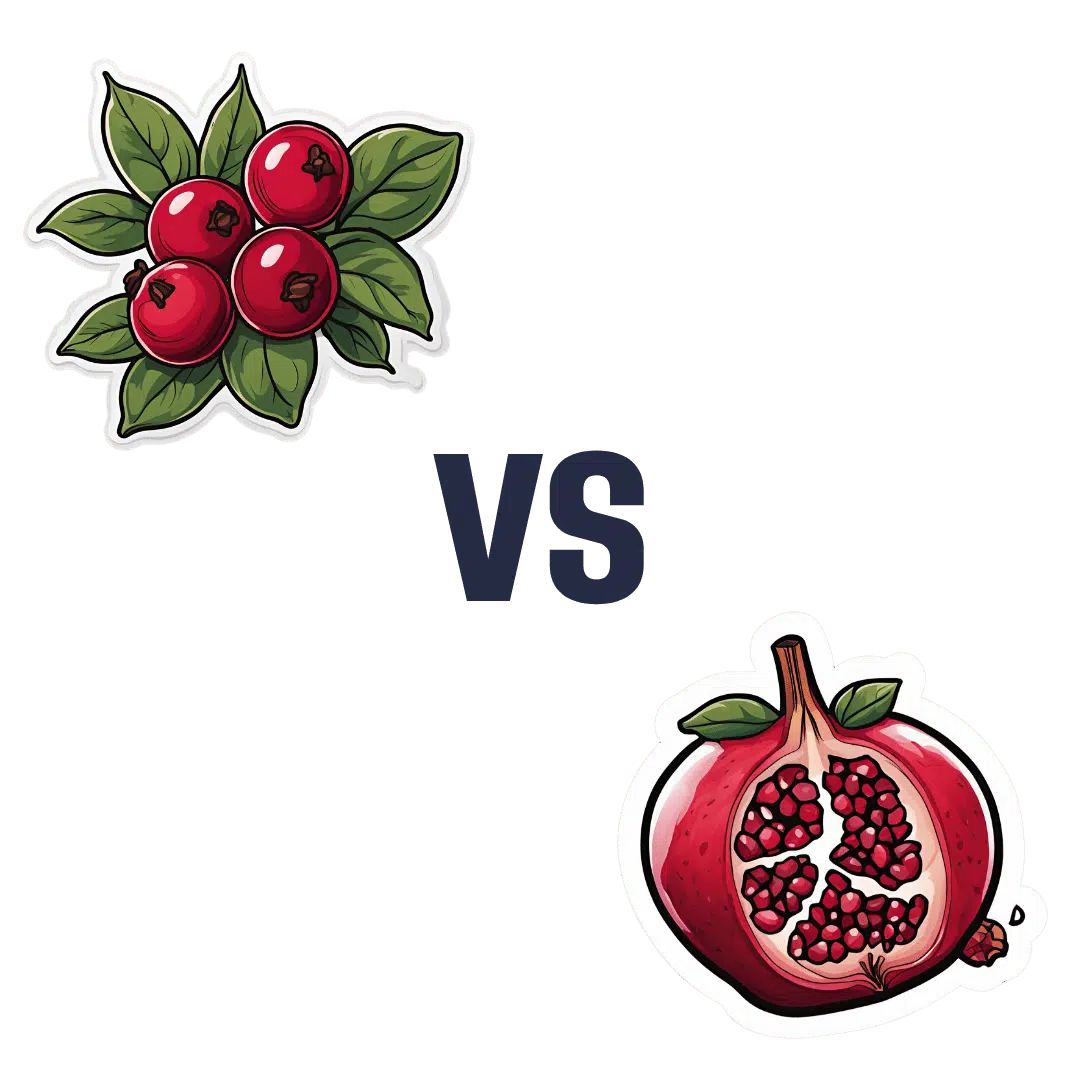
Cranberries vs Pomegranate – Which is Healthier?
10almonds is reader-supported. We may, at no cost to you, receive a portion of sales if you purchase a product through a link in this article.
Our Verdict
When comparing cranberries to pomegranate, we picked the pomegranate.
Why?
In terms of macros, pomegranate has nearly 4x the protein (actually quite a lot for a fruit, but this is not too surprising—it’s because we are eating the seeds!), and slightly more carbs and fiber. Their glycemic indices are comparable, both being low GI foods. While both of these fruits have excellent macro profiles, we say the pomegranate is slightly better, because of the protein, and when it comes to the carbs and fiber, since they balance each other out, we’ll go with the option that’s more nutritionally dense. We like foods that add more nutrients!
In the category of vitamins, cranberries are higher in vitamins A, C, and E, while pomegranate is higher in vitamins B1, B2, B3, B5, B6, B9, and K. That’s already a numerical win for pomegranate, and it’s added to by the fact that the margins of difference are greater in pomegranate’s case, too.
When it comes to minerals, it is not close: cranberries have more manganese, while pomegranates have more calcium, copper, iron, magnesium, phosphorus, potassium, selenium, and zinc. An easy win for pomegranate here!
In other considerations, both of these fruits have additional “special” properties, and it’s worth noting that:
- pomegranate’s bonus properties, which are too many to list here, but we link to an article below, are mostly in its peel (so dry it, and grind it into a powder supplement, that can be worked into foods, or used like an instant fruit tea, just without the sugar)
- cranberries’ bonus properties (including: famously very good at reducing UTI risk) come with some warnings, including that they may increase the risk of kidney stones if you are prone to such, and also that cranberries have anti-clotting effects, which are great for heart health but can be a risk of you’re on blood thinners or have a bleeding disorder.
You can read about both of these fruits’ special properties in the “learn more” section below.
Meanwhile, adding up the sections makes for a clear overall win for pomegranate, but by all means enjoy either or both, unless you have kidney issues, in which case certainly skip the cranberries!
Want to learn more?
You might like:
- Health Benefits Of Cranberries (But: You’d Better Watch Out)
- Pomegranate’s Health Gifts Are Mostly In Its Peel
Enjoy!
Don’t Forget…
Did you arrive here from our newsletter? Don’t forget to return to the email to continue learning!
Recommended
Learn to Age Gracefully
Join the 98k+ American women taking control of their health & aging with our 100% free (and fun!) daily emails:
-
Two Things You Can Do To Improve Stroke Survival Chances
10almonds is reader-supported. We may, at no cost to you, receive a portion of sales if you purchase a product through a link in this article.
Dr. Andrew’s Stroke Survival Guide
This is Dr. Nadine Andrew. She’s a Senior Research Fellow in the Department of Medicine at Monash University. She’s the Research Data Lead for the National Center of Healthy Aging. She is lead investigator on the NHMRC-funded PRECISE project… The most comprehensive stroke data linkage study to date! In short, she knows her stuff.
We’ve talked before about how sample size is important when it comes to scientific studies. It’s frustrating; sometimes we see what looks like a great study until we notice it has a sample size of 17 or something.
Dr. Andrew didn’t mess around in this regard, and the 12,386 participants in her Australian study of stroke patients provided a huge amount of data!
With a 95% confidence interval because of the huge dataset, she found that there was one factor that reduced mortality by 26%.
And the difference was…
Whether or not patients had a chronic disease management plan set up with their GP (General Practitioner, or “family doctor”, in US terms), after their initial stroke treatment.
45% of patients had this; the other 55% did not, so again the sample size was big for both groups.
Why this is important:
After a stroke, often a patient is discharged as early as it seems safe to do so, and there’s a common view that “it just takes time” and “now we wait”. After all, no medical technology we currently have can outright repair that damage—the body must repair itself! Medications—while critical*—can only support that and help avoid recurrence.
*How critical? VERY critical. Critical critical. Dr. Andrew found, some years previously, that greater levels of medication adherence (ie, taking the correct dose on time and not missing any) significantly improved survival outcomes. No surprise, right? But what may surprise is that this held true even for patients with near-perfect adherence. In other words: miss a dose at your peril. It’s that important.
But, as Dr. Andrew’s critical research shows, that’s no reason to simply prescribe ongoing meds and otherwise cut a patient loose… or, if you or a loved one are the patient, to allow yourself/them to be left without a doctor’s ongoing active support in the form of a chronic disease management plan.
What does a chronic disease management plan look like?
First, what it’s not:
- “Yes yes, I’m here if you need me, just make an appointment if something changes”
- “Let’s pencil in a check-up in three months”
- Etc
What it actually looks like:
It looks like a plan. A personal care plan, built around that person’s individual needs, risks, liabilities… and potential complications.
Because who amongst us, especially at the age where strokes are more likely, has an uncomplicated medical record? There will always be comorbidities and confounding factors, so a one-size-fits-all plan will not do.
Dr. Andrew’s work took place in Australia, so she had the Australian healthcare system in mind… We know many of our subscribers are from North America and other places. But read this, and you’ll see how this could go just as much for the US or Canada:
❝The evidence shows the importance of Medicare financially supporting primary care physicians to provide structured chronic disease management after a stroke.
We also provide a strong case for the ongoing provision of these plans within a universal healthcare system. Strategies to improve uptake at the GP level could include greater financial incentives and mandates, education for patients and healthcare professionals.❞
See her groundbreaking study for yourself here!
The Bottom Line:
If you or a loved one has a stroke, be prepared to make sure you get a chronic health management plan in place. Note that if it’s you who has the stroke, you might forget this or be unable to advocate for yourself. So, we recommend to discuss this with a partner or close friend sooner rather than later!
“But I’m quite young and healthy and a stroke is very unlikely for me”
Good for you! And the median age of Dr. Andrew’s gargantuan study was 70 years. But:
- do you have older relatives? Be aware for them, too.
- strokes can happen earlier in life too! You don’t want to be an interesting statistic.
Some stroke-related quick facts:
Stroke is the No. 5 cause of death and a leading cause of disability in the U.S.
Stroke can happen to anyone—any age, any time—and everyone needs to know the warning signs.
On average, 1.9 million brain cells die every minute that a stroke goes untreated.
Stroke is an EMERGENCY. Call 911 immediately.
Early treatment leads to higher survival rates and lower disability rates. Calling 911 lets first responders start treatment on someone experiencing stroke symptoms before arriving at the hospital.
Source: https://www.stroke.org/en/about-stroke
What are the warning signs for stroke?
Use the letters F.A.S.T. to spot a stroke and act quickly:
- F = Face Drooping—does one side of the face droop or is it numb? Ask the person to smile. Is the person’s smile uneven?
- A = Arm Weakness—is one arm weak or numb? Ask the person to raise both arms. Does one arm drift downward?
- S = Speech Difficulty—is speech slurred?
- T = Time to call 911
Source: https://www.stroke.org/en/about-stroke/stroke-symptoms
Last but not least, while we’re sharing resources:
Download the PDF Checklist: 8 Ways To Help Prevent a Second Stroke
Share This Post
-
Is fluoride really linked to lower IQ, as a recent study suggested? Here’s why you shouldn’t worry
10almonds is reader-supported. We may, at no cost to you, receive a portion of sales if you purchase a product through a link in this article.
Fluoride is a common natural element found in water, soil, rocks and food. For the past several decades, fluoride has also been a cornerstone of dentistry and public health, owing to its ability to protect against tooth decay.
Water fluoridation is a population-based program where a precise, small amount of fluoride is added to public drinking water systems. Water fluoridation began in Australia in the 1950s. Today more than 90% of Australia’s population has access to fluoridated tap water.
But a recently published review found higher fluoride exposure is linked to lower intelligence quotient (IQ) in children. So how can we interpret the results?
Much of the data analysed in this review is poor quality. Overall, the findings don’t give us reason to be concerned about the fluoride levels in our water supplies.
TinnaPong/Shutterstock Not a new controversy
Tooth decay (also known as caries or cavities) can have negative effects on dental health, overall health and quality of life. Fluoride strengthens our teeth, making them more resistant to decay. There is scientific consensus water fluoridation is a safe, effective and equitable way to improve oral health.
Nonetheless, water fluoridation has historically been somewhat controversial.
A potential link between fluoride and IQ (and cognitive function more broadly) has been a contentious topic for more than a decade. This started with reports from studies in China and India.
But it’s important to note these studies were limited by poor methodology, and water in these countries had high levels of natural fluoride when the studies were conducted – many times higher than the levels recommended for water fluoridation programs. Also, the studies did not control for other contaminants in the water supply.
Recent reviews focusing on the level of fluoride used in water fluoridation have concluded fluoride is not linked to lower IQ.
Despite this, some have continued to raise concerns. The United States National Toxicology Program conducted a review of the potential link. However, this review did not pass the quality assessment by the US National Academies of Sciences, Engineering and Medicine due to significant limitations in the conduct of the review.
The authors followed through with their study and published it as an independent publication in the journal JAMA Paediatrics last week. This is the study which has been generating media attention in recent days.
What the study did
This study was a systematic review and meta-analysis, where the researchers evaluated 74 studies from different parts of the world.
A total of 52 studies were rated as having a high risk of bias, and 64 were cross-sectional studies, which often can’t provide evidence of causal relationship.
Most of the studies were conducted in developing countries, such as China (45), India (12), Iran (4), Mexico (4) and Pakistan (2). Only a few studies were conducted in developed countries with established public water systems, where regular monitoring and treatment of drinking water ensures it’s free from contaminants.
The vast majority of studies were conducted in populations with high to very high levels of natural fluoride and without water fluoridation programs, where fluoride levels are controlled within recommended levels.
The study concluded there was an inverse association between fluoride levels and IQ in children. This means those children who had a higher intake of fluoride had lower IQ scores than their counterparts.
Water fluoridation programs reduce the occurrence of cavities. Drazen Zigic/Shutterstock Limitations to consider
While this review combined many studies, there are several limitations that cast serious doubt over its conclusion. Scientists immediately raised concerns about the quality of the review, including in a linked editorial published in JAMA.
The low quality of the majority of included studies is a major concern, rendering the quality of the review equally low. Importantly, most studies were not relevant to the recommended levels of fluoride in water fluoridation programs.
Several included studies from countries with controlled public water systems (Canada, New Zealand, Taiwan) showed no negative effects. Other recent studies from comparable populations (such as Spain and Denmark) also have not shown any negative effect of fluoride on IQ, but they were not included in the meta-analysis.
For context, the review found there was no significant association with IQ when fluoride was measured at less than 1.5mg per litre in water. In Australia, the recommended levels of fluoride in public water supplies range from 0.6 to 1.1 mg/L.
Also, the primary outcome, IQ score, is difficult to collect. Most included studies varied widely on the methods used to collect IQ data and did not specify their focus on ensuring reliable and consistent IQ data. Though this is a challenge in most research on this topic, the significant variations between studies in this review raise further doubts about the combined results.
No cause for alarm
Although no Australian studies were included in the review, Australia has its own studies investigating a potential link between fluoride exposure in early childhood and child development.
I’ve been involved in population-based longitudinal studies investigating a link between fluoride and child behavioural development and executive functioning and between fluoride and IQ. The IQ data in the second study were collected by qualified, trained psychologists – and calibrated against a senior psychologist – to ensure quality and consistency. Both studies have provided strong evidence fluoride exposure in Australia does not negatively impact child development.
This new review is not a reason to be concerned about fluoride levels in Australia and other developed countries with water fluoridation programs. Fluoride remains important in maintaining the public’s dental health, particularly that of more vulnerable groups.
That said, high and uncontrolled levels of fluoride in water supplies in less developed countries warrant attention. There are programs underway in a range of countries to reduce natural fluoride to the recommended level.
Loc Do, Professor of Dental Public Health, The University of Queensland
This article is republished from The Conversation under a Creative Commons license. Read the original article.
Share This Post
-
Why do smart people get hooked on wellness trends? Personality traits may play a role
10almonds is reader-supported. We may, at no cost to you, receive a portion of sales if you purchase a product through a link in this article.
If you’ve spent time on social media recently you have probably been exposed to questionable “wellness” content. You may have been instructed to dip your toes in icy water or let the sun shine where it usually doesn’t.
Wellness trends such as drinking “loaded” water or taking ice baths may be benign for most people, while others such as drinking raw milk, eating raw organ meats, or taping your mouth while you sleep carry real risks.
The online spaces where they circulate can also be harmful, serving as breeding grounds for conspiracy theories, anti-vaccination sentiment, and misuse of appearance- and performance-enhancing drugs.
It’s easy to dismiss followers of extreme wellness trends as gullible or misinformed. But research suggests personality traits may help explain why some educated, well-intentioned people sometimes reject conventional medicine in favour of fringe practices.
The big five personality traits
Psychologists have shown that many aspects of human personality can be described via five fundamental dimensions, of which we all have varying levels.
Two of these “big five” traits – openness and agreeableness – are particularly relevant to people’s interest in alternative health practices. (The remaining three traits are conscientiousness, extraversion and neuroticism.)
People high in openness are curious, imaginative and adventurous. They question tradition and are attracted to novelty and unconventional ideas. As a result, they are more likely to try new and unorthodox diets or treatments.
Highly agreeable people are trusting, cooperative and empathetic. They are very receptive to emotional messages, especially when they appeal to ideas of caring for others and benefiting the community.
These personality traits also influence how people search for and evaluate online information. People higher in openness tend to adopt an exploratory search strategy, preferring to seek novel or unconventional sources rather than relying on established information channels.
Because they value harmony, trust and maintaining relationships, highly agreeable people tend to give greater weight to information that comes from familiar or socially endorsed sources. They do so even when this information has not been critically evaluated.
Personality and persuasive influence
In the online wellness ecosystem, high levels of openness and agreeableness can make people susceptible to persuasion.
Influencers have a powerful advantage. They can position themselves as both novel and trustworthy. Open people can be seduced by original, eye-catching content, and agreeable people by community-focused narratives.
Influencers cultivate one-sided “parasocial” relationships in which followers feel an intimate connection with someone they have never met. These close bonds, coupled with the open personality’s attraction to unconventional ideas, can draw people into extreme, untested and unsafe health practices.
Openness to new experiences and being interpersonally agreeable are usually seen as strengths. However, in the buzzing, emotionally charged environment of online wellness culture they can become vulnerabilities.
From ice baths to anti-vax
Not all wellness practices peddled by online influencers are harmful. But some relatively innocuous trends can be a gateway to more extreme practices.
Someone might start taking ice baths for a mood boost, move on to restrictive raw diets for “clean eating”, and eventually arrive at anti-vaccine beliefs grounded in deep mistrust of health authorities.
Gateway effects can occur if a trusted influencer makes increasingly extreme recommendations. If the influencer pivots to more dangerous ideas, many followers will follow.
Over time, exposure to fringe wellness narratives can erode trust in mainstream institutions. What began as curiosity and warmth may, through repeated exposure to extreme content, shift towards cynicism and institutional mistrust.
How can public health messages adapt?
Public health campaigns sometimes assume people reject mainstream health advice because they lack knowledge or have low “health literacy”.
But if personality traits influence receptiveness to alternative wellness claims, simply giving people more information may not produce positive change.
Public health campaigns should consider personality traits for more effective preventive interventions. They can target people high in openness, for example, by presenting health science as dynamic and evolving, not just a set of rules and prescriptions. They can reach highly agreeable people with health messages that emphasise empathy and community.
To be effective for all of us, public health communication needs to be as engaging as the messages emanating from influencers. It must use eye-catching visuals, personal stories, and moral hooks while remaining truthful.
People who engage in extreme or unusual wellness practices aren’t merely misinformed. Often, they’re driven by the same urge to explore, connect, and live well as everyone else. The challenge we face is to steer that drive toward health, not harm.
Samuel Cornell, PhD Candidate in Public Health & Community Medicine, School of Population Health, UNSW Sydney and Nick Haslam, Professor of Psychology, The University of Melbourne
This article is republished from The Conversation under a Creative Commons license. Read the original article.
Share This Post
Related Posts
-
Advance Warnings Of Multiple Sclerosis (15-Year Timeline!)
10almonds is reader-supported. We may, at no cost to you, receive a portion of sales if you purchase a product through a link in this article.
There’s a lot of mystery to multiple sclerosis (MS). We don’t know what causes it. We don’t know how it happens. We don’t know how it can be fixed.
We do know approximately what it is, though; it’s not a “the doctors are half-sure the patient is making it up” thing. In MS, we know it’s an autoimmune condition, and that it degrades the myelination of nerves. We don’t know the mechanism of how the autoimmune condition actually degrades the myelin, but we see specific markers of chronic inflammation and we see myelin withering away, so we’re pretty sure the former leads to the latter somehow.
Another thing we know: we do know what heralds its coming! We wrote about that before, here: Five Advance Warnings of Multiple Sclerosis
If you don’t want to click through, we’ll not keep the 5 signs a secret, they are:
- depression
- sexual disorders
- constipation
- cystitis
- urinary tract infections
And indeed:
❝This association was sufficiently robust at the statistical level for us to state that these are early clinical warning signs, probably related to damage to the nervous system, in patients who will later be diagnosed with multiple sclerosis. The overrepresentation of these symptoms persisted and even increased over the five years after diagnosis.❞
But now there’s more: we have a timeline!
A plucky band of researchers (Dr. Marta Ruiz-Algueró et al.) looked at thousands of patients with (n=2,038) and without (n=10,182) MS, and looked at their medical histories over 25 years prior to the onset of clinical symptoms of MS (e.g., the characteristic demyelination of nerves).
They found some surprisingly clear patterns, and the timeline looks like this:
- 15 years before: increased visits to general practitioners for fatigue, pain, dizziness, and mental health concerns.
- 12 years before: increased psychiatrist visits.
- 8–9 years before: increased visits to neurologists and ophthalmologists (especially: blurry vision, eye pain).
- 3–5 years before: rise in emergency medicine and radiology visits.
- 1 year before: peak in physician visits across multiple specialties.
You may be wondering: where are the UTIs, constipation, etc from the other study? The answer is they are in the last few years, and come under the umbrella terms mentioned.
In short, there is a long, complex prodromal period (much longer and more complex than previously known) where early signs, often initially mental health-related, emerge before the disease’s clear neurological symptoms. This is interesting, because prodromal phases are also seen in Parkinson’s disease, which as the researchers suggested, might reflect a similar progression pattern (or it might not—that research is yet to be done).
You can read the paper in full, here: Health Care Use Before Multiple Sclerosis Symptom Onset
So, forewarned is fore-armed, as they say. On which note…
Is there anything that can be done?
Yes! While there is as yet no known cure, it is—per the case study of Dr. Saray Stancic—possible to at least become mostly symptom-free, which is a big win:
❝Dr. Saray Stancic is another from the ranks of “doctors who got a serious illness and it completely changed how they view the treatment of serious illness”.
In her case, Stancic was diagnosed with multiple sclerosis, and wasn’t impressed with the results from the treatments offered, so (after 8 years of pain, suffering, and many medications, only for her condition to worsen) she set about doing better with an evidence-based lifestyle medicine approach.
After 7 years of her new approach, she would go on to successfully run a marathon and live symptom-free.
All this to say: her approach isn’t a magic quick fix, but it is a serious method for serious results, and after all, while it’d be nice to be magically in perfect health tomorrow, what’s important is being in good health for life, right?❞
You can read all about what she did and how to do it, here: Lifestyle vs Multiple Sclerosis & More ← the “and more” is because the same model can be applied to quite a number of other conditions too 😎
Take care!
Don’t Forget…
Did you arrive here from our newsletter? Don’t forget to return to the email to continue learning!
Learn to Age Gracefully
Join the 98k+ American women taking control of their health & aging with our 100% free (and fun!) daily emails:
-
Working Smarter < Working Brighter!
10almonds is reader-supported. We may, at no cost to you, receive a portion of sales if you purchase a product through a link in this article.
When it comes to working smarter, not harder, there’s plenty of advice and honestly, it’s mostly quite sensible. For example:
(Nice to see they featured a method we talked about last week—great minds!)
But, as standards of productivity rise, the goalposts get moved too, and the treadmill just keeps on going…
- 49% of entrepreneurs say they’ve struggled with some kind of mental illness
- Millennial women are one of the workforce groups at the highest risk of anxiety
- About 7 in 10 millennials experience burnout at work
Not that these things are confined to Millennials, by any stretch, but Millennials make up a huge portion of working people. Ideally, this age group should be able to bring the best of both worlds to the workplace by combining years of experience with youthful energy.
So clearly something is going wrong; the question is: what can be done about it?
Workers of the World, Unwind
A knee-jerk response might be “work to rule”—a tactic long-used by disgruntled exploited workers to do no more than the absolute minimum required to not get fired. And it’s arguably better for them than breaking themselves at work, but that’s not exactly enriching, is it?
This is Brittany Berger, founder of “Work Brighter”.
She’s a content marketing consultant, mental health advocate, and (in her words) a highly ridiculous human who always has a pop culture reference at the ready.
What, besides pop culture references, is she bringing to the table? What is Working Brighter?
❝Working brighter means going beyond generic “work smarter” advice on the internet and personalizing it to work FOR YOU. It means creating your own routines for work, productivity, and self-care.❞
Brittany Berger
Examples of working brighter include…
Asking:
- What would your work involve, if it were more fun?
- How can you make your work more comfortable for you?
- What changes could you make that would make your work more sustainable (i.e., to avoid burnout)?
Remembering:
- Mental health is just health
- Self-care is a “soft skill”
- Rest is work when it’s needed
This is not one of those “what workers really want is not more pay, it’s beanbags” things, by the way (but if you want a beanbag, then by all means, get yourself a beanbag).
It’s about making time to rest, it’s about having the things that make you feel good while you’re working, and making sure you can enjoy working. You’re going to spend a lot of your life doing it; you might as well enjoy it.
❝Nobody goes to their deathbed wishing they’d spent more time at the office❞
Anon
On the contrary, having worked too hard is one of the top reported regrets of the dying!
Article: The Top Five Regrets Of The Dying
And no, they don’t wish they’d “worked smarter, not harder”. They wish (also in the above list, in fact) that they’d had the courage to live a life more true to themselves.
You can do that in your work. Whatever your work is. And if your work doesn’t permit that (be it the evil boss trope, or even that you are the boss and your line of work just doesn’t work that way), time to change that up. Stop focusing on what you can’t do, and look for what you can do.
Spoiler: you can have a blast just trying things out!
That doesn’t mean you should quit your job, or replace your PC with a Playstation, or whatever.
It just means that you deserve comfort and happiness while working, and around your work!
Need a helping hand getting started?
- Create your own self-care plan to avoid burnout
- ⏳ Complete your first “time audit”
- ❣️ Zip through to self-awareness with bullet-journalling
Like A Boss
And pssst, if you’re a business-owner who is thinking “but I have quotas to meet”, your customers are going to love your staff being happier, and will enjoy their interactions with your company much more. Or if your staff aren’t customer-facing, then still, they’ll work better when they enjoy doing it. This isn’t rocket science, but all too many companies give a cursory nod to it before proceeding to ignore it for the rest of the life of the company.
So where do you start, if you’re in those particular shoes?
Read on…
*straightens tie because this is the serious bit* —just kidding, I’m wearing my comfiest dress and fluffy-lined slipper-socks. But that makes this absolutely no less serious:
The Institute for Health and Productivity Management (IHPM) and WorkPlace Wellness Alliance (WPWA) might be a good place to get you on the right track!
❝IHPM/WPWA is a global nonprofit enterprise devoted to establishing the full economic value of employee health as a business asset—a neglected investment in the increased productivity of human capital.
IHPM helps employers identify the full economic cost impact of employee health issues on business performance, design and implement the best programs to reduce this impact by improving functional health and productivity, and measure the success of their efforts in financial terms.❞
The Institute for Health and Productivity Management
They offer courses and consultations, but they also have free downloadables and videos, which are awesome and in many cases may already be enough to seriously improve things for your business already:
Check Out IHPM’s Resources Here!
What can you do to make your working life better for you? We’d love to hear about any changes you make inspired by Brittany’s work—you can always just hit reply, and we’re always glad to hear from you!
Don’t Forget…
Did you arrive here from our newsletter? Don’t forget to return to the email to continue learning!
Learn to Age Gracefully
Join the 98k+ American women taking control of their health & aging with our 100% free (and fun!) daily emails:
-
The Brain Health Book – by Dr. John Randolph
10almonds is reader-supported. We may, at no cost to you, receive a portion of sales if you purchase a product through a link in this article.
The author, a clinical neuropsychologist and brain health consultant, brings his professional knowledge and understanding to bear on the questions of what works, what doesn’t, and why?
In practical terms, the focus is mostly on maintaining/improving attention, memory, and executive functions. To that end, he covers what kinds of exercises to do (physical and mental!), and examines what strategies make the most difference—including the usual lifestyle considerations of course, but also more specifically than that, what to prioritize over what when it comes to daily choices.
The style is easy pop-science, with an emphasis on being directly useful to the reader, rather than giving an overabundance of citations for everything as we go along. He does, however, explain the necessary science as we go, making the book educational without being academic.
Bottom line: if you’d like to maintain/improve your brain, this book can certainly help with that, and as a bonus (unless you are already an expert) you’ll learn plenty about the brain as you go.
Don’t Forget…
Did you arrive here from our newsletter? Don’t forget to return to the email to continue learning!
Learn to Age Gracefully
Join the 98k+ American women taking control of their health & aging with our 100% free (and fun!) daily emails:


