
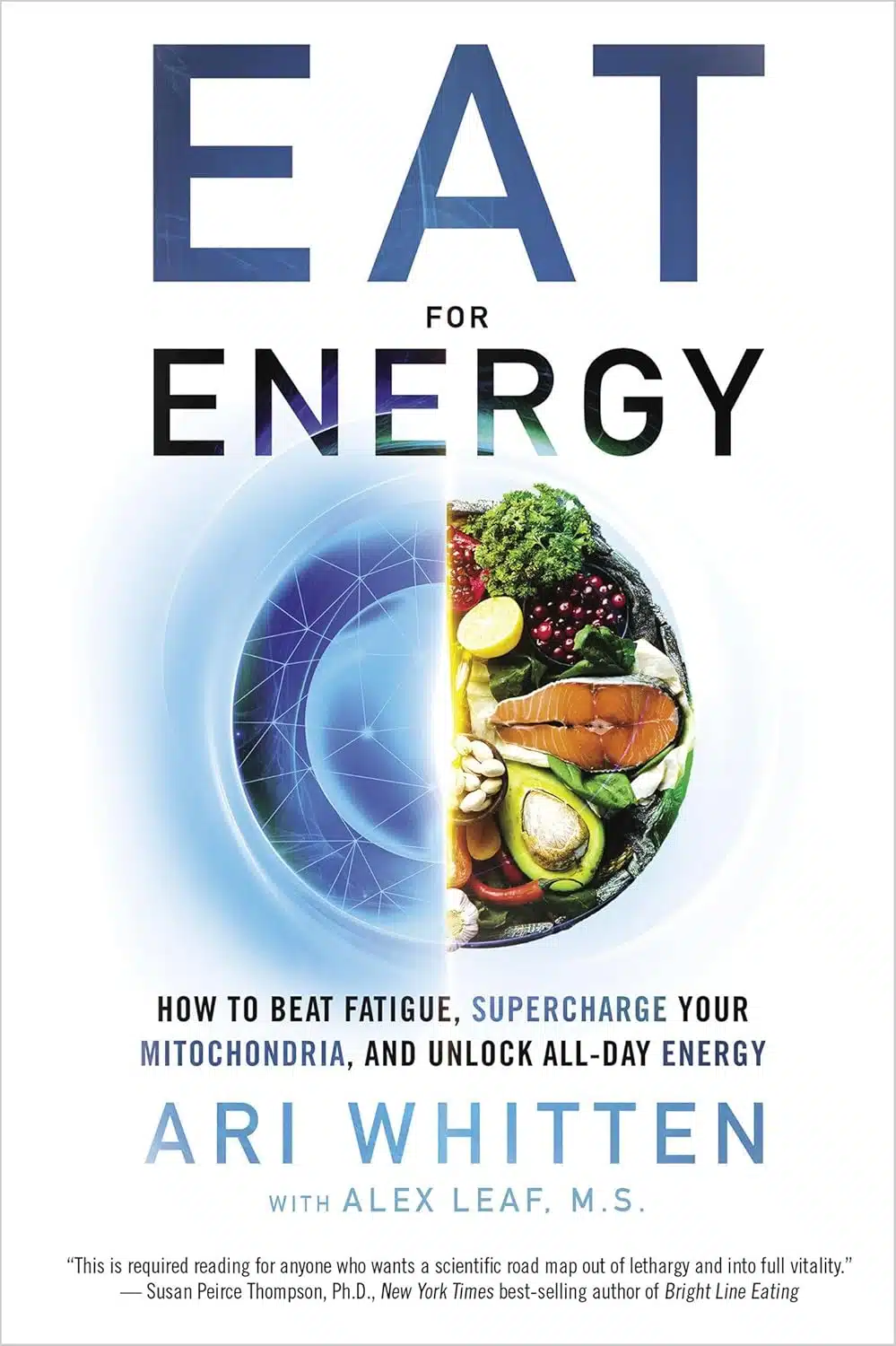
Eat For Energy – by Ari Whitten & Alex Leaf
10almonds is reader-supported. We may, at no cost to you, receive a portion of sales if you purchase a product through a link in this article.
The authors, a nutritionist and a kinesiologist, set out to combat the “hidden epidemic” of fatigue. The main cause, they argue, is mitochondrial dysfunction. And the fix? Well, that’s multivector, but as you may guess from the title, nutrition is an important component.
First though, they make the case for sorting out our sleep and stress management, because mitochondrial function will only be as good as the situation that our body perceives us to be in. In other words, our body needs to know it’s ok to rest and reset, otherwise it won’t.
After that, it’s time to tackle what’s on the table (and when), to stabilize blood sugars, rebuild the gut barrier, boost the brain, and nourish the body’s systems in their entirety (here we get into a lot of superfoods and such).
The style is… Well, it seems to have been written as mid-range pop-science and then edited down to read as light pop-science for readability/accessibility. Which makes for a quirky style choice, but works well as a very good compromise. When it comes to how evidence-based something is, we like bibliographies and we cannot lie, so the 1,000-strong bibliography in this work is a welcome sight.
Bottom line: if you have been struggling with fatigue, then this book can help you perk yourself up and then maintain that higher energy level, barring external things that might still bring it down sometimes.
Click here to check out Eat For Energy, and indeed eat for (sustainable) energy!
Don’t Forget…
Did you arrive here from our newsletter? Don’t forget to return to the email to continue learning!
Recommended
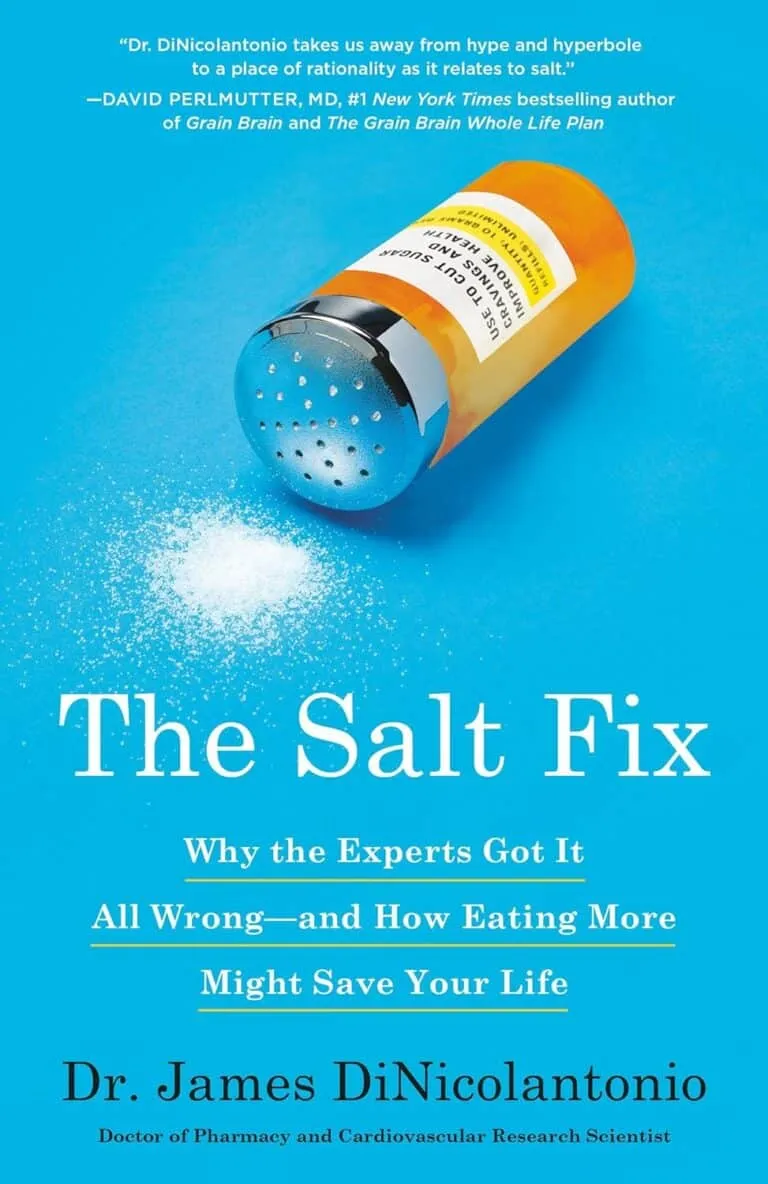
Learn to Age Gracefully
Join the 98k+ American women taking control of their health & aging with our 100% free (and fun!) daily emails:
-
Brown Rice vs Pearl Barley – Which is Healthier?
10almonds is reader-supported. We may, at no cost to you, receive a portion of sales if you purchase a product through a link in this article.
Our Verdict
When comparing brown rice to pearl barley, we picked the barley.
Why?
Both have their strong merits! But…
In terms of macros, pearl barley has more than 4x the fiber, for the same carbs and slightly more protein. So, a clear win for pearl barley in this category.
In the category of vitamins, brown rice has more of vitamins B1, B3, B5, B6, and E, while pearl barley has more of vitamins A, B2, and K, yielding to rice a 5:3 win in this round.
Looking at minerals next, brown rice has more magnesium, manganese, and phosphorus, while pearl barley has notably more calcium, copper, iron, potassium, and selenium, giving pearl barley the win here.
Adding up the sections makes for a clear overall win for pearl barley, but do enjoy either or both, as diversity is best!
Unless you have a gluten allergy, in which case, maybe skip the pearl barley, which is indeed barley that has been pearled, and thus does have gluten. But for most people that’s a non-issue, so we won’t include it in the general reckoning.
Want to learn more?
You might like:
- Gluten: What’s The Truth?
- Grains: Bread Of Life, Or Cereal Killer?
- Should You Go Light Or Heavy On Carbs?
- Why Going Gluten-Free Could Be A Bad Idea
- Why You’re Probably Not Getting Enough Fiber (And How To Fix It)
- What Do The Different Kinds Of Fiber Do? 30 Foods That Rank Highest
- What Matters Most For Your Heart? Eat More (Of This) For Lower Blood Pressure ← Spoiler: it’s fiber
Enjoy!
Share This Post
-
The “Five Tibetan Rites” & Why To Do Them!
10almonds is reader-supported. We may, at no cost to you, receive a portion of sales if you purchase a product through a link in this article.
Spinning Around
In Tuesday’s newsletter, we asked you for your opinion of the “Five Tibetan Rites”, and got the above-depicted, below-described, set of responses:
- About 41% said “I have never heard of these before”
- About 27% said “they restore youth by adjusting internal vortexes”
- About 22% said “they are basically yoga, by a different name”
- About 11% said “they are a pseudoscience popular in the US”
So what does the science say?
The Five Tibetan Rites are five Tibetan rites: True or False?
False, though this is more question of social science than of health science, so we’ll not count it against them for having a misleading name.
The first known mentioning of the “Five Tibetan Rites” is by an American named Peter Kelder, who in 1939 published, through a small LA occult-specialized publishing house, a booklet called “The Eye of Revelation”. This work was then varyingly republished, repackaged, and occasionally expanded upon by Kelder or other American authors, including Chris Kilham’s popular 1994 book “The Five Tibetans”.
The “Five Tibetan Rites” are unknown as such in Tibet, except for what awareness of them has been raised by people asking about them in the context of the American phenomenon.
Here’s a good history book, for those interested:
The author didn’t originally set out to “debunk” anything, and is himself a keen spiritualist (and practitioner of the five rites), but he was curious about the origins of the rites, and ultimately found them—as a collection of five rites, and the other assorted advices given by Kelder—to be an American synthesis in the whole, each part inspired by various different physical practices (some of them hatha yoga, some from the then-popular German gymnastics movement, some purely American spiritualism, all available in books that were popular in California in the early 1900s).
You may be wondering: why didn’t Kelder just say that, then, instead of telling stories of an ancient Tibetan tradition that empirically does not exist? The answer to this lies again in social science not health science, but it’s been argued that it’s common for Westerners to “pick ‘n’ mix” ideas from the East, champion them as inscrutably mystical, and (since they are inscrutable) then simply decide how to interpret and represent them. Here’s an excellent book on this, if you’re interested:
(in Kelder’s case, this meant that “there’s a Tibetan tradition, trust me” was thus more marketable in the West than “I read these books in LA”)
They are at least five rites: True or False?
True! If we use the broad definition of “rite” as “something done repeatedly in a solemn fashion”. And there are indeed five of them:
- Spinning around (good for balance)
- Leg raises (this one’s from German gymnastics)
- Kneeling back bend (various possible sources)
- Tabletop (hatha yoga, amongst others)
- Pendulum (hatha yoga, amongst others) ← you may recognize this one from the Sun Salutation
You can see them demonstrated here:
Click Here If The Embedded Video Doesn’t Load Automatically
Kelder also advocated for what was basically the Hay Diet (named not for the substance but for William Hay; it involved separating foods into acid and alkali, not necessarily according to the actual pH of the foods, and combining only “acid” foods or only “alkali” foods at a time), which was popular at the time, but has since been rejected as without scientific merit. Kelder referred to this as “the sixth rite”.
The Five Rites restore youth by adjusting internal vortexes: True or False?
False, in any scientific sense of that statement. Scientifically speaking, the body does not have vortexes to adjust, therefore that is not the mechanism of action.
Spiritually speaking, who knows? Not us, a humble health science publication.
The Five Rites are a pseudoscience popular in the US: True or False?
True, if 27% of those who responded of our mostly North American readership can be considered as representative of what is popular.
However…
“Pseudoscience” gets thrown around a lot as a bad word; it’s often used as a criticism, but it doesn’t have to be. Consider:
A small child who hears about “eating the rainbow” and mistakenly understands that we are all fuelled by internal rainbows that need powering-up by eating fruits and vegetables of different colors, and then does so…
…does not hold a remotely scientific view of how things are happening, but is nevertheless doing the correct thing as recommended by our best current science.
It’s thus a little similar with the five rites. Because…
The Five Rites are at least good for our health: True or False?
True! They are great for the health.
The first one (spinning around) is good for balance. Science would recommend doing it both ways rather than just one way, but one is not bad. It trains balance, trains our stabilizing muscles, and confuses our heart a bit (in a good way).
See also: Fall Special (How To Not Fall, And Not Get Injured If You Do)
The second one (leg raises) is excellent for core strength, which in turn helps keep our organs where they are supposed to be (this is a bigger health issue than most people realise, because “out of sight, out of mind”), which is beneficial for many aspects of our health!
See also: Visceral Belly Fat & How To Lose It ← visceral fat is the fat that surrounds your internal organs; too much there becomes a problem!
The third, fourth, and fifth ones stretch our spine (healthily), strengthen our back, and in the cases of the fourth and fifth ones, are good full-body exercises for building strength, and maintaining muscle mass and mobility.
See also: Building & Maintaining Mobility
So in short…
If you’ve been enjoying the Five Rites, by all means keep on doing them; they might not be Tibetan (or an ancient practice, as presented), and any mystical aspect is beyond the scope of our health science publication, but they are great for the health in science-based ways!
Take care!
Share This Post
-
Walk Like You’re 20 Years Younger Again
10almonds is reader-supported. We may, at no cost to you, receive a portion of sales if you purchase a product through a link in this article.
How fit, healthy, strong, and mobile were you 20 years ago? For most people, the answer is “better than now”. Physiotherapist Dr. Doug Weiss has advice on turning back the clock:
The exercises
If you already have no problems walking, this one is probably not for you. However, if you’re not so able to comfortably walk as you used to be, then Dr. Weiss recommends:
- Pillow squat: putting pillow on a chair, crossing hands on chest, standing up and sitting down. Similar to the very important “getting up off the floor without using your hands” exercise, but easier.
- Wall leaning: standing against a wall with heels 4″ away from it, crossing arms over chest again, and pulling the body off the wall using the muscles in the front of the shin. Note, this means not cheating by using other muscles, leveraging the upper body, pushing off with the buttocks, or anything else like that.
- Stepping forward: well, this certainly is making good on the promise of walking like we did 20 years ago; there sure was a lot of stepping forward involved. More seriously, this is actually about stepping over some object, first with support, and then without.
- Heel raise: is what it sounds like, raising up on toes and back down again; first with support, then without.
- Side stepping: step sideways 2–3 steps in each direction. First with support, then without. Bonus: if your support is your partner, then congratulations, you are now dancing bachata.
For more details (and visual demonstration) of these exercises and more, enjoy:
Click Here If The Embedded Video Doesn’t Load Automatically!
Want to learn more?
You might also like:
4 Tips To Stand Without Using Hands
Take care!
Share This Post
Related Posts
-
Sweeteners & Your Appetite
10almonds is reader-supported. We may, at no cost to you, receive a portion of sales if you purchase a product through a link in this article.
Sugar is famously not great for the health. See for example: Is Sugar The New Smoking? ← the answer is “no, but it’s still very bad, just not in the same league of badness as smoking”!
Of course, there are some important circumstantial things to bear in mind, such as:
From Apples to Bees, and High-Fructose Cs: Which Sugars Are Healthier, And Which Are Just The Same?
But even without sugar, simply sweetness itself can cause problems: we can build tolerance to sweetness. Many sugar substitutes are many times (in some cases, hundreds of times) sweeter than sugar. This leads to people craving increasingly sweeter foods for the same experiential sweetness level.
Because of this, the World Health Organization has released a report offering guidance regards the use of sugar-free sweeteners.
In a nutshell, the guidance is: don’t
- Here’s the report itself: Use of non-sugar sweeteners: WHO guideline
- And it was based on this huge systematic review: Health effects of the use of non-sugar sweeteners: a systematic review and meta-analysis
- Here’s the WHO’s own press release about it: WHO advises not to use non-sugar sweeteners for weight control in newly released guideline
Nevertheless, if you really want to, we previously did a rundown on:
- Sucrose (metabolic problems)
- Sucralose (genotoxic)
- Erythritol (ischemiagenic)
- Xylitol (gut disruptor)
- Acesulfame K (gut disruptor)
- Stevia (strong risk of sweetness tolerance problem)
- Glycine (beneficial in moderation, sweetness problem though)
For more details than those one-or-few-word summaries, see: What’s The Healthiest Sweetener?
We’ve also talked about: The Fascinating Truth About Aspartame, Cancer, & Neurotoxicity
…which covers how the most popular beliefs about aspartame are myths, and in large part stemming from a single viral hoax chain letter in the 90s!
But sweeteners really increase your appetite?
That’s the question that Dr. Sabina Anderson et al. put to the test all so recently, using a mixture of acesulfame K and acesulfame cyclamate (Ace-K/Cyc).
What they found, in few words:
- No, there was no increase in food intake: participants didn’t eat more after consuming artificial sweeteners compared with water, even when allowed to eat freely later.
- No, there was no meaningful effect on hunger overall: hunger, fullness, and satiety were the same between sweeteners and water across all time points during the study.
- In fact, the participants enjoyed reduced sweet cravings: the sweetened drink lowered the desire to eat something sweet, and this effect persisted even after adjusting for taste differences.
You may be thinking: what happened to that up top about tolerance spiralling and craving more and more sweet things?!
And the answer is: that’s in the big picture; this was a 265-minute study, done three times in a row. So, it’s less about what it does in the long term, and more about what it does in the moment.
Specifically,
❝Subjective appetite sensations were measured using visual analogue scales while fasting and nine times during a 250-min postprandial period. During this period, a standardized breakfast (0–10 min) was served and, 2 h later, a test drink containing either Ace-K/Cyc or water (120–130 min) was given. After 265 min, an ad libitum test meal was served.❞
Read in full: Acute and Prolonged Effects of Sweeteners and Sweetness Enhancers on Postprandial Appetite Sensations, Palatability, and Ad Libitum Energy Intake in Humans: A SWEET Sub-Study (yes, they say “and prolonged”, but when they say “prolonged”, they’re referring to t=265 min, as opposed to immediately after drinking the drink)
That does mean, of course, that while helpful to know about in the moment, the results may not be extrapolated to the long term.
It’s also worth noting that the sample size was small (n=26), so in terms of strength of evidence it’s more of an indicative “jumping-off point” for future studies, rather than anything that should necessarily shape policy (including your personal policy) in the meantime.
One other important limitation is that obviously the results are for acesulfame-K and cyclamate, which means the results cannot necessarily be assumed to apply to all artificial sweeteners.
In fact, there is some science to the opposite for at least one sweetener, sucralose:
The Sweetener That Interferes With Hunger/Satiety Signals
Of course, sucralose is not technically a non-sugar sweetener, as it is chemically a sugar. But in practical terms, sucralose is a sugar in the same way that coffee is a fruit, i.e. it’s true, but for most purposes we can disregard that information as it’s not how we usually use those words in daily parlance.
Want to learn more?
This recommendation’s tangential to our main topic today, but it’ll be relevant for a lot of people who use sweeteners as a blood sugar control tool, so:
Stop Overeating During Low Blood Sugars With Diabetes – by Ginger Vieira
Take care!
Don’t Forget…
Did you arrive here from our newsletter? Don’t forget to return to the email to continue learning!
Learn to Age Gracefully
Join the 98k+ American women taking control of their health & aging with our 100% free (and fun!) daily emails:
-
Missing Microbes – by Dr. Martin Blaser
10almonds is reader-supported. We may, at no cost to you, receive a portion of sales if you purchase a product through a link in this article.
You probably know that antibiotic resistance is a problem, but you might not realize just what a many-headed beast antibiotic overuse is.
From growing antibiotic superbugs, to killing the friendly bacteria that normally keep pathogens down to harmless numbers (resulting in death of the host, as the pathogens multiply unopposed), to multiple levels of dangers in antibiotic overuse in the farming of animals, this book is scary enough that you might want to save it for Halloween.
But, Dr. Blaser does not argue against antibiotic use when it’s necessary; many people are alive because of antibiotics—he himself recovered from typhoid because of such.
The style of the book is narrative, but information-dense. It does not succumb to undue sensationalization, but it’s also far from being a dry textbook.
Bottom line: if you’d like to understand the real problems caused by antibiotics, and how we can combat that beyond merely “try not to take them unnecessarily”, this book is very worthy reading.
Click here to check out Missing Microbes, and learn more about yours!
Don’t Forget…
Did you arrive here from our newsletter? Don’t forget to return to the email to continue learning!
Learn to Age Gracefully
Join the 98k+ American women taking control of their health & aging with our 100% free (and fun!) daily emails:
-
Bell Pepper vs Okra – Which is Healthier?
10almonds is reader-supported. We may, at no cost to you, receive a portion of sales if you purchase a product through a link in this article.
Our Verdict
When comparing bell pepper to okra, we picked the okra.
Why?
It wasn’t a close one, today!
In terms of macros, okra has nearly 2x the fiber, slightly more carbs, and more than 2x the protein, winning this first round easily.
In the category of vitamins, bell peppers have more of vitamins C and E, while okra has more of vitamins B2, B3, B5, B6, B9, and K, winning by a large margin. You might be wondering about vitamin A; if the bell peppers are red or yellow, then they have more; if the bell peppers are green, then okra has more. Doesn’t change the overall result for the category though; it’s still, on balance, a clear win for okra on vitamins either way.
Looking at minerals, bell peppers are not higher in any minerals, while okra has more calcium, copper, iron, magnesium, manganese, phosphorus, potassium, selenium, and zinc, for an even more one-sided victory for okra in this round.
In other considerations, okra is higher in polyphenols, so that’s another point in okra’s favor.
Adding up the sections makes for a very clear overall win for okra, but by all means do enjoy either or both, as diversity is best!
Want to learn more?
You might like:
A Spectrum Of Specialties: Which Bell Peppers To Pick? ← about the various differences between the assorted colors of bell pepper
Enjoy!
Don’t Forget…
Did you arrive here from our newsletter? Don’t forget to return to the email to continue learning!
Learn to Age Gracefully
Join the 98k+ American women taking control of their health & aging with our 100% free (and fun!) daily emails:


