
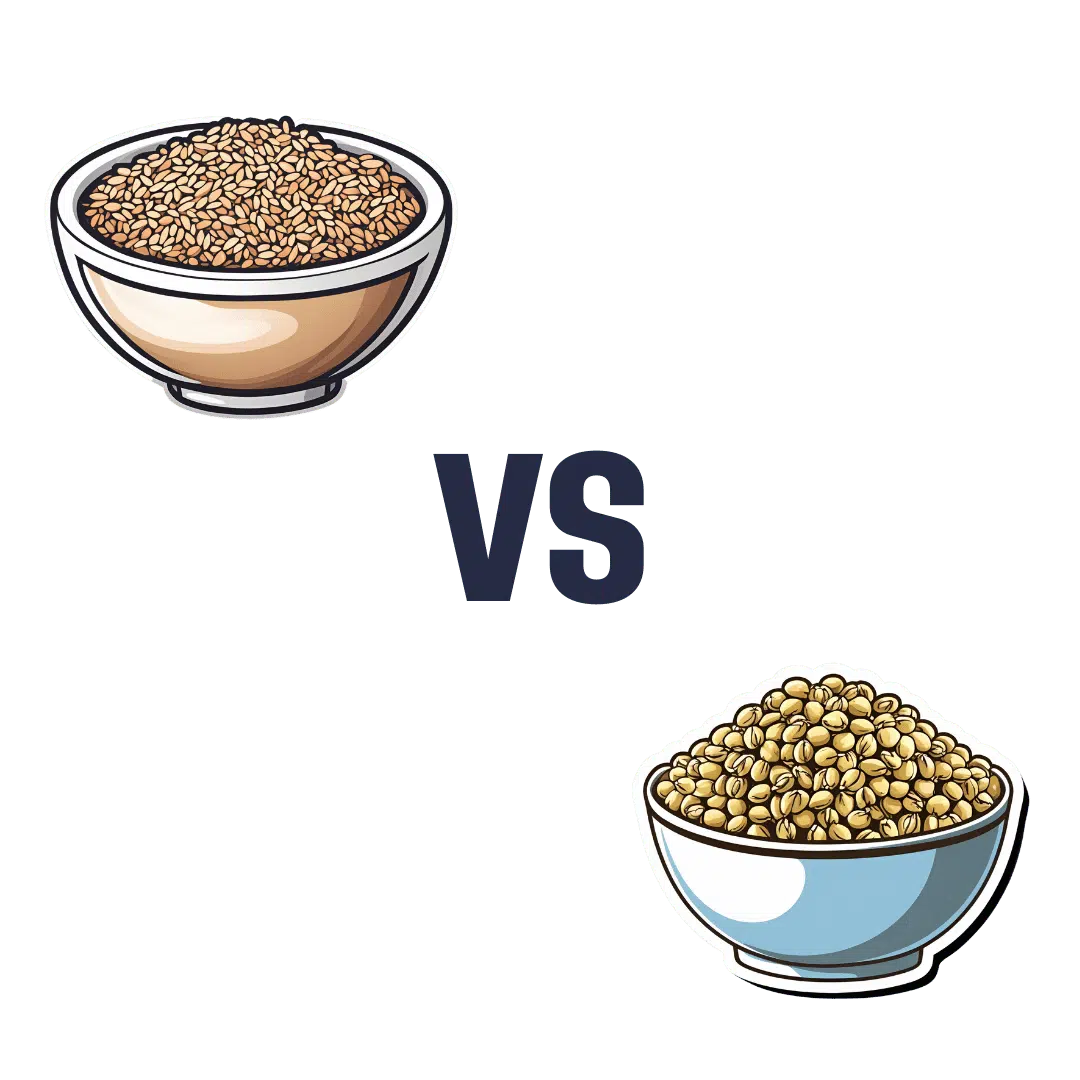
Brown Rice vs Pearl Barley – Which is Healthier?
10almonds is reader-supported. We may, at no cost to you, receive a portion of sales if you purchase a product through a link in this article.
Our Verdict
When comparing brown rice to pearl barley, we picked the barley.
Why?
Both have their strong merits! But…
In terms of macros, pearl barley has more than 4x the fiber, for the same carbs and slightly more protein. So, a clear win for pearl barley in this category.
In the category of vitamins, brown rice has more of vitamins B1, B3, B5, B6, and E, while pearl barley has more of vitamins A, B2, and K, yielding to rice a 5:3 win in this round.
Looking at minerals next, brown rice has more magnesium, manganese, and phosphorus, while pearl barley has notably more calcium, copper, iron, potassium, and selenium, giving pearl barley the win here.
Adding up the sections makes for a clear overall win for pearl barley, but do enjoy either or both, as diversity is best!
Unless you have a gluten allergy, in which case, maybe skip the pearl barley, which is indeed barley that has been pearled, and thus does have gluten. But for most people that’s a non-issue, so we won’t include it in the general reckoning.
Want to learn more?
You might like:
- Gluten: What’s The Truth?
- Grains: Bread Of Life, Or Cereal Killer?
- Should You Go Light Or Heavy On Carbs?
- Why Going Gluten-Free Could Be A Bad Idea
- Why You’re Probably Not Getting Enough Fiber (And How To Fix It)
- What Do The Different Kinds Of Fiber Do? 30 Foods That Rank Highest
- What Matters Most For Your Heart? Eat More (Of This) For Lower Blood Pressure ← Spoiler: it’s fiber
Enjoy!
Don’t Forget…
Did you arrive here from our newsletter? Don’t forget to return to the email to continue learning!
Recommended

Learn to Age Gracefully
Join the 98k+ American women taking control of their health & aging with our 100% free (and fun!) daily emails:
-
Hypertension: Factors Far More Relevant Than Salt
10almonds is reader-supported. We may, at no cost to you, receive a portion of sales if you purchase a product through a link in this article.
Hypertension: Factors Far More Relevant Than Salt
Firstly, what is high blood pressure vs normal, and what do those blood pressure readings mean?
Rather than take up undue space here, we’ll just quickly link to…
Blood Pressure Readings Explained (With A Colorful Chart)
More details of specifics, at:
Hypotension | Normal | Elevated | Stage 1 | Stage 2 | Danger zone
Keeping Blood Pressure Down
As with most health-related things (and in fact, much of life in general), prevention is better than cure.
People usually know “limit salt” and “manage stress”, but there’s a lot more to it!
Salt isn’t as big a factor as you probably think
That doesn’t mean go crazy on the salt, as it can cause a lot of other problems, including organ failure. But it does mean that you can’t skip the salt and assume your blood pressure will take care of itself.
This paper, for example, considers “high” sodium consumption to be more than 5g per day, and urinary excretion under 3g per day is considered to represent a low sodium dietary intake:
Sodium Intake and Hypertension
Meanwhile, health organizations often recommend to keep sodium intake to under 2g or under 1.5g
Top tip: if you replace your table salt with “reduced sodium” salt, this is usually sodium chloride (regular table salt) cut with potassium chloride, which is almost as “salty” tastewise, but obviously contains less sodium. Not only that, but potassium actually helps the body eliminate sodium, too.
The rest of what you eat is important too
The Mediterranean Diet is as great for this as it is for most health conditions.
If you sometimes see the DASH diet mentioned, that stands for “Dietary Approaches to Stop Hypertension”, and is basically the Mediterranean Diet with a few tweaks.
What are the tweaks?
- Beans went down a bit in priority
- Red meat got removed entirely instead of “limit to a tiny amount”
- Olive oil was deprioritized, and/but vegetable oil is at the bottom of the list (i.e., use sparingly)
You can check out the details here, with an overview and examples:
DASH Eating Plan—Description, Charts, and Recipes
Don’t drink or smoke
And no, a glass of red a day will not help your heart. Alcohol does make us feel relaxed, but that is because of what it does to our brain, not what it does to our heart.
In reality, even a single drink will increase blood pressure. Yes, really:
And smoking? It’s so bad that even second-hand smoke increases blood pressure:
Get those Zs in
Sleep is a commonly underestimated/forgotten part of health, precisely because in a way, we’re not there for it when it happens. We sleep through it! But it is important, including to protect against hypertension:
Short- and long-term health consequences of sleep disruption
Move your body!
Moving your body often is far more important for your heart than running marathons or bench-pressing your spouse.
Those 150 minutes “moderate exercise” (e.g. walking) per week are important, and can be for example:
- 22 minutes per day, 7 days per week
- 25 minutes per day, 6 days per week
- 30 minutes per day, 5 days per week
- 75 minutes per day, 2 days per week
If you’d like to know more about the science and evidence for this, as well as practical suggestions, you can download the complete second edition of the Physical Activity Guidelines for Americans here (it’s free, and no sign-up required!)
If you prefer a bite-size summary, then here’s their own:
Top 10 Things to Know About the Second Edition of the Physical Activity Guidelines for Americans
PS: Want a blood pressure monitor? We don’t sell them (or anything else), but for your convenience, here’s a good one you might want to consider.
Share This Post
-
Why do some people get bad ‘hangxiety’ after a night of drinking and others don’t?
10almonds is reader-supported. We may, at no cost to you, receive a portion of sales if you purchase a product through a link in this article.
You wake up after a night out. Your head’s pounding and a wave of unease hits before you’ve even looked at your phone. Restlessness, self-doubt and flashes of regret creep in as last night’s conversations start to replay.
“Hangxiety” is not a clinical term but the anxious, uneasy feeling that follows drinking is widely recognised. Most people expect a headache, but the emotional comedown can hit just as hard.
Alcohol disrupts brain systems that regulate mood and stress. It boosts gamma-aminobutyric acid (GABA), a calming chemical, and suppresses glutamate, which keeps you alert. That’s why confidence rises and worries fade.
As your body processes alcohol, this balance flips. Calming signals drop, excitatory ones surge and your nervous system swings into overdrive.
Alcohol also disrupts the hypothalamic–pituitary–adrenal (HPA) axis – the body’s stress system – spiking cortisol, our main stress hormone.
Combine that with poor sleep, dehydration and low blood sugar, and you’ve got the perfect recipe for feeling on edge.
To understand how common these feelings are, we analysed 22 studies spanning four decades and involving more than 6,000 adults worldwide. Our systematic review published today included lab experiments, surveys and interviews capturing real-world experiences.
Despite differences in study designs and the challenge of asking hungover people to accurately recall their experiences, the results were consistent: hangovers triggered higher levels of anxiety, stress, guilt, irritability and sadness.
Boy_Anupong/Getty Images Certain traits make hangxiety hit harder
People prone to anxiety or low mood, or those who drink to cope with stress, experience hangxiety more intensely – not because hangovers create new problems, but because alcohol temporarily dulls negative emotions.
When the effects wear off, those feelings return in sharper focus, which can amplify stress and worry.
Hangxiety also hits harder when people act out of character while drunk. Saying or doing things that clash with personal values can trigger embarrassment or shame the next day, fuelling harsh self-criticism and intensifying emotional distress.
People who struggle with emotional regulation – recognising and managing your emotions in healthy ways – face particular challenges.
Good emotional regulation might mean noticing stress and choosing to go for run or call a friend, rather than reaching straight for a drink. It’s pausing to ask “what do I actually need right now?”
Without these skills, people get stuck in cycles of self-blame, amplifying the emotional rebound.
What traits make it less bothersome?
Not everyone experiences hangxiety the same way. People with higher emotional resilience – the ability to adapt to stress and keep perspective – tend to cope more effectively.
Reframing “I’m falling apart” into “my body’s recovering” shifts hangxiety from crisis into something temporary.
Social support helps too. Sharing a laugh about the night before or talking it through eases isolation and shame. Knowing you’re not alone makes the experience less overwhelming.
Bad hangxiety doesn’t stop people drinking
You might assume a brutal hangover would deter future drinking, but most people in our review saw hangovers as a routine inconvenience or rite of passage.
Rather than reducing their alcohol intake, people relied on short-term fixes such as, drinking water or eating beforehand to lessen the severity of their hangover.
When alcohol becomes a coping tool for stress, hangxiety can actually reinforce the cycle. Alcohol dulls discomfort, but when it wears off, the same feelings return, prompting another drink for relief.
This loop helps explain why even frequent hangovers rarely lead to meaningful behaviour change.
If you’re experiencing hangxiety, aside from planning to drink less next time, to get through the day:
- hydrate, rest and eat well to support your body’s recovery
- skip the “hair of the dog”. More alcohol only delays the crash
- ground yourself with slow breaths or a short walk to calm the nervous system
- reach out to friends or loved ones. Connection eases both guilt and anxiety.
In the longer term, reflect on why you drink and whether it’s become a way to manage stress.
If you’re drinking daily to manage emotions, if hangxiety disrupts your work or relationships, or if anxiety lingers long after the hangover fades, it’s time to seek professional help. A GP or a psychologist can assess whether underlying anxiety or problematic drinking patterns need support.
Hangxiety is more than a bad mood after drinking – it’s your brain and body recalibrating after chemical turbulence, where brain chemistry, personality and coping strategies interact.
Some people feel it mildly, others more deeply, depending on levels of emotional awareness, resilience and support. Understanding this can help replace self-criticism with self-compassion, and perhaps rethink what the “morning after” really means.
Rebecca Rothman, PhD Candidate in Clinical Psychology, School of Health Sciences, Swinburne University of Technology and Blair Aitken, Postdoctoral Research Fellow in Psychopharmacology, Swinburne University of Technology
This article is republished from The Conversation under a Creative Commons license. Read the original article.
Share This Post
-
Healing The Modern Brain – by Dr. Drew Ramsey
10almonds is reader-supported. We may, at no cost to you, receive a portion of sales if you purchase a product through a link in this article.
We previously reviewed Dr. Ramsey’s Eat To Beat Depression & Anxiety, and this time [it briefly covers that ground again, and then] it’s more about comprehensive brain health and mental fitness.
He tackles this in a methodical fashion, first briefly covering the need for mental fitness, and the obstacles to same, before the main part of the book—which covers the “how”.
The “how” in question is multifaceted, and the “nine tenets” mentioned in the subtitle cover very obvious things like diet, exercise, sleep, etc, as well as less obvious yet very important things like connection, engagement, purpose, and so forth, and some things that don’t get talked about much at all elsewhere, such as the processes of grounding and unburdening, as he describes them.
The style is mostly narrative with many anecdotes to illustrate points, but with practical advice woven throughout also, all very readable. There’s a respectable bibliography at the back.
Bottom line: if you’d like your brain health to get gradually better instead of gradually worse, this book can help set you on the right track.
Click here to check out Healing The Modern Brain, and heal your modern brain!
Share This Post
Related Posts
-
Do you have knee pain from osteoarthritis? You might not need surgery. Here’s what to try instead
10almonds is reader-supported. We may, at no cost to you, receive a portion of sales if you purchase a product through a link in this article.
Most people with knee osteoarthritis can control their pain and improve their mobility without surgery, according to updated treatment guidelines from the Australian Commission on Safety and Quality in Health Care.
So what is knee osteoarthritis and what are the best ways to manage it?
Pexels/Kindelmedia More than 2 million Australians have osteoarthritis
Osteoarthritis is the most common joint disease, affecting 2.1 million Australians. It costs the economy A$4.3 billion each year.
Osteoarthritis commonly affects the knees, but can also affect the hips, spine, hands and feet. It impacts the whole joint including bone, cartilage, ligaments and muscles.
Most people with osteoarthritis have persistent pain and find it difficult to perform simple daily tasks, such as walking and climbing stairs.
Is it caused by ‘wear and tear’?
Knee osteoarthritis is most likely to affect older people, those who are overweight or obese, and those with previous knee injuries. But contrary to popular belief, knee osteoarthritis is not caused by “wear and tear”.
Research shows the degree of structural wear and tear visible in the knee joint on an X-ray does not correlate with the level of pain or disability a person experiences. Some people have a low degree of structural wear and tear and very bad symptoms, while others have a high degree of structural wear and tear and minimal symptoms. So X-rays are not required to diagnose knee osteoarthritis or guide treatment decisions.
Telling people they have wear and tear can make them worried about their condition and afraid of damaging their joint. It can also encourage them to try invasive and potentially unnecessary treatments such as surgery. We have shown this in people with osteoarthritis, and other common pain conditions such as back and shoulder pain.
This has led to a global call for a change in the way we think and communicate about osteoarthritis.
What’s the best way to manage osteoarthritis?
Non-surgical treatments work well for most people with osteoarthritis, regardless of their age or the severity of their symptoms. These include education and self-management, exercise and physical activity, weight management and nutrition, and certain pain medicines.
Education is important to dispel misconceptions about knee osteoarthritis. This includes information about what osteoarthritis is, how it is diagnosed, its prognosis, and the most effective ways to self-manage symptoms.
Health professionals who use positive and reassuring language can improve people’s knowledge and beliefs about osteoarthritis and its management.
Many people believe that exercise and physical activity will cause further damage to their joint. But it’s safe and can reduce pain and disability. Exercise has fewer side effects than commonly used pain medicines such as paracetamol and anti-inflammatories and can prevent or delay the need for joint replacement surgery in the future.
Many types of exercise are effective for knee osteoarthritis, such as strength training, aerobic exercises like walking or cycling, Yoga and Tai chi. So you can do whatever type of exercise best suits you.
Increasing general physical activity is also important, such as taking more steps throughout the day and reducing sedentary time.
Weight management is important for those who are overweight or obese. Weight loss can reduce knee pain and disability, particularly when combined with exercise. Losing as little as 5–10% of your body weight can be beneficial.
Pain medicines should not replace treatments such as exercise and weight management but can be used alongside these treatments to help manage pain. Recommended medicines include paracetamol and non-steroidal anti-inflammatory drugs.
Opioids are not recommended. The risk of harm outweighs any potential benefits.
What about surgery?
People with knee osteoarthritis commonly undergo two types of surgery: knee arthroscopy and knee replacement.
Knee arthroscopy is a type of keyhole surgery used to remove or repair damaged pieces of bone or cartilage that are thought to cause pain.
However, high-quality research has shown arthroscopy is not effective. Arthroscopy should therefore not be used in the management of knee osteoarthritis.
Joint replacement involves replacing the joint surfaces with artificial parts. In 2021–22, 53,500 Australians had a knee replacement for their osteoarthritis.
Joint replacement is often seen as being inevitable and “necessary”. But most people can effectively manage their symptoms through exercise, physical activity and weight management.
The new guidelines (known as “care standard”) recommend joint replacement surgery only be considered for those with severe symptoms who have already tried non-surgical treatments.
I have knee osteoarthritis. What should I do?
The care standard links to free evidence-based resources to support people with osteoarthritis. These include:
- education, such as a decision aid and four-week online course
- self-directed online exercise and yoga programs
- weight management support
- pain management strategies, such as MyJointPain and painTRAINER.
If you have osteoarthritis, you can use the care standard to inform discussions with your health-care provider, and to make informed decisions about your care.
Belinda Lawford, Postdoctoral research fellow in physiotherapy, The University of Melbourne; Giovanni E. Ferreira, NHMRC Emerging Leader Research Fellow, Institute of Musculoskeletal Health, University of Sydney; Joshua Zadro, NHMRC Emerging Leader Research Fellow, Sydney Musculoskeletal Health, University of Sydney, and Rana Hinman, Professor in Physiotherapy, The University of Melbourne
This article is republished from The Conversation under a Creative Commons license. Read the original article.
Don’t Forget…
Did you arrive here from our newsletter? Don’t forget to return to the email to continue learning!
Learn to Age Gracefully
Join the 98k+ American women taking control of their health & aging with our 100% free (and fun!) daily emails:
-
‘Noisy’ autistic brains seem better at certain tasks. Here’s why neuroaffirmative research matters
10almonds is reader-supported. We may, at no cost to you, receive a portion of sales if you purchase a product through a link in this article.
Pratik Raul, University of Canberra; Jeroen van Boxtel, University of Canberra, and Jovana Acevska, University of Canberra
Autism is a neurodevelopmental difference associated with specific experiences and characteristics.
For decades, autism research has focused on behavioural, cognitive, social and communication difficulties. These studies highlighted how autistic people face issues with everyday tasks that allistic (meaning non-autistic) people do not. Some difficulties may include recognising emotions or social cues.
But some research, including our own study, has explored specific advantages in autism. Studies have shown that in some cognitive tasks, autistic people perform better than allistic people. Autistic people may have greater success in identifying a simple shape embedded within a more complex design, arranging blocks of different shapes and colours, or spotting an object within a cluttered visual environment (similar to Where’s Wally?). Such enhanced performance has been recorded in babies as young as nine months who show emerging signs of autism.
How and why do autistic individuals do so well on these tasks? The answer may be surprising: more “neural noise”.
What is neural noise?
Generally, when you think of noise, you probably think of auditory noise, the ups and downs in the amplitude of sound frequencies we hear.
A similar thing happens in the brain with random fluctuations in neural activity. This is called neural noise.
This noise is always present, and comes on top of any brain activity caused by things we see, hear, smell and touch. This means that in the brain, an identical stimulus that is presented multiple times won’t cause exactly the same activity. Sometimes the brain is more active, sometimes less. In fact, even the response to a single stimulus or event will fluctuate continuously.
Neural noise in autism
There are many sources of neural noise in the brain. These include how the neurons become excited and calm again, changes in attention and arousal levels, and biochemical processes at the cellular level, among others. An allistic brain has mechanisms to manage and use this noise. For instance, cells in the hippocampus (the brain’s memory system) can make use of neural noise to enhance memory encoding and recall.
Evidence for high neural noise in autism can be seen in electroencephalography (EEG) recordings, where increased levels of neural fluctuations were observed in autistic children. This means their neural activity is less predictable, showing a wider range of activity (higher ups and downs) in response to the same stimulus.
In simple terms, if we imagine the EEG responses like a sound wave, we would expect to see small ups and downs (amplitude) in allistic brains each time they encounter a stimulus. But autistic brains seem to show bigger ups and downs, demonstrating greater amplitude of neural noise.
Many studies have linked this noisy autistic brain with cognitive, social and behavioural difficulties.
But could noise be a bonus?
The diagnosis of autism has a long clinical history. A shift from the medical to a more social model has also seen advocacy for it to be reframed as a difference, rather than a disorder or deficit. This change has also entered autism research. Neuroaffirming research can examine the uniqueness and strengths of neurodivergence.
Psychology and perception researcher David Simmons and colleagues at the University of Glasgow were the first to suggest that while high neural noise is generally a disadvantage in autism, it can sometimes provide benefits due to a phenomenon called stochastic resonance. This is where optimal amounts of noise can enhance performance. In line with this theory, high neural noise in the autistic brain might enhance performance for some cognitive tasks.
Our 2023 research explores this idea. We recruited participants from the general population and investigated their performance on letter-detection tasks. At the same time, we measured their level of autistic traits.
We performed two letter-detection experiments (one in a lab and one online) where participants had to identify a letter when displayed among background visual static of various intensities.
By using the static, we added additional visual noise to the neural noise already present in our participants’ brains. We hypothesised the visual noise would push participants with low internal brain noise (or low autistic traits) to perform better (as suggested by previous research on stochastic resonance). The more interesting prediction was that noise would not help individuals who already had a lot of brain noise (that is, those with high autistic traits), because their own neural noise already ensured optimal performance.
Indeed, one of our experiments showed people with high neural noise (high autistic traits) did not benefit from additional noise. Moreover, they showed superior performance (greater accuracy) relative to people with low neural noise when the added visual static was low. This suggests their own neural noise already caused a natural stochastic resonance effect, resulting in better performance.
It is important to note we did not include clinically diagnosed autistic participants, but overall, we showed the theory of enhanced performance due to stochastic resonance in autism has merits.
Why this is important?
Autistic people face ignorance, prejudice and discrimination that can harm wellbeing. Poor mental and physical health, reduced social connections and increased “camouflaging” of autistic traits are some of the negative impacts that autistic people face.
So, research underlining and investigating the strengths inherent in autism can help reduce stigma, allow autistic people to be themselves and acknowledge autistic people do not require “fixing”.
The autistic brain is different. It comes with limitations, but it also has its strengths.
Pratik Raul, PhD candidiate, University of Canberra; Jeroen van Boxtel, Associate professor, University of Canberra, and Jovana Acevska, Honours Graduate Student, University of Canberra
This article is republished from The Conversation under a Creative Commons license. Read the original article.
Don’t Forget…
Did you arrive here from our newsletter? Don’t forget to return to the email to continue learning!
Learn to Age Gracefully
Join the 98k+ American women taking control of their health & aging with our 100% free (and fun!) daily emails:
-
Healing Spices – by Dr. Bharat Aggarwal & Debora Yost
10almonds is reader-supported. We may, at no cost to you, receive a portion of sales if you purchase a product through a link in this article.
This is exactly what the subtitle promises it to be, and more. It’s actually herbs and spices, but definitely mostly spices, and includes the kinds found in even the smallest supermarket, to some you might not have heard of, and might need to order online.
We are treated to an explanation of the health-giving properties of each (and any potential contraindications), as well as the culinary properties, many tables of what goes with what and how and why, and even recipes to use them in. For the more adventurous, there’s even advice on how to grow, prepare, and store each of them.
An extra benefit is that everything is cross-linked such that you can look things up by spice or by health condition or by flavor profile, and find what you need and what’ll go with it.
The style is simple and informational, clearly laid-out in encyclopedic form.
Bottom line: this book should be in your kitchen (or related nearby kitchen-book-place).
Click here to check out Healing Spices, and advance your culinary repertoire!
Don’t Forget…
Did you arrive here from our newsletter? Don’t forget to return to the email to continue learning!
Learn to Age Gracefully
Join the 98k+ American women taking control of their health & aging with our 100% free (and fun!) daily emails:


