
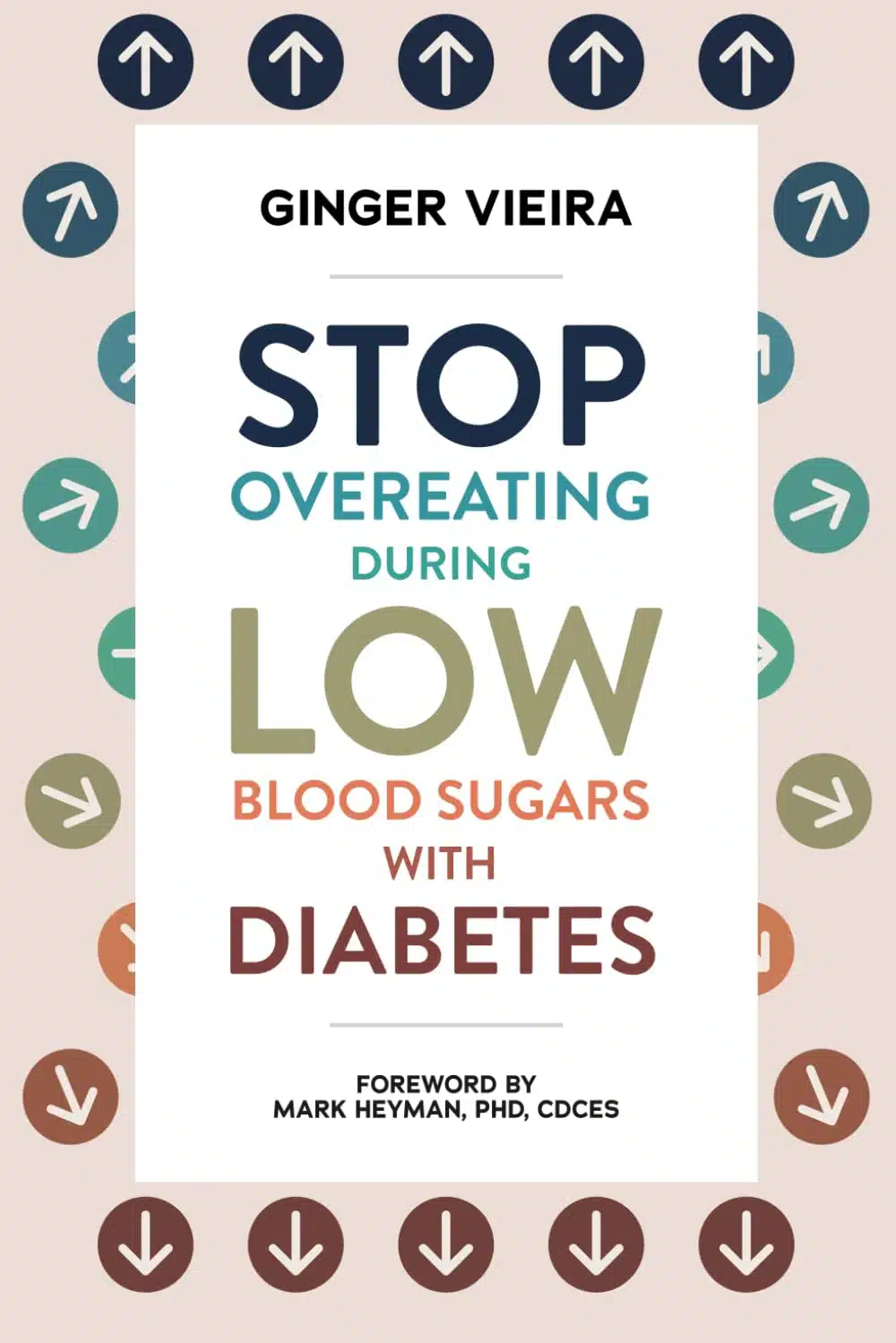
Stop Overeating During Low Blood Sugars With Diabetes – by Ginger Vieira
10almonds is reader-supported. We may, at no cost to you, receive a portion of sales if you purchase a product through a link in this article.
We previously reviewed this author’s “Exercise With Type 1 Diabetes”, and now it’s about managing blood sugars (with either of the most common types of diabetes) without doing the rollercoaster that otherwise often happens.
And why does it happen? As she describes, while you are hypoglycemic, your body is crying out for carbs, certain it will die if you don’t eat every carb in sight. And you know, even while hypo, that the current 50mg/dL will soon be 300mg/dL if you’re not careful, but your body insists to carry on anyway.
How, then, to overcome this? That’s the topic that that this book’s 8 chapters cover, because in practical terms there’s a lot more to it than “just say no”, which has rarely been a viable response to any problem, and doesn’t help here, either.
Instead, we learn about what keeps this vicious cycle going, and how to interrupt it. How to work through the panic and the stress, and how to interrupt the twisted relationship with food that’s likely arisen. Most practically, she also talks us through treating lows with new guidelines, how to understand glucagon metabolism, and other technical aspects to round off the equally important more psychological matters.
The style is direct and personal, yet written with the confidence that comes from her expertise. It is, it’s worth noting, on the absolute lightest end of pop-science, but that’s understandable as the author is not a career scientist, just someone with T1D who’s become an expert out of necessity.
Bottom line: if you or a loved one has diabetes and struggles with this problem, then this book can help a lot.
Don’t Forget…
Did you arrive here from our newsletter? Don’t forget to return to the email to continue learning!
Recommended
Learn to Age Gracefully
Join the 98k+ American women taking control of their health & aging with our 100% free (and fun!) daily emails:
-
No-Needle Vaccination Against Many Avian/Human Flu Types
10almonds is reader-supported. We may, at no cost to you, receive a portion of sales if you purchase a product through a link in this article.
And other items from this week’s health news:
Intranasal spray provides broad protection
The flu isn’t fun, and kills many people very year. Needles, meanwhile, are often viewed as a necessary evil when it comes to protection against such. However, this newly-developed intranasal spray vaccinates against a wide variety of flu strains (including the bird flu strains currently rife in some parts of the US).
Most flu vaccines only target a few strains and (as you’re probably very aware) must be updated every year, as viruses mutate. They also don’t usually protect well against flu viruses that come from animals, like bird flu. The World Health Organization has called for better, more universal flu vaccines, and this research does just that.
The team used two methods:
- One method added a human gene to the flu virus, helping the immune system recognize and destroy infected cells more easily.
- The other method changed parts of the virus’s genetic code to make it weaker in humans but still easy to produce using current vaccine technology.
Both approaches showed strong results in trials, offering protection against multiple types of flu.
Read in full: Needle-free, live-attenuated influenza vaccines with broad protection against human and avian virus subtypes
Related: Flu vaccines are now available for 2025. What’s on offer and which one should I get?
How pets help in old age
It’s probably not news to you that pets can be a remedy against feelings of loneliness, but there’s more to it than that: daily routines like feeding, walking, and playing with a pet can bring structure to the day, reduce stress, and boost physical activity.
Pets also help a lot of older adults connect with their communities, simply because walking a dog or visiting a pet-friendly place often leads to casual conversations and new friendships, which can otherwise sometimes be thin on the ground.
However, owning a pet inevitably comes with some challenges, so it’s worth bearing them in mind up front. Some people may struggle with caring for pets that need a lot of exercise, or have health issues of their own, for example. It’s therefore especially important to choose a pet that fits your lifestyle and what you’re able to deal with on a daily basis—if indeed a pet is the right option for you at all (it’s not for everyone!).
Read in full: How pets enrich the lives of the elderly
Related: How To Beat Loneliness & Isolation
Beyond statins: a cholesterol-lowering pill that helps reduce heart disease risk
Heart disease is a leading killer in the US, and stroke is also rising up the “most fatal” list in recent years. Many opt to treat high cholesterol levels (which can contribute to hypertension, and thus cardiovascular disease, and thus also vascular dementia and stroke) with statins, but statins have their side effects too, many of which are very serious, and for some people, they may not even be that effective.
So, it might be worth knowing about a new contender: Obicetrapib.
This new drug was tested in a large (n=2,530) clinical trial and was shown to significantly reduce two major causes of heart disease: LDL (“bad”) cholesterol, and lipoprotein(a), also called: Lp(a).
The study participants were people with heart disease or inherited high cholesterol, and after 12 weeks, those taking Obicetrapib had lowered their LDL cholesterol by over 30%, and Lp(a) by about the same amount. This is important because many people cannot reach safe cholesterol levels with current medications, and there are no widely approved treatments for lowering Lp(a) yet.
Read in full: Cholesterol pill helps those at high risk of heart attack and stroke: Study
Related: Lower Cholesterol, Without Statins
Take care!
Share This Post
-
Is honey good for you? Can it speed recovery if you’re sick or injured?
10almonds is reader-supported. We may, at no cost to you, receive a portion of sales if you purchase a product through a link in this article.
Honey is often praised for a range of health benefits, from soothing a sore throat and helping you get to sleep to healing woulds and lowering risk factors for diabetes and heart disease.
Honey’s acidity has the potential to prevent bacterial growth, while its density and stickiness generates osmotic pressure (in the same way as quicksand) which restrain bacteria.
Other compounds in honey contribute anti-inflammatory and antioxidant effects.
But do the claims about honey for specific health problems and injuries stack up to science? Let’s check what the evidence says.
abe livi/Unsplash First, what’s in honey?
Honey contains up to 20% water. The remaining 80% is made of simple sugars: monasaccharides that we rapidly digest. Fructose (32-28%) and glucose (26-31%) are the main ones, followed by small amounts of sucrose and others.
This can increase blood sugar levels to varying degrees. The glycemic index (GI) measures how fast blood sugars rise after eating or drinking. The GI of different Australian honeys ranges from 35 (low) to 72 (high), though most food labels don’t contain GI information.
Honey also has traces of vitamins (A, B1, B2, B6, C), minerals (potassium, magnesium, iron, zinc), amino acids (protein) and enzymes from plant, bee and insect secretions.
Nutrients vary depending on where the honeybees collected pollen, the time of honey harvest and how long it has been stored.
Can honey heal wounds?
A 2015 Cochrane review update assessed the effects of honey in treating acute burns, lacerations and chronic wounds, compared to topical treatments or other dressings.
It found high-quality evidence that honey dressings healed second-degree burns 4–5 days faster than conventional dressings. There was moderate-quality evidence that wounds infected after surgery healed faster with honey.
A 2020 review evaluated antimicrobial activity of Manuka and medical-grade honeys against a range of multi-drug resistant bacterial species. It found all honeys were effective against most species and could be considered for use in antibiotic-resistant infections.
Only sterilised medical-grade honey that has been processed to remove contaminants, and meets safety and antibacterial standards, should be used, with guidance from your doctor.
Does honey help adults sleep?
Research on the effects of honey on sleep is limited.
One trial compared sleep quality of 68 adults admitted to hospital. Half were given a mixture of milk (150mL) and honey (30g) twice a day, and half were not.
Those in the honey-mixture group said they slept better after day three. But these results could be biased, because participants were aware they were getting honey-milk and drinking it can be associated with feeling of comfort.
Can it soothe sore throats and coughs, or help kids sleep?
Five studies in children have compared honey mixtures to over-the-counter cough medicines or no medication. Each study linked honey to better sleep and less severe coughs in children.
But before you rush out to stock up on honey, there are major limitations related to the honey used. The quantity and type of honey given varies across the studies, with no certainty about which components are present. So the results need to be interpreted with caution.
Chemical analysis of some honey varieties found traces of the “feel-good” brain chemical serotonin and the hormone melatonin, which affects sleep and circadian rhythm. But the researchers concluded the small amounts detected were more likely to affect activity of the bees, rather than affecting human behaviour.
What about for diabetes, heart disease and cancer care?
For diabetes, a 2023 review of 48 clinical trials found honey had some positive effects on a range of risk factors, including glucose tolerance and wound healing. However, the honey dose and type weren’t standardised, so the researchers concluded that honey could be used in addition to, but not instead of, regular medications.
For heart disease, a 2022 analysis combining findings from trials evaluated the impact of honey on blood fats. It found no effect on several risk factors for heart disease: total cholesterol, triglycerides (another type of blood fat), low-density lipoprotein (LDL or bad) cholesterol or high-density lipoprotein (HDL or good) cholesterol.
However a 2025 meta-analysis of propolis (bee glue) did find significant reductions in triglycerides, LDL (bad) cholesterol, fasting blood sugars, insulin and systolic blood pressure (the top number on a reading). But given most propolis supplement trials have only lasted a few months and supplements are expensive, that money is likely better spent on healthy foods.
For cancer patients, a 2023 review found honey alleviated ulceration and inflammation in the mouth following chemotherapy or radiotherapy, and it reduced some of the toxic effects of chemotherapy.
Can it affect your mind?
Some honeys have psychotropic, or mind-altering effects. “Mad honey” comes from plant nectar of Rhododendron species and naturally contains grayanotoxins, which have pharmacological and toxic effects.
These include nausea, dizziness, low blood pressure, severe bradycardia (an abnormally slow heart rate), neurological complications and even life-threatening cardiac arrhythmia (irregular heart beat).
It’s illegal to import or sell “mad honey” in Australia but Nepal and Turkey have historically used it for medicinal and psychoactive properties.
Who shouldn’t have honey?
Although commercial honey is pasteurised, the process does not kill spores of the bacteria Clostridium botulinum. This is why babies under one year and immunocompromised people shouldn’t have honey.
Clare Collins, Laureate Professor in Nutrition and Dietetics, University of Newcastle
This article is republished from The Conversation under a Creative Commons license. Read the original article.
Share This Post
-
Studies of Parkinson’s disease have long overlooked Pacific populations – our work shows why that must change
10almonds is reader-supported. We may, at no cost to you, receive a portion of sales if you purchase a product through a link in this article.
A form of Parkinson’s disease caused by mutations in a gene known as PINK1 has long been labelled rare. But our research shows it’s anything but – at least for some populations.
Our meta-analysis revealed that people in specific Polynesian communities have a much higher rate of PINK1-linked Parkinson’s than expected. This finding reshapes not only our understanding of who is most at risk, but also how soon symptoms may appear and what that might mean for treatment and testing.
Parkinson’s disease is often thought of as a single condition. In reality, it is better understood as a group of syndromes caused by different factors – genetic, environmental or a combination of both.
These varying causes lead to differences in disease patterns, progression and subsequent diagnosis. Recognising this distinction is crucial as it paves the way for targeted interventions and may even help prevent the disease altogether.
Shutterstock/sfam_photo Why we focus on PINK1-linked Parkinson’s
We became interested in this gene after a 2021 study highlighted five people of Samoan and Tongan descent living in New Zealand who shared the same PINK1 mutation.
Previously, this mutation had been spotted only in a few more distant places –Malaysia, Guam and the Philippines. The fact it appeared in people from Samoan and Tongan backgrounds suggested a historical connection dating back to early Polynesian migrations.
One person in 1,300 West Polynesians carries this mutation. This is a frequency well above what scientists usually classify as rare (below one in 2,200). This discovery means we may be overlooking entire communities in Parkinson’s research if we continue to assume PINK1-linked cases are uncommon.
This world map shows people in some Polynesian communities have a much higher rate of PINK1-linked Parkinson’s than the global population. Eden Yin, CC BY-SA Traditional understanding says PINK1-linked Parkinson’s is both rare and typically strikes younger people, mostly in their 30s or 40s, if they inherit two faulty copies of the gene. In other words, it’s considered a recessive condition, needing two matching puzzle pieces before the disease can unfold.
Our work challenges this view. We show that even one defective PINK1 gene can cause Parkinson’s at an average age of 43, much earlier than the typical onset after 65. That’s a significant departure from the standard belief that only people with two defective gene copies are at risk.
Why this matters for people with the disease
It’s not just genetics that challenge long-held views. Historically, PINK1-linked Parkinson’s was thought to lack some of the classic features of the disease, such as toxic clumps of alpha-synuclein protein.
In typical Parkinson’s, alpha-synuclein builds up in the brain, forming sticky clumps known as Lewy bodies. Our results, contrary to prior beliefs, show that alpha-synuclein pathology is present in 87.5% of PINK1 cases. This finding opens up a promising new avenue for future treatment development.
The biggest concern is early onset. PINK1-linked Parkinson’s can begin as early as 11 years old, although a more common starting point is around the mid-30s. This early onset means living longer with the disease, which can profoundly affect education, work opportunities and family life.
Current treatments (such as levodopa, a precursor of dopamine) help manage symptoms, but they’re not designed to address the root cause. If we know someone has a PINK1 mutation, scientists and clinicians can explore therapies for specific genetic pathways, potentially delivering relief beyond symptom management.
Sex differences add a layer of complexity
In Parkinson’s, generally, men are at higher risk and tend to develop symptoms earlier. However, our findings suggest the opposite pattern for PINK1-linked cases. Particularly, women with two defective copies of the gene experience onset earlier than men.
This highlights the need to consider sex-related factors in Parkinson’s research. Overlooking them risks missing key elements of the disease.
Genetic testing could be a game-changer for PINK1-linked Parkinson’s. Because it often appears earlier, doctors may not recognise it immediately, especially if they are more familiar with the common, later-onset form of Parkinson’s.
Early genetic testing could lead to a faster, more accurate diagnosis, allowing treatment to begin when interventions are most effective. It would help families understand how the disease is inherited, enabling relatives to get tested.
In some cases, where appropriate and culturally acceptable, embryo screening may be considered to prevent the passing of the faulty gene.
Knowing you have a PINK1 mutation could also make finding the right treatment more efficient. Instead of a lengthy trial-and-error process with different medications, doctors could use emerging therapies designed to target the underlying PINK1 mutation rather than relying on general Parkinson’s treatments meant for the broader population.
Addressing research gaps
These findings underscore how crucial it is to include diverse populations in health research.
Many communities, such as those in Samoa, Tonga and other Pacific nations, have had little to no involvement in global Parkinson’s genetics studies. This has created gaps in knowledge and real-world consequences for people who may not receive timely or accurate diagnoses.
Researchers, funding bodies and policymakers must prioritise projects beyond the usual focus on European or industrialised countries to ensure research findings and treatments are relevant to all affected populations.
To better diagnose and treat Parkinson’s, we need a more inclusive approach. Recognising that PINK1-linked Parkinson’s is not as rare as previously thought – and that genetics, sex differences and cultural factors all play a role – allows us to improve care for everyone.
By expanding genetic testing, refining treatments and ensuring research reflects the full spectrum of Parkinson’s, we can move closer to more precise diagnoses, targeted therapies and better support systems for all.
Victor Dieriks, Research Fellow in Health Sciences, University of Auckland, Waipapa Taumata Rau and Eden Paige Yin, PhD candidate in Health Sciences, University of Auckland, Waipapa Taumata Rau
This article is republished from The Conversation under a Creative Commons license. Read the original article.
Share This Post
Related Posts
-
Artichoke vs Celeriac – Which is Healthier?
10almonds is reader-supported. We may, at no cost to you, receive a portion of sales if you purchase a product through a link in this article.
Our Verdict
When comparing artichoke to celeriac, we picked the artichoke.
Why?
It wasn’t close:
In terms of macros, artichokes have nearly 3x the fiber for just slightly more carbs, and more than 2x the protein, scoring an easy first-round win.
In the category of vitamins, artichokes have more of vitamins A, B1, B2, B3, B7, B9, and C, while celeriac has more of vitamins B6, E, and K, yielding a 7:3 victory to artichokes here.
Looking at minerals, artichokes have more copper, iron, magnesium, manganese, potassium, and zinc, while celeriac has more phosphorus and selenium, meaning a convincing 6:2 win for artichokes in this round.
In other considerations, artichokes also have a much higher polyphenol content, so that’s another point in their favor.
Adding up the sections makes for an overwhelming overall win for artichoke, but by all means do enjoy either or both, as diversity is best!
Want to learn more?
You might like:
What’s Your Plant Diversity Score?
Enjoy!
Don’t Forget…
Did you arrive here from our newsletter? Don’t forget to return to the email to continue learning!
Learn to Age Gracefully
Join the 98k+ American women taking control of their health & aging with our 100% free (and fun!) daily emails:
-
Yes, you do need to clean your tongue. Here’s how and why
10almonds is reader-supported. We may, at no cost to you, receive a portion of sales if you purchase a product through a link in this article.
Has your doctor asked you to stick out your tongue and say “aaah”? While the GP assesses your throat, they’re also checking out your tongue, which can reveal a lot about your health.
The doctor will look for any changes in the tongue’s surface or how it moves. This can indicate issues in the mouth itself, as well as the state of your overall health and immunity.
But there’s no need to wait for a trip to the doctor. Cleaning your tongue twice a day can help you check how your tongue looks and feels – and improve your breath.
luisrsphoto/Shutterstock What does a healthy tongue look like?
Our tongue plays a crucial role in eating, talking and other vital functions. It is not a single muscle but rather a muscular organ, made up of eight muscle pairs that help it move.
The surface of the tongue is covered by tiny bumps that can be seen and felt, called papillae, giving it a rough surface.
These are sometimes mistaken for taste buds – they’re not. Of your 200,000-300,000 papillae, only a small fraction contain taste buds. Adults have up to 10,000 taste buds and they are invisible to the naked eye, concentrated mainly on the tip, sides and back of the tongue. https://www.youtube.com/embed/uYvpUl7li9Y?wmode=transparent&start=0
A healthy tongue is pink although the shade may vary from person to person, ranging from dark to light pink.
A small amount of white coating can be normal. But significant changes or discolouration may indicate a disease or other issues.
How should I clean my tongue?
Cleaning your tongue only takes around 10-15 seconds, but it’s is a good way to check in with your health and can easily be incorporated into your teeth brushing routine.
Build-up can occur if you stop brushing or scraping your tongue even for a few days. Anthony Shkraba/Pexels You can clean your tongue by gently scrubbing it with a regular toothbrush. This dislodges any food debris and helps prevent microbes building up on its rough textured surface.
Or you can use a special tongue scraper. These curved instruments are made of metal or plastic, and can be used alone or accompanied by scrubbing with your toothbrush.
Your co-workers will thank you as well – cleaning your tongue can help combat stinky breath. Tongue scrapers are particularly effective at removing the bacteria that commonly causes bad breath, hidden in the tongue’s surface.
What’s that stuff on my tongue?
So, you’re checking your tongue during your twice-daily clean, and you notice something different. Noting these signs is the first step. If you observe any changes and they worry you, you should talk to your GP.
Here’s what your tongue might be telling you.
White coating
Developing a white coating on the tongue’s surface is one of the most common changes in healthy people. This can happen if you stop brushing or scraping the tongue, even for a few days.
In this case, food debris and microbes have accumulated and caused plaque. Gentle scrubbing or scraping will remove this coating. Removing microbes reduces the risk of chronic infections, which can be transferred to other organs and cause serious illnesses.
Scrubbing or scraping your tongue only takes around ten seconds and can be done while brushing your teeth. Ketut Subiyanto/Pexels Yellow coating
This may indicate oral thrush, a fungal infection that leaves a raw surface when scrubbed.
Oral thrush is common in elderly people who take multiple medications or have diabetes. It can also affect children and young adults after an illness, due to the temporary suppression of the immune system or antibiotic use.
If you have oral thrush, a doctor will usually prescribe a course of anti-fungal medication for at least a month.
Black coating
Smoking or consuming a lot of strong-coloured food and drink – such as tea and coffee, or dishes with tumeric – can cause a furry appearance. This is known as a black hairy tongue. It’s not hair, but an overgrowth of bacteria which may indicate poor oral hygiene.
Smoking can add to poor oral hygiene and make the tongue look black. Sophon Nawit/Shutterstock Pink patches
Pink patches surrounded by a white border can make your tongue look like a map – this is called “geographic tongue”. It’s not known what causes this condition, which usually doesn’t require treatment.
Pain and inflammation
A red, sore tongue can indicate a range of issues, including:
- nutritional deficiencies such as folic acid or vitamin B12
- diseases including pernicious anaemia, Kawasaki disease and scarlet fever
- inflammation known as glossitis
- injury from hot beverages or food
- ulcers, including cold sores and canker sores
- burning mouth syndrome.
Dryness
Many medications can cause dry mouth, also called xerostomia. These include antidepressants, anti-psychotics, muscle relaxants, pain killers, antihistamines and diuretics. If your mouth is very dry, it may hurt.
What about cancer?
White or red patches on the tongue that can’t be scraped off, are long-standing or growing need to checked out by a dental professional as soon as possible, as do painless ulcers. These are at a higher risk of turning into cancer, compared to other parts of the mouth.
Oral cancers have low survival rates due to delayed detection – and they are on the rise. So checking your tongue for changes in colour, texture, sore spots or ulcers is critical.
Dileep Sharma, Professor and Head of Discipline – Oral Health, University of Newcastle
This article is republished from The Conversation under a Creative Commons license. Read the original article.
Don’t Forget…
Did you arrive here from our newsletter? Don’t forget to return to the email to continue learning!
Learn to Age Gracefully
Join the 98k+ American women taking control of their health & aging with our 100% free (and fun!) daily emails:
-
Hazelnuts vs Pistachios – Which is Healthier?
10almonds is reader-supported. We may, at no cost to you, receive a portion of sales if you purchase a product through a link in this article.
Our Verdict
When comparing hazelnuts to pistachios, we picked the hazelnuts.
Why?
An argument could be made for either, depending on what we prioritize! So there was really no wrong answer here today, but it is good to know what each nut’s strengths are:
In terms of macros, pistachios have more fiber, carbs, protein, and (mostly healthy) fat. That does make them the “more food per food” option, but it’s worth noting that while hazelnuts have more fiber, they also have a higher margin of difference when it comes to their greater carb count, and resultantly, hazelnuts do have the lower glycemic index. That said, they’re still both low-GI foods, so we’ll call this section a win for pistachios overall.
When it comes to vitamins, hazelnuts have more of vitamins B3, B5, B9, C, E, K, and choline, while pistachios have more of vitamins A, B1, B2, and B6. So, a fair 7:4 win for hazelnuts here.
In the category of minerals, hazelnuts have more calcium, copper, iron, magnesium, manganese, and zinc, while pistachios have more phosphorus, potassium, and selenium. A clear 6:3 win for hazelnuts.
In short, both are good sources of many nutrients, so choose according to what you want to prioritize, or better yet, enjoy both.
Want to learn more?
You might like to read:
Why You Should Diversify Your Nuts
Take care!
Don’t Forget…
Did you arrive here from our newsletter? Don’t forget to return to the email to continue learning!
Learn to Age Gracefully
Join the 98k+ American women taking control of their health & aging with our 100% free (and fun!) daily emails:


