
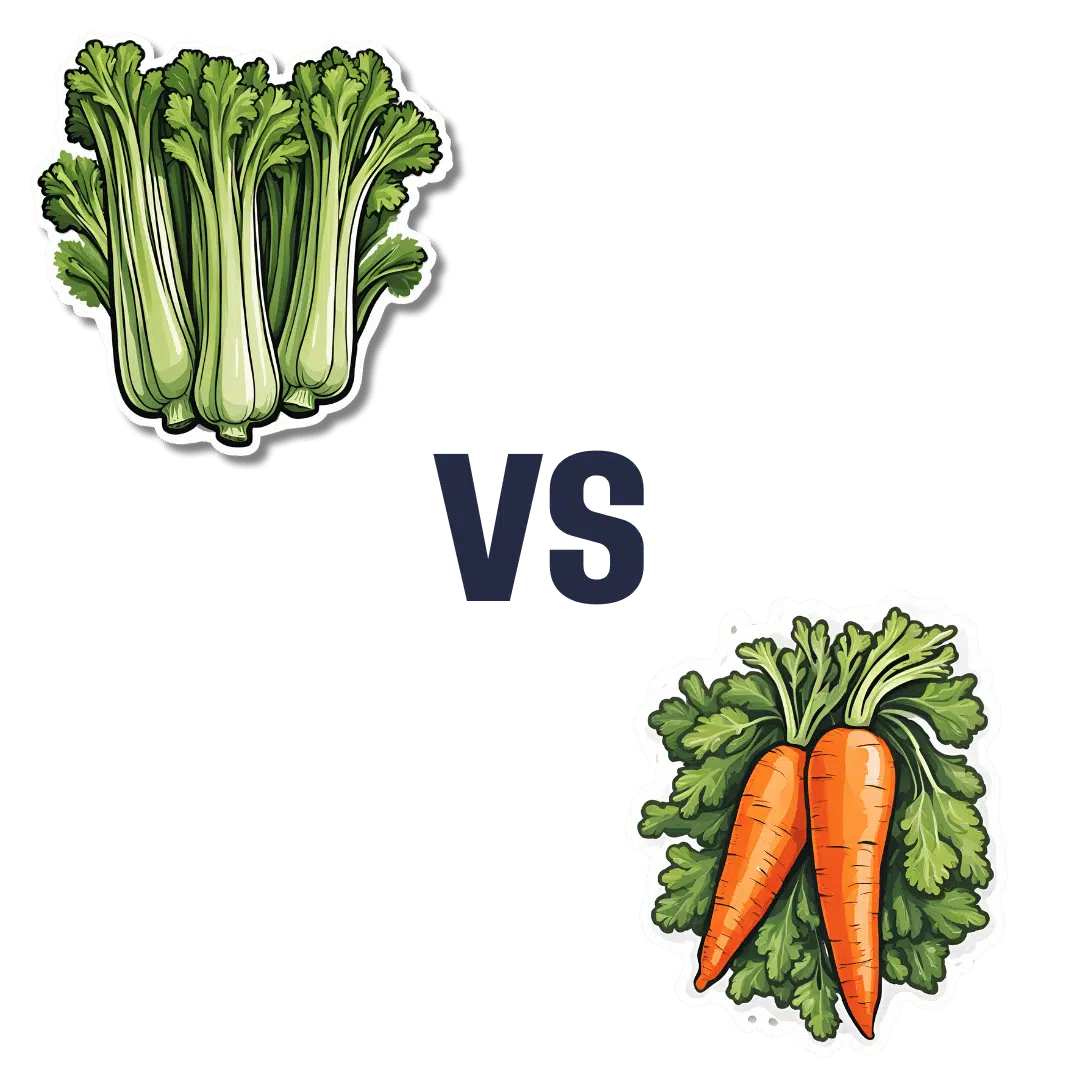
Celery vs Carrot – Which is Healthier?
10almonds is reader-supported. We may, at no cost to you, receive a portion of sales if you purchase a product through a link in this article.
Our Verdict
When comparing celery to carrot, we picked the carrot.
Why?
In terms of macros, carrot has more protein, carbs, and fiber, and is thus the “most food per food” option. The carb:fiber ratio is such that they have about the same glycemic index (when raw, anyway).
In the category of vitamins, celery has more of vitamins B9 and K, while carrot has more of vitamins A, B1, B2, B3, B5, B6, C, E, and choline. An easy win for carrot here.
When it comes to minerals, celery has more calcium and selenium, while carrot has more copper, iron, magnesium, manganese, phosphorus, potassium, and zinc. Another clear win for carrot.
In short, both are very respectable foods, but carrot simply has more in it, and it’s all good.
Enjoy!
Want to learn more?
You might like to read:
Level-Up Your Fiber Intake! (Without Difficulty Or Discomfort)
Take care!
Don’t Forget…
Did you arrive here from our newsletter? Don’t forget to return to the email to continue learning!
Recommended
Learn to Age Gracefully
Join the 98k+ American women taking control of their health & aging with our 100% free (and fun!) daily emails:
-
Chestnuts vs Dates – Which is Healthier?
10almonds is reader-supported. We may, at no cost to you, receive a portion of sales if you purchase a product through a link in this article.
Our Verdict
When comparing chestnuts to dates, we picked the chestnuts.
Why?
Both are great! But…
In terms of macros, they are comparable for fiber and protein while dates have more carbs, giving dates the higher glycemic index, thus generally making chestnuts the better option in this category.
In the category of vitamins, chestnuts have more of vitamins A, B1, B3, B6, B9, and C, while dates have more of vitamins B3 and B5, giving chestnuts a 6:2 win in this round.
Looking at minerals, chestnuts have more calcium, copper, iron, magnesium, manganese, phosphorus, potassium, and selenium, while dates have (slightly) more zinc, thus yielding a 7:1 victory to chestnuts here.
In other considerations, they’re both good for polyphenols, but chestnuts have more, with an entire 1g/100g of ellagic acid and gallic acid, which is a huge number rarely seen in such measurements.
Adding up the sections makes for a clear overall win for chestnuts, but by all means do enjoy either or both, as diversity is great, unless you have a nut allergy, in which case, please do stick to the dates on this one!
Want to learn more?
You might like:
21 Most Beneficial Polyphenols & What Foods Have Them
Enjoy!
Share This Post
-
True Age – by Dr. Morgan Levine
10almonds is reader-supported. We may, at no cost to you, receive a portion of sales if you purchase a product through a link in this article.
Yesterday’s book review (Counterclockwise) was about psychological factors affecting physical aging (progression or reversal thereof); today we have a book about the physiological factors affecting physical aging (progression or reversal thereof).
Dr. Levine is first and foremost a gerontological epigeneticist, and a lot of this book touches on her research in that field and that of her colleagues.
She does also discuss direct environmental factors also though, and—as you might well expect—lifestyle factors.
Regular readers of 10almonds are unlikely to gain anything new in the category of lifestyle matters, but a lot of the other material will be enlightening, especially with regard to the things that might at first glance seem set in stone, but we can in fact modify, and thus “choose our own adventure” when it comes to how the rest of our life plays out, healthwise (so: choose wisely!).
The book is mostly an overview on the (at time of writing: 2022) current state of affairs in the world of longevity research, and although it’s not a “how to” manual, there is plenty in the category of practical takeaways to be gleaned too.
The style is is mostly light pop science, but with a lot of hard science woven in—she is a good explainer, and has clearly made a notable effort to explain complex concepts in simple ways, while still delivering the complex concepts too (i.e. not overly “dumbing down”).
Bottom line: if you’d like to know about what can be done to increase your healthspan and general longevity, this book has a lot of answers!
Click here to check out True Age, and shift yours in the direction you prefer!
Share This Post
-
White Noise vs Pink Noise
10almonds is reader-supported. We may, at no cost to you, receive a portion of sales if you purchase a product through a link in this article.
It’s Q&A Day at 10almonds!
Have a question or a request? You can always hit “reply” to any of our emails, or use the feedback widget at the bottom!
In cases where we’ve already covered something, we might link to what we wrote before, but will always be happy to revisit any of our topics again in the future too—there’s always more to say!
As ever: if the question/request can be answered briefly, we’ll do it here in our Q&A Thursday edition. If not, we’ll make a main feature of it shortly afterwards!
So, no question/request too big or small
❝I live in a large city and even late at night there is always a bit of background noise. While I am pretty used to it by now, I find I don’t sleep nearly as well in the city as I do in the country. I have seen some stuff about “white noise” generators. I was wondering whether you have any thoughts about the science behind these, and whether it is something I should try out – or maybe I should be trying something completly different.❞
The science says…
❝Our data show that white noise significantly improved sleep based on subjective and objective measurements in subjects complaining of difficulty sleeping due to high levels of environmental noise. This suggests that the application of white noise may be an effective tool in helping to improve sleep in those settings.❞
That said, you might also consider “pink noise”, which is very similar to white noise (having all frequencies normally audible to the human ear), but has greater intensity of lower frequencies, creating a more deep and even sound. While white noise and pink noise are both great at “muting” external sounds like those that have been disturbing your sleep, pink noise may have an advantage in helping to stimulate deep and restful sleep:
❝This study demonstrates that steady pink noise has significant effect on reducing brain wave complexity and inducing more stable sleep time to improve sleep quality of individuals.❞
Source: Pink noise: effect on complexity synchronization of brain activity and sleep consolidation
There may be extra benefits to pink noise, too:
Acoustic Enhancement of Sleep Slow Oscillations and Concomitant Memory Improvement in Older Adults
Rest well!
Share This Post
Related Posts
-
Why Your Weight Loss Journey Keeps Failing
10almonds is reader-supported. We may, at no cost to you, receive a portion of sales if you purchase a product through a link in this article.
A bleak title, but troubleshooting is important to progress. Here’s how, per personal trainer Elisi Wolf::
Intentional eating, sensible training
Here’s what she found during her own journey:
- You’re likely eating more than you think: people often underestimate their calorie intake—snacks like pretzels add up quickly, and what feels like a deficit might actually be a surplus depending on your metabolism and needs.
- You’re not eating the right amount of protein: many eat too little or too much, leading to burnout or bingeing; neither are helpful. Calculate your needs, and then plan around getting that amount each day.
- Burnout happens when you go too hard too fast: using early motivation to overly restrict or overtrain leads to quitting; ease into changes gradually, and make things sustainable.
- Cardio is not an effective weight-loss tool: it’s often overestimated for fat loss; strength training and diet have a bigger impact, because muscle increases your resting calorie burn.
- Make your meals enjoyable: fitting tasty meals into your plan helps you stick with it. Find recipes you love that meet your nutritional needs!
- You might be being too hard on yourself: weight loss is a journey, and going easier while staying committed leads to better long-term success than beating yourself up over having had a little bread you didn’t plan for.
For more on all of this, enjoy:
Click Here If The Embedded Video Doesn’t Load Automatically!
Want to learn more?
You might also like:
Hit A Weight Loss Plateau? Here’s What To Do
Take care!
Don’t Forget…
Did you arrive here from our newsletter? Don’t forget to return to the email to continue learning!
Learn to Age Gracefully
Join the 98k+ American women taking control of their health & aging with our 100% free (and fun!) daily emails:
-
Are You Getting The Right Kinds Of Flavonoids?
10almonds is reader-supported. We may, at no cost to you, receive a portion of sales if you purchase a product through a link in this article.
First, a quick note on terms:
- Polyphenol: often simplified to “beneficial phytochemical”, but that’s misleading as there are many beneficial phytochemicals (naturally-occurring chemicals in plants) that do not meet the definition of “polyphenol”, which is very specifically: a compound containing more than one phenolic hydroxyl group
- Flavonoid: a class of polyphenolic secondary metabolites found in many plants, named for its association with yellow pigment (although the end result in appearance might not be yellow, depending on what else is present, but it’s present in the mix biochemically!). Flavonoids can also be further subcategorized into:
- Anthocyanidins
- Anthoxanthins
- Flavanones
- Flavanonols
- Flavans
- Isoflavonoids
- Flavonoid: a class of polyphenolic secondary metabolites found in many plants, named for its association with yellow pigment (although the end result in appearance might not be yellow, depending on what else is present, but it’s present in the mix biochemically!). Flavonoids can also be further subcategorized into:
…which can each be subcategorized further, but if we continue expanding the tree of possibilities each time, this page is going to get very long, so we’ll call it sufficient there for now!
However, this subcategorization isn’t only important to biologists who get excited about taxonomy; it has important health implications too.
For example, let’s remember when we wrote about how you can Fight Inflammation & Protect Your Brain, With Quercetin ← Quercetin is a flavonol (which, in turn, is a kind of anthoxanthin)!
Well, not really!
By this we mean it’s not one flavonol, but rather a stack of flavonols in a trenchcoat, and by “trenchcoat” we mean a vegetable or something.
In fact, in today’s “This or That” article, we mentioned that one of the items compared has “more polyphenols (most notably a wide range of flavonoids including multiple anthocyanins, luteolin, and 6 different kinds of quercetin)”. Because we’ve a little more room here and we’re writing about flavonoids, we’ll mention that the data we were looking at, looked like this:
- Flavonoids
- Anthocyanins
- Cyanidin 3-O-(6”-malonyl-glucoside)
- Cyanidin 3-O-glucoside
- Flavones
- Luteolin 7-O-glucuronide
- Flavonols
- Quercetin 3-O-(6″-malonyl-glucoside)
- Quercetin 3-O-(6″-malonyl-glucoside) 7-O-glucoside
- Quercetin 3-O-galactoside
- Quercetin 3-O-glucoside
- Quercetin 3-O-glucuronide
- Quercetin 3-O-rhamnoside
- Anthocyanins
…along with a lot of additional data that we won’t bore you with here, pertaining to mg/100g values, minimums and maximums, standard deviations, studies done, etc. The data table fills the screen and more.
So you see, even following the tree of possibilities down as far as quercetin yields 9 flavonoids including 6 kinds of quercetin present in that plant alone, and that’s a fairly modest list.
Why this matters for your health
Scientists (Dr. Alysha Thompson et al.) examined an uncontroversial topic, the connection between flavonoid intake and good health.
What was a little different from the norm, though, was that the study looked beyond flavonoid quantity, to also look at diversity of flavonoids.
They found that people who consumed a greater variety of flavonoids had much lower risks of death and major chronic diseases, independent of total quantity consumed.
This was a big (n=124,805) study, looking at UK adults aged 40+: participants were mostly women (56%), with 60% overweight or obese and 25% hypertensive.
Shocking nobody in this British population study, 67% of the total flavonoid consumption came from tea.
Which is a problem. Not because there’s anything wrong with tea (it’s a very healthful drink), but rather because very many people had it as their primary source of flavonoids, which isn’t very diverse; indeed, flavan-3-ols (mostly found in tea) made up 87% of total flavonoid intake.
Quantity vs Diversity
People who consumed the largest amounts of flavonoids (mostly from tea) often consumed the least diverse flavonoids (i.e. fewest kinds).
Which made the results all the starker, since those consuming a wider range of flavonoids got more from beneficial compounds like anthocyanins, flavanones, and proanthocyanidins—rather than just thearubigins from tea.
Notably, the people who did get more diversity of flavonoids tended to be healthier overall; they were also (as a matter of demographic information, since it’s there in the paper) more likely to be female, older, leaner, more physically active, better educated, and less likely to smoke.
This means that while previous recommendations focused on quantity (e.g. 400–600 mg/day of flavan-3-ols), this study suggests expanding to include as many different sources of flavonoids as reasonably possible.
In particular, the researches found that top-scorers for diversity of flavonoids includes berries, apples, citrus fruits, so they’re best enjoyed alongside black and green teas (which are very good), and yes, even some dark chocolate if you like.
Note that written like that, it looks like 6 different sources. But for example, how many different kinds of flavonoid does a blueberry contain?
Well, we can’t give an exhaustive list because each one has to be tested for individually, but we can say that a partial list of different kinds of flavonoids contained in a blueberry looks like this:
- Cyanidin 3-O-(6”-acetyl-galactoside)
- Cyanidin 3-O-(6”-acetyl-glucoside)
- Cyanidin 3-O-arabinoside
- Cyanidin 3-O-galactoside
- Cyanidin 3-O-glucoside
- Delphinidin 3-O-(6”-acetyl-galactoside)
- Delphinidin 3-O-(6”-acetyl-glucoside)
- Delphinidin 3-O-arabinoside
- Delphinidin 3-O-galactoside
- Delphinidin 3-O-glucoside
- Malvidin 3-O-(6”-acetyl-galactoside)
- Malvidin 3-O-(6”-acetyl-glucoside)
- Malvidin 3-O-arabinoside
- Malvidin 3-O-galactoside
- Malvidin 3-O-glucoside
- Peonidin 3-O-(6”-acetyl-galactoside)
- Peonidin 3-O-(6”-acetyl-glucoside)
- Peonidin 3-O-arabinoside
- Peonidin 3-O-galactoside
- Peonidin 3-O-glucoside
- Petunidin 3-O-(6”-acetyl-galactoside)
- Petunidin 3-O-(6”-acetyl-glucoside)
- Petunidin 3-O-arabinoside
- Petunidin 3-O-galactoside
- Petunidin 3-O-glucoside
- (-)-Epicatechin
- Kaempferol 3-O-glucoside
- Myricetin 3-O-arabinoside
- Myricetin 3-O-rhamnoside
- Quercetin 3-O-acetyl-rhamnoside
- Quercetin 3-O-arabinoside
- Quercetin 3-O-galactoside
- Quercetin 3-O-glucoside
- Quercetin 3-O-xyloside
And there are plenty of other polyphenols in a blueberry too; that’s just the flavonoids, and not even an exhaustive list of those!
So, all this to say, diversity can be found easily, if you know where to look 😎
You can read the paper in full, here: High diversity of dietary flavonoid intake is associated with a lower risk of all-cause mortality and major chronic diseases
In summary…
The trick to getting the most health benefits out of flavonoids is not focusing on total quantity, but on diversity.
Want to learn more?
Check out:
- 21 Most Beneficial Polyphenols & What Foods Have Them ← including 9 different first-order categories of flavonoid, e.g. quercetin, kaempferol, etc, along with links to wherever we’ve done spotlight main features on each of them
- Which Tea Is Best, By Science? ← we compare and contrast the phytochemical properties of black, white, green, and red teas.
- Enjoy Bitter Foods For Your Heart & Brain ← it’s about the polyphenols, of which, mostly flavonoids, phenolic acids, and tannins
- And of course, for polyphenol diversity and more: What’s Your Plant Diversity Score?
Alternatively, for a middle-ground approach of targeting 16 most polyphenol delivering foods, see this super-dense arrangement:
Mediterranean Diet… In A Pill? ← it’s about plant extracts from 16 specific foods, and the polyphenols they deliver
Enjoy!
Don’t Forget…
Did you arrive here from our newsletter? Don’t forget to return to the email to continue learning!
Learn to Age Gracefully
Join the 98k+ American women taking control of their health & aging with our 100% free (and fun!) daily emails:
- Polyphenol: often simplified to “beneficial phytochemical”, but that’s misleading as there are many beneficial phytochemicals (naturally-occurring chemicals in plants) that do not meet the definition of “polyphenol”, which is very specifically: a compound containing more than one phenolic hydroxyl group
-
Want straighter teeth or a gap between? Don’t believe TikTok – filing them isn’t the answer
10almonds is reader-supported. We may, at no cost to you, receive a portion of sales if you purchase a product through a link in this article.
After decades of Hollywood showcasing white-picket-fence celebrity smiles, the world has fallen for White Lotus actor Aimee Lou Wood’s teeth.
Wood was bullied for her looks in her youth and expressed gratitude for the positive comments she received about her teeth since appearing on White Lotus. She also joked that people shouldn’t take to drastic measures like filing teeth to copy her famous gap.
But social media influencers are promising that teeth filing is a quick way to achieve a straight smile. Some influencers even use electric nail drills to cut gaps between their front teeth.
A few of my patients admit to taking a nail file to “buff” or file jagged edges off their teeth. Many do this without understanding what they are cutting away.
Here’s why you should think twice about filing your teeth at home, and why we as dentists or orthodontists occasionally resort to this.
When might a dentist file a tooth?
Dentists and orthodontists occasionally file a tooth’s enamel, known as enameloplasty, to conservatively smooth-down a chipped tooth, or even-out a smile.
But adjustments to a person’s smile are minute, and always limited to the superficial enamel layer of the tooth.
Why don’t dentists routinely file teeth?
Dentists and orthodontists are particular about what and when we cut because teeth don’t grow back like fingernails or hair.
So what is a tooth? A tooth is like an egg, with an outer diamond-like lustrous crystal enamel coat that envelops the hard yet springy dentine.
The enamel and dentine envelop a central chamber – containing blood vessels, cells and nerves – called the pulp.
The outer periphery of the pulp is surrounded by and nourishes special dentine-making cells called odontoblasts.
The odontoblasts are similar to our bone-making cells but don’t have the capacity to regenerate. These cells eventually give way to age-related changes or trauma.
Our enamel-making cells die when our teeth cut through our gums as children, which means we can no longer make new, or repair damaged, enamel.
So damaged enamel or dentine on the outer surface of the tooth cannot self-repair.
Cutting your teeth without sealing and filling them can leave the tooth exposed, destroying the previously well-insulated pulp and causing sensitivity and pain.
Infections can occur because the bacteria from the plaque inside your mouth travels into the tooth and inflames the pulp.
And just like a cut on your skin, the pulp inflames and swells as part of the healing process. But your pulp is encased in a hard enamel-dentine chamber, so it has no room to expand and swell, leading to a throbbing toothache.
What can you do if you want to change your teeth?
You can change your smile without compromising the integrity of your teeth. Dentists can even create or close gaps.
And we will always offer conservative options, including “no treatment”, to keep as many of your teeth whole and healthy as possible.
Sometimes, your dentists and or orthodontists may offer options to:
- use braces to move teeth. Moving teeth can create a different smile, and sometimes change the shape and position of your jaws, lips and cheeks
- whiten teeth to remove superficial stains to make your smile look more visually even
- adapt white resin fillings or veneers to add and change the shape of teeth, with little or no tooth cutting required.
If you’re concerned about the look of your teeth, talk to your dentist or orthodontist about options that won’t damage your teeth and make them last the distance.
Don’t forget that Aimee Lou Wood’s iconic smile makes her stand out from the crowd. Your smile is what makes you special, and is part of who you are.
Arosha Weerakoon, Senior Lecturer and General Dentist, School of Dentistry, The University of Queensland
This article is republished from The Conversation under a Creative Commons license. Read the original article.
Don’t Forget…
Did you arrive here from our newsletter? Don’t forget to return to the email to continue learning!
Learn to Age Gracefully
Join the 98k+ American women taking control of their health & aging with our 100% free (and fun!) daily emails:


