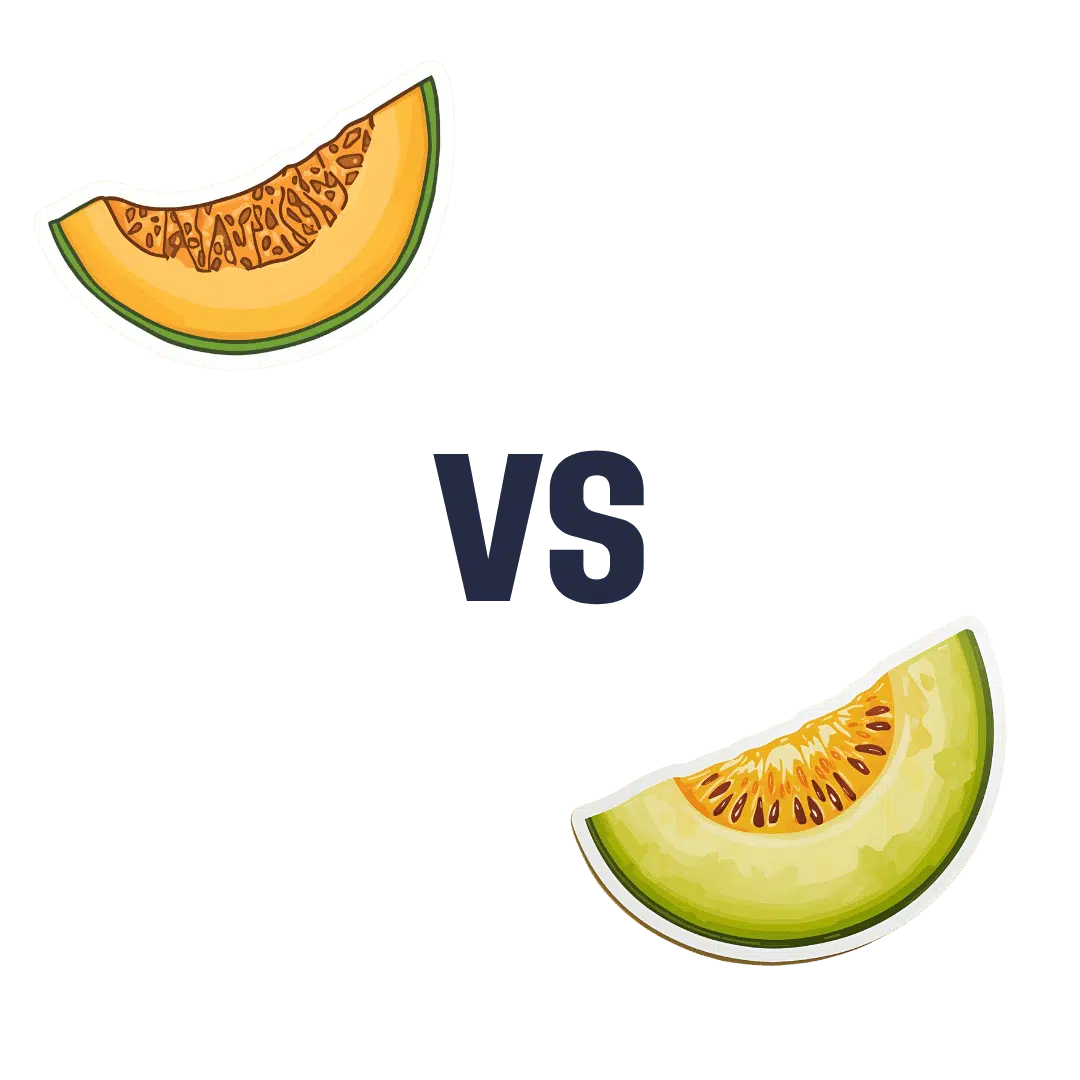
Cantaloupe vs Honeydew – Which is Healthier?

10almonds is reader-supported. We may, at no cost to you, receive a portion of sales if you purchase a product through a link in this article.

Our Verdict

When comparing cantaloupe to honeydew, we picked the cantaloupe.

Why?

In terms of macros, there’s not a lot between them—they’re both mostly water. Nominally, cantaloupe has more fiber and protein, while honeydew has more carbs, but the differences are very small. So, a very slight win for cantaloupe.

Looking at vitamins, cantaloupe has a more of vitamins A, B1, B2, B3, C, and E (especially notably 67x more vitamin A, whence its color), while honeydew has slightly more of vitamins B5 and B6 (so, the vitamins that are in pretty much everything). A much more convincing win for cantaloupe in this round!

The minerals category is even more polarized: cantaloupe has more calcium, copper, iron, magnesium, manganese, phosphorus, potassium, and zinc, while honeydew has more selenium (and for what it’s worth, more sodium too, though that’s not usually a plus for most of us in the industrialized world). An overwhelming victory for cantaloupe here.

Adding up the sections makes for a clear overall win for cantaloupe, but by all means enjoy either or both, as diversity is good!

Want to learn more?

You might like:

Some Surprising Truths About Hunger And Satiety ← our main feature in which we examine the science of volumetrics, including a study that shows how water that is part of a food (but not served with a food) decreases caloric intake.

Enjoy!

Don’t Forget…

Did you arrive here from our newsletter? Don’t forget to return to the email to continue learning!

Learn to Age Gracefully

Join the 98k+ American women taking control of their health & aging with our 100% free (and fun!) daily emails:

  • The Keys to Good Mental Wellbeing

    10almonds is reader-supported. We may, at no cost to you, receive a portion of sales if you purchase a product through a link in this article.

    The Nine Keys To Good Mental Wellbeing

    Today’s main feature is a bit “pop psychology”, but it has its underpinnings in actual psychology, and is especially useful if approached from that angle.

    What it’s most popularly enjoyed as:

    • A personality-typing system.
    • People love little quizzes and identifiers and such.

    What it’s actually really useful as:

    • A tool for understanding why people (including ourselves) are the way we are
    • A foundational knowledge for living better ourselves, and helping others too

    This stems from the fairly simple principle, uncontroversial in psychology:

    • We have needs, desires, and aversions
    • We act in a way that tries to get our needs met and avoid suffering
    • Thus: Need/Fear → Motivation → Action

    The Enneagram

    The Enneagram (ἐννέα = “nine” in Ancient Greek) system posits that we each have one fundamental need/fear (from a list of nine) that’s strongest for us. A deep-seated insecurity/longing, that we’ll go to almost any lengths to try to meet. Sometimes, in good ways, sometimes, bad.

    The Nine Basic Fears/Insecurities, And Their Corresponding Needs/Desires:

    1. Fear of being a fundamentally bad, wrong person / Need to be good and correct
    2. Fear of being fundamentally unloveable / Need to be loved
    3. Fear of being fundamentally worthless / Need to be valued
    4. Fear of being like everyone else / Need to be different
    5. Fear of being useless / Need to be useful
    6. Fear of being outcast / Need to have a set place in the group
    7. Fear of missing out / Need to experience things
    8. Fear of being hurt or controlled / Need to be in control
    9. Fear of conflict / Need to be at peace

    Of course, most of us have most of these fears/needs to some extent, though usually one will stand out—especially if we aren’t managing it well. The less healthy our coping mechanisms, the more obvious it is how we’re trying to overcompensate in some fashion. For example:

    1. A person who fears being wrong and so becomes a perfectionist rules-abider to a fault
    2. A person who fears being unloveable, and so exaggerates problems to get pity, as the next best thing
    3. A person who fears being worthless, and so exaggerates their accomplishments in order to be admired and valued
    4. A person who fears being like everyone else, and so descends into a “nobody could ever possibly understand me” black hole of pathos.
    5. A person who fears being useless, so burns themself out trying to be an omnicompetent Leonardo da Vinci without ever actually taking the time to stop and smell the flowers as Leonardo did.
    6. A person who fears being outcast, so becomes clingy, passive-aggressive, and suspicious
    7. A person who fears missing out, so tries to experience all the things all the time, ruining their health with dizzying highs and crushing lows.
    8. A person who fears being hurt or controlled, so becomes aggressive and domineering
    9. A person who fears conflict, so shuts down at the slightest hint of it

    If we have healthier coping mechanisms, these same nine people can look a lot different, but in much more subtle ways because we’re not trying to overcompensate so badly:

    1. A person who lives their life rationally by principles that can be adapted as they learn
    2. A person who loves and is loved, as perhaps the most notable part of their character
    3. A person who sets reasonable goals and accomplishes them, and seeks to uplift others
    4. A person who creates and innovates, enriching their own life and the lives of others
    5. A person who is simply very competent and knowledgeable, without overstretching
    6. A person who is dependable and loyal, and a reliable part of something bigger than themself
    7. A person who is fun to be around and loves trying new things, while also knowing how to relax
    8. A person who develops their leadership skills and is a tower of strength for others
    9. A person who knows how to make peace and does so—by themself, and with others

    By being aware of our own fears/insecurities that may drive our motivations and thus underpin our behaviors, we can usually manage them in a much more mindful fashion. Same goes when it comes to managing interactions with other people, too:

    • Letting the Type 3 know you value them, not their accomplishments or what they can do for you.
    • Appreciating the Type 5’s (varied or specialist) skills and knowledge.
    • Giving love to a Type 2 unprompted, but on your own terms, with your own boundaries.
    • And so on for other types

    Or for yourself…

    • As a Type 8, remembering that you can let go sometimes and let someone else be in charge.
    • As a Type 1, catching yourself holding yourself (or others) to impossible standards, and then easing up on that a little.
    • As a Type 9, remembering to stand up for yourself and others, however gently, but firmly.
    • And so on for other types

    If you’re unsure what to focus on, ask yourself: what’s your worst nightmare or greatest daydream? Then work out what it is about that, that makes it feel so bad or good.

    Then, approach things mindfully. Catch yourself in your unhealthy coping mechanisms, and find healthy ones instead.

    What if I get my type wrong? Or I get someone else’s type wrong?

    Obviously it’s better to get them right for maximum effect, but you can never go too far wrong anyway… because we all have all nine of those qualities in us, it’s just a matter of how strong a factor each is for us. So in the worst case scenario, you’ll make someone feel more secure about something that was only a very minor insecurity for them, for example.

    Or in the case of your own type, you may mistakenly think you’re acing being the world’s healthiest Type 5, until you realize you’re actually a Type 3 who thought learning all those things would make you more worthy (spoiler: those things are great, but you’re worthy already). Again, not the end of the world! No matter what, you’re learning and growing, and that’s good.

    Want to delve further?

    Read: The Nine Enneagram Type Descriptions (Basic, but more detailed descriptions than the above)

    Read: How The Enneagram System Works (More complex. Now we’re getting into the more arcane stuff we didn’t have time for today—wings and lines, triads, health levels, directions of integration and disintegration, and more)

    Like learning from books? Here are our top two picks, depending on your learning style:

    We’d love to offer a quick free test here, but all the tests we could find either require paid registration or are wildly inaccurate, so we’ll not waste your time.

    However, we do also think that working it out for yourself is better, as it means you have a handle on what those ideas, fears, insecurities, desires, needs, really mean to you—that way you can actually use the information!

    We’ll close by repeating our previous advice: If you’re unsure what to focus on, ask yourself: what’s your worst nightmare or greatest daydream? Then work out what it is about those scenarios that make them so bad or good. That’ll help you find your real fears/needs, such that you can work on them.

    Good luck!

    Share This Post

  • Why does squishing NeeDoh, slime, or putty feel so satisfying?

    10almonds is reader-supported. We may, at no cost to you, receive a portion of sales if you purchase a product through a link in this article.

    NeeDoh is the latest squishy sensory toy to go viral. Social media is reporting how these blobs of gel are flying off the shelves, and are in short supply.

    But squishy sensory toys have been around much longer than this latest fad. You might remember putty, slime or stress balls.

    So why are these products so popular? And when are sensory objects more than just toys?

    Instagram

    What are these products?

    NeeDoh is one of many stress-ball-esque, pliable, squeezable products.

    They’re mainly made from a type of rubber or polymer. And their composition affects their consistency, pliability, texture and ability to form shapes.

    For instance, they can be soft, stretchy and oozy while still being able to hold a shape. Some form into a ball and can bounce.

    Often, the products are said to be non-toxic, durable and satisfying to squeeze repeatedly.

    Why do people like them?

    People find such products appealing for a number of reasons. This might depend on their personal preference, sensory sensitivity among neurodivergent people, energy levels, or a combination. They might:

    • enjoy the tactile experience
    • find it makes them feel calm
    • allows them to focus more easily
    • use these products to avoid other behaviours, such as nail biting.

    Neuroscience helps explain some of this.

    Brain regions associated with planning and emotional regulation are activated when adults squeeze a soft or medium density stress ball. This might explain why some people can feel calm or say they can focus on a task more easily.

    The brain also wants fingers and hands to fidget and tinker, even when doing sedentary activities like reading. So rather than using hands for less accepted behaviours, such as skin picking or nail biting, they can be used to squish these objects. It can be comforting when we see others fidgeting too as it makes it more socially acceptable.

    But not everyone likes how these squishable objects make them feel. Others find the sensation unpleasant or even painful.

    We have neural circuits in our body and brain responsible for perceiving and processing incoming sensory information from the world around us, such as light, sound, pressure and temperature.

    These circuits form a loop between our brain and body to work out if we find these sensations pleasant or unpleasant. If there is too much sensory input at one time, we can even find these sensations painful.

    The serious side of sensory products

    Sensory objects are more than a marketing gimmick. They are increasingly used in schools, but with mixed results.

    There have been no formal studies on the educational benefits of NeeDoh. However, we can look at studies on fidget tools, such as fidget spinners or fidget cubes, in the classroom.

    Some studies in primary school-age children show fidget tools increase on-task behaviour, decrease hyperactivity movements for children with ADHD (attention-deficit hyperactivity disorder). However, the results differ based on the type of fidget tool. There’s also limited evidence to show these tools help students accurately complete school work, such as answering a maths question.

    Different children may also benefit from different types of fidget tool, depending on their needs and how stimulating their environment is. So it’s best to consult a health-care professional who will usually recommend a specific tool for a specific therapeutic purpose.

    For instance, a wobble stool may be recommended to reduce hyperactive movement for one child or to increase movement and energy levels for a different child.

    But the real benefit from the increased use of sensory objects in classrooms is this can increase acceptance of neurodivergence and make it more acceptable for those who once felt they had to mask their use.

    Sensory tools are also being trialled in higher education. Our first-year students at Bond University set up “sensory toolboxes” to help the on-campus experience for neurodivergent students.

    These boxes included items in a variety of textures and pliability. Items were “no sound” to reduce noise reverberation, which some people find unpleasant. Items included those that were smooth, bendy, stretchy, tactile and squishy. NeeDoh cubes were the most popular.

    But these items weren’t only popular with students. Some educators said they also enjoyed the sensory stimulation of holding items from the box as they taught classes.

    In a nutshell

    If you enjoy their texture, and how they make you feel, there’s no harm in using squishable objects like NeeDoh.

    These remind us that people experience textures and use their hands in different ways, and for different reasons.

    But if you or your child want to use sensory tools therapeutically, check in with a health professional and your child’s inclusive-education teacher to match you with the right type. This may not be a squishable one.

    Susan Rowe, Associate Professor in Clinical Psychology, Bond University; Amy L. Kenworthy, Professor of Management, Bond University, and Daniel Brennan, Assistant Professor, Transformation CoLab, Bond University

    This article is republished from The Conversation under a Creative Commons license. Read the original article.

    Share This Post

  • How Not To Get Sick: A Cookbook – by Dr. Benjamin Bikman and Diana Keuilian

    10almonds is reader-supported. We may, at no cost to you, receive a portion of sales if you purchase a product through a link in this article.

    We’ve previously reviewed Dr. Bikman’s excellent “Why We Get Sick”, and if you haven’t read that yet, we recommend doing so.

    Nevertheless, you don’t need to have read it to benefit from this one, which is about cooking with those learnings (from the other book) in mind.

    Before getting to the recipes, we get a section recapping what we learned previously, as well as adding some more general lifestyle advices beyond the kitchen. The science is also expanded a bit, to include such things as the two-way relationship between insulin and aging, as well as the interplay with other metrics of health, including blood lipids, for example.

    The authors then provide a plan, in the three stages: reverse (insulin resistance), prevent (insulin resistance), maintain (insulin sensitivity).

    The recipes themselves, of which there are 70, are of course tailored to do the above three things; they’re also quite diverse, albeit if you are vegetarian or vegan, you should know in advance that most of these recipes are not.

    Bottom line: if the above doesn’t apply to you, and you would like to improve your insulin sensitivity, this book can indeed help.

    Click here to check out How Not To Get Sick, and stay well!

    Share This Post

  • Two Things You Can Do To Improve Stroke Survival Chances

    10almonds is reader-supported. We may, at no cost to you, receive a portion of sales if you purchase a product through a link in this article.

    Dr. Andrew’s Stroke Survival Guide

    This is Dr. Nadine Andrew. She’s a Senior Research Fellow in the Department of Medicine at Monash University. She’s the Research Data Lead for the National Center of Healthy Aging. She is lead investigator on the NHMRC-funded PRECISE project… The most comprehensive stroke data linkage study to date! In short, she knows her stuff.

    We’ve talked before about how sample size is important when it comes to scientific studies. It’s frustrating; sometimes we see what looks like a great study until we notice it has a sample size of 17 or something.

    Dr. Andrew didn’t mess around in this regard, and the 12,386 participants in her Australian study of stroke patients provided a huge amount of data!

    With a 95% confidence interval because of the huge dataset, she found that there was one factor that reduced mortality by 26%.

    And the difference was…

    Whether or not patients had a chronic disease management plan set up with their GP (General Practitioner, or “family doctor”, in US terms), after their initial stroke treatment.

    45% of patients had this; the other 55% did not, so again the sample size was big for both groups.

    Why this is important:

    After a stroke, often a patient is discharged as early as it seems safe to do so, and there’s a common view that “it just takes time” and “now we wait”. After all, no medical technology we currently have can outright repair that damage—the body must repair itself! Medications—while critical*—can only support that and help avoid recurrence.

    *How critical? VERY critical. Critical critical. Dr. Andrew found, some years previously, that greater levels of medication adherence (ie, taking the correct dose on time and not missing any) significantly improved survival outcomes. No surprise, right? But what may surprise is that this held true even for patients with near-perfect adherence. In other words: miss a dose at your peril. It’s that important.

    But, as Dr. Andrew’s critical research shows, that’s no reason to simply prescribe ongoing meds and otherwise cut a patient loose… or, if you or a loved one are the patient, to allow yourself/them to be left without a doctor’s ongoing active support in the form of a chronic disease management plan.

    What does a chronic disease management plan look like?

    First, what it’s not:

    • “Yes yes, I’m here if you need me, just make an appointment if something changes”
    • “Let’s pencil in a check-up in three months”
    • Etc

    What it actually looks like:

    It looks like a plan. A personal care plan, built around that person’s individual needs, risks, liabilities… and potential complications.

    Because who amongst us, especially at the age where strokes are more likely, has an uncomplicated medical record? There will always be comorbidities and confounding factors, so a one-size-fits-all plan will not do.

    Dr. Andrew’s work took place in Australia, so she had the Australian healthcare system in mind… We know many of our subscribers are from North America and other places. But read this, and you’ll see how this could go just as much for the US or Canada:

    ❝The evidence shows the importance of Medicare financially supporting primary care physicians to provide structured chronic disease management after a stroke.

    We also provide a strong case for the ongoing provision of these plans within a universal healthcare system. Strategies to improve uptake at the GP level could include greater financial incentives and mandates, education for patients and healthcare professionals.❞

    See her groundbreaking study for yourself here!

    The Bottom Line:

    If you or a loved one has a stroke, be prepared to make sure you get a chronic health management plan in place. Note that if it’s you who has the stroke, you might forget this or be unable to advocate for yourself. So, we recommend to discuss this with a partner or close friend sooner rather than later!

    “But I’m quite young and healthy and a stroke is very unlikely for me”

    Good for you! And the median age of Dr. Andrew’s gargantuan study was 70 years. But:

    • do you have older relatives? Be aware for them, too.
    • strokes can happen earlier in life too! You don’t want to be an interesting statistic.

    Some stroke-related quick facts:

    Stroke is the No. 5 cause of death and a leading cause of disability in the U.S.

    Stroke can happen to anyone—any age, any time—and everyone needs to know the warning signs.

    On average, 1.9 million brain cells die every minute that a stroke goes untreated.

    Stroke is an EMERGENCY. Call 911 immediately.

    Early treatment leads to higher survival rates and lower disability rates. Calling 911 lets first responders start treatment on someone experiencing stroke symptoms before arriving at the hospital.

    Source: https://www.stroke.org/en/about-stroke

    What are the warning signs for stroke?

    Use the letters F.A.S.T. to spot a stroke and act quickly:

    • F = Face Drooping—does one side of the face droop or is it numb? Ask the person to smile. Is the person’s smile uneven?
    • A = Arm Weakness—is one arm weak or numb? Ask the person to raise both arms. Does one arm drift downward?
    • S = Speech Difficulty—is speech slurred?
    • T = Time to call 911

    Source: https://www.stroke.org/en/about-stroke/stroke-symptoms

    Last but not least, while we’re sharing resources:

    Download the PDF Checklist: 8 Ways To Help Prevent a Second Stroke

    Don’t Forget…

    Did you arrive here from our newsletter? Don’t forget to return to the email to continue learning!

    Learn to Age Gracefully

    Join the 98k+ American women taking control of their health & aging with our 100% free (and fun!) daily emails:

  • Ozempic Helps People Walk Further

    10almonds is reader-supported. We may, at no cost to you, receive a portion of sales if you purchase a product through a link in this article.

    There’s often a catch-22 when it comes to exercise: it’s important for good health, and/but people with ill health usually cannot exercise much.

    A recent (published today, at time of writing, the 29th of March 2025, never let it be said we don’t bring you the very most up-to-date health science!) study by Dr. Neda Rasouli et al. has shown there is a possible way through that catch-22, depending on the nature of the illness.

    This study followed 792 people across 112 outpatient clinical trial sites in 20 countries in North America, Asia, and Europe, with type 2 diabetes and peripheral artery disease.

    What they found

    Patients taking semaglutide (specifically, 1mg Ozempic) enjoyed a 21% median increase in walking distance, as well as some bonus benefits, namely:

    • Weight reduction: the semaglutide group saw a greater reduction in body weight (–4.1 kg; P < 0 .0001)
    • HbA1c levels: semaglutide lowered HbA1c by 1 percentage point (P < 0.0001)
    • Blood pressure: systolic blood pressure decreased by 3.2 mmHg (P = 0.0042)

    You may be wondering what that “P =” means: it’s the probability of this occurring by random chance, on a scale from zero (impossible outcome) to 1 (unavoidable outcome).

    For example:

    “We hypothesized that singing the happy birthday song before tossing a coin would result in it landing on heads. We sang the happy birthday song and tossed the coin; it landed on heads (P = 0.5)”

    In science, generally speaking anything with a probability of under 0.05 (expressed as: “P < 0.05”) is considered a statistically significant result.

    All this to say, the cited figures of, for example, P < 0.0001, are very significant indeed.

    On which note, that 21% median increase in walking distance? P < 0.0004.

    As for side effects? Serious adverse events related to the drug occurred in 1% of the semaglutide group vs 2% in the placebo group. So, that seems quite safe indeed.

    You can find the paper itself here:

    Semaglutide and walking capacity in people with symptomatic peripheral artery disease and type 2 diabetes (STRIDE): a phase 3b, double-blind, randomised, placebo-controlled trial

    Want to learn more?

    Check out:

    Take care!

    Don’t Forget…

    Did you arrive here from our newsletter? Don’t forget to return to the email to continue learning!

    Learn to Age Gracefully

    Join the 98k+ American women taking control of their health & aging with our 100% free (and fun!) daily emails:

  • The Body Is Not an Apology – by Sonya Renee Taylor

    10almonds is reader-supported. We may, at no cost to you, receive a portion of sales if you purchase a product through a link in this article.

    First, a couple of things that this book is not about:

    1. Self-confidence (it’s about more than merely thinking highly of oneself)
    2. Self-acceptance (it’s about more than merely settling for “good enough”)

    In contrast, it’s about loving and celebrating what is, while striving for better, for oneself and for others.

    You may be wondering: whence this “radical” in the title?

    The author argues that often, the problem with our bodies is not actually our bodies. If we have cancer, or diabetes, then sure, that’s a problem with the body. But most of the time, the “problem with our bodies” is simply society’s rejection of our “imperfect” bodies as somehow “less than”, and something we must invest time and money to correct. Hence, the need for a radical uprooting of ideas, to fix the real problem.

    Bottom line: if, like most of us, you have a body that would not entirely pass for that of a Marvel Comics superhero, this is a book for you. And if you do have a MCU body? This is also a book for you, because we have bad news for you about what happens with age.

    Click here to check out The Body Is Not An Apology, and appreciate more about yours!

    Don’t Forget…

    Did you arrive here from our newsletter? Don’t forget to return to the email to continue learning!

    Learn to Age Gracefully

    Join the 98k+ American women taking control of their health & aging with our 100% free (and fun!) daily emails: