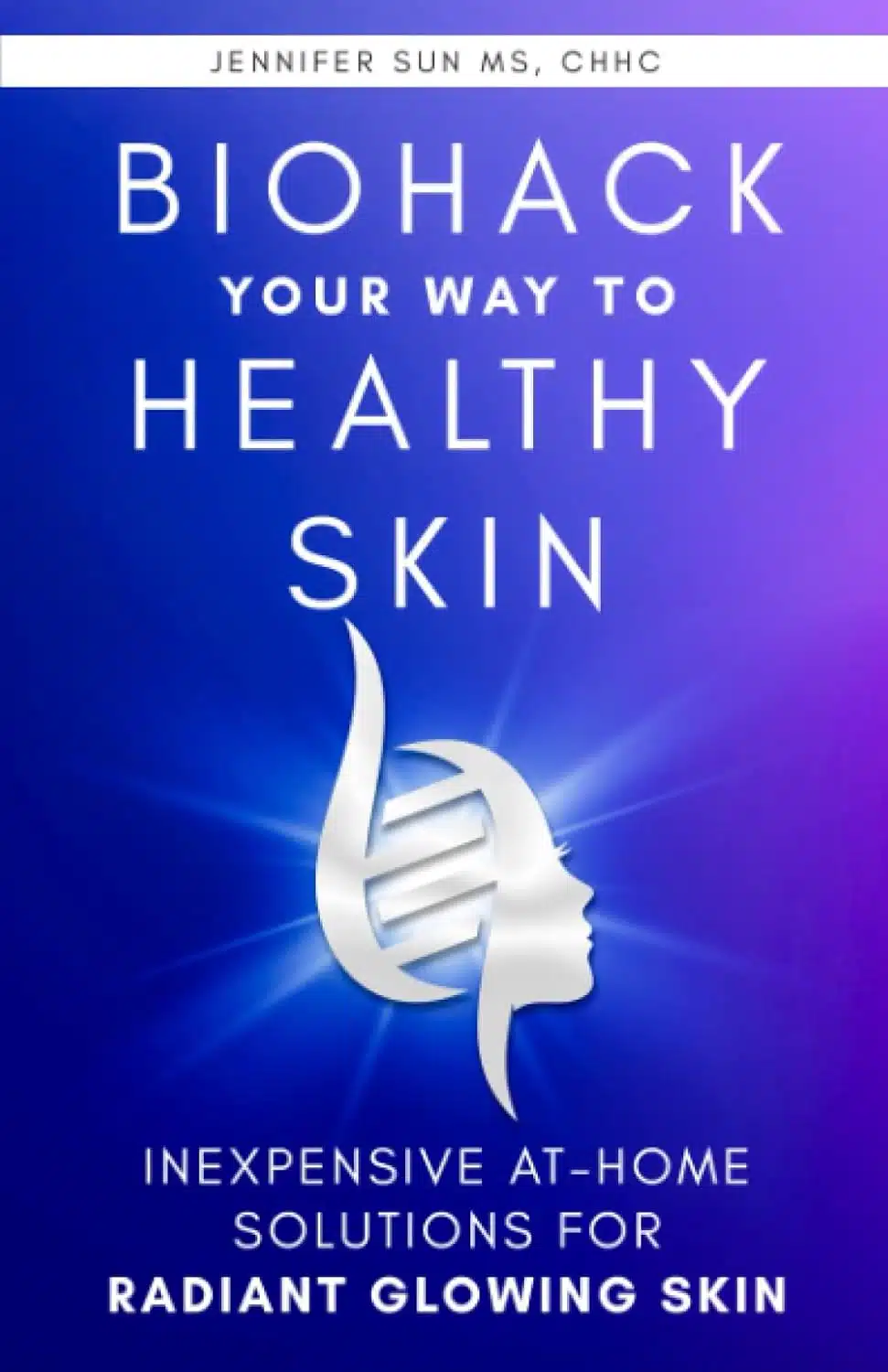
Biohack Your Way to Healthy Skin – by Jennifer Sun

10almonds is reader-supported. We may, at no cost to you, receive a portion of sales if you purchase a product through a link in this article.

The author, an aesthetician with a biotech background, explains about the overlap of skin health and skin beauty, making it better from the inside first (diet and other lifestyle factors), and then tweaking things as desired from the outside.

We previous reviewed another book of hers, “Unleashing Your Best Skin”, and this time the focus is on things you can do at home—not requiring expensive salon treatments (the other book covers both approaches; this one simply skips the clinic work and instead has a lot more detail in the at-home category).

As for what she covers, it comes in categories:

  • Gadgets to consider investing in, how to pick good ones, and what gadgets to avoid
  • Basic skincare knowledge and practice; here we’re talking cleaners, tonics, moisturizers, and so forth
  • Best topical and oral ingredients for the skin (and in contrast, ingredients to be wary of)
  • Nutrition for skincare; not just “your skin needs these ingredients”, but also…
  • Gut health for skincare, which gets a whole chapter just for that
  • Biohacking hormones for skincare, including in the cases of various common hormone imbalances (e.g. menopause, PCOS, etc) and other complications not generally thought of in terms of skincare, such as diabetes and hypo-/hyperthyroidism.
  • Circulatory health for skincare (blood and lymph)
  • Mental health techniques for skincare (including improving sleep, managing stress, supplements to consider, etc).

As with her other book that we reviewed, the book is broadly aimed at women, and the section on sex-hormonal considerations is completely aimed at women, but as for the rest of the book, there’s no pressing reason why this book couldn’t benefit men too. It also addresses considerations when it comes to darker skintones, something that a lot of similar books overlook.

The style is directly instructional, albeit light and conversational in tone, and still with 20+ pages of scientific references to show that she does indeed know her stuff.

Bottom line: if you’d like to improve your skin health, and/but aren’t a fan of going to the salon, then this book will be an invaluable resource.

Click here to check out Biohack Your Way To Healthy Skin, and biohack your way to healthy skin!

Don’t Forget…

Did you arrive here from our newsletter? Don’t forget to return to the email to continue learning!

Learn to Age Gracefully

Join the 98k+ American women taking control of their health & aging with our 100% free (and fun!) daily emails:

  • PS, We Love You

    10almonds is reader-supported. We may, at no cost to you, receive a portion of sales if you purchase a product through a link in this article.

    Phosphatidylserine (PS), we love you. With good reason!

    There are nearly 20,000 studies on PS listed on PubMed alone, and its established benefits include:

    We’ll explore some of these studies and give an overview of how PS does what it does. Just like the (otherwise unrelated) l-theanine we talked about a couple of weeks ago, it does do a lot of things.

    PS = Cow Brain?!

    Let’s first address a concern. You may have heard something along the lines of “hey, isn’t PS made from cow brain, and isn’t that Very Bad™ for humans, mad cow disease and all?”. The short answer is:

    Firstly: ingesting cow brain tissue is indeed generally considered Very Bad™ for humans, on account of the potential for transmission of Bovine Spongiform Encephalopathy (BSE) resulting in its human equivalent, Creutzfeldt–Jakob Disease (CJD), whose unpleasantries are beyond the scope of this newsletter.

    Secondly (and more pleasantly): whilst PS can be derived from bovine brain tissue, most PS supplements these days derive from soy—or sometimes sunflower lecithin. Check labels if unsure.

    Using PS to Improve Other Treatments

    In the human body, the question of tolerance brings us a paradox (not the tolerance paradox, important as that may also be): we must build and maintain a strong immune system capable of quickly adapting to new things, and then when we need medicines (or even supplements), we need our body to not build tolerance of them, for them to continue having an effect.

    So, we’re going to look at a very hot-off-the-press study (Feb 2023), that found PS to “mediate oral tolerance”, which means that it helps things (medications, supplements etc.) that we take orally and want to keep working, keep working.

    In the scientists’ own words (we love scientists’ own words because they haven’t been distorted by the popular press)…

    ❝This immunotherapy has been shown to prevent/reduce immune response against life-saving protein-based therapies, food allergens, autoantigens, and the antigenic viral capsid peptide commonly used in gene therapy, suggesting a broad spectrum of potential clinical applications. Given the good safety profile of PS together with the ease of administration, oral tolerance achieved with PS-based nanoparticles has a very promising therapeutic impact.❞

    Nguyen et al, Feb 2023

    In other words, to parse those two very long sentences into two shorter bullet points:

    • It allows a lot of important treatments to continue working—treatments that the body would otherwise counteract
    • It is very safe—and won’t harm the normal function of your immune system at large

    This is also very consistent with one of the benefits we mentioned up top—PS helps avoid rejection of implants, something that can be a huge difference to health-related quality of life (HRQoL), never mind sometimes life itself!

    What is PS Anyway, and How Does It Work?

    Phosphatidylserine is a phospholipid, a kind of lipid, found in cell membranes. More importantly:

    It’s a signalling agent, mainly for apoptosis, which in lay terms means: it tells cells when it’s time to die.

    Cellular death sounds like a bad thing, but prompt and efficient cellular apoptosis (death) and resultant prompt and efficient autophagy (recycling) reduce the risk of your body making mistakes when creating new cells from old cells.

    Think about photocopying:

    • Situation A: You have a document, and you want to copy it. If you copy it before it gets messed up, your copy will look almost, if not exactly, like the original. It’ll be super easy to read.
    • Situation B: You have a document, and you want to copy it, but you delay doing so for so long that the original is all scuffed and creased and has a coffee stain on it. These unwanted changes will get copied onto the new document, and any copy made of that copy will keep the problems too. It gets worse and worse each time.

    So, using this over-simplifier analogy, the speed of ‘copying’ is a major factor in cellular aging. The sooner cells are copied, before something gets damaged, the better the copy will be.

    So you really, really want to have enough PS (our bodies make it too, by the way) to signal promptly to a cell when its time is up.

    You do not want cells soldiering on until they’re the biological equivalent of that crumpled up, coffee-stained sheet of paper.

    Little wonder, then, that PS’ most commonly-sought benefit when it comes to supplementation is to help avoid age-related neurodegeneration (most notably, memory loss)!

    Keeping the cells young means keeping the brain young!

    PS’s role as a signalling agent doesn’t end there—it also has a lot to say to a wide variety of the body’s immunological cells, helping them know what needs to happen to what. Some things should be immediately eaten and recycled; other things need more extreme measures applied to them first, and yet other things need to be ignored, and so forth.

    You can read more about that in Elsevier’s publication if you’re curious 🙂

    Wow, what a ride today’s newsletter has been! We started at paracetamoxyfrusebendroneomycin, and got down to the nitty gritty with a bunch of hopefully digestible science!

    We love feedback, so please let us know if we’re striking the balance right, and/or if you’d like to see more or less of something—there’s a feedback widget at the bottom of this email!

    Share This Post

  • How To Stay Lean All Year (3 Rules To Live By)

    10almonds is reader-supported. We may, at no cost to you, receive a portion of sales if you purchase a product through a link in this article.

    It’s common for weight (and specifically: adiposity, i.e. how much fat we carry) to fluctuate throughout the year. This is reasonable; we are, after all, mammals—and so will naturally tend towards putting on a few pounds for the winter, if food is available to do so.

    However, as we’re no longer living with the seasonal food scarcity of tens of thousands of years ago and earlier, it’s nowadays all too easy to put on significantly more weight for winter, and then it’s either a) an arduous challenge to lose it in spring, or b) it gets set as our new base weight, to which we will now add even more weight in the following winter, and repeat each year.

    So… Is there a third option? Cori Lefkowitz, of “Redefining Strength” and “Strong at every age”, shows how to keep the weight off for as long as you want:

    In for the long run

    With the caveat that this is for maintenance (and not any initial fat loss you might want to do first) her three principles are as follows:

    1. Sustainability evolves: true change doesn’t feel sustainable at first—because it isn’t yet, in the sense of being self-sustaining, at least. Habit takes 3–4 months, lifestyle 16–18 months, and identity 3–4 years to form. Over time, habits become as automatic as brushing your teeth—you just have to get there!
    2. Adaptability remains critical: one strategy won’t work forever; your lifestyle should evolve with seasons and circumstances. Doing less perfectly is infinitely better than doing nothing when you can’t do it all. Build a strong foundation (like tracking food or regular workouts), then adjust the smaller details (such as macros and specific exercises) as needed.
    3. Mindset matters most: no perfect macro or workout exists—your mindset is what makes the single biggest difference. Generally speaking, people are held back more by unrealistic expectations, guilt, and self-sabotage than by a lack of tools or knowledge. Progress isn’t about avoiding setbacks completely (though by all means, do try to avoid them); what’s most important if and when they do occur, however, is recovering from them quickly.

    PS: you might not want to be as lean as Cori! That’s fine. This very healthy writer usually has a body fat percentage around 21% or a little under, which is a) the level I prefer to maintain; I consider it optimal for me personally, and b) rather more than we see Cori with here. So all this to say, while the above method is presented as a way to stay lean all year, it’s up to you to define what body composition you want to “lock in” and then maintain.

    For more on all of this, enjoy:

    Click Here If The Embedded Video Doesn’t Load Automatically!

    Want to learn more?

    You might also like:

    Is A Visible Six-Pack Obtainable Regardless Of Genetic Predisposition?

    Take care!

    Share This Post

  • Chatter – by Dr. Ethan Kross

    10almonds is reader-supported. We may, at no cost to you, receive a portion of sales if you purchase a product through a link in this article.

    This book is about much more than just one’s internal monologue. It does tackle that, but also the many non-verbal rabbit-holes that our brains can easily disappear into.

    The author is an experimental psychologist, and brings his professional knowledge and experience to bear on this problem—citing many studies, including his own studies from his own lab, in which he undertook to answer precisely the implicit questions of “How can I…” in terms of tackling these matters, from root anxiety (for example) to end-state executive dysfunction (for example).

    The writing style isn’t dense science though, and is very approachable for all.

    The greatest value in this book lies in its prescriptive element, that is to say, its advice, especially in the category of evidence-based things we can do to improve matters for ourselves; beyond generic things like “mindfulness-based stress reduction” to much more specific things like “observe yourself in the 3rd person for a moment” and “take a break to imagine looking back on this later” and “interrupt yourself with a brief manual task”. With these sorts of interventions and more, we can shift the voice in our head from critic to coach.

    Bottom line: if you would like your brain to let you get on with the things you actually want to do instead of constantly sidetracking you, this is the book for you.

    Click here to check out Chatter, and manage yours better!

    Share This Post

  • Understanding Cellulitis: Skin And Soft Tissue Infections

    10almonds is reader-supported. We may, at no cost to you, receive a portion of sales if you purchase a product through a link in this article.

    What’s the difference between a minor passing skin complaint, and a skin condition that’s indicative of something more serious? Dr. Thomas Watchman explains:

    More than skin-deep

    Cellulitis sounds benign enough, like having a little cellulite perhaps, but in fact it means an infection of the skin and—critically—the underlying soft tissues.

    Normally, the skin acts as a barrier against infections, but this barrier can be breached by physical trauma (i.e. an injury that broke the skin), eczema, fungal nail infections, skin ulcers, and other similar things that disrupt the skin’s ability to protect us.

    Things to watch out for: Dr. Watchman advises we keep an eye out for warm, reddened skin, swelling, and blisters. Specifically, a golden-yellow crust to these likely indicates a Staphylococcus aureus infection (hence the name).

    There’s a scale of degrees of severity:

    • Class 1: No systemic toxicity or comorbidities
    • Class 2: Systemic toxicity or comorbidities present
    • Class 3: Significant systemic toxicity or comorbidities with risk of significant deterioration
    • Class 4: Sepsis or life-threatening infection

    …with antibiotics being recommended in the latter two cases there, or in other cases for frail, young, old, or immunocompromised patients. Given the rather “scorched earth” results of antibiotics (they cause a lot of collateral iatrogenic damage), this can be taken as a sign of how seriously such infections should be taken.

    For more about all this, including visual guides, enjoy:

    Click Here If The Embedded Video Doesn’t Load Automatically!

    Want to learn more?

    You might also like to read:

    Take care!

    Don’t Forget…

    Did you arrive here from our newsletter? Don’t forget to return to the email to continue learning!

    Learn to Age Gracefully

    Join the 98k+ American women taking control of their health & aging with our 100% free (and fun!) daily emails:

  • This Mobility Test Is Linked To How Long You’ll Live

    10almonds is reader-supported. We may, at no cost to you, receive a portion of sales if you purchase a product through a link in this article.

    Can you do it?

    Sit-to-rise

    The sit-to-rise (STR) or sitting-rising test (SRT) is a quick mobility assessment where you sit down on the floor and stand back up again using as little support as possible, measuring how well your strength, mobility, balance, coordination, and control work together.

    • How the test works: start with 10 points total—5 points for sitting down and 5 for standing up.
    • How points are deducted: lose 1 point every time you use a hand, knee, elbow, or another support, and lose 0.5 points for wobbling or losing your balance.
    • What higher scores suggest: scores between 8 and 10 are associated with strong physical capability, good overall function, and the lowest mortality risk in research studies.
    • What mid-range scores suggest: scores between 5 and 7.5 may indicate emerging physical limitations or reduced movement quality.
    • What lower scores suggest: scores below 5 are linked with reduced physical resilience and substantially higher mortality risk in long-term studies.

    What the science says: studies involving thousands of adults over 40 found that lower SRT scores were consistently associated with higher mortality risk over subsequent years. Indeed, each additional point on the SRT was associated with roughly a 21% improvement in life expectancy in the cited research.

    In terms of expectations, you should know that perfect scores are common in people aged 16 to 25, but fewer than 8% of adults over 55 achieve a perfect 10.

    However! The good news is that if you don’t score well, you can practice and then score better.

    You may be thinking: but I use a wheelchair and physically cannot stand at all, what does this mean for me? And the answer is: nothing, really. The research wasn’t done with your body in mind, and therefore the results may not reflect your healthy longevity. Likely a different test is needed, and the grip strength test is generally considered a good one that has similar associations (due to being inversely associated with frailty, and therefore positively associated with healthy longevity).

    For more on all of this plus demonstrations of the incorrect ways of doing it and suspiciously no demonstration of the correct way, just a slightly edited bit where she sort of teleports from sitting to standing (we suspect she cannot do it and was embarrassed to admit it and hoped nobody would notice), enjoy:

    Click Here If The Embedded Video Doesn’t Load Automatically!

    Want to learn more?

    You might also like:

    4 Tips To Stand Without Using Hands

    Take care!

    Don’t Forget…

    Did you arrive here from our newsletter? Don’t forget to return to the email to continue learning!

    Learn to Age Gracefully

    Join the 98k+ American women taking control of their health & aging with our 100% free (and fun!) daily emails:

  • GLP-1 Drugs vs Arthritis?

    10almonds is reader-supported. We may, at no cost to you, receive a portion of sales if you purchase a product through a link in this article.

    First introduced as a diabetes medication, GLP-1 drugs quickly took hold for off-label use as weight loss aids, even when the science was still very young.

    Here’s one of our first articles on that, back in the day: Semaglutide’s Surprisingly Big Research Gap

    As for that popularity? Check out: 1 in 5 US Women Aged 50–64 Has Used GLP-1 RAs: What We’ve Learned

    Spoiler, one of the things we’ve learned is: Most People Who Start GLP-1 RAs Quit Them Within A Year (Here’s Why)

    One of the main things in their favor is, of course, that (for most people, anyway), they work (except when they don’t: Why Intermittent Fasting (& GLP-1 Drugs!) Might Not Work For You).

    In other words, a rocky road with pros and cons. But today, let’s talk about a newly-identified benefit…

    Arthritis relief beyond weight loss

    It has previously been assumed that GLP-1 drugs help vs arthritis because of weight loss—by the simple mechanism that if you have less weight, then less weight will be stressing your knee joints, for example (knee osteoarthritis being perhaps the most well-studied form of arthritis).

    However! Researchers (Dr. Amalie Dyrelund Broksø et al.) detected very small amounts of the hormone GLP-1 in the joint fluid of people with inflammatory arthritis, including rheumatoid arthritis and spondyloarthritis, suggesting that high-dose GLP-1 drugs directly reduce inflammation inside joints.

    In particular, GLP-1 levels in joint fluid closely mirrored GLP-1 levels in the bloodstream, suggesting that increasing circulating GLP-1 with medication will indeed also increase how much reaches arthritic joints (something that wouldn’t otherwise be a given).

    Nevertheless, while this much is established, what’s not yet tested (and thus not yet proven) is that this apparent cause and effect is indeed cause and effect, and not just a case of a correlation being caused by some third thing:

    ❝Our findings provide a biological basis for investigating whether GLP-1-based medication may have direct effects in the joints — beyond the known effects on weight and metabolism. However, we have not demonstrated that the treatment works against arthritis. This will require a number of clinical studies❞

    ~ Dr. Tue Wenzel Kragstrup, one of the researchers involved in this study

    The good news, of course, is that if future trials confirm the effect, GLP-1 drugs could then offer a “double benefit” for many arthritis patients by both promoting weight loss and directly reducing inflammation in joints.

    You can find this paper itself, here: Detection of GLP-1 and DPP-4 in synovial fluid: implications for therapeutical strategies in arthritis

    If you’d like to enjoy at least the anti-inflammatory effects without GLP-1 drugs, then do check out:

    And for arthritis care in general, consider:

    Want to learn more?

    You might also like this book that we reviewed a little while back:

    Magic Pill: The Extraordinary Benefits and Disturbing Risks of the New Weight-Loss Drugs – by Johann Hari

    Take care!

    Don’t Forget…

    Did you arrive here from our newsletter? Don’t forget to return to the email to continue learning!

    Learn to Age Gracefully

    Join the 98k+ American women taking control of their health & aging with our 100% free (and fun!) daily emails: