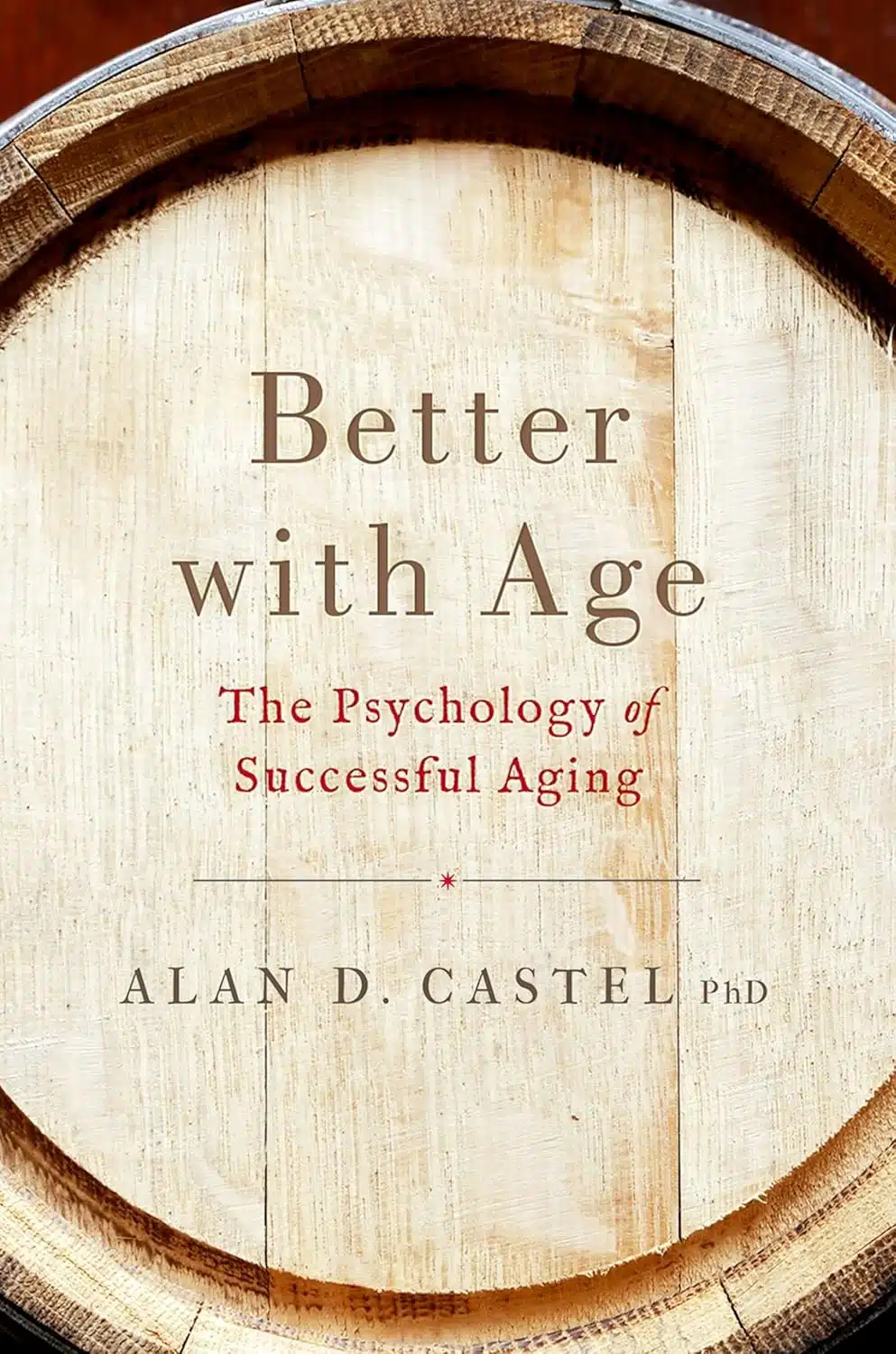
Better With Age – by Dr. Alan Castel

10almonds is reader-supported. We may, at no cost to you, receive a portion of sales if you purchase a product through a link in this article.

This one isn’t about the biology of aging, so much as (as the subtitle promises) the psychology of it.

Dr. Castel first covers the grounds of what “successful aging” is, and the benefits that can be expected from doing it right. Spoiler, it’s not just “reduced decline”, there are numerous things that actually get better, too.

We also learn how our memory works differently—it can be worse, of course, but it can also be just different, in a way that tends to tie in with vastness of the accumulated knowledge over the years, allowing for easiest access to the things the brain thinks are most important—ranging from expertise in a certain field, to life-experience “wisdom”.

There’s a lot of advice that’s mostly not going to be anything new to regular readers of 10almonds, in terms of staying sharp with an active lifestyle and a well-nourished brain.

The style is very soft pop-science; there are citations dotted throughout, but mostly this is more of a “curl up with a book” book, not a textbook.

In the category of subjective criticism, it can be a little repetitive (but for those who like repetition for ease of learning, you will love this), and his name-dropping habit gets quite eyeroll-worthy quite quickly.

Bottom line: if you’d like to learn about the very many ways in which “over the hill” is simply defeatist pessimism, then this book can help you to ensure you do better.

Click here to check out Better With Age, and get better with age!

Don’t Forget…

Did you arrive here from our newsletter? Don’t forget to return to the email to continue learning!

Learn to Age Gracefully

Join the 98k+ American women taking control of their health & aging with our 100% free (and fun!) daily emails:

  • If We Had A Nickel For Every Time We Were Asked About Nickel Poisoning…

    10almonds is reader-supported. We may, at no cost to you, receive a portion of sales if you purchase a product through a link in this article.

    It’s Q&A Day at 10almonds!

    Have a question or a request? We love to hear from you!

    In cases where we’ve already covered something, we might link to what we wrote before, but will always be happy to revisit any of our topics again in the future too—there’s always more to say!

    No question/request too big or small 😎

    ❝I was just reading something about nickel poisoning. It’s not anything I had come across before. Is it very common and is it something people should be wary of?❞

    If we had a nickel for every time we were asked about nickel poisoning, then we’d have one nickel, but it’s a good question and worthy of exploring.

    So…

    In most cases, nickel’s health risk is more about its allergenic properties, than its toxicity per se.

    Nickel allergy is a form of contact dermatitis in which your immune system reacts to nickel after skin contact, most commonly causing an itchy rash at the point of exposure, though it can get worse. For example, symptoms usually appear within 1–3 days after contact and may include a rash, bumps, severe itching, skin discoloration, dry cracked skin, blisters, and/or fluid drainage.

    This is mostly about piercings, jewelry, and accessories such as belts or wristwatches, though there are plenty of other possible sources (including, yes, the US coin of the same name, which usually contains 25% nickel). Inconveniently, other sources include various pieces of medical/dental kit, so do watch out for those.

    However, sometimes it really is about poisoning, and nickel’s toxicity.

    Nick poisoning is usually about nickel carbonyl, whose ingestion or inhalation can cause all manner of woes, for example, as the Journal of the American Medical Association (JAMA) details:

    ❝An industrial accident is described in which 100 oil refinery workers were exposed to nickel-carbonyl, 31 were hospitalized, and 3 died.

    Mild initial symptoms are listed, including headache, vertigo, nausea, and local pains. Delayed reactions are described, including constrictive chest pain, cough, pneumonia like symptoms, stomach pains, nausea, and weakness.

    Death between 4 and 11 days after exposure is noted. The presence of nickel in tobacco, and the formation of nickel-carbonyl during smoking are discussed.❞

    You can find the JAMA article’s entry here: Nickel May Be Potentially Hazardous to Health

    And you can find a lot more information on the UK’s “Health & Security Agency” website, here:

    So all this to say, it’s definitely something that it’s well worth knowing about and avoiding!

    You can also learn more about its other also-dangerous forms, here: Nickel; a metal with threats to human health, focusing on its intoxication mechanisms

    Want to learn more?

    For a much deeper dive into the broader topic of avoiding the toxins the industrial world is keen to throw our way, you might like this book that we reviewed a little while back:

    Healthy Living in a Contaminated World – by Dr. Donald Hoernschemeyer

    Take care!

    Share This Post

  • The Hidden Reason You’re Exhausted As A Midlife Woman (Not Menopause!)

    10almonds is reader-supported. We may, at no cost to you, receive a portion of sales if you purchase a product through a link in this article.

    Dr. Ruth Machin spells it out:

    Cognitive load

    Midlife fatigue in women isn’t caused only by aging or menopause, but also by an often-overlooked burden, also called cognitive labor or mental load—the ongoing mental work of managing a household and caring responsibilities, very often in addition to one’s paid work, which trifecta of responsibilities has collectively been known as “the triple-burden”.

    Cognitive labor is the constant thinking, planning, organizing, remembering, deciding, and monitoring required to keep daily life running, and it can be mentally exhausting even when physical tasks are shared.

    Indeed, the researcher Dr. Allison Daminger identified four phases:

    1. Anticipating what needs to be done
    2. Identifying options
    3. Deciding on a course of action
    4. Monitoring to ensure the task is completed

    Notably, research shows that women perform a disproportionately large share of cognitive labor, even in households where physical chores are more evenly divided and even when women have demanding careers or high incomes.

    In particular, midlife often brings peak levels of responsibility, with many women simultaneously managing careers, households, children, aging parents, and other caregiving duties while also often dealing with menopause-related symptoms.

    The resultant constant mental vigilance can increase anxiety, disrupt sleep, create a feeling of being “tired but wired,” contribute to decision fatigue, and make healthy behaviors such as exercising, cooking nutritious meals, and maintaining routines more difficult.

    Alas, cognitive labor is often hard for others to recognize, precisely because much of it happens internally, making it difficult to share unless the tasks are first made visible and explicitly discussed (which often takes more cognitive labor). Worse yet, delegation can be undermined by perfectionism and a reluctance to relinquish control, leading to micromanagement that keeps the mental burden attached to the original person.

    Reducing cognitive overload can require declining additional organizing, coordinating, or administrative roles that are automatically assumed or assigned. It can also help to clearly define expectations, priorities, budgets, preferences, and non-negotiables when handing over a responsibility, then allow the other person to take ownership of the task.

    While we’re at it: self-care should be viewed as an essential way to restore mental and physical energy rather than as a selfish indulgence, and it may need to be scheduled deliberately like any other important commitment.

    For mroe on all of this, enjoy:

    Click Here If The Embedded Video Doesn’t Load Automatically!

    Want to learn more?

    You might also like this book we reviewed:

    Women Rowing North: Navigating Life’s Currents & Flourishing As We Age – by Dr. Mary Pipher

    Take care!

    Share This Post

  • 10 Healthiest Foods You Should Eat In The Morning

    10almonds is reader-supported. We may, at no cost to you, receive a portion of sales if you purchase a product through a link in this article.

    For many of us, our creative minds aren’t their absolute best first thing in the morning, and it’s easy to reach for what’s available, if we haven’t planned ahead.

    So here’s some inspiration for the coming week! If you’re a regular coffee-and-toast person, at least consider alternating some of these with that:

    • Oatmeal with fresh fruit: fiber, energy, protein, vitamins and minerals (10almonds tip: we recommend making it as overnight oats! Same nutrients, lower glycemic index)
    • Greek yogurt parfait: probiotic gut benefits, along with all the goodness of fruit
    • Avocado toast: so many nutrients; most famous for the healthy fats, but there’s lots more in there too!
    • Egg + vegetable scramble: protein, healthy fats, vitamins and minerals, fiber
    • Smoothie bowl: many nutrients—But be aware that blending will reduce fiber and make the sugar quicker to enter your bloodstream. Still not bad as an occasional feature for the sake of variety, though!
    • Wholegrain pancakes: energy, fiber, and whatever your toppings! Fresh fruit is a top-tier choice; the video suggests maple syrup; we however invite you to try aged balsamic vinegar instead (sounds unlikely, we know, but try it and you’ll see; it is so delicious and your blood sugars will thank you too!)
    • Chia pudding: so many nutrients in this one; chia seeds are incredible!
    • Quinoa breakfast bowl: the healthy grains are a great start to the day, and contain a fair bit of protein too, and served with nuts, seeds, and diced fruit, many more nutrients get added to the mix. Unclear why the video-makers want to put honey or maple syrup on everything.
    • Berries: lots of vitamins, fiber, hydration, and very many polyphenols

    For a quick visual overview, and a quick-start preparation guide for the ones that aren’t just “berries” or similar, enjoy this short (3:11) video:

    Click Here If The Embedded Video Doesn’t Load Automatically!

    PS: They said 10, and we only counted 9. Where is the tenth one? Who would say “10 things” and then ostensibly only have 9? Who would do such a thing?!

    About that chia pudding…

    It’s a great way to get a healthy dose of protein, healthy fats, antioxidants, and a lot of other benefits for the heart and brain:

    The Tiniest Seeds With The Most Value

    Enjoy!

    Share This Post

  • Art and music therapies can be ‘life changing’ for people with disability

    10almonds is reader-supported. We may, at no cost to you, receive a portion of sales if you purchase a product through a link in this article.

    From November, music and art therapists will be able to charge the National Disability Insurance Scheme (NDIS) the same as counsellors, after an independent review found they can be effective and “even life changing” for some people with disability.

    The National Disability Insurance Agency commissioned the review, led by health economist Stephen Duckett, after widespread criticism of pricing changes it announced last year.

    In November last year, the federal government announced it would slash the maximum therapists could bill per hour from A$193.99 to $67.56, citing insufficient evidence they were effective.

    This week, the National Disability Insurance Agency (NDIA) has accepted the Duckett Review’s 19 recommendations, and the finding these therapies are effective and beneficial for people with specific conditions and disabilities.

    Here’s what we know, and what will change.

    Halfpoint/Getty

    What’s changing

    Art and music therapies will be restored to the “therapy supports” funding category, following last year’s unexpected announcement they would be restricted to the “community participation” category.

    These NDIS funding categories are different in two important ways.

    The first relates to the maximum hourly rate for an individual session. Therapy supports can cost a maximum of $193.99 an hour. In contrast, “community participation” costs are capped at $67.56 an hour.

    The review recommended a new hourly rate of $156.16 for individual art and music therapy sessions – the same hourly rate as counselling. However this remains significantly lower than other allied health services with similar levels of training, such as occupational therapy.

    The second difference is that therapy services and community participation programs have very different requirements for providing evidence they are beneficial, and for providers’ qualifications levels and training.

    The review also recommended a clearer distinction between art and music as a therapeutic support, and art and music as an activity.

    And it recommended these therapies should be delivered by a qualified and registered music or art therapist.

    So, what’s the difference?

    As a music therapy researcher, I am often asked to explain the difference between “music therapy” and “music activity”.

    People can be confused because music activities might also make us feel good. For example, music activities such as singing in a community choir can have mental health benefits for adults. Learning to play the ukulele has been shown to build stronger empathic skills in children.

    Music activities like these are valuable for many people, but they are not music therapy.

    Music therapy practice is informed by research into the benefits of specific methods and techniques for people with disability. These include autistic children, people with profound disabilities, and people recovering from major injury.

    For example, if a client is non-speaking, the therapist might use a vocal improvisation technique, creating supportive music to encourage the person to make sounds with their voice. The back-and-forth musical dialogue at first doesn’t rely on words. But the therapist may help the client extend to more expressive vocalisations and even word production.

    In Australia, music therapists must complete a two-year master’s degree before they are able to register with the Australian Music Therapy Association, and engage in continuous professional development.

    The review said artists or musicians who do not have relevant qualifications to register with their professional bodies should not charge the new hourly rate for therapy.

    So, what does the evidence say?

    The new review acknowledged that establishing the evidence for therapy and disability is a complex task.

    Around one in five Australians live with disability. Each person has unique needs and strengths, and disability occurs across the lifespan, meaning needs can also change. But when studying whether a particular kind of therapy is beneficial, researchers will focus on a particular group of people, such as adults with cerebral palsy.

    This means the quantity and quality of evidence available will vary across different age groups and conditions – and there may be gaps. So care needs to be taken when interpreting the research to consider whether findings from one study might be applicable to other people with similar goals, needs, or conditions.

    Qualified therapists are trained to interpret this evidence. They may be working with a client whose condition or needs differ from what’s in the existing research literature. So, they will consider whether a study showing benefits for music therapy with one group (such as non-speaking autistic children) could be relevant to another (for example, other people who have limitations in verbal expression).

    The Duckett Review acknowledges this challenge of generalising evidence across different therapies. But it also warns of possible discrimination against people with rare conditions that attract limited research funding, and calls for more research.

    Grace Thompson, Associate Professor in Music Therapy; Senior Academic Fellow at Melbourne Centre for the Study of Higher Education, The University of Melbourne

    This article is republished from The Conversation under a Creative Commons license. Read the original article.

    Don’t Forget…

    Did you arrive here from our newsletter? Don’t forget to return to the email to continue learning!

    Learn to Age Gracefully

    Join the 98k+ American women taking control of their health & aging with our 100% free (and fun!) daily emails:

  • Unbreakable: A Woman’s Guide to Aging with Power – by Dr. Vonda Wright

    10almonds is reader-supported. We may, at no cost to you, receive a portion of sales if you purchase a product through a link in this article.

    The author, an orthopedic surgeon and longevity specialist, puts the focus on a) women b) musculoskeletal health.

    Because, while when thinking about hormones and health a lot of people focus on visible things like hair and nails and such, when it comes to the effects of untreated menopause, let’s face it: more people die from the consequences of a broken hip than from a broken nail.

    So, she wants us to avoid the train of sarcopenia → osteopenia → osteoporosis → fractures → infections → death, by reducing our risk factors early, and staying more robust and biologically younger.

    She advises doing this in four main ways:

    • Exercise: because stronger muscles mean stronger bones, and the impact on metabolic health is important too
    • Nutrition: nourishing our muscles and bones, looking after our gut microbiome, and eliminating inflammation
    • Supplements: mostly things we can’t reasonably get from diet, such as senolytics that tackle aging on a cellular level
    • Lifestyle: in ways not already covered by the above three methods, so now we’re adding such things as sleep, stress management, and so forth.
      • This may sound like an optional add-on, but the reality is that our body can’t do the other things properly if we don’t also have this in hand.

    With these things in order, she argues, we can reasonably expect to go from strength to strength, rather than the decline that most people experience in later years.

    The style is light and personable easy-reading pop-science, with minimal jargon, and any necessary terms explained. After a respectable bibliography, there are also appendices with exercise protocols, recipes, and a how-to guide for managing pain and injury.

    Bottom line: if you are a woman and/or care about a woman, the contents of this book are something you should know inside-out, because it’s that important.

    Click here to check out Unbreakable, and make yourself as unbreakable as humanly possible!

    Don’t Forget…

    Did you arrive here from our newsletter? Don’t forget to return to the email to continue learning!

    Learn to Age Gracefully

    Join the 98k+ American women taking control of their health & aging with our 100% free (and fun!) daily emails:

  • How Does Extreme Heat Affect Your Body?

    10almonds is reader-supported. We may, at no cost to you, receive a portion of sales if you purchase a product through a link in this article.

    Dr. Carolyn Beans talks us through it:

    Are we cooked?

    A couple of years ago, it was predicted that by 2050, many mid-latitude regions could experience extreme heat for 90–180 days per year, with tropical regions facing even more, making heat-related disruptions a routine part of life.

    There’s a limit to how much of this we are physically able to take.

    The reason is that when temperatures rise, your hypothalamus signals blood vessels near your skin to widen, increasing heat loss, while sweat glands produce sweat that cools your body through evaporation. However, sweat only cools you if it can evaporate, and high humidity reduces or even stops the required evaporation of sweat, making it harder for your body to shed heat.

    Because of this, a wet-bulb temperature of about 35°C is generally considered the upper limit of human survival because sweating can no longer adequately cool the body, and continued exposure can lead to heat exhaustion and heat stroke, a medical emergency in which body temperature exceeds 40°C.

    It’s also worth remembering that children, older adults, pregnant people, and those with existing health conditions face elevated risks during extreme heat, and these demographics are foremost in the numbers when heat waves increase emergency calls and hospital visits for heat illness, as well as heart, kidney, and lung conditions, amongst others (heat exhaustion can cause organ failure and death; heat stroke can cause the same plus, as the name suggests, stroke), potentially overwhelming entire healthcare systems as well as people.

    To compound matters, widespread air-conditioner use (which on a global scale also contributes to this planet-warming climate change) increases electricity demand, which can overload power grids and trigger large-scale blackouts, at which point not even your desk fan can help you.

    For more on all of this… Well, we usually say “enjoy”, but in this case, perhaps simply, see:

    Click Here If The Embedded Video Doesn’t Load Automatically!

    Want to learn more?

    You might also like:

    Sun, Sea, And Sudden Killers To Avoid

    Take care!

    Don’t Forget…

    Did you arrive here from our newsletter? Don’t forget to return to the email to continue learning!

    Learn to Age Gracefully

    Join the 98k+ American women taking control of their health & aging with our 100% free (and fun!) daily emails: