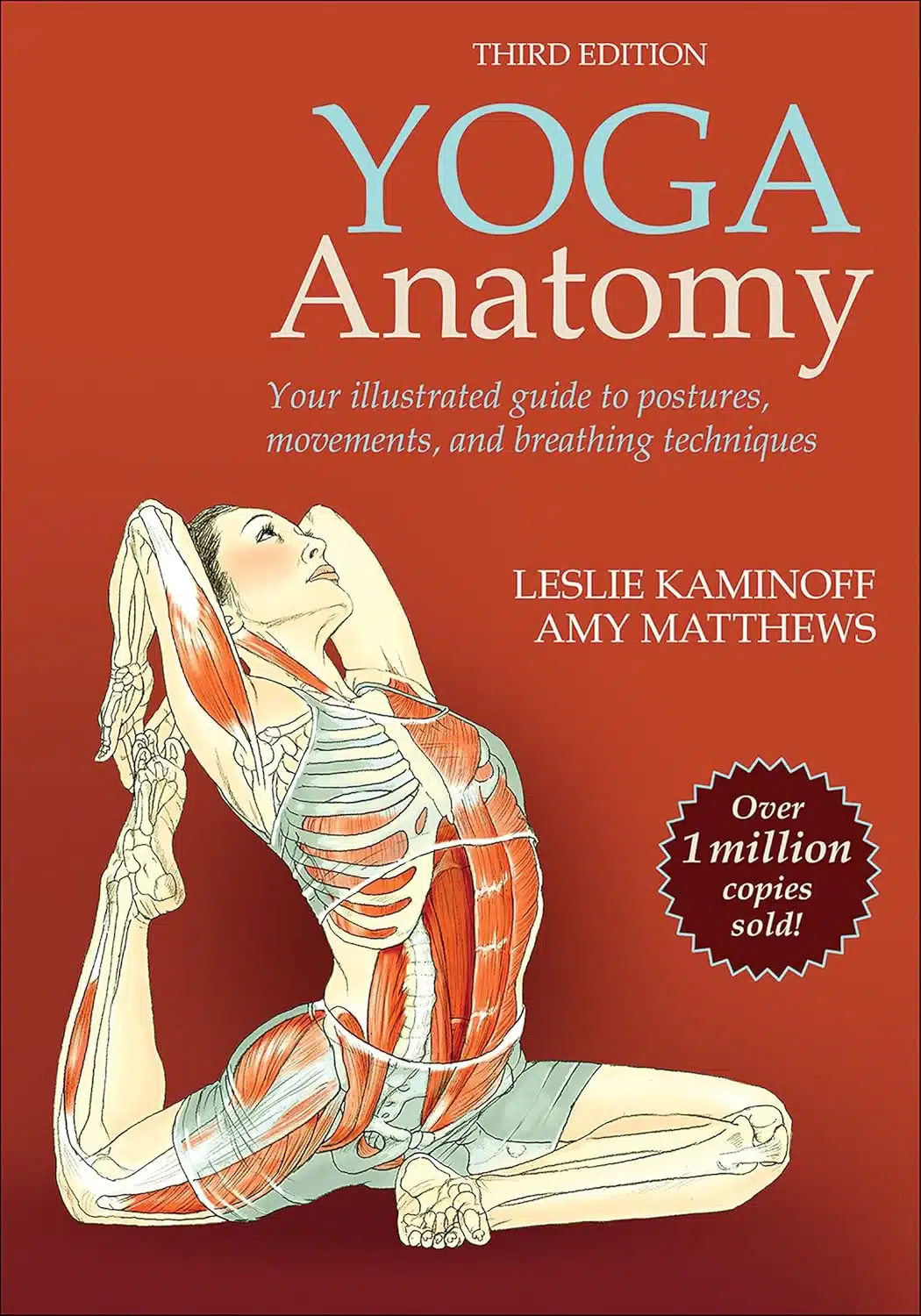
Yoga Anatomy – by Leslie Kaminoff & Amy Matthews

10almonds is reader-supported. We may, at no cost to you, receive a portion of sales if you purchase a product through a link in this article.

First and foremost this is what you would expect it to be from the title: a guide to human anatomy in the context of yoga.

What sets it apart from many books of its genre is its holistic approach, considering the importance of factors ranging from the tiny (e.g. how a nerve connects) to the huge (e.g. your body’s relationship to the gravitational field of the planet).

The illustrations throughout are very clear; ink drawings with color added to highlight parts, and often attention given to aspects that are commonly neglected—for example that we are made of more things than just muscles and bones, and what happens to the various internal organs is often relevant too!

Similarly, oft-forgotten muscles and joints get the attention they are due. For example, did you know the diaphragm affects over a hundred joints? It’s obvious when you think about it, but without a reason to do so, it’s easy to forget that the diaphragm even is a muscle, or that many of the joints near it are indeed joints. So, it takes on extra importance when the authors discuss how breathing affects the practice of a given posture—and conversely, how practice of a given posture affects breathing.

There is also discussion of the philosophy of yoga throughout, but the greatest value of the book is surely the better understanding of the biomechanics involved in yoga practice.

Bottom line: if you’re interested in yoga and would like to be better-informed with regard to what’s actually going on with your body, then this is a great book for you.

Click here to check out Yoga Anatomy, and get to grips with the anatomy of yoga!

Don’t Forget…

Did you arrive here from our newsletter? Don’t forget to return to the email to continue learning!

Learn to Age Gracefully

Join the 98k+ American women taking control of their health & aging with our 100% free (and fun!) daily emails:

  • Chard vs Lettuce – Which is Healthier?

    10almonds is reader-supported. We may, at no cost to you, receive a portion of sales if you purchase a product through a link in this article.

    Our Verdict

    When comparing chard to lettuce, we picked the chard.

    Why?

    In terms of macros, there’s nothing meaningful between them, being approximately equal on fiber, carbs, and protein. So, a tie in the first round.

    In the category of vitamins, chard has more of vitamins B2, B3, B5, B6, C, E, and K, while lettuce has more of vitamins A, B1, and B9, yielding a 7:3 win to chard.

    Looking at minerals, chard has more calcium, copper, iron, magnesium, manganese, phosphorus, potassium, selenium, and zinc, while lettuce is not higher in any minerals, making this round an easy victory for chard.

    In other considerations, chard also has more polyphenols, especially flavonoids such as kaempferol and quercetin. So that’s another round to chard.

    Adding up the sections makes for a clear overall win for chard, but by all means do enjoy either or both, as diversity is best!

    Want to learn more?

    You might like:

    Enjoy!

    Share This Post

  • I have a bit of a cold. Am I sick enough to take a day off work?

    10almonds is reader-supported. We may, at no cost to you, receive a portion of sales if you purchase a product through a link in this article.

    Whether it’s your first or fourth cold of the season, many Australians are waking up at the moment with a sniffle, a sore throat or feeling more tired than usual.

    June to August is peak flu season in Australia. There are also high rates of COVID circulating, along with other respiratory viruses such as respiratory syncytial virus (RSV) and adenovirus.

    Sometimes it’s clear when you need to spend the day in bed: you have a fever, aches and pains, and can’t think clearly. If it’s the flu or COVID, you’ll want to stay away from others, and to rest and recover.

    But what about if your symptoms are mild? Are you sick enough to take the day off, or should you push through it? And what if you feel pressured to work?

    Here’s what to consider.

    Are you likely to spread it?

    While it may seem like a good idea to continue working, especially when your symptoms are mild, going to work when infectious with a respiratory virus risks infecting your co-workers.

    If you are in a client-facing role, such as a teacher or a salesperson, you may also infect others like students or customers.

    The risks may be even greater for those working with vulnerable communities, such as in aged care work, where the consequences can be severe.

    From an organisational perspective, you are likely less productive when you are not feeling well.

    So, whenever possible, avoid going into work when you’re feeling unwell.

    Should I work from home?

    The COVID pandemic normalised working from home. Since then, more people work from home when they’re unwell, rather than taking sick leave.

    Some employees join Zoom or Teams meetings out of guilt, not wanting to let their co-workers down. Others – and in particular, some men – feel the need to maintain their performance at work, even if it’s at the expense of their health.

    A downside of powering through is that workers may prolong their illness by not looking after themselves.

    Can you take leave when you need it?

    Employees in Australia can take either paid or unpaid time off when they are unwell.

    Most full-time employees get ten days of paid sick leave per year, while part-time employees get the equivalent pro-rata.

    Employers can ask for reasonable evidence from employees to show they are unwell, such as asking for a medical certificate from a pharmacy or GP, or a statutory declaration. The type of evidence required may differ from organisation to organisation, with some awards and enterprise agreements specifying the type of evidence needed.

    While taking a sick day helps many workers recuperate, a significant proportion of workers engaged in non-standard work arrangements do not receive these benefits. There are, for example, 2.6 million casual employees who don’t have access to paid sick leave.

    Similarly, most self-employed people such as tradies and gig workers do not have any paid leave entitlements. Although these workers can still take unpaid leave, they are sacrificing income when they call in sick.

    Research from the Australian Council of Trade Unions has found more than half of insecure workers don’t take time off when injured or sick.

    So a significant proportion of workers in Australia simply cannot afford to call in sick.

    Why pushing through isn’t the answer

    “Presenteeism” is the phenomenon of people reporting for work even when they are unwell or not fully functioning, affecting their health and productivity.

    While exact figures are hard to determine, since most organisations don’t systematically track it, estimates suggest 30%–90% of employees work while sick at least once a year.

    People work while sick for different reasons. Some choose to because they love their job or enjoy the social side of work – this is called voluntary presenteeism.

    But many don’t have a real choice, facing financial pressure or job insecurity. That’s involuntary presenteeism, and it’s a much bigger problem.

    Research has found industry norms may be shaping the prevalence of “involuntary presenteeism”, with workers in the health and education sectors more likely to feel obligated to work when sick due to “at work” caring responsibilities.

    What can organisations do about it?

    Leaders set the tone, especially around health and wellbeing. When they role-model healthy behaviour and support time off, it gives others permission to do the same.

    Supportive leaders can help reduce presenteeism, while pressure from demanding leaders can make it worse.

    Your co-workers matter too. When teams step up and share the load, it creates a culture where people feel safe to take leave. A supportive environment makes wellbeing a shared responsibility.

    But for some workers, leave isn’t an option. Fixing this requires policy change across industries and society more broadly, not just inside the workplace.

    Alex Veen, Senior Lecturer and University of Sydney Business School Emerging Scholar Research Fellow, University of Sydney; Hannah Kunst, Lecturer in Leadership, University of Sydney, and Nate Zettna, Lecturer in Leadership, University of Sydney

    This article is republished from The Conversation under a Creative Commons license. Read the original article.

    Share This Post

  • Paramedics are less likely to identify a stroke in women than men. Closing this gap could save lives – and money

    10almonds is reader-supported. We may, at no cost to you, receive a portion of sales if you purchase a product through a link in this article.

    A stroke happens when the blood supply to part of the brain is cut off, either because of a blockage (called an ischaemic stroke) or bleeding (a haemorrhagic stroke). Around 83% of strokes are ischaemic.

    The main emergency treatment for ischaemic strokes is a “clot-busting” process called intravenous thrombolysis. But this only works if administered quickly – ideally within an hour of arriving to hospital, and no later than 4.5 hours after symptoms begin. The faster treatment is given, the better the person’s chance of survival and recovery.

    However, not everyone gets an equal chance of receiving this treatment quickly. Notably, research has shown ambulance staff are significantly less likely to correctly identify a stroke in women compared to men.

    In a recent study, we modelled the potential health gains and cost savings of closing this gap. And they’re substantial.

    SolStock/Getty Images

    The sex gap in stroke diagnosis

    In Australia, about three-quarters of people who experience stroke arrive at hospital by ambulance. If paramedics suspect a stroke, they can take patients directly to a hospital which specialises in stroke care, and alert the hospital team so scans and treatment can start immediately.

    Research has shown women aged under 70 are 11% less likely than men to have their stroke recognised by paramedics before they arrive at the hospital.

    While younger men and women experience stroke at a similar rate, the symptoms they present with may be different, with “typical” symptoms more common in men and “atypical” symptoms more common in women.

    Research has shown women and men are equally likely to present with movement and speech problems when having a stroke. However, women are more likely to show vague symptoms, such as general weakness, changes in alertness, or confusion.

    These “atypical” symptoms can be overlooked, leaving women more vulnerable to misdiagnosis, delayed treatment, and preventable harm.

    What we did

    In our study, published recently in the Medical Journal of Australia (MJA), we used ambulance and hospital data from a 2022 MJA study in New South Wales. This is the study we mentioned above that showed paramedics correctly identified stroke more often in men than women under 70.

    From this dataset, we identified more than 5,500 women under 70 who had an ischaemic stroke between 2005 and 2018. Using this group, we built a model to compare two scenarios:

    1. the status quo, where women’s strokes are identified at the current rate of accuracy; and
    2. an improved scenario, where women’s strokes are identified at the same rate as men’s.

    We then projected patients’ health over time, including their level of impairment, risk of another stroke, and immediate and long-term survival.

    Closing the diagnosis gap would save lives and money

    When women’s stroke diagnosis rate was improved to match men’s, each woman gained an average of 0.14 extra years of life (roughly 51 days) and 0.08 extra quality-adjusted life years (QALYs), meaning an additional 29 days in full health.

    Scenario two also meant A$2,984 in health-care costs would be saved per woman.

    Scaled to the national level based on the number of women under 70 hospitalised with ischaemic stroke each year, closing this gap would mean 252 extra years of life, 144 extra QALYs, and $5.4 million in cost savings annually.

    Some limitations

    We didn’t have sex-specific data for every aspect of the model, which is in itself a telling sign of the lack of recognition of sex as an important factor in understanding disease. Because of this, we used combined data from both men and women in some parts of our model, which may have affected the results.

    Further, the NSW data we used for rates of treatment with intravenous thrombolysis were higher than the national average, so our national figures may be slightly over-estimated.

    Beyond stroke – why all this matters

    The disparity we found is one example of a broader, systemic issue in women’s health: sex-based differences in diagnosis and treatment that favour men.

    Too often, women’s symptoms are misinterpreted or dismissed because they don’t match a “typical” pattern. This can lead to delays, missed opportunities for early treatment, and worse outcomes for women.

    In stroke, faster and more accurate diagnosis means people are less likely to die or require long-term care, and more likely to recover better and get back to their daily lives sooner.

    So what can we do to close the diagnosis gap?

    Investing in better training for paramedics and other emergency responders, so they can recognise a wider range of stroke presentations, could pay off many times over. Public awareness campaigns that highlight atypical stroke symptoms could also help.

    Technologies such as mobile stroke units and telemedicine support may be part of the solution, but they must be implemented with attention to sex-specific needs.

    Lei Si, Associate Professor in Health Services Management, Western Sydney University; Laura Emily Downey, Senior Lecturer, Health Economics and Policy, George Institute for Global Health, and Thomas Gadsden, Research Fellow, Health Systems Science, George Institute for Global Health

    This article is republished from The Conversation under a Creative Commons license. Read the original article.

    Share This Post

  • Cut The Pain Of Fibromyalgia By 1/3

    10almonds is reader-supported. We may, at no cost to you, receive a portion of sales if you purchase a product through a link in this article.

    First of all, let’s make one important note about fibromyalgia: fibromyalgia is less of a useful diagnosis and more of a rubber stamp, much like the role historically often fulfilled by “heart failure” as an official cause of death (because certainly, that heart sure did stop beating). It’s a way of answering the question without answering the question.

    It’s what doctors write down when they’ve ruled out possible causes they’re aware of, and don’t want to admit they don’t know why your body is doing what it is.

    It’s saying “I diagnose you with tired hurty syndrome, good luck, that’ll be [astonishing sum of dollars for the privilege of receiving this nothingburger answer] thank you”.

    To be clear, while we are disparaging fibromyalgia as a useful diagnosis, we’re not dismissing the actual effect it has on people.

    So while fibromyalgia has some potential use as a placeholder descriptor, it’s not an actionable answer, and it means that if that’s the diagnosis you’re handed, it can be beneficial to keep looking for the cause (because fibromyalgia is a result, not a cause).

    For more on that, see: Why Fibromyalgia Is Not An Acceptable Diagnosis (and what to look for instead)

    That covered, let’s move on to a new option for managing the symptoms:

    A first-in-class, non-opioid approach

    We’ll get straight to it: Tonmya (cyclobenzaprine hydrochloride), a once-daily sublingual tablet, received FDA approval all so recently, becoming the first new FDA-approved fibromyalgia medication in more than 15 years (the only others before that being pregabalin, duloxetine, and milnacipran, all of which have their faults and none of which produce great results*), and is now available in US pharmacies.

    *In a survey of 800 patients with fibromyalgia, 70% reported using one of those medications as prescribed by their doctor, but only 19% reported being very satisfied with their current treatment (source)

    Importantly, this new drug works independently of opioid pathways by modulating 5-HT2A, α1, H1, and M1 receptors*; as such, it improves sleep quality as well as central pain processing, addressing both pain and nonrestorative sleep—which are both very common, very serious problems associated with fibromyalgia, and certainly both things make the other hard to deal with, so having a medication that addresses both is truly a big deal.

    *For more detail/clarity, we’ll quote from a paper on the topic:

    ❝Cyclobenzaprine antagonizes serotonin 2A (5-HT2A), 5-HT2B, and 5-HT2C; histamine 1 (H1); α1A-, α1B-, α2B-, and α2C-adrenergic; and muscarinic 1 (M1) acetylcholine receptors, as well as relatively weakly inhibits activity at the norepinephrine transporter (NET) and serotonin transporter (SERT)❞

    Read in full: Efficacy and Safety of Sublingual Cyclobenzaprine for the Treatment of Fibromyalgia: Results From a Randomized, Double-Blind, Placebo-Controlled Trial ← this is actually a very interesting read in its entirety, by the way, so if you have the time, we recommend it!

    The most recent trials, with nearly 1,000 participants, showed statistically significant reductions in daily pain; most achieved at least a 30% pain improvement or greater, after three months.

    Now, the very most recent paper hasn’t been officially published yet so we can’t link it at this time, but you can read the press release here:

    First new fibromyalgia drug in 15 years, Tonmya (cyclobenzaprine HCl) gains FDA approval and hits pharmacy shelves

    Want to learn more?

    You might like this book that we reviewed a while back:

    What Your Doctor May Not Tell You About Fibromyalgia – by Dr. R. Paul St Amand

    We’ve also written quite a bit about pain management, including:

    Take care!

    Don’t Forget…

    Did you arrive here from our newsletter? Don’t forget to return to the email to continue learning!

    Learn to Age Gracefully

    Join the 98k+ American women taking control of their health & aging with our 100% free (and fun!) daily emails:

  • Berberine For Metabolic Health

    10almonds is reader-supported. We may, at no cost to you, receive a portion of sales if you purchase a product through a link in this article.

    Is Berberine Nature’s Ozempic/Wegovy?

    Berberine is a compound found in many plants. Of which, some of them are variations of the barberry, hence the name.

    It’s been popular this past couple of years, mostly for weight loss. In and of itself, something being good for weight loss doesn’t mean it’s good for the health (just ask diarrhoea, or cancer).

    Happily, berberine’s mechanisms of action appear to be good for metabolic health, including:

    • Reduced fasting blood sugar levels
    • Improved insulin sensitivity
    • Reduced LDL and triglycerides
    • Increased HDL levels

    So, what does the science say?

    It’s (mostly!) not nature’s Wegovy/Ozempic

    It’s had that title in a number of sensationalist headlines (and a current TikTok trend, apparently), but while both berberine and the popular weight-loss drugs Wegovy/Ozempic act in part on insulin metabolism, they mostly do so by completely different mechanisms.

    Wegovy and Ozempic are GLP-1 agonists, which mean they augment the action of glucagon-like-peptide 1, which increases insulin release, decreases glucagon release, and promotes a more lasting feeling of fullness.

    Berberine works mostly by other means, not all of which are understood. But, we know that it activates AMP-activated protein kinase, and on the flipside, inhibits proprotein convertase subtilisin/kexin type 9.

    In less arcane words: it boosts some enzymes and inhibits others.

    Each of these boosts/inhibitions has a positive effect on metabolic health.

    However, it does also have a slight GLP-1 agonist effect too! Bacteria in the gut can decompose and metabolize berberine into dihydroberberine, thus preventing the absorption of disaccharides in the intestinal tract, and increasing GLP-1 levels.

    See: Effects of Berberine on the Gastrointestinal Microbiota

    Does it work for weight loss?

    Yes, simply put. And if we’re going to put it head-to-head with Wegovy/Ozempic, it works about half as well. Which sounds like a criticism, but for a substance that’s a lot safer (and cheaper, and easier—if we like capsules over injections) and has fewer side effects.

    ❝But more interestingly, the treatment significantly reduced blood lipid levels (23% decrease of triglyceride and 12.2% decrease of cholesterol levels) in human subjects.

    However, there was interestingly, an increase in calcitriol levels seen in all human subjects following berberine treatment (mean 59.5% increase)

    Collectively, this study demonstrates that berberine is a potent lipid-lowering compound with a moderate weight loss effect, and may have a possible potential role in osteoporosis treatment/prevention.❞

    (click through to read in full)

    Is it safe?

    It appears to be, with one special caveat: remember that paper about the effects of berberine on the gastrointestinal microbiota? It also has some antimicrobial effects, so you could do harm there if not careful. It’s recommended to give it a break every couple of months, to be sure of allowing your gut microbiota to not get too depleted.

    Also, as with anything you might take that’s new, always consult your doctor/pharmacist in case of contraindications based on medications you are taking.

    Where can I get it?

    As ever, we don’t sell it, but here’s an example product on Amazon, for your convenience.

    Enjoy!

    Don’t Forget…

    Did you arrive here from our newsletter? Don’t forget to return to the email to continue learning!

    Learn to Age Gracefully

    Join the 98k+ American women taking control of their health & aging with our 100% free (and fun!) daily emails:

  • Women don’t have a ‘surge’ in fertility before menopause – but surprise pregnancies can happen, even after 45

    10almonds is reader-supported. We may, at no cost to you, receive a portion of sales if you purchase a product through a link in this article.

    Every now and then we see media reports about celebrities in their mid 40s having surprise pregnancies. Or you might hear stories like these from friends or relatives, or see them on TV.

    Menopause signals the end of a woman’s reproductive years and happens naturally between age 45 and 55 (the average is 51). After 12 months with no periods, a woman is considered postmenopausal.

    While the chance of pregnancy is very low in the years leading up to menopause – the so called menopausal transition or perimenopause – the chance is not zero.

    So, what do we know about the chance of conceiving naturally after age 45? And what are the risks?

    IKO-studio/Shutterstock

    Is there a spike in fertility before menopause?

    The hormonal changes that accompany perimenopause cause changes to the menstrual cycle pattern, and some have suggested there can be a “surge” in fertility at perimenopause. But there’s no evidence this exists.

    In the years leading up to menopause, a woman’s periods often become irregular, and she might have some of the common symptoms of menopause such as hot flushes and night sweats.

    This might lead women to think they have hit menopause and can’t get pregnant anymore. But while pregnancy in a woman in her mid 40s is significantly less likely compared to a woman in her 20s or 30s, it’s still possible.

    The stats for natural pregnancies after age 45

    Although women in their mid- to late 40s sometimes have “miracle babies”, the chance of pregnancy is minimal in the five to ten years leading up to menopause.

    The monthly chance of pregnancy in a woman aged 30 is about 20%. By age 40 it’s less than 5% and by age 45 the chance is negligible.

    We don’t know exactly how many women become pregnant in their mid to late 40s, as many pregnancies at this age miscarry. The risk of miscarriage increases from 10% in women in their 20s to more than 50% in women aged 45 years or older. Also, for personal or medical reasons some pregnancies are terminated.

    According to a review of demographic data on age when women had their final birth across several countries, the median age was 38.6 years. But the range of ages reported for last birth in the reviewed studies showed a small proportion of women give birth after age 45.

    Having had many children before seems to increase the odds of giving birth after age 45. A study of 209 women in Israel who had conceived spontaneously and given birth after age 45 found 81% had already had six or more deliveries and almost half had had 11 or more previous deliveries.

    A couple outdoors smiling. The woman is pregnant.
    Conceiving naturally at age 45 plus is not unheard of. pixelheadphoto digitalskillet/Shutterstock

    There’s no reliable data on how common births after age 45 are in Australia. The most recent report on births in Australia show that about 5% of babies are born to women aged 40 years or older.

    However, most of those were likely born to women aged between 40 and 45. Also, the data includes women who conceive with assisted reproductive technologies, including with the use of donor eggs. For women in their 40s, using eggs donated by a younger woman significantly increases their chance of having a baby with IVF.

    What to be aware of if you experience a late unexpected pregnancy

    A surprise pregnancy late in life often comes as a shock and deciding what to do can be difficult.

    Depending on their personal circumstances, some women decide to terminate the pregnancy. Contrary to the stereotype that abortions are most common among very young women, women aged 40–44 are more likely to have an abortion than women aged 15–19.

    This may in part be explained by the fact older women are up to ten times more likely to have a fetus with chromosomal abnormalities.

    There are some extra risks involved in pregnancy when the mother is older. More than half of pregnancies in women aged 45 and older end in miscarriage and some are terminated if prenatal testing shows the fetus has the wrong number of chromosomes.

    This is because at that age, most eggs have chromosomal abnormalities. For example, the risk of having a pregnancy affected by Down syndrome is one in 86 at age 40 compared to one in 1,250 at age 20.

    A woman in hospital holding a newborn baby.
    There are some added risks associated with pregnancy when the mother is older. Natalia Deriabina/Shutterstock

    Apart from the increased risk of chromosomal abnormalities, advanced maternal age also increases the risk of stillbirth, fetal growth restriction (when the unborn baby doesn’t grow properly), preterm birth, pre-eclampsia, gestational diabetes and caesarean section.

    However, it’s important to remember that since the overall risk of all these things is small, even with an increase, the risk is still small and most babies born to older mothers are born healthy.

    Multiple births are also more common in older women than in younger women. This is because older women are more likely to release more than one egg if and when they ovulate.

    A study of all births in England and Wales found women aged 45 and over were the most likely to have a multiple birth.

    The risks of babies being born prematurely and having health complications are higher in twin than singleton pregnancies, and the risks are highest in women of advanced maternal age.

    What if you want to become pregnant in your 40s?

    If you’re keen to avoid pregnancy during perimenopause, it’s recommended you use contraception.

    But if you want to get pregnant in your 40s, there are some things you can do to boost your chance of conceiving and having a healthy baby.

    These include preparing for pregnancy by seeing a GP for a preconception health check, taking folic acid and iodine supplements, not smoking, limiting alcohol consumption, maintaining a healthy weight, exercising regularly and having a nutritious diet.

    If you get good news, talking to a doctor about what to expect and how to best manage a pregnancy in your 40s can help you be prepared and will allow you to get personalised advice based on your health and circumstances.

    Karin Hammarberg, Adjunct Senior Research Fellow, Global and Women’s Health, School of Public Health & Preventive Medicine, Monash University

    This article is republished from The Conversation under a Creative Commons license. Read the original article.

    Don’t Forget…

    Did you arrive here from our newsletter? Don’t forget to return to the email to continue learning!

    Learn to Age Gracefully

    Join the 98k+ American women taking control of their health & aging with our 100% free (and fun!) daily emails: