
The Princess of Wales wants to stay cancer-free. What does this mean?

10almonds is reader-supported. We may, at no cost to you, receive a portion of sales if you purchase a product through a link in this article.

Catherine, Princess of Wales, has announced she has now completed a course of preventive chemotherapy.

The news comes nine months after the princess first revealed she was being treated for an unspecified form of cancer.

In the new video message released by Kensington Palace, Princess Catherine says she’s focused on doing what she can to stay “cancer-free”. She acknowledges her cancer journey is not over and the “path to recovery and healing is long”.

While we don’t know the details of the princess’s cancer or treatment, it raises some questions about how we declare someone fully clear of the disease. So what does being – and staying – “cancer-free” mean?

Pete Hancock/Shutterstock

What’s the difference between being cancer-free and in remission?

Medically, “cancer-free” means two things. First, it means no cancer cells are able to be detected in a patient’s body using the available testing methods. Second, there is no cancer left in the patient.

These might sound basically the same. But this second aspect of “cancer-free” can be complicated, as it’s essentially impossible to be sure no cancer cells have survived a treatment.

Two nurses look at two computer screens as a patient enters a CT scan machine.
Testing can’t completely rule out the chance some cancer cells have survived treatment. Andrewshots/Shutterstock

It only takes a few surviving cells for the cancer to grow back. But these cells may not be detectable via testing, and can lie dormant for some time. The possibility of some cells still surviving means it is more accurate to say a patient is “in remission”, rather than “cancer-free”.

Remission means there is no detectable cancer left. Once a patient has been in remission for a certain period of time, they are often considered to be fully “cancer-free”.

Princess Catherine was not necessarily speaking in the strict medical sense. Nonetheless, she is clearly signalling a promising step in her recovery.

What happens during remission?

During remission, patients will usually undergo surveillance testing to make sure their cancer hasn’t returned. Detection tests can vary greatly depending on both the patient and their cancer type.

Many tests involve simply looking at different organs to see if there are cancer cells present, but at varying levels of complexity.

Some cancers can be detected with the naked eye, such as skin cancers. In other cases, technology is needed: colonoscopies for colorectal cancers, X-ray mammograms for breast cancers, or CT scans for lung cancers. There are also molecular tests, which test for the presence of cancer cells using protein or DNA from blood or tissue samples.

For most patients, testing will continue for years at regular intervals. Surveillance testing ensures any returning cancer is caught early, giving patients the best chance of successful treatment.

Remaining in remission for five years can be a huge milestone in a patient’s cancer journey. For most types of cancer, the chances of cancer returning drop significantly after five years of remission. After this point, surveillance testing may be performed less frequently, as the patients might be deemed to be at a lower risk of their cancer returning.
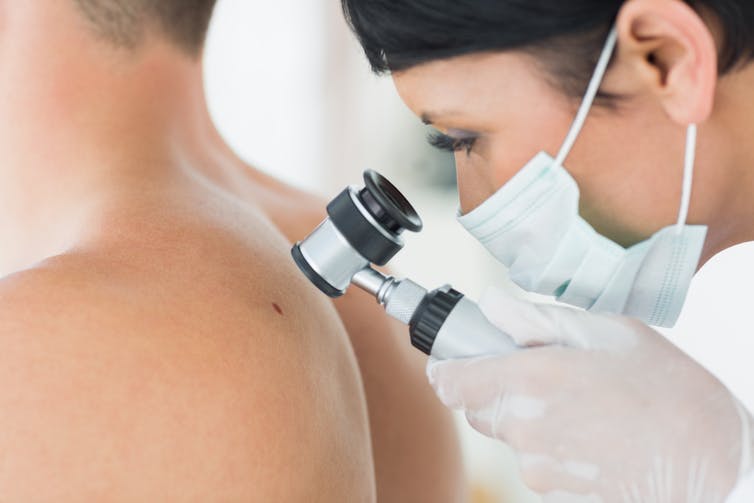
A dermatologist peers through a magnifying lens at a mole on a man's back.
Skin cancer may be detected by the naked eye, but many other cancers require technology for detection and monitoring. wavebreakmedia/Shutterstock

Measuring survival rates

Because it is very difficult to tell when a cancer is “cured”, clinicians may instead refer to a “five-year survival rate”. This measures how likely a cancer patient is to be alive five years after their diagnosis.

For example, data shows the five-year survival rate for bowel cancer among Australian women (of all ages) is around 70%. That means if you had 100 patients with bowel cancer, after five years you would expect 70 to still be alive and 30 to have succumbed to the disease.

These statistics can’t tell us much about individual cases. But comparing five-year survival rates between large groups of patients after different cancer treatments can help clinicians make the often complex decisions about how best to treat their patients.

The likelihood of cancer coming back, or recurring, is influenced by many factors which can vary over time. For instance, approximately 30% of people with lung cancer develop a recurrent disease, even after treatment. On the other hand, breast cancer recurrence within two years of the initial diagnosis is approximately 15%. Within five years it drops to 10%. After ten, it falls below 2%.

These are generalisations though – recurrence rates can vary greatly depending on things such as what kind of cancer the patient has, how advanced it is, and whether it has spread.

Staying cancer-free

Princess Catherine says her focus now is to “stay cancer-free”. What might this involve?

How a cancer develops and whether it recurs can be influenced by things we can’t control, such as age, ethnicity, gender, genetics and hormones.

However, there are sometimes environmental factors we can control. That includes things like exposure to UV radiation from the sun, or inhaling carcinogens like tobacco.

Lifestyle factors also play a role. Poor diet and nutrition, a lack of exercise and excessive alcohol consumption can all contribute to cancer development.

Research estimates more than half of all cancers could potentially be prevented through regular screening and maintaining a healthy lifestyle (not to mention preventing other chronic conditions such as heart disease and diabetes).

Recommendations to reduce cancer risk are the same for everyone, not just those who’ve had treatment like Princess Catherine. They include not smoking, eating a nutritious and balanced diet, exercising regularly, cutting down on alcohol and staying sun smart.

Amali Cooray, PhD Candidate in Genetic Engineering and Cancer, WEHI (Walter and Eliza Hall Institute of Medical Research) ; John (Eddie) La Marca, Senior Research Officer, Blood Cells and Blood Cancer, WEHI (Walter and Eliza Hall Institute of Medical Research) , and Sarah Diepstraten, Senior Research Officer, Blood Cells and Blood Cancer Division, WEHI (Walter and Eliza Hall Institute of Medical Research)

This article is republished from The Conversation under a Creative Commons license. Read the original article.

Don’t Forget…

Did you arrive here from our newsletter? Don’t forget to return to the email to continue learning!

Learn to Age Gracefully

Join the 98k+ American women taking control of their health & aging with our 100% free (and fun!) daily emails:

  • Can We Edit Parkinson’s Disease?

    10almonds is reader-supported. We may, at no cost to you, receive a portion of sales if you purchase a product through a link in this article.

    …and other items from this week’s health news:

    A new approach for treating Parkinson’s?

    In Parkinson’s, a protein (α-synuclein) clumps together in brain cells, causing damage, analogous to that of β-amyloid plaques in Alzheimer’s.

    Researchers used brain cells made from stem cells of Parkinson’s patients and exposed them to harmful forms of α-synuclein. This triggered immune responses and activated an enzyme (ADAR1) that edits RNA. Normally, ADAR1 helps control immune responses during infections, but in Parkinson’s, this study shows that it becomes overly active in genes linked to inflammation.

    What this means in practical terms is that ADAR1 could be a new target for treatments, offering a fresh way to tackle brain inflammation in Parkinson’s disease.

    Read in full: Editing Parkinson’s disease—discovery of an inflammatory RNA editing enzyme

    Related: Norepinephrine vs Alzheimer’s Disease

    In the summertime, when the weather is high…

    …then people might also be, depending on drug use—a team of researchers in Japan found that metabolism of many drugs (including prescription and recreational ones, and notably including alcohol) varies by season. This was an animal study, using close primate cousins of ours, but importantly: they have the same genes when it comes to the genes that are affected by this:

    ❝Their analysis, reported in Nature Communications, identified multiple “seasonally variable genes” from a comprehensive gene expression map of more than 54,000 genes expressed in 80 tissues.

    The study identified seasonal fluctuations in genes responsible for drug metabolism, particularly CYP2D6 and CYP2C19, which affect a quarter of common medications. Several widely used pharmaceuticals may be affected by these seasonal variations, including treatments for cancer, diabetes, high cholesterol, psychiatric conditions, hormonal therapies, and immunosuppressants used in organ transplantation.❞

    As for alcohol, by the way: it’s tolerated better in winter, with intoxication in summer being quicker in its onset, and slower in recovery—in other words, alcohol’s effects are stretched out at both ends in summer.

    The researchers note that this may also explain why hospitalizations for alcohol overdose are much more common in summer, despite people drinking just as heavily if not more heavily (based on alcohol sales) in winter.

    Read in full: Seasonal changes affect alcohol tolerance and your waistline

    Related: An Unexpected Extra Threat Of Alcohol

    The end to the biological arms race between pathogens and vaccines?

    Since the invention of the vaccine, humans and pathogens have been locked in an ongoing biological arms race, as each tries to outdo the other. From the pathogens’ side, of course this is completely unthinking and without malice, just a case of mutating and thus finding versions that aren’t “unnaturally deselected” by the previous round of vaccines. And, while this race hasn’t showed signs of slowing, the fact that the battle is being fought, has saved millions of lives.

    However! One thing that’s critical is rolling vaccines out as soon as they’re ready. Yes, they have safety checks first of course, but once they’re good to go, they need to be out there not only saving people, but also reducing the infection rate by virtue of herd immunity (which occurs when most people are vaccinated).

    The latest plan from the US Health & Human Services department is to require placebo testing of all new vaccines. Placebo trials typically last for months or years, depending on what it is. In the case of vaccines, then what’s being tested would be “is this vaccine more effective than placebo at stopping infection” so we’d need to wait until infection numbers roll in, tally how many get infected on each side, how many die on each side, and then if the numbers support its use (which based on pretty much any vaccine’s historic stats, they will) it’ll be rolled out to the general populace.

    However, this means that (for example) when flu season rolls around, scientists will develop the appropriate vaccine, but instead of getting rolled out after safety testing, it’ll go into placebo trials instead, and be rolled out sometime the following year. Which is just not how a helpful response to “flu season” goes; it’d be like if your house were on fire so they send the fire crew out next week.

    Read in full: US government to require placebo testing of all new vaccines: How will it affect updated COVID shots?

    Related: Vaccine Mythbusting

    Take care!

    Share This Post

  • Save Your Back With Strong Glutes

    10almonds is reader-supported. We may, at no cost to you, receive a portion of sales if you purchase a product through a link in this article.

    Your glutes really are the seat of your power, and without strong glutes, your back tries to pick up the slack. Unfortunately, without strong glutes, your back can only do that with questionable body mechanics, and guess who suffers for it?

    So instead…

    The brain-butt connection

    It might sound funny, but it’s true! Most squats don’t train the glutes through a proper neural connection; they over-recruit the quads and other nearby muscles, meaning the glutes have no reason to get stronger.

    This trainer (Elisi Wolf)’s own lower-back injury (sacroiliac joint ligament tear) forced a shift away from traditional squats. That injury led to years of experimenting, and she found that Bulgarian split squats are different in this regard.

    How they’re different: Bulgarian split squats reduce distractions to the brain, letting it build stronger neural pathways to the glutes, in contrast to how traditional squats divide focus between multiple large muscle groups and turn the movement into a calorie-burning, full-body effort rather than isolated glute training.

    Additionally, because Bulgarian split squats use lighter weight and one leg at a time, they allow better control, slower reps, and more focused muscle engagement—all key for glute hypertrophy (and thus: strengthening).

    For more on all of this, enjoy:

    Click Here If The Embedded Video Doesn’t Load Automatically!

    Want to learn more?

    You might also like:

    Bulgarian Split Squats: How To Get The Best Glute Strength & Size ← this one details how, specifically, to do Bulgarian split squats correctly (and avoid common mistakes)

    Take care!

    Share This Post

  • Elderberries vs Gooseberries – Which is Healthier?

    10almonds is reader-supported. We may, at no cost to you, receive a portion of sales if you purchase a product through a link in this article.

    Our Verdict

    When comparing elderberries to gooseberries, we picked the elderberries.

    Why?

    It’s a fairly straightforward one today!

    In terms of macros, elderberries have nearly 2x the fiber and carbs (for a similar glycemic index) making them the most nutritionally-dense option, and the fiber-richness gives them the win.

    In the category of vitamins, elderberries have more of vitamins A, B1, B2, B3, B6, and C, while gooseberries have more vitamin B5 (the vitamin that’s in literally everything edible). An easy win for elderberries here.

    When it comes to minerals, elderberries have more calcium, iron, phosphorus, and potassium, while gooseberries have more copper, magnesium, and selenium. A closer one this round, but still a 4:3 win for elderberries (and by larger margins per mineral, too).

    Looking at phytochemicals, both are good but elderberries have more polyphenols, plus some additional beneficial properties (see the link below), meaning a fourth win for elderberries.

    Adding up the sections makes for a very clear 4:0 win for elderberries, but by all means enjoy either or both; diversity is good!

    Want to learn more?

    You might like:

    Herbs For Evidence-Based Health & Healing ← elderberry significantly hastens recovery from upper respiratory viral infections 😎

    Enjoy!

    Share This Post

  • 7 things you can do if you think you sweat too much

    10almonds is reader-supported. We may, at no cost to you, receive a portion of sales if you purchase a product through a link in this article.

    Sweating is our body’s way of cooling down, a bit like an internal air conditioner.

    When our core temperature rises (because it’s hot outside, or you’re exercising), sweat glands all over our skin release a watery fluid. As that fluid evaporates, it takes heat with it, keeping us from overheating.

    But sweating can vary from person to person. Some people might just get a little dewy under the arms, others feel like they could fill a swimming pool (maybe not that dramatic, but you get the idea).

    So what’s a normal amount of sweat? And what’s too much?

    ERIK Miheyeu/Shutterstock

    Why do some people sweat more than others?

    How much you sweat depends on a number of factors including:

    • your age (young kids generally sweat less than adults)
    • your sex (men tend to sweat more than women)
    • how active you are.

    The average person sweats at the rate of 300 millilitres per hour (at 30°C and about 40% humidity). But as you can’t go around measuring the volume of your own sweat (or weighing it), doctors use another measure to gauge the impact of sweating.

    They ask whether sweating interferes with your daily life. Maybe you stop wearing certain clothes because of the sweat stains, or feel embarrassed so don’t go to social events or work.

    If so, this is a medical condition called hyperhidrosis, which affects millions of people worldwide.

    People with this condition most commonly report problematic armpit sweating, as you’d expect. But sweaty hands, feet, scalp and groin can also be an issue.

    Hyperhidrosis can be a symptom of another medical condition, such as an overactive thyroid, fever or menopause.

    But hyperhidrosis can have no obvious cause, and the reasons behind this so-called primary hyperhidrosis are a bit of a mystery. People have normal numbers of sweat glands but researchers think they simply over-produce sweat after triggers such as stress, heat, exercise, tobacco, alcohol and hot spices. There may also be a genetic link.

    OK, I sweat a lot. What can I do?

    1. Antiperspirants

    Antiperspirants, particularly ones with aluminium, are your first line of defence and are formulated to reduce sweating. Deodorants only stop body odour.

    Aluminum chloride hexahydrate, aluminium chloride or the weaker aluminum zirconium tetrachlorohydrex glycinate react with proteins in the sweat glands, forming a plug. This plug temporarily blocks the sweat ducts, reducing the amount of sweat reaching the skin’s surface.

    These products can contain up to 25% aluminium. The higher the percentage the better these products work, but the more they irritate the skin.

    Woman with antiperspirant in one hand, reading the lid in the other
    Make sure you’re buying antiperspirant and not deodorant. Okrasiuk/Shutterstock

    2. Beat the heat

    This might seem obvious, but staying cool can make a big difference. That’s because you have less heat to lose, so the body makes less sweat.

    Avoid super-hot, long showers (you will have more heat to loose), wear loose-fitting clothes made from breathable fabrics such as cotton (this allows any sweat you do produce to evaporate more readily), and carry a little hand fan to help your sweat evaporate.

    When exercising try ice bandanas (ice wrapped in a scarf or cloth, then applied to the body) or wet towels. You can wear these around the neck, head, or wrists to reduce your body temperature.

    Try also to modify the time or place you exercise; try to find cool shade or air-conditioned areas when possible.

    If you have tried these first two steps and your sweating is still affecting your life, talk to your doctor. They can help you figure out the best way to manage it.

    3. Medication

    Some medications can help regulate your sweating. Unfortunately some can also give you side effects such as a dry mouth, blurred vision, stomach pain or constipation. So talk to your doctor about what’s best for you.

    Your GP may also refer you to a dermatologist – a doctor like myself who specialises in skin conditions – who might recommend different treatments, including some of the following.

    4. Botulinum toxin injections

    Botulinum toxin injections are not just used for cosmetic reasons. They have many applications in medicine, including blocking the nerves that control the sweat glands. They do this for many months.

    A dermatologist usually gives the injections. But they’re only subsidised by Medicare in Australia for the armpits and if you have primary hyperhidrosis that hasn’t been controlled by the strongest antiperspirants. These injections are given up to three times a year. It is not subsidised for other conditions, such as an overactive thyroid or for other areas such as the face or hands.

    If you don’t qualify, you can have these injections privately, but it will cost you hundreds of dollars per treatment, which can last up to six months.

    Health worker administering Botox injection to man's armpit
    Injections are available on Medicare in some cases. Satyrenko/Shutterstock

    5. Iontophoresis

    This involves using a device that passes a weak electrical current through water to the skin to reducing sweating in the hands, feet or armpits. Scientists aren’t sure exactly how it works.

    But this is the only way to control sweating of the hands and feet that does not require drugs, surgery or botulinum toxin injections.

    This treatment is not subsidised by Medicare and not all dermatologists provide it. However, you can buy and use your own device, which tends to be cheaper than accessing it privately. You can ask your dermatologist if this is the right option for you.

    6. Surgery

    There is a procedure to cut certain nerves to the hands that stop them sweating. This is highly effective but can cause sweating to occur elsewhere.

    There are also other surgical options, which you can discuss with your doctor.

    7. Microwave therapy

    This is a newer treatment that zaps your sweat glands to destroy them so they can’t work any more. It’s not super common yet, and it is quite painful. It’s available privately in a few centres.

    Michael Freeman, Associate Professor of Dermatology, Bond University

    This article is republished from The Conversation under a Creative Commons license. Read the original article.

    Don’t Forget…

    Did you arrive here from our newsletter? Don’t forget to return to the email to continue learning!

    Learn to Age Gracefully

    Join the 98k+ American women taking control of their health & aging with our 100% free (and fun!) daily emails:

  • Do you really need a dental check-up and clean every 6 months?

    10almonds is reader-supported. We may, at no cost to you, receive a portion of sales if you purchase a product through a link in this article.

    Just over half of Australian adults saw a dental practitioner in the past 12 months, most commonly for a check-up.

    But have you been told you should get a check-up and clean every six months? Perhaps your dental clinic’s or health insurance policy’s default is to ask you to book these services twice a year.

    Let’s look at whether this advice is based on evidence or opinion.

    Why do you need regular check-ups and cleans?

    A regular oral health checkup usually involves a dentist or oral health practitioner (dental therapist, dental hygienist, oral health therapist) examining the teeth, gums and surrounding structures of the mouth. This helps identify signs of tooth decay or gum disease, in addition to any changes to soft tissues.

    In most instances, you will have your teeth professionally cleaned in the same visit, with a “scale and clean”, along with dental x-rays to identify issues that aren’t visible to the eye.

    Regular brushing with fluoride toothpaste and cleaning between teeth (for example, by flossing) at home can’t reach all the surfaces of the teeth and gums. Professional cleaning is needed to remove the remaining plaque and tartar (calcified dental plaque) and the bacteria they contain, which cause tooth decay and gum disease.

    What does the research evidence say?

    Not all research is equal: some types of evidence are more reliable than others.

    Cochrane systematic reviews are the most trusted because they use rigorous methods to collect and evaluate all available research evidence on a specific health question. These reviews judge how strong the evidence is and whether the studies might be affected by bias.

    For adult oral health check-ups, a 2020 Cochrane review found strong evidence that six-monthly check-ups did not offer any additional benefit in preventing tooth decay or gum bleeding, compared to those whose frequency of check-ups was risk-based.

    Risk-based means dental practitioners set the time between dental check-ups depending on the individual’s risk of dental disease.

    The review, which looked at data over four years, also found there wasn’t enough good research to know how different dental check-up schedules affected children’s and teenagers’ teeth and gums.

    On the issue of six-monthly professional cleaning, a 2018 Cochrane review found strong evidence that having regular professional cleaning made little or no difference to signs of gum disease (gingivitis or bleeding gums), or to levels plaque deposits, compared to adults with less regular professional cleaning.

    There was a small reduction in tartar levels, however it’s unclear if this is meaningful to consumers and dental practitioners.

    Participants who had six- or 12-monthly cleans reported their teeth felt cleaner than those who didn’t have scheduled cleans, but there was no difference between groups in reports of quality of life.

    Based on these reviews, six-monthly visits and cleans don’t seem to consistently lead to better oral health for adults compared to check-ups and cleans based on individual risk.

    So can you forgo six-monthly visits?

    Regular professional dental check-ups are important throughout life, starting from the eruption of the first tooth.

    But everyone has different oral health needs and risk levels which should be reflected in the frequency of their check-ups.

    Some people who are at high risk of oral disease do need to see a dental practitioner more regularly: every six months or even more often – such as every three months – to treat severe gum disease or tooth decay.

    Those with good oral health might only need to visit a dental practitioner every year or two years.

    Others still may be willing to pay for six-monthly check-ups and cleans for peace of mind, despite their lower oral health risk profile.

    How else can I keep my teeth and gums healthy?

    Maintain your oral health by brushing twice a day with fluoridated toothpaste. The evidence shows children and adults who brush less than twice daily are at high risk of tooth decay.

    Cleaning between your teeth can also help reduce gum problems and dental plaque – more than brushing alone. You can use traditional dental floss or a flossing tool. Interdental brushes, which have a tiny bristled head that fits between teeth, can also be more effective than flossing.

    For people who lack manual dexterity and for children, water flossers can be an effective alternative to traditional flossing.

    Finally, avoiding sugars added to foods and drinks, as well as the sugars naturally found in honey, syrups and fruit juices, helps protect teeth from tooth decay.

    Tan Nguyen, Casual Research Fellow in Oral Health, Deakin University and Santosh Tadakamadla, Professor and Head of Dentistry and Oral Health, La Trobe University

    This article is republished from The Conversation under a Creative Commons license. Read the original article.

    Don’t Forget…

    Did you arrive here from our newsletter? Don’t forget to return to the email to continue learning!

    Learn to Age Gracefully

    Join the 98k+ American women taking control of their health & aging with our 100% free (and fun!) daily emails:

  • The Exercise That Protects Older Adults From Cancer

    10almonds is reader-supported. We may, at no cost to you, receive a portion of sales if you purchase a product through a link in this article.

    The relationship between exercise and cancer has sometimes been laden with confusion, and in particular, it was long popularly believed that exercise accelerates cancer once it occurs, but now it seems that’s not the case.

    You might have read about that, and specifically about how a research team (Dr. Alice Avancini et al.) analysed data from 22 randomized controlled trials (total n=968 participants) that investigated the effects of exercise on various pro-inflammatory biomarkers (mostly interleukin variants, but also c-reactive proteins) that are known to increase breast cancer reoccurrence risk.

    What they found was:

    ❝Exercise induced small to large significant reductions in IL-6 (SMD = -0.85; 95% CI = -1.68 to -0.02; p =.05) and TNF-α (SMD = -0.40; 95% CI = -0.81 to 0.01; p =.05) and a trend for a decrease in CRP.

    When stratifying by exercise mode, trends toward reduction in IL-6 and TNF-α were observed for combined exercise, whilst changes were not generally affected by exercise program duration❞

    Source: Effects of exercise on inflammation in female survivors of nonmetastatic breast cancer: a systematic review and meta-analysis

    The “combined exercise” mentioned?

    Aerobic exercise and resistance training.

    This is important, because as regular 10almonds readers may remember…

    What Your Metabolism Says About How Aggressive Cancer Is Likely To Be For You ← this makes a huge difference to survival chances

    So, this study’s findings are very consistent with that, because:

    • Aerobic training increases cardiovascular fitness, improving metabolism
    • Resistance training increases muscle mass, improving metabolism*

    *because muscle “costs” calories to maintain, prompting an increase in metabolism, whereas fat prompts our metabolism to slow, to conserve energy to face the obvious food shortage that must be coming

    See also: Stop Cancer 20 Years Ago

    Exercise & aging muscle

    Yes, we said “older adults” specifically in the title, and now we’re getting to that part!

    Most recently, another team of scientists (Dr. Jun Nishiyama et al.) that healthy skeletal* muscle acts as an anti-tumor organ, releasing tiny particles called extracellular vesicles (EVs) that help suppress the development of tumors.

    *This means the muscles that move your skeleton, as opposed to different kinds of muscle such as, for example, the smooth muscle that operates the peristaltic motion of your intestines, or that forms the main part of the walls of your uterus (if you have one), or that wiggle your ears, and so forth.

    As muscles age and lose mass (per sarcopenia), they produce fewer of these vesicles. The vesicles that are released also contain lower levels of a molecule (known as miR-7a-5p to its friends) that normally helps restrain tumor growth. As a result, aging muscle can lose a lot of its natural cancer-fighting ability.

    The good news is that exercise appears to reverse part of this process. The researchers found that physical activity reactivates a biological pathway involved in EV production, restoring the release of protective signals from muscle.

    In other words: exercise more (be it with aerobic activity or resistance training, though ideally both), and greatly reduce your risk of cancer.

    You can find this paper in full, here: Sarcopenia promotes tumorigenesis by disrupting NOTCH-SDC2-regulated biogenesis of muscle-derived extracellular vesicles

    Want to learn more?

    You might like this excellent book we reviewed:

    Moving Through Cancer – by Dr. Kathryn Schmitz

    Take care!

    Don’t Forget…

    Did you arrive here from our newsletter? Don’t forget to return to the email to continue learning!

    Learn to Age Gracefully

    Join the 98k+ American women taking control of their health & aging with our 100% free (and fun!) daily emails: