
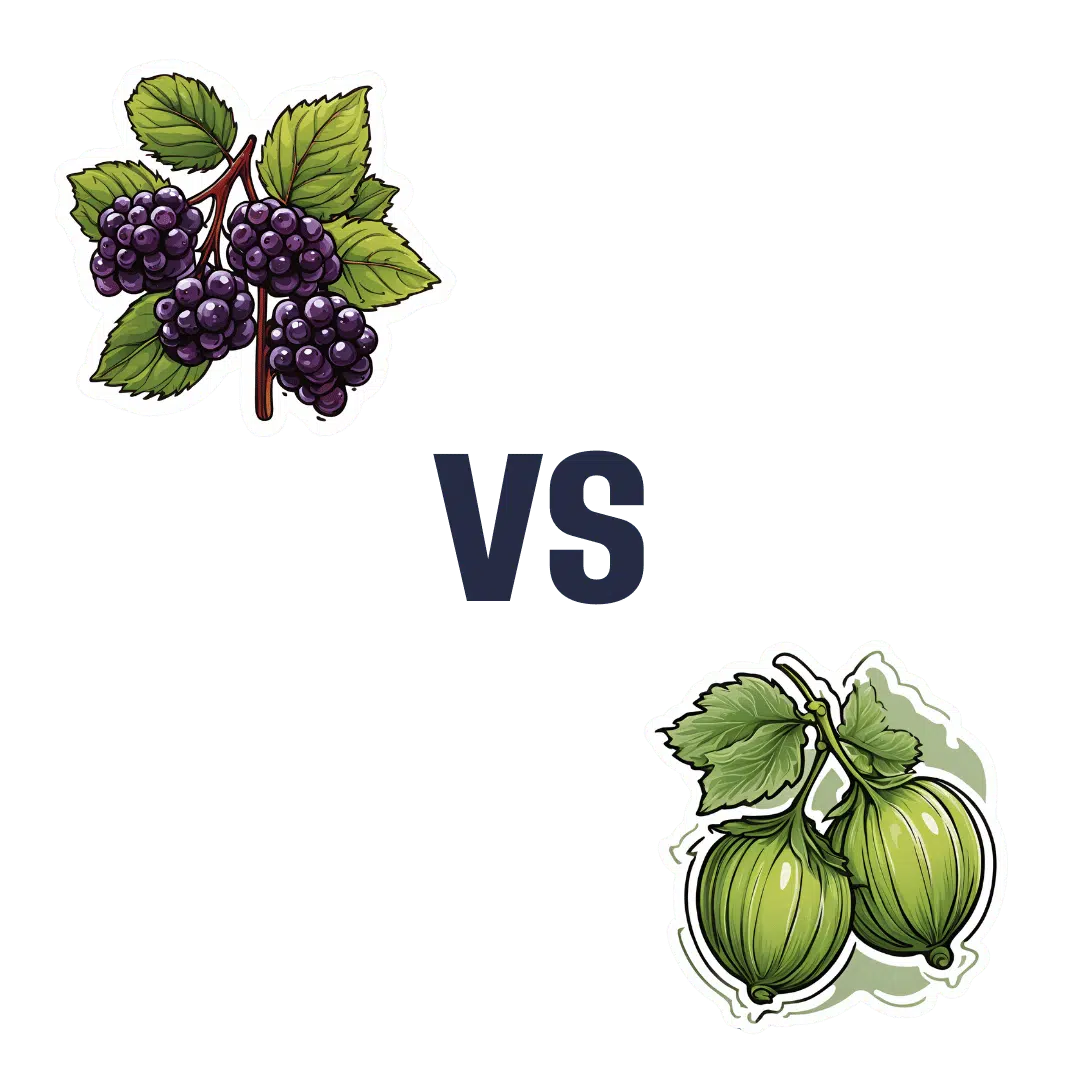
Elderberries vs Gooseberries – Which is Healthier?
10almonds is reader-supported. We may, at no cost to you, receive a portion of sales if you purchase a product through a link in this article.
Our Verdict
When comparing elderberries to gooseberries, we picked the elderberries.
Why?
It’s a fairly straightforward one today!
In terms of macros, elderberries have nearly 2x the fiber and carbs (for a similar glycemic index) making them the most nutritionally-dense option, and the fiber-richness gives them the win.
In the category of vitamins, elderberries have more of vitamins A, B1, B2, B3, B6, and C, while gooseberries have more vitamin B5 (the vitamin that’s in literally everything edible). An easy win for elderberries here.
When it comes to minerals, elderberries have more calcium, iron, phosphorus, and potassium, while gooseberries have more copper, magnesium, and selenium. A closer one this round, but still a 4:3 win for elderberries (and by larger margins per mineral, too).
Looking at phytochemicals, both are good but elderberries have more polyphenols, plus some additional beneficial properties (see the link below), meaning a fourth win for elderberries.
Adding up the sections makes for a very clear 4:0 win for elderberries, but by all means enjoy either or both; diversity is good!
Want to learn more?
You might like:
Herbs For Evidence-Based Health & Healing ← elderberry significantly hastens recovery from upper respiratory viral infections 😎
Enjoy!
Don’t Forget…
Did you arrive here from our newsletter? Don’t forget to return to the email to continue learning!
Recommended
Learn to Age Gracefully
Join the 98k+ American women taking control of their health & aging with our 100% free (and fun!) daily emails:
-
8 Signs Of Hypothyroidism Beyond Tiredness & Weight Gain
10almonds is reader-supported. We may, at no cost to you, receive a portion of sales if you purchase a product through a link in this article.
When it comes to hypothyroidism, most people know to look out for tiredness and weight gain, and possibly menstrual disturbances in those who menstruate. But those symptoms could be caused by very many things, so what more specific signs and symptoms of hypothyroidism should we look out for?
Dr. James O’Donovan shows us in this short video:
The lesser-known signs
Dr. O’Donovan discusses:
- Asteatotic eczema (also called: eczema craquelé): dry, cracked skin with a “crazy paving” appearance, leading to fissures. It’s common on the lower legs, back, torso, and arms, especially in older patients and especially in winter.
- Cold peripheries with pale, dry, coarse skin: cold hands and feet, along with dryness due to decreased sweating; these invariably come together, though the exact link is unclear.
- Yellowish hue to the skin (carotenoderma): yellow-orange discoloration from elevated beta-carotene levels. This can easily be mistaken for jaundice and also occurs in diabetes, liver, and kidney diseases.
- Thin, brittle hair: the hair on one’s head may become dry, coarse, and fall out in handfuls.
- Loss of hair on the outer third of eyebrows: thinning or disappearance of hair in this very specific area.
- Slow-growing, rigid, brittle nails: slowed nail growth due to decreased cell turnover rate. Ridges may form as keratin cells accumulate.
- Myxedema: puffy face, eyelids, legs, and feet caused by tissue swelling from cutaneous deposition.
- Delayed wound healing: is what it sounds like; a slower healing process.
10almonds note: this video, like much of medical literature as well, does focus on what things are like for white people. Black people with hypothyroidism are more likely to see a lightening of hair pigmentation, and, in contrast, hyperpigmentation of the skin, usually in patches. We couldn’t find data for other ethnicities or skintones, but it does seem that most of the signs and symptoms (unrelated to pigmentation) should be the same for most people.
Meanwhile, for more on the above 8 signs, with visuals, enjoy:
Click Here If The Embedded Video Doesn’t Load Automatically!
Want to learn more?
You might also like to read:
The Three Rs To Boost Thyroid-Related Energy Levels
Take care!
Share This Post
-
The Brain-Training Game That Reduces Your Pain
10almonds is reader-supported. We may, at no cost to you, receive a portion of sales if you purchase a product through a link in this article.
A little while ago, we wrote about How Nature Provides Us With A Surprisingly Powerful Painkiller—literally, that viewing nature scenes (even if just on video) alleviates physical pain—not just in self-reported subjective assessments, but also by a reduction of the neural activity that signals pain (unlike placebo, which changes our response to pain when the signal arrives).
That means, of course, that virtual reality can be a potential painkilling technology, if used to view nature scenes.
Of course, a top-tier option in this regard is to view actual nature scenes directly (i.e., spend time in green spaces), but we recognize that it’s not possible for everyone, especially not on-demand.
Beyond virtual reality
Today, we’re going to talk about a new synthesis of existing technologies, to reduce pain (in the case of the study: neuropathic pain) by adjusting one’s brain waves directly.
How? The software monitors brain activity via an electroencephalogram (EEG) headset, and responds in real-time with visual cues as the user learns to regulate abnormal brainwave patterns using biofeedback (specifically: neurofeedback), because…
❝The brainwaves of people with neuropathic pain show a distinct pattern: more slow theta waves, fewer alpha waves, and more fast, high beta waves.
We believe these changes interfere with how the thalamus talks to other parts of the brain, especially the sensory motor cortex, which registers pain.
I wondered, can we develop a treatment that directly targets and normalizes these abnormal waves?❞
~ Dr. Sylvia Gustin, lead researcher
And the answer to that question appears to be “yes”. We say “appears to be”, as so far there’s only been a small pilot study, but they’re recruiting for a larger study to launch soon.
The game itself is tablet-based and simple, and involves a simple visual challenge, on the tablet screen, in various possible ways, but generally taking the form of “this thing on the screen moves this way when your brain state is what it needs to be”, and then the user performs mental exercises (instructions are given) to make the thing on the screen move in the appropriate direction.
Doing this correctly yields—according to preliminary results at least (which admittedly are very preliminary)—pain relief comparable to opioids.
A small but significant portion of the readers may be thinking: wasn’t this the plot of a Star Trek episode in the 90s? And yes it was, but we promise that the headset-based move-the-object-with-neurofeedback opioid-like relief-giving game is not part of an alien takeover attempt this time.
You can read about the pilot study, here: The effect of an EEG neurofeedback intervention for corneal neuropathic pain
If, on the other hand, you don’t want to wait for this to become widely available, you can use other mental techniques to achieve a similar end, without technology; we did a main feature on this before; here it is: How To Dial Down Your Pain
Want to learn more?
We’ve written quite a bit about pain management, including:
- How To Stop Pain Spreading
- Managing Chronic Pain (Realistically!)
- Get The Right Help For Your Pain
- The 7 Approaches To Pain Management
- Science-Based Alternative Pain Relief (When Painkillers Aren’t Helping, These Things Might)
Take care!
Share This Post
-
Bamboo Shoots vs Green Beans – Which is Healthier?
10almonds is reader-supported. We may, at no cost to you, receive a portion of sales if you purchase a product through a link in this article.
Our Verdict
When comparing bamboo shoots to green beans, we picked the beans.
Why?
It was close!
In terms of macros, bamboo has slightly more protein and green beans have slightly more fiber, which not only balances but also there’s not much between them in either case, so all things considered, we’re calling this first round a tie.
In the category of vitamins, bamboo has more of vitamins B1, B3, B5, B6, and E, while green beans have more of vitamins A, B2, B7, B9, C, and K, winning marginally in this second round.
Looking at minerals, bamboo has more copper, phosphorus, potassium, and zinc, while green beans have more calcium, iron, magnesium, and manganese, tying 4:4 here.
In other considerations, green beans have more polyphenols, so that’s an extra point in their favor.
Adding up the sections makes for an overall win for green beans, but as we say, it was close, so by all means do enjoy either or both, as diversity is best!
Want to learn more?
You might like:
Don’t Be Bamboozled By Bamboo! ← including how to eat bamboo, for those unfamiliar with such, as we have been asked about it 🙂
Enjoy!
Share This Post
Related Posts
-
Food for Thought – by Lorraine Perretta
10almonds is reader-supported. We may, at no cost to you, receive a portion of sales if you purchase a product through a link in this article.
What are “brain foods”? If you think for a moment, you can probably list a few. What this book does is better.
As well as providing the promised 50 recipes (which themselves are varied, good, and easy), Perretta explains the science of very many brain-healthy ingredients. Not just that, but also the science of a lot of brain-unhealthy ingredients. In the latter case, probably things you already knew to stay away from, but still, it’s a good reminder of one more reason why.
Nor does she merely sort things into brain-healthy (or brain-unhealthy, or brain-neutral), but rather she gives lists of “this for memory” and “this against depression” and “this for cognition” and “this against stress” and so forth.
Perhaps the greatest value of this book is in that; her clear explanations with science that’s simplified but not dumbed down. The recipes are definitely great too, though!
Bottom line: if you’d like to eat more for brain health, this book will give you many ways of doing so
Click here to check out Food for Thought, and upgrade your recipes!
Don’t Forget…
Did you arrive here from our newsletter? Don’t forget to return to the email to continue learning!
Learn to Age Gracefully
Join the 98k+ American women taking control of their health & aging with our 100% free (and fun!) daily emails:
-
Languishing – by Prof. Corey Keyes
10almonds is reader-supported. We may, at no cost to you, receive a portion of sales if you purchase a product through a link in this article.
We’ve written before about depression and “flourishing” but what about when one isn’t exactly flourishing, but is not necessarily in the depths of depression either? That’s what this book is about.
Prof. Keyes offers, from his extensive research, hope for those who do not check enough of the boxes to be considered depressed, but who are also definitely more in the lane of “surviving” than “thriving”.
Specifically, he outlines five key ways to make the step from languishing to flourishing, based not on motivational rhetoric, but actual data-based science:
- Learn (creating your personal story of self-growth)
- Connect (building relationships, on the individual level and especially on the community level)
- Transcend (developing psychological resilience to the unexpected)
- Help (others! This is about finding your purpose, and then actively living it)
- Play (this is a necessary “recharge” element that many people miss, especially as we get older)
With regard to finding one’s purpose being given the one-word summary of “help”, this is a callback to our tribal origins, and how we thrive and flourish best and feel happiest when we have a role to fulfil and provide value to those around us)
Bottom line: if you’re not at the point of struggling to get out of bed each day, but you’re also not exactly leaping out of bed with a smile, this book can help get you from one place to the other.
Don’t Forget…
Did you arrive here from our newsletter? Don’t forget to return to the email to continue learning!
Learn to Age Gracefully
Join the 98k+ American women taking control of their health & aging with our 100% free (and fun!) daily emails:
-
Avoid This Food To Avoid IBS
10almonds is reader-supported. We may, at no cost to you, receive a portion of sales if you purchase a product through a link in this article.
If you have inflammatory bowel syndrome (IBS), including ulcerative colitis, Crohn’s disease, or similar, then suddenly a lot of common dietary advice gets flipped on its head:
While resistant starches and the like (so, doing the job of fiber; see: When Is A Fiber Not A Fiber? When It’s A Resistant Starch) making it to the end parts of our digestive tract is good for our bacteria there, in the case of people with IBS or similar, it can be a bit too good for our bacteria there.
As a result, a common understanding is “if you have IBS, you mustn’t eat fiber” which is understandable—but incorrect—advice. More on that in the “Learn more” bit at the bottom, but for now…
What’s the actual biggest driver of IBS?
Another reason to skip red meat
Researchers (Dr. Chunbao Li et al.) noted that relevant epidemiological studies (of which, The China Study is the most famous, but there are countless others) have long shown a strong association between red meat consumption and the development of IBS, and wanted to ascertain how exactly this happened.
This is critical, because while epidemiological studies can present an overwhelming amount of evidence for association/correlation, they cannot outright prove causality.
So, they did a mouse study (mice are opportunistic omnivores like us, indeed often eating our* food, and as a result, have very similar gut microbiota), experimenting with dietary modifications, and then measuring colonic inflammation.
*The mice may disagree, and contest that it is we who are eating their food. But they are free to argue that in their own publication.
What they (the researchers, not the mice) did: they fed the mice red meat diets (beef, pork, lamb) or control for 2 weeks, followed by an induction of colitis.
What they found: red meat diets (all of them) worsened colonic inflammation, increased pro-inflammatory cytokines, and caused neutrophil and macrophage infiltration.
Specifically: red meat intake (any) decreased beneficial bacteria (Streptococcus, Akkermansia, Faecalibacterium, Lactococcus) and increased harmful ones (Clostridium, Mucispirillum).
There were some differences between the three red meats (beef, pork, lamb), but the differences pertained more to variations within:
- which beneficial bacteria were decreased the most
- which harmful bacteria were increased the most
You can see the exact results (including: per meat type and per bacterial strain) in the paper, here: Red Meat Diet Exacerbates Colitis by Promoting the Accumulation of Myeloid Cells and Disrupting Gut Microbiota
This dysbiosis (that is to say: disruption of the gut microbiome) then led to an overproduction of pro-inflammatory cytokines and infiltration of immune cells in the colon.
In other words, it inflamed the bowel—that is to say, promoted inflammatory bowel syndrome.
Want to learn more?
Check out:
Fruit, Fiber, & Leafy Greens… On A Low-FODMAP Diet!
Enjoy!
Don’t Forget…
Did you arrive here from our newsletter? Don’t forget to return to the email to continue learning!
Learn to Age Gracefully
Join the 98k+ American women taking control of their health & aging with our 100% free (and fun!) daily emails:


