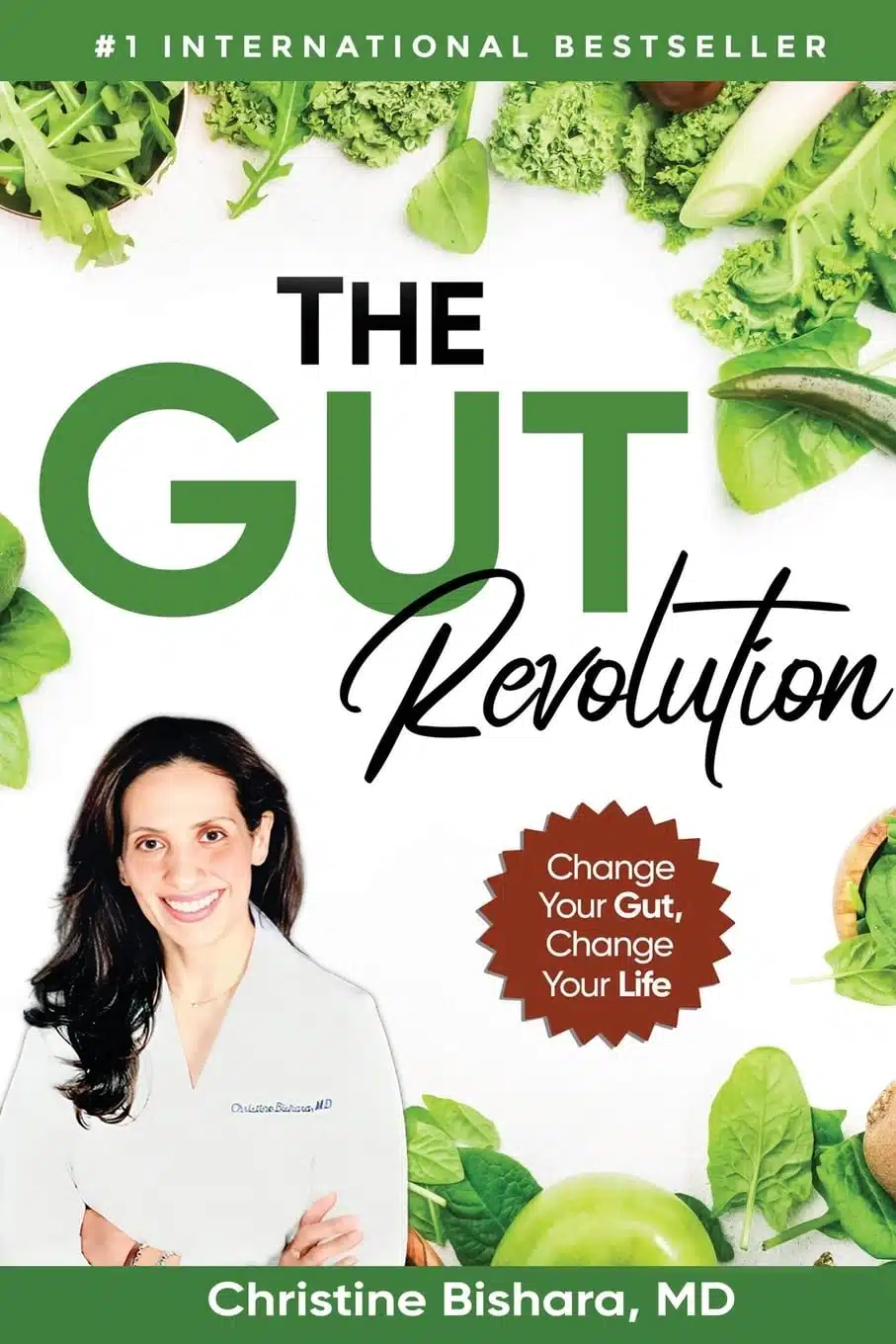
The Gut Revolution – by Dr. Christine Bishara

10almonds is reader-supported. We may, at no cost to you, receive a portion of sales if you purchase a product through a link in this article.

You may be wondering: what sets this apart from other books about gut health?

And one answer is: the author discusses her own published study, with regard to the connection between a deficiency in Bifidobacterium sp., and COVID infection risk/severity. However, this is not an entire book to say “supplement Bifidobacterium sp.”; rather, there are many other things at hand too.

And indeed, supplementing with probiotics will be useless if your gut is not an environment conducive to them thriving. If you take probiotics on an otherwise “Standard American Diet”, then this is approximately the equivalent of paradropping firefighters naked into a raging fire. It will not help. It isn’t the thought that counts.

Instead, Dr. Bishara talks us through what is required for beneficial gut bacteria to thrive, and how to go about making our gut an ideal place for them. In return, they will produce important biochemical metabolites for us, they will improve our immune response, regulate our emotions, help us maintain a healthy weight, heal our skin, and make us smell nice too. In short, they’re a trillions-strong clean-up and maintenance team, if only we treat our workforce well.

Another thing that Dr. Bishara brings of value here that’s not found in a lot of gut health books is the benefits (for gut health) of intermittent fasting, and specifically, a very useful timeline of what happens when, to ensure we do not sabotage our efforts by breaking our fast too early or too late.

The style is easy-reading pop-science, albeit with scientific references throughout for those who want to delve deeper.

Bottom line: this is a gut health book that stands out from the crowd in several ways, and is well worth the investment of reading it!

Click here to check out Gut Revolution, and help yours to help you!

Don’t Forget…

Did you arrive here from our newsletter? Don’t forget to return to the email to continue learning!

Learn to Age Gracefully

Join the 98k+ American women taking control of their health & aging with our 100% free (and fun!) daily emails:

  • Too much vitamin B6 can be toxic. 3 symptoms to watch out for

    10almonds is reader-supported. We may, at no cost to you, receive a portion of sales if you purchase a product through a link in this article.

    Side effects from taking too much vitamin B6 – including nerve damage – may be more widespread than we think, Australia’s medicines regulator says.

    In an ABC report earlier this week, a spokesperson for the Therapeutic Goods Administration (TGA) says it may have underestimated the extent of the side effects from vitamin B6 supplements.

    However, there are proposals to limit sales of high-dose versions due to safety concerns.

    A pathologist who runs a clinic that tests vitamin B6 in blood samples from across Australia also appeared on the program. He told the ABC that data from May suggests 4.5% of samples tested had returned results “very likely” indicating nerve damage.

    Selena3726/Shutterstock

    What is vitamin B6?

    Vitamin B6, also known as pyridoxine, plays an important role in keeping the body healthy. It is involved in the metabolism of proteins, carbohydrates and fats in food. It is also important for the production of neurotransmitters – chemical messengers in the brain that maintain its function and regulate your mood.

    Vitamin B6 also supports the immune system by helping to make antibodies, which fight off infections. And it is needed to produce haemoglobin, the protein in red blood cells that carries oxygen around the body.

    Some women take a vitamin B6 supplement when pregnant. It is thought this helps reduce the nausea associated with the early stages of pregnancy. Some women also take it to help with premenstrual syndrome.

    However, most people don’t need, and won’t benefit from, a vitamin B6 supplement. That’s because you get enough vitamin B6 from your diet through meat, breakfast cereal, fruit and vegetables.

    You don’t need much. A dose of 1.3–1.7 milligrams a day is enough for most adults.

    Currently, vitamin B6 supplements with a daily dose of 5–200mg can be sold over the counter at health food stores, supermarkets and pharmacies.

    Because of safety concerns, the TGA is proposing limiting their sale to pharmacies, and only after consultation with a pharmacist.

    Daily doses higher than 200mg already need a doctor’s prescription. So under the proposal that would stay the same.

    What happens if you take too much?

    If you take too much vitamin B6, in most cases the excess will be excreted in your urine and most people won’t experience side effects. But there is a growing concern about long-time, high-dose use.

    A side effect the medical community is worried about is peripheral neuropathy – where there is damage to the nerves outside the brain and spinal cord. This results in pain, numbness or weakness, usually in your hands and feet. We don’t yet know exactly how this happens.

    In most reported cases, these symptoms disappear once you stop taking the supplement. But for some people it may take three months to two years before they feel completely better.

    There is growing, but sometimes contradictory, evidence that high doses (more than 50mg a day) for extended periods can result in serious side effects.

    A study from the 1990s followed 70 patients for five years who took a dose of 100 to 150mg a day. There were no reported cases of neuropathy.

    But more recent studies show high rates of side effects.

    A 2023 case report provides details of a man who was taking multiple supplements. This resulted in a daily combined 95mg dose of vitamin B6, and he experienced neuropathy.

    Another report describes seven cases of neuropathy linked to drinking energy drinks containing vitamin B6.

    Reports to the TGA’s database of adverse events notifications (a record of reported side effects) shows 174 cases of neuropathy linked with vitamin B6 use since 2023.

    What should I do if I take vitamin B6?

    The current advice is that someone who takes a dose of 50mg a day or more, for more than six months, should be monitored by a health-care professional. So if you regularly take vitamin B6 supplements you should discuss continued use with your doctor or pharmacist.

    There are three side effects to watch out for, the first two related to neuropathy:

    1. numbness or pain in the feet and hands
    2. difficulty with balance and coordination as a result of muscle weakness
    3. heartburn and nausea.

    If you have worrying side effects after taking vitamin B6 supplements, contact your state’s poison information centre on 13 11 26 for advice.

    Nial Wheate, Professor, School of Natural Sciences, Macquarie University and Slade Matthews, Senior Lecturer, Toxicology, University of Sydney

    This article is republished from The Conversation under a Creative Commons license. Read the original article.

    Share This Post

  • Viruses aren’t always harmful. 6 ways they’re used in health care and pest control

    10almonds is reader-supported. We may, at no cost to you, receive a portion of sales if you purchase a product through a link in this article.

    We tend to just think of viruses in terms of their damaging impacts on human health and lives. The 1918 flu pandemic killed around 50 million people. Smallpox claimed 30% of those who caught it, and survivors were often scarred and blinded. More recently, we’re all too familiar with the health and economic impacts of COVID.

    But viruses can also be used to benefit human health, agriculture and the environment.

    Viruses are comparatively simple in structure, consisting of a piece of genetic material (RNA or DNA) enclosed in a protein coat (the capsid). Some also have an outer envelope.

    Viruses get into your cells and use your cell machinery to copy themselves.
    Here are six ways we’ve harnessed this for health care and pest control.

    1. To correct genes

    Viruses are used in some gene therapies to correct malfunctioning genes. Genes are DNA sequences that code for a particular protein required for cell function.

    If we remove viral genetic material from the capsid (protein coat) we can use the space to transport a “cargo” into cells. These modified viruses are called “viral vectors”.

    Viruses consist of a piece of RNA or DNA enclosed in a protein coat called the capsid.
    DEXi

    Viral vectors can deliver a functional gene into someone with a genetic disorder whose own gene is not working properly.

    Some genetic diseases treated this way include haemophilia, sickle cell disease and beta thalassaemia.

    2. Treat cancer

    Viral vectors can be used to treat cancer.

    Healthy people have p53, a tumour-suppressor gene. About half of cancers are associated with the loss of p53.

    Replacing the damaged p53 gene using a viral vector stops the cancerous cell from replicating and tells it to suicide (apoptosis).

    Viral vectors can also be used to deliver an inactive drug to a tumour, where it is then activated to kill the tumour cell.

    This targeted therapy reduces the side effects otherwise seen with cytotoxic (cell-killing) drugs.

    We can also use oncolytic (cancer cell-destroying) viruses to treat some types of cancer.

    Tumour cells have often lost their antiviral defences. In the case of melanoma, a modified herpes simplex virus can kill rapidly dividing melanoma cells while largely leaving non-tumour cells alone.

    3. Create immune responses

    Viral vectors can create a protective immune response to a particular viral antigen.

    One COVID vaccine uses a modified chimp adenovirus (adenoviruses cause the common cold in humans) to transport RNA coding for the SARS-CoV-2 spike protein into human cells.

    The RNA is then used to make spike protein copies, which stimulate our immune cells to replicate and “remember” the spike protein.

    Then, when you are exposed to SARS-CoV-2 for real, your immune system can churn out lots of antibodies and virus-killing cells very quickly to prevent or reduce the severity of infection.

    4. Act as vaccines

    Viruses can be modified to act directly as vaccines themselves in several ways.

    We can weaken a virus (for an attenuated virus vaccine) so it doesn’t cause infection in a healthy host but can still replicate to stimulate the immune response. The chickenpox vaccine works like this.

    The Salk vaccine for polio uses a whole virus that has been inactivated (so it can’t cause disease).

    Others use a small part of the virus such as a capsid protein to stimulate an immune response (subunit vaccines).

    An mRNA vaccine packages up viral RNA for a specific protein that will stimulate an immune response.

    5. Kill bacteria

    Viruses can – in limited situations in Australia – be used to treat antibiotic-resistant bacterial infections.

    Bacteriophages are viruses that kill bacteria. Each type of phage usually infects a particular species of bacteria.

    Unlike antibiotics – which often kill “good” bacteria along with the disease-causing ones – phage therapy leaves your normal flora (useful microbes) intact.

    A phage
    Bacteriophages (red) are viruses that kill bacteria (green).
    Shutterstock

    6. Target plant, fungal or animal pests

    Viruses can be species-specific (infecting one species only) and even cell-specific (infecting one type of cell only).

    This occurs because the proteins viruses use to attach to cells have a shape that binds to a specific type of cell receptor or molecule, like a specific key fits a lock.

    The virus can enter the cells of all species with this receptor/molecule. For example, rabies virus can infect all mammals because we share the right receptor, and mammals have other characteristics that allow infection to occur whereas other non-mammal species don’t.

    When the receptor is only found on one cell type, then the virus will infect that cell type, which may only be found in one or a limited number of species. Hepatitis B virus successfully infects liver cells primarily in humans and chimps.

    We can use that property of specificity to target invasive plant species (reducing the need for chemical herbicides) and pest insects (reducing the need for chemical insecticides). Baculoviruses, for example, are used to control caterpillars.

    Similarly, bacteriophages can be used to control bacterial tomato and grapevine diseases.

    Other viruses reduce plant damage from fungal pests.

    Myxoma virus and calicivirus reduce rabbit populations and their environmental impacts and improve agricultural production.

    Just like humans can be protected against by vaccination, plants can be “immunised” against a disease-causing virus by being exposed to a milder version.The Conversation

    Thea van de Mortel, Professor, Nursing, School of Nursing and Midwifery, Griffith University

    This article is republished from The Conversation under a Creative Commons license. Read the original article.

    Share This Post

  • The End Of Diabetes – by Dr. Joel Fuhrman

    10almonds is reader-supported. We may, at no cost to you, receive a portion of sales if you purchase a product through a link in this article.

    We’ve previously reviewed another of Dr. Fuhrman’s books, “Eat To Live”, and this time, he’s focusing specifically on preventing/reversing type 2 diabetes.

    And yes, this is really only about type 2 diabetes. Type 1 diabetics can still benefit from this dietary approach (it won’t cure T1D but it will help manage it), as indeed can people with one of the rarer forms of diabetes or for that matter people with no diabetes at all (it’s great for all of us to avoid blood sugar spikes and improve insulin sensitivity)… But this book is written with the type diabetic firmly in mind.

    The title “The End Of…” is fair, by the way—on an individual level, at the very least. While most doctors treat type 2 diabetes as a lifelong condition to be managed, the simple (well-evidenced and honestly uncontroversial at this point) truth is that it can be reversed. So, why not do that?

    The dietary approach here is sensible: eat many plants, aim for high protein, high fiber, low carb, and limit animal products to just small portions of those that don’t spike insulin levels.

    It’s worth noting that Dr. Fuhrman’s “Nutritarian Diet” (which works by assigning all foods a single numerical aggregate nutritional value) has been criticised as being pseudoscientific, and technically it is (there is no evidence-base that optimizing nutrients in this fashion is best; indeed, it could result in missing out on some nutrients that are critical but occur only in otherwise lower-scoring foods—see for example if someone notes how highly Brussels sprouts score and decides to eat only Brussels sprouts, thus missing out on nutrients that aren’t in this otherwise top-tier food), but in practical application, it clearly works well and helps people to eat more nutritionally-dense foods, on balance, which can only be a good thing.

    The style of the book is information-dense pop-science (with more than 20 pages of bibliography to back it up), with also a recipe section (60 pages of that). The recipes are a touch on the basic side for this reviewer’s tastes, but perhaps that’s no bad thing—it provides a good “base” from which we can all personalize our recipes according to our preferences and local availability of ingredients.

    Bottom line: whether or not you (and/or a loved one) are diabetic, this is a great book for understanding glycemic control and insulin sensitivity, and a great resource for improving those in one’s own life and one’s own body.

    Click here to check out The End Of Diabetes, and put an end to diabetes!

    Share This Post

  • The Easiest Way To Take Up Journaling

    10almonds is reader-supported. We may, at no cost to you, receive a portion of sales if you purchase a product through a link in this article.

    Dear Diary…

    It’s well-established that journaling is generally good for mental health. It’s not a magical panacea, as evidenced by The Diaries of Franz Kafka for example (that man was not in good mental health). But for most of us, putting our thoughts and feelings down on paper (or the digital equivalent) is a good step for tidying our mind.

    And as it can be said: mental health is also just health.

    But…

    What to write about?

    It’s about self-expression (even if only you will read it), and…

    ❝Writing about traumatic, stressful or emotional events has been found to result in improvements in both physical and psychological health, in non-clinical and clinical populations.

    In the expressive writing paradigm, participants are asked to write about such events for 15–20 minutes on 3–5 occasions.

    Those who do so generally have significantly better physical and psychological outcomes compared with those who write about neutral topics.❞

    Source: Emotional and physical health benefits of expressive writing

    In other words, write about whatever moves you.

    Working from prompts

    If you read the advice above and thought “but I don’t know what moves me”, then fear not. It’s perfectly respectable to work from prompts, such as:

    • What last made you cry?
    • What last made you laugh?
    • What was a recent meaningful moment with family?
    • What is a serious mistake that you made and learned from?
    • If you could be remembered for just one thing, what would you want it to be?

    In fact, sometimes working from prompts has extra benefits, precisely because it challenges us to examine things we might not otherwise think about.

    If a prompt asks “What tends to bring you most joy recently?” and the question stumps you, then a) you now are prompted to look at what you can change to find more joy b) you probably wouldn’t have thought of this question—most depressed people don’t, and if you cannot remember recent joy, then well, we’re not here to diagnose, but let’s just say that’s a symptom.

    A quick aside: if you or a loved oneare prone to depressive episodes, here’s a good resource, by the way:

    The Mental Health First-Aid That You’ll Hopefully Never Need

    And in the event of the mental health worst case scenario:

    How To Stay Alive (When You Really Don’t Want To)

    The six prompts we gave earlier are just ideas that came to this writer’s mind, but they’re (ok, some bias here) very good ones. If you’d like more though, here’s a good resource:

    550+ Journal Prompts: The Ultimate List

    The Good, The Bad, and The Ugly

    While it’s not good to get stuck in ruminative negative thought spirals, it is good to have a safe outlet to express one’s negative thoughts/feelings:

    The Psychological Health Benefits of Accepting Negative Emotions and Thoughts: Laboratory, Diary, and Longitudinal Evidence

    Remember, your journal is (or ideally, should be) a place without censure. If you fear social consequences should your journal be read, then using an app with a good security policy and encryption options can be a good idea for journaling

    Finch App is a good free option if it’s not too cutesy for your taste, because in terms of security:

    • It can’t leak your data because your data never leaves your phone (unless you manually back up your data and then you choose to put it somewhere unsafe)
    • It has an option to require passcode/biometrics etc to open the app

    As a bonus, it also has very many optional journaling prompts, and also (optional) behavioral activation prompts, amongst more other offerings that we don’t have room to list here.

    Take care!

    Don’t Forget…

    Did you arrive here from our newsletter? Don’t forget to return to the email to continue learning!

    Learn to Age Gracefully

    Join the 98k+ American women taking control of their health & aging with our 100% free (and fun!) daily emails:

  • From banning junk food ads to a sugar tax: with diabetes on the rise, we can’t afford to ignore the evidence any longer

    10almonds is reader-supported. We may, at no cost to you, receive a portion of sales if you purchase a product through a link in this article.

    There are renewed calls this week for the Australian government to implement a range of measures aimed at improving our diets. These include restrictions on junk food advertising, improvements to food labelling, and a levy on sugary drinks.

    This time the recommendations come from a parliamentary inquiry into diabetes in Australia. Its final report, tabled in parliament on Wednesday, was prepared by a parliamentary committee comprising members from across the political spectrum.

    The release of this report could be an indication that Australia is finally going to implement the evidence-based healthy eating policies public health experts have been recommending for years.

    But we know Australian governments have historically been unwilling to introduce policies the powerful food industry opposes. The question is whether the current government will put the health of Australians above the profits of companies selling unhealthy food.

    benjamas11/Shutterstock

    Diabetes in Australia

    Diabetes is one of the fastest growing chronic health conditions in the nation, with more than 1.3 million people affected. Projections show the number of Australians diagnosed with the condition is set to rise rapidly in coming decades.

    Type 2 diabetes accounts for the vast majority of cases of diabetes. It’s largely preventable, with obesity among the strongest risk factors.

    This latest report makes it clear we need an urgent focus on obesity prevention to reduce the burden of diabetes. Type 2 diabetes and obesity cost the Australian economy billions of dollars each year and preventive solutions are highly cost-effective.

    This means the money spent on preventing obesity and diabetes would save the government huge amounts in health care costs. Prevention is also essential to avoid our health systems being overwhelmed in the future.

    What does the report recommend?

    The report puts forward 23 recommendations for addressing diabetes and obesity. These include:

    • restrictions on the marketing of unhealthy foods to children, including on TV and online
    • improvements to food labelling that would make it easier for people to understand products’ added sugar content
    • a levy on sugary drinks, where products with higher sugar content would be taxed at a higher rate (commonly called a sugar tax).

    These key recommendations echo those prioritised in a range of reports on obesity prevention over the past decade. There’s compelling evidence they’re likely to work.

    Restrictions on unhealthy food marketing

    There was universal support from the committee for the government to consider regulating marketing of unhealthy food to children.

    Public health groups have consistently called for comprehensive mandatory legislation to protect children from exposure to marketing of unhealthy foods and related brands.

    An increasing number of countries, including Chile and the United Kingdom, have legislated unhealthy food marketing restrictions across a range of settings including on TV, online and in supermarkets. There’s evidence comprehensive policies like these are having positive results.

    In Australia, the food industry has made voluntary commitments to reduce some unhealthy food ads directly targeting children. But these promises are widely viewed as ineffective.

    The government is currently conducting a feasibility study on additional options to limit unhealthy food marketing to children.

    But the effectiveness of any new policies will depend on how comprehensive they are. Food companies are likely to rapidly shift their marketing techniques to maximise their impact. If any new government restrictions do not include all marketing channels (such as TV, online and on packaging) and techniques (including both product and brand marketing), they’re likely to fail to adequately protect children.

    Food labelling

    Food regulatory authorities are currently considering a range of improvements to food labelling in Australia.

    For example, food ministers in Australia and New Zealand are soon set to consider mandating the health star rating front-of-pack labelling scheme.

    Public health groups have consistently recommended mandatory implementation of health star ratings as a priority for improving Australian diets. Such changes are likely to result in meaningful improvements to the healthiness of what we eat.

    Regulators are also reviewing potential changes to how added sugar is labelled on product packages. The recommendation from the committee to include added sugar labelling on the front of product packaging is likely to support this ongoing work.

    But changes to food labelling laws are notoriously slow in Australia. And food companies are known to oppose and delay any policy changes that might hurt their profits.

    A woman holding a young boy while looking at products on a supermarket shelf.
    Health star ratings are not compulsory in Australia. BLACKDAY/Shutterstock

    A sugary drinks tax

    Of the report’s 23 recommendations, the sugary drinks levy was the only one that wasn’t universally supported by the committee. The four Liberal and National party members of the committee opposed implementation of this policy.

    As part of their rationale, the dissenting members cited submissions from food industry groups that argued against the measure. This follows a long history of the Liberal party siding with the sugary drinks industry to oppose a levy on their products.

    The dissenting members didn’t acknowledge the strong evidence that a sugary drinks levy has worked as intended in a wide range of countries.

    In the UK, for example, a levy on sugary drinks implemented in 2018 has successfully lowered the sugar content in UK soft drinks and reduced sugar consumption.

    The dissenting committee members argued a sugary drinks levy would hurt families on lower incomes. But previous Australian modelling has shown the two most disadvantaged quintiles would reap the greatest health benefits from such a levy, and accrue the highest savings in health-care costs.

    What happens now?

    Improvements to population diets and prevention of obesity will require a comprehensive and coordinated package of policy reforms.

    Globally, a range of countries facing rising epidemics of obesity and diabetes are starting to take such strong preventive action.

    In Australia, after years of inaction, this week’s report is the latest sign that long-awaited policy change may be near.

    But meaningful and effective policy change will require politicians to listen to the public health evidence rather than the protestations of food companies concerned about their bottom line.

    Gary Sacks, Professor of Public Health Policy, Deakin University

    This article is republished from The Conversation under a Creative Commons license. Read the original article.

    Don’t Forget…

    Did you arrive here from our newsletter? Don’t forget to return to the email to continue learning!

    Learn to Age Gracefully

    Join the 98k+ American women taking control of their health & aging with our 100% free (and fun!) daily emails:

  • How can I improve my running? 5 top tips for every runner, from a biomechanics expert

    10almonds is reader-supported. We may, at no cost to you, receive a portion of sales if you purchase a product through a link in this article.

    Humans and our ancestors have been running for millions of years. Back then, it helped us capture – or avoid becoming – prey. Now, we do it to keep fit, boost mental health, unwind in nature, or play our favourite sport.

    But while many of us were taught how to ride a bike, throw and catch a ball, or kick a footy, it seems very few people are ever taught how to run. You might’ve wondered: am I running wrong?

    Well, the truth is there’s no one right way to run. Your ideal technique depends on factors such as leg and foot length, muscle mass, and even how springy your tendons are.

    It also depends on whether you’re out for your Sunday run or running full pelt in a sprint.

    That said, thinking a little more about how to run can make it feel easier and faster, and reduce injury risk.

    Here are five basics to keep in mind.

    A woman goes for a run at sunset.
    Thinking a little more about how to run can make it feel easier and faster. Rocksweeper/Shutterstock

    1. Feet: how you land matters

    Some of us land on our heels, others on the balls of our feet. If you grew up running barefoot, you’ll more often land towards the forefoot.

    Debate rages on which is best. The truth is heel-first striking stresses the knees a bit more while forefoot landing places more impact on the calves and Achilles tendon.

    So, if you’re injury prone in one of those areas, it might be worth adjusting your style.

    But for healthy runners, there’s no strong evidence one technique is better for injury.

    If you’re considering a change, do it slowly over several months, ideally with expert help.

    As you run faster, you’ll bounce more in each step. You’ll naturally land more on your forefoot, especially when sprinting.

    Majdanski/Shutterstock

    2. Legs: softer landings and smoother strides

    Three things are worth focusing on:

    • minimise the twisting of the legs under your body as you land, to reduce strain on knees and ankles
    • keep your pelvis level during landings (dropping or rotating it increases injury risk)
    • don’t bounce too high; a smooth, low trajectory uses less energy and keeps impacts manageable.

    These principles are perfectly demonstrated by Ethiopian former long-distance runner Haile Gebrselassie:

    Just keep relaxed, and allow the knees and ankles to flex normally.

    If you find your landing style causes stress or pain, consider running with slightly shorter strides.

    Then there’s the “leg recovery phase” – when your leg swings forward after push-off. During jogging, we pull the leg forward briefly with our hip muscles, but otherwise it’s a pretty passive task.

    In sprinting, however, the faster leg recovery powered by your hip can contribute about 25% of your forward propulsion in each step. So make sure you flex at the hip while you push back into the ground, so your legs act like scissors as they swing.

    Also, the faster you run, the more your knee should flex, and the more the foot should rise under you. This helps the leg swing forwards faster.

    In other words: pick your feet up more as you pick up the pace.

    3. Arms: built-in shock absorbers

    During jogging, your arms help with balance, absorbing bumps or stumbles, especially on uneven ground, as seen here: https://www.youtube.com/embed/ifctluuNkXE?wmode=transparent&start=0

    They swing mostly passively and act as shock absorbers during jogging; they can’t do their job when they’re stiff. Relaxation is key.

    To keep energy cost low, try bending your elbows to keep their mass closer to your shoulder and keep your shoulders relaxed.

    When sprinting, your arms become more active. They help stabilise your whole body in the short time your feet are on the ground.

    Top sprint coaches often insist the “drive arm” (the arm swinging backwards) contributes to forward propulsion, thanks to physics.

    But the limited studies to date suggest the effect on propulsion is moderate; future studies might shed more light.

    That said, the fastest sprinters, like Usain Bolt, are renowned for their aggressive backwards arm drive: https://www.youtube.com/embed/D09QkQ8Cyow?wmode=transparent&start=0

    See how his drive arm whips backwards with rapid extension of the shoulder and elbow? Meanwhile, the recovery arm – swinging forwards – is more flexed and moves much slower.

    4. Torso: lean just a little

    When we run, the torso naturally rotates left and right. That’s fine, although when we run faster there should be less rotation. A more aggressive arm swing helps balance out these rotations.

    Our pelvis then rotates in the opposite direction to the torso. The twisting helps us balance, but also contributes a little to forward force.

    But as we run faster, these rotations should become smaller as we use our arms to balance better. As your speed increases, swing your arms a bit harder and your body, legs and other arm will follow.

    Finally, it’s generally accepted that we keep our torso upright when we run relaxed, with only a very slight forward lean.

    But if we want to speed up, leaning forward is a great way to accelerate quickly without doing too much tiring muscle work.

    And for those with knee troubles, leaning forward a bit might help reduce impact on the knees.

    A woman runs in the park.
    If you’re not sure how you run, try asking a friend to take a quick video of you running. Demkat/Shutterstock

    5. Head: a balancing act

    You might be tempted to tilt your head down when you run, to watch your feet or in an effort to accelerate forwards.

    But during upright (non-sprinting) running, try to keep it in normal position. Rest your head quietly on the top of your shoulders, just as as evolution intended.

    During sprinting, try looking about 20 metres in front of you (a slight chin tuck is fine). When jogging, try looking ahead toward the horizon.

    Not sure what your own technique looks like? Try asking a friend to take a quick video of you running. Compare it to an experienced runner running at the same speed.

    You might be surprised what you notice.

    Anthony Blazevich, Professor of Biomechanics, Edith Cowan University

    This article is republished from The Conversation under a Creative Commons license. Read the original article.

    Don’t Forget…

    Did you arrive here from our newsletter? Don’t forget to return to the email to continue learning!

    Learn to Age Gracefully

    Join the 98k+ American women taking control of their health & aging with our 100% free (and fun!) daily emails: