
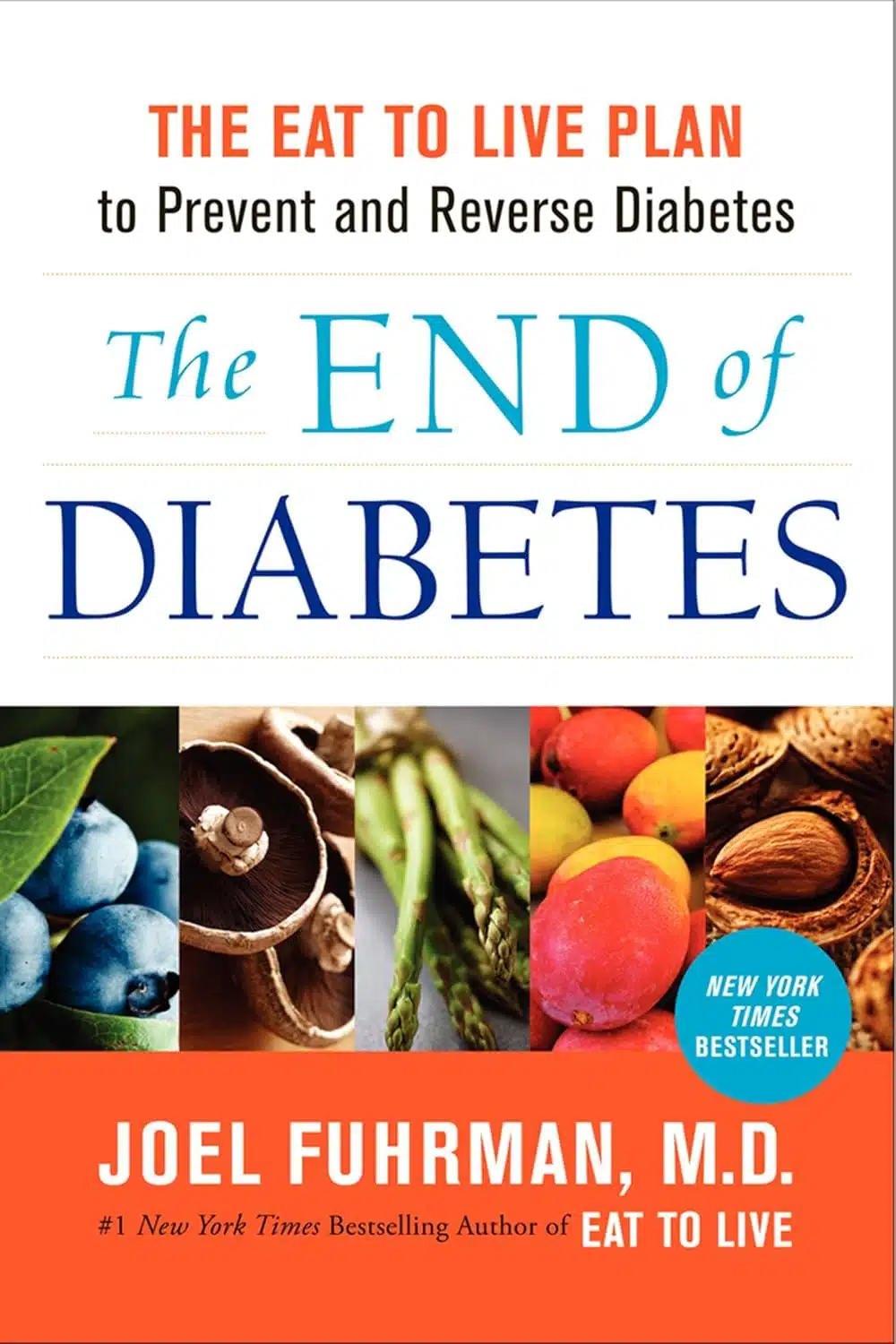
The End Of Diabetes – by Dr. Joel Fuhrman

10almonds is reader-supported. We may, at no cost to you, receive a portion of sales if you purchase a product through a link in this article.

We’ve previously reviewed another of Dr. Fuhrman’s books, “Eat To Live”, and this time, he’s focusing specifically on preventing/reversing type 2 diabetes.

And yes, this is really only about type 2 diabetes. Type 1 diabetics can still benefit from this dietary approach (it won’t cure T1D but it will help manage it), as indeed can people with one of the rarer forms of diabetes or for that matter people with no diabetes at all (it’s great for all of us to avoid blood sugar spikes and improve insulin sensitivity)… But this book is written with the type diabetic firmly in mind.

The title “The End Of…” is fair, by the way—on an individual level, at the very least. While most doctors treat type 2 diabetes as a lifelong condition to be managed, the simple (well-evidenced and honestly uncontroversial at this point) truth is that it can be reversed. So, why not do that?

The dietary approach here is sensible: eat many plants, aim for high protein, high fiber, low carb, and limit animal products to just small portions of those that don’t spike insulin levels.

It’s worth noting that Dr. Fuhrman’s “Nutritarian Diet” (which works by assigning all foods a single numerical aggregate nutritional value) has been criticised as being pseudoscientific, and technically it is (there is no evidence-base that optimizing nutrients in this fashion is best; indeed, it could result in missing out on some nutrients that are critical but occur only in otherwise lower-scoring foods—see for example if someone notes how highly Brussels sprouts score and decides to eat only Brussels sprouts, thus missing out on nutrients that aren’t in this otherwise top-tier food), but in practical application, it clearly works well and helps people to eat more nutritionally-dense foods, on balance, which can only be a good thing.

The style of the book is information-dense pop-science (with more than 20 pages of bibliography to back it up), with also a recipe section (60 pages of that). The recipes are a touch on the basic side for this reviewer’s tastes, but perhaps that’s no bad thing—it provides a good “base” from which we can all personalize our recipes according to our preferences and local availability of ingredients.

Bottom line: whether or not you (and/or a loved one) are diabetic, this is a great book for understanding glycemic control and insulin sensitivity, and a great resource for improving those in one’s own life and one’s own body.

Click here to check out The End Of Diabetes, and put an end to diabetes!

Don’t Forget…

Did you arrive here from our newsletter? Don’t forget to return to the email to continue learning!

Learn to Age Gracefully

Join the 98k+ American women taking control of their health & aging with our 100% free (and fun!) daily emails:

  • Papaya vs Pear – Which is Healthier?

    10almonds is reader-supported. We may, at no cost to you, receive a portion of sales if you purchase a product through a link in this article.

    Our Verdict

    When comparing papaya to pear, we picked the papaya.

    Why?

    Both have their merits:

    In terms of macros, pear has more fiber and carbs, winning in this category.

    In the category of vitamins, papaya has a lot more of vitamins A, B1, B2, B3, B5, B6, B7, B9, C, E, and choline, while pear has slightly more vitamin K, giving an easy win to papaya.

    Looking at minerals, papaya has more calcium, iron, magnesium, potassium, and selenium, while pear has more copper, manganese, phosphorus, and zinc, making this round a modest 5:4 win for papaya.

    Adding up the sections makes for an overall win for papaya, but by all means do enjoy either or both; diversity is good!

    Want to learn more?

    You might like:

    What’s Your Plant Diversity Score?

    Enjoy!

    Share This Post

  • Twenty-One, No Wait, Twenty Tweaks For Better Health

    10almonds is reader-supported. We may, at no cost to you, receive a portion of sales if you purchase a product through a link in this article.

    Dr. Greger’s 21 Tweaks… We say 20, though!

    We’ve talked before about Dr. Greger’s Daily Dozen (12 things he advises that we make sure to eat each day, to enjoy healthy longevity), but much less-talked-about are his “21 Tweaks”…

    They are, in short, a collection of little adjustments one can make for better health. Some of them are also nutritional, but many are more like lifestyle tweaks. Let’s do a rundown:

    At each meal:

    • Preload with water
    • Preload with “negative calorie” foods (especially: greens)
    • Incorporate vinegar (1-2 tbsp in a glass of water will slow your blood sugar increase)
    • Enjoy undistracted meals
    • Follow the 20-minute rule (enjoy your meal over the course of at least 20 minutes)

    Get your daily doses:

    • Black cumin ¼ tsp
    • Garlic powder ¼ tsp
    • Ground ginger (1 tsp) or cayenne pepper (½ tsp)
    • Nutritional yeast (2 tsp)
    • Cumin (½ tsp)
    • Green tea (3 cups)

    Every day:

    • Stay hydrated
    • Deflour your diet
    • Front-load your calories (this means implementing the “king, prince, pauper” rule—try to make your breakfast the largest meal of your day, followed my a medium lunch, and a small evening meal)
    • Time-restrict your eating (eat your meals within, for example, an 8-hour window, and fast the rest of the time)
    • Optimize exercise timing (before breakfast is best for most people, unless you are diabetic)
    • Weigh yourself twice a day (doing this when you get up and when you go to bed results in much better long-term weight management than weighing only once per day)
    • Complete your implementation intentions (this sounds a little wishy-washy, but it’s about building a set of “if this, then that” principles, and then living by them. An example could be directly physical health-related such as “if there is a choice of stairs or elevator, I will take the stairs”, or could be more about holistic good-living, such as “if someone asks me for help, I will try to oblige them so far as I reasonably can”)

    Every night:

    • Fast after 7pm
    • Get sufficient sleep (7–9 hours is best. As we get older, we tend more towards the lower end of that, but try get at least those 7 hours!)
    • Experiment with Mild Trendelenburg (better yet, skip this one)*

    *This involves a 6º elevation of the bed, at the foot end. Dr. Greger advises that this should only be undertaken after consulting your doctor, though, as a lot of health conditions can contraindicate it. We at 10almonds couldn’t find any evidence to support this practice, and numerous warnings against it, so we’re going to go ahead and say we think this one’s skippable.

    Again, we do try to bring you the best evidence-based stuff here at 10almonds, and we’re not going to recommend something just because of who suggested it

    As for the rest, you don’t have to do them all! And you may have noticed there was a little overlap in some of them. But, we consider them a fine menu of healthy life hacks from which to pick and choose!

    Share This Post

  • Skincare “Scams” That Are Actually Very Recommendable

    10almonds is reader-supported. We may, at no cost to you, receive a portion of sales if you purchase a product through a link in this article.

    Dr. Andrea Suarez explains why some things got a bad reputation despite, actually, working if used correctly:

    Looking past the surface

    What Dr. Suarez wants us to know is that some products widely labelled as skincare “scams” can be genuinely useful when their biology, limits, and realistic outcomes are understood.

    As for why they sometimes get labelled as scams, she blames overpromising marketing claims, misunderstood skin biology, and unrealistic expectations about speed and magnitude of results. Which is a pity, because bold hype can boost short-term sales (which is why it’s used), but often damages long-term trust once results fail to match the promises.

    So, with that in mind:

    • Collagen creams: no, collagen molecules do not penetrate to rebuild collagen, but they act as humectants that improve hydration, smoothness, plumpness, comfort, and symptoms such as dryness and tightness.
    • Red and near-infrared light: photobiomodulation can improve mitochondrial activity, blood flow, and inflammation, leading to modest gains in fine lines, texture, collagen density, acne inflammation, and hair thickness with consistent use. However, at-home devices require ongoing use, and deliver gradual rather than dramatic changes.
    • Retinoids : these are among the most studied dermatologic ingredients, retinoids improve collagen production, wrinkles, pigmentation, texture, and treat conditions such as acne and melasma. However, many people quit due to delayed results, irritation, dryness, and poor introduction strategies rather than any actual lack of efficacy.
    • Niacinamide : evidence supports improvements in discoloration, moisturization, redness, oil control, and glycation-related yellowing. However, overuse and stacking across multiple products, especially at high percentages above the 2–5% studied range, are likely to drive irritation and backlash.
    • Silicone tape: silicone scar sheets are evidence-based for improving raised scar thickness, texture, redness, and discomfort by reducing transepidermal water loss. However, facial taping does not replace neuromodulators or treat dynamic wrinkles, even though temporary softening from moisturization can occur.

    Red flags to watch out for: instant or permanent claims without clear science for it, vague buzzwords like “medical grade” without context, and no discussion of limitations or who should avoid the product.

    Green flags to watch out for: modest claims, emphasis on gradual improvement, clear limitations, and honest discussion of who benefits and who does not.

    For more on all of this, enjoy:

    Click Here If The Embedded Video Doesn’t Load Automatically!

    Want to learn more?

    You might also like:

    The Evidence-Based Skincare That Beats Product-Specific Hype

    Take care!

    Share This Post

  • Can We Drink To Good Health?

    10almonds is reader-supported. We may, at no cost to you, receive a portion of sales if you purchase a product through a link in this article.

    Can we drink to good health?

    We asked you for your thoughts on alcohol and heart health, and we got quite an even spread of results!

    If perchance that’s too tiny to read, the figures were:

    • 32% voted for “Alcohol is a relaxant, reduces stress, and can contain resveratrol too. It’s good for the heart!”
    • 32% voted for: “Moderate alcohol consumption can be at least neutral for the health, if not positive ⚖️”
    • 36% voted for: “Alcohol is bad for pretty much everything, including heart health ✋”

    One subscriber who voted for “Alcohol is a relaxant, reduces stress, and can contain resveratrol too. It’s good for the heart!” added the following thoughts:

    ❝While it isn’t necessary to consume alcohol, moderate amounts can be beneficial and contribute to well-being through social activity, celebrations, etc.❞

    That’s an interesting point, and definitely many people do see alcohol that way! Of course, that does not mean that one will find no social activities, celebrations, etc, in parts of the world where alcohol consumption is uncommon. Indeed, in India, wedding parties where no alcohol is consumed can go on for days!

    But, “we live in a society” and all that, and while we’re a health newsletter not a social issues newsletter, it’d be remiss of us to not acknowledge the importance of socialization for good mental health—and thus the rest of our health too.

    So, if indeed all our friends and family drink alcohol, it can certainly make abstaining more of a challenge.

    On that note, let’s take a moment to considerThe French Paradox” (an observation of a low prevalence of ischemic heart disease despite high intakes of saturated fat, a phenomenon accredited to the consumption of red wine).

    As it happens, a comprehensive review in “Circulation”, a cardiovascular health journal, has suggested the French Paradox may not be so paradoxical after all.

    Research suggests it has more to do with other lifestyle factors (and historic under-reporting of cardiovascular disease by French doctors), which would explain why Japan has lower rates of heart disease, despite drinking little wine, and more beer and spirits.

    So, our subscriber’s note may not be completely without reason! It’s just about the party, not the alcohol.

    One subscriber who voted for “Moderate alcohol consumption can be at least neutral for the health, if not positive ⚖️” wrote:

    ❝Keeping in mind, moderate means one glass of wine for women a day and two for men. Hard alcohol doesn’t have the same heart benefits as wine❞

    That is indeed the guideline according to some health bodies!

    In other places with different guiding advisory bodies, that’s been dropped down to one a day for everyone (the science may be universal, but how government institutions interpret that is not).

    About that wine… Specifically, red wine, for its resveratrol content:

    While there are polyphenols such as resveratrol in red wine that could boost heart health, there’s so little per glass that you may need 100–1000 glasses to get the dosage that provides benefits in mouse studies. If you’re not a mouse, you might even need more.

    To this end, many people prefer resveratrol supplementation. ← link is to an example product, but there are plenty more so feel free to shop around

    A subscriber who voted for “Alcohol is bad for pretty much everything, including heart health ✋” says:

    ❝New guidelines suggest 1 to 2 drinks a week are okay but the less the better.❞

    If you haven’t heard these new guidelines, we’ll mention again: every government has its own official bodies and guidelines so perhaps your local guidelines differ, but for example here’s what that World Health Organization has to say (as of January this year):

    WHO: No level of alcohol consumption is safe for our health

    So, whom to believe? The governments who hopefully consider the welfare of their citizenry more important than the tax dollars from alcohol sales, or the World Health Organization?

    It’s a tough one, but we’ll always err on the side of the science.

    Don’t Forget…

    Did you arrive here from our newsletter? Don’t forget to return to the email to continue learning!

    Learn to Age Gracefully

    Join the 98k+ American women taking control of their health & aging with our 100% free (and fun!) daily emails:

  • What’s The Best Position To Sleep In?

    10almonds is reader-supported. We may, at no cost to you, receive a portion of sales if you purchase a product through a link in this article.

    Dr. Rachel Salas takes us through the options:

    Put yourself in your position

    Sleep position is important, because it changes the arrangement of internal organs and (through that and other means) can influence chronic health conditions, spinal alignment, muscle relaxation, morning stiffness, and even cognitive decline (which is arguably a chronic health condition, but deserves its own mention as people often don’t think of it as such).

    As for what’s “normal”, often it’s tied to age: babies are advised to sleep on their backs to reduce choking and suffocation risk (so, parents will often tend to ensuring the baby follows that advice), children commonly sleep on their sides or backs, and adolescents/adults usually prefer side-sleeping, with stomach-sleeping being the least common.

    It’s also worth noting that most people change position 20–30 times each night, and these movements help relieve pressure, respond to discomfort, and generally keep things ticking over nicely the way they should. However, even with this in mind, usually some positions are more favored than others, e.g. alternating between two main positions, or switching between numerous positions but most often returning to the same one, that sort of thing.

    Now, for the positions and their effects:

    • Stomach sleeping: sleeping prone is generally the least recommended position because it can flatten the natural curve of your spine, although it may help some people with respiratory conditions by allowing the back portions of the lungs to expand more freely.
    • Back sleeping: sleeping on your back can help some people with lower back pain, especially when a small pillow is placed under your knees to support your spine’s natural curve.
      • Special note about snoring and sleep apnea: back sleeping can cause the soft tissues of your throat and tongue to fall backwards into your airway, increasing snoring and potentially worsening obstructive sleep apnea by making airway collapse more likely.
    • Side-sleeping: most experts generally recommend side-sleeping, particularly with a pillow between your knees, because it can improve spinal alignment. An additional thing that’s not mentioned in the video is also that side-sleeping is best for the brain’s glymphatic system, for reasons discussed in the “learn more” link at the bottom of this article.
      • Left-side sleeping: sleeping on your left side may reduce heartburn and acid reflux symptoms because your stomach sits mostly on the left side of your body, allowing gravity to help keep stomach acid from flowing into your esophagus.
      • Right-side sleeping: people with congestive heart failure may sleep better on their right side because it can reduce pressure on an enlarged left ventricle and improve comfort.

    Thus, the ideal position depends on an individual’s health conditions, symptoms, and comfort—with the above factors taken into account.

    For more on all of this as well as visual illustrations (and some interesting trivia about debunked pseudoscience pertaining to sleep positions and personality), enjoy:

    Click Here If The Embedded Video Doesn’t Load Automatically!

    Want to learn more?

    You might also like:

    Sleeping Positions & Your Heart & Brain

    Take care!

    Don’t Forget…

    Did you arrive here from our newsletter? Don’t forget to return to the email to continue learning!

    Learn to Age Gracefully

    Join the 98k+ American women taking control of their health & aging with our 100% free (and fun!) daily emails:

  • Accidental falls in the older adult population: What academic research shows

    10almonds is reader-supported. We may, at no cost to you, receive a portion of sales if you purchase a product through a link in this article.

    Accidental falls are among the leading causes of injury and death among adults 65 years and older worldwide. As the aging population grows, researchers expect to see an increase in the number of fall injuries and related health spending.

    Falls aren’t unique to older adults. Nealy 684,000 people die from falls each year globally. Another 37.3 million people each year require medical attention after a fall, according to the World Health Organization. But adults 65 and older account for the greatest number of falls.

    In the United States, more than 1 in 4 older adults fall each year, according to the National Institute on Aging. One in 10 report a fall injury. And the risk of falling increases with age.

    In 2022, health care spending for nonfatal falls among older adults was $80 billion, according to a 2024 study published in the journal Injury Prevention.

    Meanwhile, the fall death rate in this population increased by 41% between 2012 and 2021, according to the latest CDC data.

    “Unfortunately, fall-related deaths are increasing and we’re not sure why that is,” says Dr. Jennifer L. Vincenzo, an associate professor at the University of Arkansas for Medical Sciences in the department of physical therapy and the Center for Implementation Research. “So, we’re trying to work more on prevention.”

    Vincenzo advises journalists to write about how accidental falls can be prevented. Remind your audiences that accidental falls are not an inevitable consequence of aging, and that while we do decline in many areas with age, there are things we can do to minimize the risk of falls, she says. And expand your coverage beyond the national Falls Prevention Awareness Week, which is always during the first week of fall — Sept. 23 to 27 this year.

    Below, we explore falls among older people from different angles, including injury costs, prevention strategies and various disparities. We have paired each angle with data and research studies to inform your reporting.

    Falls in older adults

    In 2020, 14 million older adults in the U.S. reported falling during the previous year. In 2021, more than 38,700 older adults died due to unintentional falls, according to the CDC.

    A fall could be immediately fatal for an older adult, but many times it’s the complications from a fall that lead to death.

    The majority of hip fractures in older adults are caused by falls, Vincenzo says, and “it could be that people aren’t able to recover [from the injury], losing function, maybe getting pneumonia because they’re not moving around, or getting pressure injuries,” she says.

    In addition, “sometimes people restrict their movement and activities after a fall, which they think is protective, but leads to further functional declines and increases in fall risk,” she adds.

    Factors that can cause a fall include:

    • Poor eyesight, reflexes and hearing. “If you cannot hear as well, anytime you’re doing something in your environment and there’s a noise, it will be really hard for you to focus on hearing what that noise is and what it means and also moving at the same time,” Vincenzo says.
    • Loss of strength, balance, and mobility with age, which can lessen one’s ability to prevent a fall when slipping or tripping.
    • Fear of falling, which usually indicates decreased balance.
    • Conditions such as diabetes, heart disease, or problems with nerves or feet that can affect balance.
    • Conditions like incontinence that cause rushed movement to the bathroom.
    • Cognitive impairment or certain types of dementia.
    • Unsafe footwear such as backless shoes or high heels.
    • Medications or medication interactions that can cause dizziness or confusion.
    • Safety hazards in the home or outdoors, such as poor lighting, steps and slippery surfaces.

    Related Research

    Nonfatal and Fatal Falls Among Adults Aged ≥65 Years — United States, 2020–2021
    Ramakrishna Kakara, Gwen Bergen, Elizabeth Burns and Mark Stevens. Morbidity and Mortality Weekly Report, September 2023.

    Summary: Researchers analyzed data from the 2020 Behavioral Risk Factor Surveillance System — a landline and mobile phone survey conducted each year in all 50 U.S. states and the District of Columbia — and data from the 2021 National Vital Statistics System to identify patterns of injury and death due to falls in the U.S. by sex and state for adults 65 years and older. Among the findings:

    • The percentage of women who reported falling was 28.9%, compared with 26.1% of men.
    • Death rates from falls were higher among white and American Indian or Alaska Native older adults than among older adults from other racial and ethnic groups.
    • In 2020, the percentage of older adults who reported falling during the past year ranged from 19.9% in Illinois to 38.0% in Alaska. The national estimate for 18 states was 27.6%.
    • In 2021, the unintentional fall-related death rate among older adults ranged from 30.7 per 100,000 older adults in Alabama to 176.5 in Wisconsin. The national estimate for 26 states was 78.

    “Although common, falls among older adults are preventable,” the authors write. “Health care providers can talk with patients about their fall risk and how falls can be prevented.”

    Trends in Nonfatal Falls and Fall-Related Injuries Among Adults Aged ≥65 Years — United States, 2012-2018
    Briana Moreland, Ramakrishna Kakara and Ankita Henry. Morbidity and Mortality Weekly Report, July 2020.

    Summary: Researchers compared data from the 2018 Behavioral Risk Factor Surveillance System. Among the findings:

    • The percentage of older adults reporting a fall increased from 2012 to 2016, then slightly decreased from 2016 to 2018.
    • Even with this decrease in 2018, older adults reported 35.6 million falls. Among those falls, 8.4 million resulted in an injury that limited regular activities for at least one day or resulted in a medical visit.

    “Despite no significant changes in the rate of fall-related injuries from 2012 to 2018, the number of fall-related injuries and health care costs can be expected to increase as the proportion of older adults in the United States grows,” the authors write.

    Understanding Modifiable and Unmodifiable Older Adult Fall Risk Factors to Create Effective Prevention Strategies
    Gwen Bergen, et al. American Journal of Lifestyle Medicine, October 2019.

    Summary: Researchers used data from the 2016 U.S. Behavioral Risk Factor Surveillance System to better understand the association between falls and fall injuries in older adults and factors such as health, state and demographic characteristics. Among the findings:

    • Depression had the strongest association with falls and fall injuries. About 40% of older adults who reported depression also reported at least one fall; 15% reported at least one fall injury.
    • Falls and depression have several factors in common, including cognitive impairment, slow walking speed, poor balance, slow reaction time, weakness, low energy and low levels of activity.
    • Other factors associated with an increased risk of falling include diabetes, vision problems and arthritis.

    “The multiple characteristics associated with falls suggest that a comprehensive approach to reducing fall risk, which includes screening and assessing older adult patients to determine their unique, modifiable risk factors and then prescribing tailored care plans that include evidence-based interventions, is needed,” the authors write.

    Health care use and cost

    In addition to being the leading cause of injury, falls are the leading cause of hospitalization in older adults. Each year, about 3 million older adults visit the emergency department due to falls. More than 1 million get hospitalized.

    In 2021, falls led to more than 38,000 deaths in adults 65 and older, according to the CDC.

    The annual financial medical toll of falls among adults 65 years and older is expected to be more than $101 billion by 2030, according to the National Council on Aging, an organization advocating for older Americans.

    Related research

    Healthcare Spending for Non-Fatal Falls Among Older Adults, USA
    Yara K. Haddad, et al. Injury Prevention, July 2024.

    Summary: In 2015, health care spending related to falls among older adults was roughly $50 billion. This study aims to update the estimate, using the 2017, 2019 and 2021 Medicare Current Beneficiary Survey, the most comprehensive and complete survey available on the Medicare population. Among the findings:

    • In 2020, health care spending for non-fatal falls among older adults was $80 billion.
    • Medicare paid $53.3 billion of the $80 billion, followed by $23.2 billion paid by private insurance or patients and $3.5 billion by Medicaid.

    “The burden of falls on healthcare systems and healthcare spending will continue to rise if the risk of falls among the aging population is not properly addressed,” the authors write. “Many older adult falls can be prevented by addressing modifiable fall risk factors, including health and functional characteristics.”

    Cost of Emergency Department and Inpatient Visits for Fall Injuries in Older Adults Lisa Reider, et al. Injury, February 2024.

    Summary: The researchers analyzed data from the 2016-2018 National Inpatient Sample and National Emergency Department Sample, which are large, publicly available patient databases in the U.S. that include all insurance payers such as Medicare and private insurance. Among the findings:

    • During 2016-2018, more than 920,000 older adults were admitted to the hospital and 2.3 million visited the emergency department due to falls. The combined annual cost was $19.2 billion.
    • More than half of hospital admissions were due to bone fractures. About 14% of these admissions were due to multiple fractures and cost $2.5 billion.

    “The $20 billion in annual acute treatment costs attributed to fall injury indicate an urgent need to implement evidence-based fall prevention interventions and underscores the importance of newly launched [emergency department]-based fall prevention efforts and investments in geriatric emergency departments,” the authors write.

    Hip Fracture-Related Emergency Department Visits, Hospitalizations and Deaths by Mechanism of Injury Among Adults Aged 65 and Older, United States 2019
    Briana L. Moreland, Jaswinder K. Legha, Karen E. Thomas and Elizabeth R. Burns. Journal of Aging and Health, June 2024.

    Summary: The researchers calculated hip fracture-related U.S. emergency department visits, hospitalizations and deaths among older adults, using data from the Healthcare Cost and Utilization Project and the National Vital Statistics System. Among the findings:

    • In 2019, there were 318,797 emergency department visits, 290,130 hospitalizations and 7,731 deaths related to hip fractures among older adults.
    • Nearly 88% of emergency department visits and hospitalizations and 83% of deaths related to hip fractures were caused by falls.
    • These rates were highest among those living in rural areas and among adults 85 and older. More specifically, among adults 85 and older, the rate of hip fracture-related emergency department visits was nine times higher than among adults between 65 and 74 years old.

    “Falls are common among older adults, but many are preventable,” the authors write. “Primary care providers can prevent falls among their older patients by screening for fall risk annually or after a fall, assessing modifiable risk factors such as strength and balance issues, and offering evidence-based interventions to reduce older adults’ risk of falls.”

    Fall prevention

    Several factors, including exercising, managing medication, checking vision and making homes safer can help prevent falls among older adults.

    “Exercise is one of the best interventions we know of to prevent falls,” Vincenzo says. But “walking in and of itself will not help people to prevent falls and may even increase their risk of falling if they are at high risk of falls.”

    The National Council on Aging also has a list of evidence-based fall prevention programs, including activities and exercises that are shown to be effective.

    The National Institute on Aging has a room-by-room guide on preventing falls at home. Some examples include installing grab bars near toilets and on the inside and outside of the tub and shower, sitting down while preparing food to prevent fatigue, and keeping electrical cords near walls and away from walking paths.

    There are also national and international initiatives to help prevent falls.

    Stopping Elderly Accidents, Deaths and Injuries, or STEADI, is an initiative by the CDC’s Injury Center to help health care providers who treat older adults. It helps providers screen patients for fall risk, assess their fall risk factors and reduce their risk by using strategies that research has shown to be effective. STEADI’s guidelines are in line with the American and British Geriatric Societies’ Clinical Practice Guidelines for fall prevention.

    “We’re making some iterations right now to STEADI that will come out in the next couple of years based on the World Falls Guidelines, as well as based on clinical providers’ feedback on how to make [STEADI] more feasible,” Vincenzo says.

    The World Falls Guidelines is an international initiative to prevent falls in older adults. The guidelines are the result of the work of 14 international experts who came together in 2019 to consider whether new guidelines on fall prevention were needed. The task force then brought together 96 experts from 39 countries across five continents to create the guidelines.

    The CDC’s STEADI initiative has a screening questionnaire for consumers to check their risk of falls, as does the National Council on Aging.

    On the policy side, U.S. Rep. Carol Miller, R-W.V., and Melanie Stansbury, D-N.M., introduced the Stopping Addiction and Falls for the Elderly (SAFE) Act in March 2024. The bill would allow occupational and physical therapists to assess fall risks in older adults as part of the Medicare Annual Wellness Benefit. The bill was sent to the House Subcommittee on Health in the same month.

    Meanwhile, older adults’ attitudes toward falls and fall prevention are also pivotal. For many, coming to terms with being at risk of falls and making changes such as using a cane, installing railings at home or changing medications isn’t easy for all older adults, studies show.

    “Fall is a four-letter F-word in a way to older adults,” says Vincenzo, who started her career as a physical therapist. “It makes them feel ‘old.’ So, it’s a challenge on multiple fronts: U.S. health care infrastructure, clinical and community resources and facilitating health behavior change.”

    Related research

    Environmental Interventions for Preventing Falls in Older People Living in the Community
    Lindy Clemson, et al. Cochrane Database of Systematic Reviews, March 2023.

    Summary: This review includes 22 studies from 10 countries involving a total of 8,463 older adults who live in the community, which includes their own home, a retirement facility or an assisted living facility, but not a hospital or nursing home. Among the findings:

    • Removing fall hazards at home reduced the number of falls by 38% among older adults at a high risk of having a fall, including those who have had a fall in the past year, have been hospitalized or need support with daily activities. Examples of fall hazards at home include a stairway without railings, a slippery pathway or poor lighting.
    • It’s unclear whether checking prescriptions for eyeglasses, wearing special footwear or installing bed alarm systems reduces the rate of falls.
    • It’s also not clear whether educating older adults about fall risks reduces their fall risk.

    The Influence of Older Adults’ Beliefs and Attitudes on Adopting Fall Prevention Behaviors
    Judy A. Stevens, David A. Sleet and Laurence Z. Rubenstein. American Journal of Lifestyle Medicine. January 2017.

    Summary: Persuading older adults to adopt interventions that reduce their fall risk is challenging. Their attitudes and beliefs about falls play a large role in how well they accept and adopt fall prevention strategies, the authors write. Among the common attitudes and beliefs:

    • Many older adults believe that falls “just happen,” are a normal result of aging or are simply due to bad luck.
    • Many don’t acknowledge or recognize their fall risk.
    • For many, falls are considered to be relevant only for frail or very old people.
    • Many believe that their home environment or daily activities can be a risk for fall, but do not consider biological factors such as dizziness or muscle weakness.
    • For many, fall prevention simply consists of “being careful” or holding on to things when moving about the house.

    “To reduce falls, health care practitioners have to help patients understand and acknowledge their fall risk while emphasizing the positive benefits of fall prevention,” the authors write. “They should offer patients individualized fall prevention interventions as well as provide ongoing support to help patients adopt and maintain fall prevention strategies and behaviors to reduce their fall risk. Implementing prevention programs such as CDC’s STEADI can help providers discuss the importance of falls and fall prevention with their older patients.”

    Reframing Fall Prevention and Risk Management as a Chronic Condition Through the Lens of the Expanded Chronic Care Model: Will Integrating Clinical Care and Public Health Improve Outcomes?
    Jennifer L. Vincenzo, Gwen Bergen, Colleen M. Casey and Elizabeth Eckstrom. The Gerontologist, June 2024.

    Summary: The authors recommend approaching fall prevention from the lens of chronic disease management programs because falls and fall risk are chronic issues for many older adults.

    “Policymakers, health systems, and community partners can consider aligning fall risk management with the [Expanded Chronic Care Model], as has been done for diabetes,” the authors write. “This can help translate high-quality research on the effectiveness of fall prevention interventions into daily practice for older adults to alter the trajectory of older adult falls and fall-related injuries.”

    Disparities

    Older adults face several barriers to reducing their fall risk. Accessing health care services and paying for services such as physical therapy is not feasible for everyone. Some may lack transportation resources to go to and from medical appointments. Social isolation can increase the risk of death from falls. In addition, physicians may not have the time to fit in a fall risk screening while treating older patients for other health concerns.

    Moreover, implementing fall risk screening, assessment and intervention in the current U.S. health care structure remains a challenge, Vincenzo says.

    Related research

    Mortality Due to Falls by County, Age Group, Race, and Ethnicity in the USA, 2000-19: A Systematic Analysis of Health Disparities
    Parkes Kendrick, et al. The Lancet Public Health, August 2024.

    Summary: Researchers analyzed death registration data from the U.S. National Vital Statistics System and population data from the U.S. National Center for Health Statistics to estimate annual fall-related mortality. The data spanned from 2000 to 2019 and includes all age groups. Among the findings:

    • The disparities between racial and ethnic populations varied widely by age group. Deaths from falls among younger adults were highest for the American Indian/Alaska Native population, while among older adults it was highest for the white population.
    • For older adults, deaths from falls were particularly high in the white population within clusters of counties across states including Florida, Minnesota and Wisconsin.
    • One factor that could contribute to higher death rates among white older adults is social isolation, the authors write. “Studies suggest that older Black and Latino adults are more likely to have close social support compared with older white adults, while AIAN and Asian individuals might be more likely to live in multigenerational households,” they write.

    “Among older adults, current prevention techniques might need to be restructured to reduce frailty by implementing early prevention and emphasizing particularly successful interventions. Improving social isolation and evaluating the effectiveness of prevention programs among minoritized populations are also key,” the authors write.

    Demographic Comparisons of Self-Reported Fall Risk Factors Among Older Adults Attending Outpatient Rehabilitation
    Mariana Wingood, et al. Clinical Interventions in Aging, February 2024.

    Summary: Researchers analyzed the electronic health record data of 108,751 older adults attending outpatient rehabilitation within a large U.S. health care system across seven states, between 2018 and 2022. Among the findings:

    • More than 44% of the older adults were at risk of falls; nearly 35% had a history of falls.
    • The most common risk factors for falls were diminished strength, gait and balance.
    • Compared to white older adults, Native American/Alaska Natives had the highest prevalence of fall history (43.8%) and Hispanics had the highest prevalence of falls with injury (56.1%).

    “Findings indicate that rehabilitation providers should perform screenings for these impairments, including incontinence and medication among females, loss of feeling in the feet among males, and all Stay Independent Questionnaire-related fall risk factors among Native American/Alaska Natives, Hispanics, and Blacks,” the authors write.

    Resources and articles

    This article first appeared on The Journalist’s Resource and is republished here under a Creative Commons license.

    Don’t Forget…

    Did you arrive here from our newsletter? Don’t forget to return to the email to continue learning!

    Learn to Age Gracefully

    Join the 98k+ American women taking control of their health & aging with our 100% free (and fun!) daily emails: