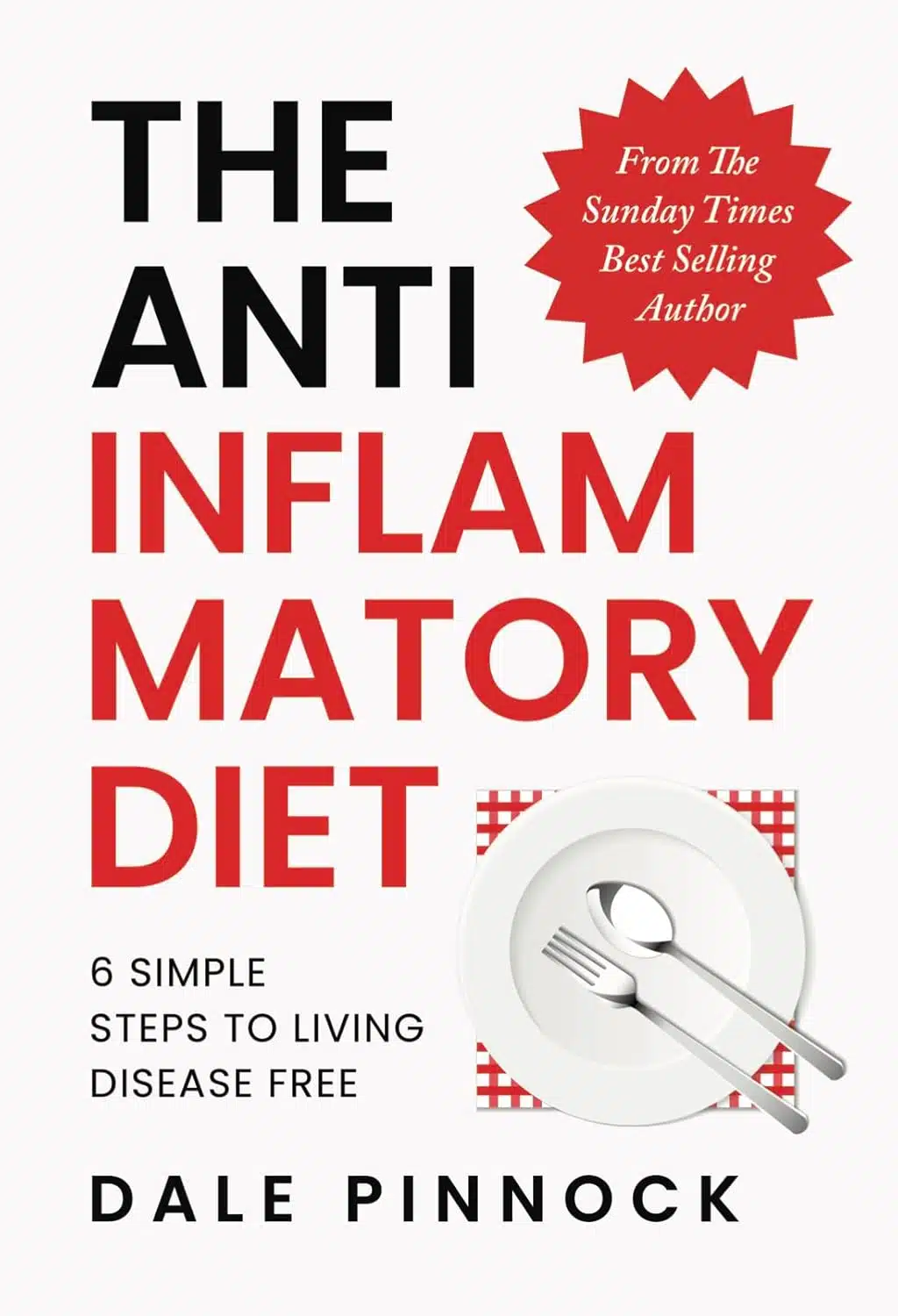
The Anti-Inflammatory Diet – by Dale Pinnock

10almonds is reader-supported. We may, at no cost to you, receive a portion of sales if you purchase a product through a link in this article.

We previously reviewed this author’s “The Medicinal Chef”, which focus on a “eat this to improve that” approach on a system-by-system basis through the body. This time, it’s purely about fighting inflammation.

This is important, because inflammation is a root cause of many diseases, and the diseases it doesn’t outright cause, it makes nearly all of them worse.

Thus, Pinnock takes us through a simple explanation of the biology of inflammation, the impact of chronic inflammation on health, and non-dietary lifestyle drivers of such, plus the all-important gut-inflammation connection.

Thereafter, he presents dietary solutions: being aware of foods that “fuel the fire” of inflammation, to avoid or at least minimize those, and then how to “power your plate” with actively anti-inflammatory foods that stand a tier above the “well, at least they don’t make it worse” middle-range foods, to instead give your body everything it needs to dial down inflammation the most effectively. And yes, there are recipes (80 of them).

For those who like step-by-step “do this, do that” plans, that’s what the “6 simple steps” mentioned in the subtitle are (it’s a 6-week plan), and this is toward the end of the book, to bring together everything learned over the course of the book, and integrate those learnings into one’s kitchen and life.

The style is the lightest of light pop-science, which is what one might expect from a TV chef who isn’t a scientist or doctor, but the scientific content is nevertheless sound, and well-referenced.

Bottom line: if you’d like to reduce your inflammation in an easy, step-by-step fashion, this book can definitely help with that.

Click here to check out The Anti-Inflammatory Diet, and dial down your inflammation!

Don’t Forget…

Did you arrive here from our newsletter? Don’t forget to return to the email to continue learning!

Learn to Age Gracefully

Join the 98k+ American women taking control of their health & aging with our 100% free (and fun!) daily emails:

  • 100 Ways to Change Your Life – by Liz Moody

    10almonds is reader-supported. We may, at no cost to you, receive a portion of sales if you purchase a product through a link in this article.

    Sometimes we crave changing things up, just to feel something new. This can result in anything from bad haircut decisions or impulsive purchases, to crashing and burning-out of a job, project, or relationship. It doesn’t have to be that way, though!

    This book brings us (as the title suggest) 100 evidence-based ways of changing things up in a good way—small things that can make a big difference in many areas of life.

    In terms of format, these are presented in 100 tiny chapters, each approximately 2 pages long (obviously it depends on the edition, but you get the idea). Great to read in any of at least three ways:

    1. Cover-to-cover
    2. One per day for 100 days
    3. Look up what you need on an ad hoc basis

    Bottom line: even if you already do half of these things, the other half will each compound your health happiness one-by-one as you add them. This is a very enjoyable and practical book!

    Click here to check out 100 Ways to Change Your Life, and level-up yours!

    Share This Post

  • Pumpkin Protein Crackers

    10almonds is reader-supported. We may, at no cost to you, receive a portion of sales if you purchase a product through a link in this article.

    Ten of these (give or take what size you make them) will give you the 20g protein that most people’s body’s can use at a time. Five of these plus some of one of the dips we list at the bottom will also do it:

    You will need

    • 1 cup chickpea flour (also called gram flour or garbanzo bean flour)
    • 2 tbsp pumpkin seeds
    • 1 tbsp chia seeds
    • 1 tsp baking powder
    • ¼ tsp MSG or ½ tsp low-sodium salt
    • 2 tbsp extra virgin olive oil

    Method

    (we suggest you read everything at least once before doing anything)

    1) Preheat the oven to 350℉ / 180℃.

    2) Combine the dry ingredients in a mixing bowl, and mix thoroughly.

    3) Add the oil, and mix thoroughly.

    4) Add water, 1 tbsp at a time, mixing thoroughly until the mixture comes together and you have a dough ball. You’ll probably need 3–4 tbsp in total, but do add them one at a time.

    5) Roll out the dough as thinly and evenly as you can between two sheets of baking paper. Remove the top layer of the paper, and slice the dough into squares or triangles. You could use a cookie-cutter to make other shapes if you like, but then you’ll need to repeat the rolling to use up the offcuts. So we recommend squares or triangles at least for your first go.

    6) Bake them in the oven for 12–15 minutes or until golden and crispy. Enjoy immediately or keep in an airtight container.

    Enjoy!

    Want to learn more?

    For those interested in some things to go with what we have going on today:

    Take care!

    Share This Post

  • Can You Get Addicted To MSG, Like With Sugar?

    10almonds is reader-supported. We may, at no cost to you, receive a portion of sales if you purchase a product through a link in this article.

    Have a question or a request? We love to hear from you!

    In cases where we’ve already covered something, we might link to what we wrote before, but will always be happy to revisit any of our topics again in the future too—there’s always more to say!

    As ever: if the question/request can be answered briefly, we’ll do it here in our Q&A Thursday edition. If not, we’ll make a main feature of it shortly afterwards!

    So, no question/request too big or small 😎

    ❝Hello, I love your newsletter 🙂 Can I have a question? While browsing through your recepies, I realised many contained MSG. As someone based in Europe, I am not used to using MSG while cooking (of course I know that processed food bought in supermarket containes MSG). There is a stigma, that MSG is not particulary healthy, but rather it should be really bad and cause negative effects like headaches. Is this true? Also, can you get addicted to MSG, just like you get addicted to sugar? Thank you :)❞

    Thank you for the kind words, and the interesting questions!

    Short answer: no and no 🙂

    Longer answer: most of the negative reputation about MSG comes from a single piece of satire written in the US in the 1960s, which the popular press then misrepresented as a genuine concern, and the public then ran with, mostly due to racism/xenophobia/sinophobia specifically, given the US’s historically not fabulous relations with China, and the moniker of “Chinese restaurant syndrome”, notwithstanding that MSG was first isolated in Japan, not China, more than 100 years ago.

    The silver lining that comes out of this is that because of the above, MSG has been one of the most-studied food additives in recent decades, with many teams of scientists in many countries trying to determine its risks and not finding any (except insofar as anything in extreme quantities can kill you, including water or oxygen).

    You can read more about this and other* myths about MSG, here:

    Monosodium Glutamate: Sinless Flavor-Enhancer Or Terrible Health Risk?

    *such as pertaining to gluten sensitivity, which in reality MSG has no bearing on whatsoever as it does not contain gluten and is not even made of the same basic stuff; gluten being a protein made of (amongst other things) the amino acid glutamine, not a glutamate salt. Glutamate is as closely related to gluten as cyanocobalamin (vitamin B12) is to cyanide (the famous poison).

    PS: if you didn’t click the above link to read that article, then 1) we really do recommend it 2) we did some LD50 calculations there and looked at available research, and found that for someone of this writer’s (very medium) size, eating 1kg of MSG at once is sufficient to cause toxicity, and injecting >250g of MSG may cause heart problems. So we don’t recommend doing that.

    However, ½ tsp in a recipe that gives multiple portions is not going to get you anywhere close to the danger zone, unless you consume that entire meal by yourself hundreds of times per day. And if you do, the MSG is probably the least of your concerns.

    (2 tsp of cassia cinnamon, however, is enough to cause coumarin toxicity; for this reason we recommend Ceylon (or “True” or “Sweet”) cinnamon in our recipes, as it has almost undetectable levels of coumarin)

    With regard to your interesting question about addiction, first of all let’s speak briefly about sugar addiction:

    Sugar addiction is, by broad scientific consensus, agreed-upon as an extant thing that does exist, and contemporary research is more looking into the “hows” and “whys” and “whats” rather than the “whether”. It is a somewhat complicated topic, because it’s halfway between what science would usually consider a chemical addiction, and what science would usually consider a behavioral addiction:

    The Not-So-Sweet Science Of Sugar Addiction

    The reasonable prevailing hypothesis, therefore, is that sugar simply has two moderate mechanisms of addiction, rather than one strong one.

    The biochemical side of sugar addiction comes from the body’s metabolism of sugar, so this cannot be a thing for MSG, because there is nothing to metabolize in the same sense of the word (MSG being an inorganic compound with zero calories).

    People can crave salt, especially when deficient in it, and MSG does contain sodium (it’s what the “S” stands for), but it contains a little under ⅓ of the sodium that table salt does (sodium chloride in whatever form, be it sea salt, rock salt, or such):

    MSG vs. Salt: Sodium Comparison ← we do molecular calculations here!

    Sea Salt vs MSG – Which is Healthier? ← this one for a head-to-head

    However, even craving salt does not constitute an addiction; nobody is shamefully hiding their rock salt crystals under their bed and getting a fix when they feel low, and nor does withdrawal cause adverse side effects, except insofar as (once again) a person deficient in salt will crave salt.

    Finally, the only other way we know of that one might wonder if MSG could be addictive, is about glutamate and glutamate receptors. The glutamate in MSG is the same glutamate (down to the atoms) as the glutamate formed if one consumes tomatoes in the presence of salt, and triggers the same glutamate receptors in the same way. We have the same number of receptors either way, and uptake is exactly the same (because again, it’s exactly the same chemical) so there is a maximum to how strong this effect can be, and that maximum is the same whatever the source of the glutamate was.

    In this respect, if MSG is addictive, then so is a tomato salad with a pinch of salt: it’s not—it’s just tasty.

    We haven’t cited papers in today’s article, but it’s just because we cited them already in the articles we linked, and so we avoided doubling up. Most of them are in that first link we gave 🙂

    One final note

    Technically anyone can develop a sensitivity to anything, so in theory someone could develop a sensitivity to MSG, just like they could for any other ingredient. Our usual legal/medical disclaimer applies.

    However, it’s certainly not a common trigger, putting it well below common allergens like nuts (or less common allergens like, say, bananas), not even in the same league as common intolerances such as gluten, and less worthy of health risk warnings than, say, spinach (high in oxalates; fine for most people but best avoided if you have kidney problems).

    The reason we use it in the recipes we use it in, is simply because it’s a lower-sodium alternative to salt, and while it contains a (very) tiny bit less sodium than low-sodium salt (which itself has about ⅓ the sodium of regular salt), it has more of a flavor-enhancing effect, such that one can use half as much, for a more than sixfold total sodium reduction. Which for most of us in the industrialized world, is beneficial.

    Want to try some?

    If today’s article has inspired you to give MSG a try, here’s an example product on Amazon 😎

    Enjoy!

    Share This Post

  • What Your Skin Says About Nutrient Deficiencies

    10almonds is reader-supported. We may, at no cost to you, receive a portion of sales if you purchase a product through a link in this article.

    Dr. Andrea Suarez, dermatologist, shows us:

    Watch out for…

    Fun fact: skin, hair, and nail cells divide rapidly, making them among the first tissues to reflect inadequate nutrition.

    These deficiencies mimic other common skin conditions: nutrient shortages can disrupt your skin barrier, immune function, cell turnover, and inflammation control, causing rashes that resemble dandruff, eczema, acne, or seborrheic dermatitis.

    So, what’s to blame?

    Deficiencies and their signs/symptoms include:

    • Vitamin B2 deficiency: can cause severely chapped lips, cracks at the corners of your mouth, angular cheilitis, a smooth red tongue, and a facial rash that resembles seborrheic dermatitis.
    • Vitamin B3 deficiency: can cause a severe sunburn-like rash, skin darkening and thickening, a dark band around the neck called Casal’s necklace, mouth pain, a smooth tongue, diarrhea, dementia, and can eventually be fatal if untreated (technically all vitamin deficiencies are fatal if not corrected, or else they wouldn’t be called vitamins, but this one speedruns it)
    • Vitamin B6 deficiency: can produce a seborrheic dermatitis-like facial rash, dandruff, and eczema-like skin changes, especially in people with alcohol misuse, inflammatory bowel disease, malabsorption disorders, kidney failure, or certain medication use.
    • Vitamin B9 deficiency: can contribute to pale skin, brittle nails, mouth sores, fatigue, and symptoms that overlap with B12 deficiency.
    • Vitamin B12 deficiency: can cause skin darkening, especially in skin folds and on your palms, dark streaks in your nails, a sore smooth tongue, loss of taste, angular cheilitis, and sometimes premature graying of your hair.
    • Iron deficiency: can lead to hair thinning, excessive shedding, brittle nails, spoon-shaped nails, pale or dry skin, and unexplained itching.

    For more on all of this plus visual illustrations, enjoy:

    Click Here If The Embedded Video Doesn’t Load Automatically!

    Want to learn more?

    As for why you might want to favor getting these from food if you can, then while the title says “vitamins”, the following book discusses an assortment of vitamins, minerals, and other nutrients; the “other nutrients” category including amino acids (branched chain and essential), prebiotics and probiotics, and triglycerides of various kinds:

    Eat Your Vitamins – by Mascha Davis, RDN ← see our review, here

    Take care!

    Don’t Forget…

    Did you arrive here from our newsletter? Don’t forget to return to the email to continue learning!

    Learn to Age Gracefully

    Join the 98k+ American women taking control of their health & aging with our 100% free (and fun!) daily emails:

  • The Music That Keeps Dementia At Bay

    10almonds is reader-supported. We may, at no cost to you, receive a portion of sales if you purchase a product through a link in this article.

    We have previously addressed the question: Does Music Really Benefit The Brain?

    The short answer is “yes”, the longer answer we covered in the above-linked article, and today we will explore another benefit:

    Tuning in to lasting cognitive health

    Researchers (Dr. Emma Jaffa et al.) investigated the effects of listening to music, playing to music, or both, on cognitive health in older age.

    Specifically, the study looked at 10,893 people over the age of 70 with no diagnosis of dementia at the start of the study.

    In a nutshell, they found:

    • older adults who listened to music after age 70 enjoyed a 39% lower risk of dementia and a 17% lower risk of cognitive impairment.
    • those who played a musical instrument had a 35% lower risk of dementia compared with those who rarely or never played, but no additional reduction in risk of cognitive impairment.
    • people who both listened to and played music regularly showed a 33% reduction in dementia risk and a 22% reduction in cognitive impairment.

    Furthermore, benefits were strongest in those with higher education (16+ years) but showed inconsistent results in the middle education group (12–15 years).

    You can find the paper itself, here: What Is the Association Between Music-Related Leisure Activities and Dementia Risk? A Cohort Study

    You might be wondering:

    • why playing music yields a lower decrease in risk of dementia than listening to it
    • why doing both yields an even smaller reduction in dementia risk than listening without playing or playing without listening

    That’s very counterintuitive, isn’t it? We might hypothesize that the answer lies in how we go about the activities, and what that means for our brain.

    It is quite likely that someone over the age of 70 who regularly plays a musical instrument is not new to doing so; in fact, chances are they learned as a child. This means that for them, playing music is in large part a matter of muscle memory. Which is great, but is very different from actively engaging conscious parts of the brain to do things.

    In contrast, it’s quite likely someone over the age of 70 who regularly listens to music is having their brain constantly surprised by whatever the radio station (or streaming service playlist on shuffle) puts up next.

    An additional hypothesis (that tags on to that last one) is that someone who regularly listens to music, but is not the one playing, is more likely to be dancing to that music, and we’ve written about that previously:

    Dancing vs Parkinson’s Depression ← this article is about a rather fun study, and the results were very predictable (i.e: it helps), and/but the mechanism of action is not necessarily something that people might think of in advance!

    Even without dancing, there are other benefits too, though, including engaging our parasympathetic nervous system, which is good for our heart, gut, brain, and general healthespecially if we sing or hum along to the music:

    The Science Of Sounds ← this also covers the science (yes, science) of mantra meditation vs music

    And, for that matter: The Music That Has Painkilling Effects ← and no, it’s not about distraction! As it turns out, listening to pleasurable music activates the brain’s opioid receptors.

    In other words, the response is neurologically similar to taking an opioid drug, except that it’s more moderate, so it’s not addictive (and even if it were, then well, it would be a much safer addiction than opioids!)

    Want to learn more?

    For a deeper dive into this topic, you might like this book that we reviewed a while back:

    This Is Your Brain on Music – by Dr. Daniel Levitin

    Enjoy!

    Don’t Forget…

    Did you arrive here from our newsletter? Don’t forget to return to the email to continue learning!

    Learn to Age Gracefully

    Join the 98k+ American women taking control of their health & aging with our 100% free (and fun!) daily emails:

  • Beetroot vs Cauliflower – Which is Healthier?

    10almonds is reader-supported. We may, at no cost to you, receive a portion of sales if you purchase a product through a link in this article.

    Our Verdict

    When comparing beetroot to cauliflower, we picked the beetroot.

    Why?

    Both are great! But…

    In terms of macros, beetroot has more fiber and carbs for about the same protein, winning in this category.

    In the category of vitamins, beetroot has more of vitamins A, B7, and B9, while cauliflower has more of vitamins B1, B2, B3, B5, B6, C, E, and K, winning this round.

    Looking at minerals, beetroot has more copper, iron, magnesium, manganese, potassium, selenium, and zinc, while cauliflower has more calcium, yielding a 7:1 win to beetroot here.

    In other considerations, both are abundant sources of polyphenols, and beetroot has betalains while cauliflower has sulforaphane, both of which are great (see the “learn more” links below for details), so we’re calling this round a tie.

    Adding up the sections makes for an overall win for beetroot, but by all means do enjoy either or both, as diversity is best!

    Want to learn more?

    You might like:

    Enjoy!

    Don’t Forget…

    Did you arrive here from our newsletter? Don’t forget to return to the email to continue learning!

    Learn to Age Gracefully

    Join the 98k+ American women taking control of their health & aging with our 100% free (and fun!) daily emails: