
Flu vaccines are now available for 2025. What’s on offer and which one should I get?

10almonds is reader-supported. We may, at no cost to you, receive a portion of sales if you purchase a product through a link in this article.

It’s that time of year when flu vaccines are becoming available in Australia. You may have received an email from your GP clinic or a text message from your pharmacy telling you they’re in stock.

So far in 2025 in Australia, there have been more flu notifications compared to the same period in previous years.

Elsewhere, many northern hemisphere countries have reported intense flu activity during the 2024–25 winter season. This has included several deaths in children.

Although it’s difficult to make predictions about the intensity and timing of the upcoming flu season, it’s a good time to start thinking about vaccination.

PeopleImages.com – Yuri A/Shutterstock

Who should get vaccinated, and when?

In Australia, flu vaccines are available for everyone over the age of six months. Flu vaccines don’t work well in young infants, but they can be protected if their mothers are immunised during pregnancy.

The National Immunisation Program provides free vaccines for people at higher risk, including specific age groups (adults older than 65 and children between six months and five years), those with chronic medical conditions, pregnant women and Aboriginal and Torres Strait Islander people.

For healthy adults and children outside these groups, a flu vaccine costs around A$20–30. The vaccines are widely available at GPs and pharmacies, and through workplace programs.

Flu vaccines reduce the risk of GP presentation with influenza by around 30–60% and hospitalisation with influenza by about 50–70%.

There’s some evidence the protection from flu vaccines wanes over several months. Ideally, everyone would get vaccinated within a few months of the peak of the flu season. But in reality, we can’t easily predict when this will occur, and since the COVID pandemic, flu seasons have arrived unusually early in the year. So, some time in the next month or so is a good time to get vaccinated.
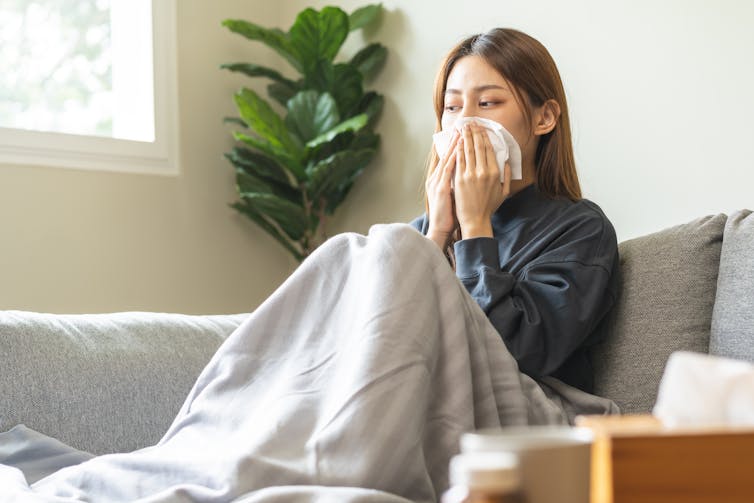
A woman sitting on a couch blowing her nose.
The flu can be a nasty virus to catch. Kmpzzz/Shutterstock

In general, flu vaccines can be given at the same time as most other vaccines, including COVID vaccines, but check with your vaccination provider about whether this is appropriate for you.

Influenza vaccines are regarded as safe. While some people may get a sore arm or fever, these symptoms are usually mild and short lived. Serious side effects, such as Guillain-Barré syndrome, are rare, and are thought to be less common than after influenza infection.

Why do we need a flu vaccine every year?

Influenza is a difficult virus to make vaccines for, as the virus changes frequently, and vaccines generally only provide protection against a limited range of strains. Some studies suggest mutations in the influenza virus are 20 times more common than with SARS-CoV-2, the virus that causes COVID.

This means, each year, experts need to predict the likely circulating strains in the next season, so vaccines can be manufactured in preparation.

The World Health Organization coordinates two meetings each year – in February to decide on vaccine strains for the following northern hemisphere season, and around September for the southern hemisphere.

Although all current influenza vaccines contain strains from four influenza subtypes (A/H1N1, A/H3N2, B Victoria and B Yamagata), one of the strains appears to have disappeared during the pandemic. So next year’s vaccines will probably drop the B Yamagata strain.

Seasonal flu vaccines don’t provide protection against avian influenza (bird flu) strains, but vaccination is still recommended for people who may be at risk of bird flu, such as poultry workers. This is to reduce the chance that a new virus could result from the combination of both seasonal and avian influenza strains.

Which vaccines are available?

There are a variety of vaccines you may be offered when you book in or turn up for a flu vaccine.

Over the past few years, new types of vaccines have been developed. Some of these attempt to improve the body’s immune response to vaccines. For example, Fluad Quad contains an adjuvant called MF59, an additional substance designed to attract immune cells to the site of vaccination.

Other vaccines, such as Fluzone High-Dose, use a larger dose of the vaccine strains to improve the immune response. These vaccines are recommended for older people, as immune responses tend to decline with age.

Certain vaccines use alternative production methods to try to improve the match between vaccine strains and the circulating strains. Standard flu vaccines are produced using influenza viruses grown in chicken eggs. One weakness of this method is that viral mutations can occur during the production process, known as “egg adaptation”. During some of the seasons between 2014 and 2019, this was shown to reduce the effectiveness of flu vaccines.

The avoid this issue, cell-based vaccines, such as Flucelvax Quad, use influenza vaccine strains grown in mammalian cells rather than eggs.

A doctor examines a small boy with a stethoscope.
Flu vaccines are free for certain vulnerable groups, such as children under five. SeventyFour/Shutterstock

The key takeaways are:

  1. older people are recommended to receive an enhanced vaccine (Fluad Quad for >65 years or Fluzone High-Dose for >60 years), with Fluad Quad provided free under the National Immunisation Program
  2. other people are recommended to receive a standard vaccine (egg-based or cell-based), with vaccines provided free for high-risk groups and children between six months and five years.

Looking to the future

There are several new flu vaccines currently under development. Recombinant vaccines, such as Flublok, use insect cells to produce a specific component of the virus.

With the success of mRNA vaccines for COVID, there is interest in using a similar process for influenza. In theory, this could shorten the time to develop vaccines, for both seasonal influenza and pandemic influenza.

There’s also interest in combination vaccines – for example, a single shot could provide protection against both COVID and the flu.

The “holy grail” of influenza vaccines is one that could provide long-lasting protection against many different strains. Although we’re not there yet, you’re at lower risk of influenza and its complications if you get a flu shot.

Allen Cheng, Professor of Infectious Diseases, Monash University

This article is republished from The Conversation under a Creative Commons license. Read the original article.

Don’t Forget…

Did you arrive here from our newsletter? Don’t forget to return to the email to continue learning!

Learn to Age Gracefully

Join the 98k+ American women taking control of their health & aging with our 100% free (and fun!) daily emails:

  • Better Sex Through Mindfulness – by Dr. Lori Brotto

    10almonds is reader-supported. We may, at no cost to you, receive a portion of sales if you purchase a product through a link in this article.

    Female sexuality is such a taboo topic that, if one searches for (ob/gyn professor, women’s health research director, and psychologist) Dr. Brotto’s book on Google or Amazon, it suggests only “lori brotto mindfulness book”. So, for those brave enough to read a book that would have shocked Victorians, what does this one contain?

    The focus is on, as the title suggests, better sex, by and for women. That said, it’s mostly because typically women are more likely to experience the problems described in the book; it’s nothing actually intrinsic to womanhood. A man with the same problems could read this book and benefit just the same.

    While the book covers many possible problems between the sheets, the overarching theme is problems of the mind, such as:

    • Not getting into the mood in the first place
    • Losing the mood quickly and easily, such as by becoming distracted
    • Difficulty achieving orgasm even when mechanically everything’s delightful
    • Physical discomfort creating a barrier to enjoyment

    …and yes, that last one is in part mind-stuff too! Though Dr. Brotto isn’t arguing that mindfulness is a panacea, just an incredibly useful tool. And, it’s one she not only explains very well, but also explains from the position of a wealth of scientific evidence… Enough so, that we see a one-star Amazon reviewer from Canada complained that it was too well-referenced! For us, though, it’s what we like to see.

    Good science, presented clearly and usefully, giving practical tips that improve people’s lives.

    Bottom line: if you’ve ever lost the mood because you got distracted into thinking about taxes or that meeting on Tuesday, this is the book for you.

    Click here to check out Better Sex Through Mindfulness—you can thank us later!

    Share This Post

  • Coca-Cola vs Diet Coke – Which is Healthier?

    10almonds is reader-supported. We may, at no cost to you, receive a portion of sales if you purchase a product through a link in this article.

    Our Verdict

    When comparing Coca-Cola to Diet Coke, we picked the Diet Coke.

    Why?

    While the Diet Coke is bad, the Coca-Cola has mostly the same problems plus sugar.

    The sugar in a can of Coca-Cola is 39g high-fructose corn syrup (the worst kind of sugar yet known to humanity), and of course it’s being delivered in liquid form (the most bioavailable way to get, which in this case, is bad).

    To put those 39g into perspective, the daily recommended amount of sugar is 36g for men or 25g for women, according to the AHA.

    The sweetener in Diet Coke is aspartame, which has had a lot of health risk accusations made against it, most of which have not stood up to scrutiny, and the main risk it does have is “it mimics sugar too well” and it can increase cravings for sweetness, and therefore higher consumption of sugars in other products. For this reason, the World Health Organization has recommended to simply reduce sugar intake without looking to artificial sweeteners to help.

    Nevertheless, aspartame has been found safe (in moderate doses; the upper tolerance level would equate to more than 20 cans of diet coke per day) by food safety agencies ranging from the FDA to the EFSA, based on a large body of science.

    Other problems that Diet Coke has are present in Coca-Cola too, such as its acidic nature (bad for tooth enamel) and gassy nature (messes with leptin/ghrelin balance).

    Summary: the Diet Coke is relatively less unhealthy, but is still bad in numerous ways, and remains best avoided.

    Read more:

    Share This Post

  • The 7 Approaches To Pain Management

    10almonds is reader-supported. We may, at no cost to you, receive a portion of sales if you purchase a product through a link in this article.

    More Than One Way To Kill Pain

    This is Dr. Deepak Ravindran (MD, FRCA. FFPMRCA, EDRA. FIPP, DMSMed). He has decades of experience and is a specialist in acute and chronic pain management, anesthesia, musculoskeletal medicine, and lifestyle medicine.

    A quick catch-up, first:

    We’ve written about chronic pain management before:

    Managing Chronic Pain (Realistically!)

    As well as:

    Science-Based Alternative Pain Relief

    Dr. Ravindran’s approach

    Dr. Ravindran takes a “trauma-informed care” approach to his professional practice, and recommends the same for others.

    In a nutshell, this means starting from a position of not “what’s wrong with you?”, but rather “what happened to you?”.

    This seemingly subtle shift is important, because it means actually dealing with a person’s issues, instead of “take one of these and call my secretary next month”. Read more:

    What is Trauma-Informed Care?

    Pain itself can be something of a many-headed hydra. Dr. Ravindran’s approach is equally many-headed; specifically, he has a 7-point plan:

    Medications

    Dr. Ravindran sees painkillers (and a collection of other drugs, like antidepressants and muscle relaxants) as a potential means to an end worth exploring, but he doesn’t expect them to be the best choice for everyone, and nor does he expect them to be a cure-all. Neither should we. He also advises being mindful of the drawbacks and potential complications of these drugs, too.

    Interventions

    Sometimes, surgery is the right choice. Sometimes it isn’t. Often, it will change a life—one way or the other. Similar to with medications, Dr. Ravindran is very averse to a “one size fits all” approach here. See also:

    The Insider’s Guide To Making Hospital As Comfortable As Possible

    Neuroscience and stress management

    Often a lot of the distress of pain is not just the pain itself, but the fear associated with it. Will it get worse if I move wrong or eat the wrong thing? How long will it last? Will it ever get better? Will it get worse if I do nothing?. Dr. Ravindran advises tackling this, with the same level of importance as the pain itself. Here’s a good start:

    Stress, And Building Psychological Resilience

    Diet and the microbiome

    Many chronic illnesses are heavily influenced by this, and Dr. Ravindran’s respect for lifestyle medicine comes into play here. While diet might not fix all our ills, it certainly can stop things from being a lot worse. Beyond the obvious “eat healthily” (Mediterranean diet being a good starting point for most people), he also advises doing elimination tests where appropriate, to screen out potential flare-up triggers. You also might consider:

    Four Ways To Upgrade The Mediterranean Diet

    Sleep

    “Get good sleep” is easy advice for those who are not in agonizing pain that sometimes gets worse from staying in the same position for too long. Nevertheless, it is important, and foundational to good health. So it’s important to explore—whatever limitations one might realistically have—what can be done to improve it.

    If you can only sleep for a short while at a time, you may get benefit from this previous main feature of ours:

    How To Nap Like A Pro (No More “Sleep Hangovers”!)

    Exercise and movement

    The trick here is to move little and often; without overdoing it, but without permitting loss of mobility either. See also:

    The Doctor Who Wants Us To Exercise Less, And Move More

    Therapies of the mind and body

    This is about taking a holistic approach to one’s wellness. In Dr. Ravindran’s words:

    ❝Mind-body therapies are often an extremely sensitive topic about which people hold very strong opinions and sometimes irrational beliefs.

    Some, like reiki and spiritual therapy and homeopathy, have hardly any scientific evidence to back them up, while others like yoga, hypnosis, and meditation/mindfulness are mainstream techniques with many studies showing the benefits, but they all work for certain patients.❞

    In other words: evidence-based is surely the best starting point, but if you feel inclined to try something else and it works for you, then it works for you. And that’s a win.

    Want to know more?

    You might like his book…

    The Pain-Free Mindset: 7 Steps to Taking Control and Overcoming Chronic Pain

    He also has a blog and a podcast.

    Take care!

    Share This Post

  • Crispy Tofu Pad Thai

    10almonds is reader-supported. We may, at no cost to you, receive a portion of sales if you purchase a product through a link in this article.

    Easy to make, delicious to enjoy, and packed with phytonutrients, this dish is a great one to add to your repertoire:

    You will need

    • 10 oz ready-to-wok rice noodles, or 6 oz dry
    • 5 oz silken tofu
    • 5 oz firm or extra firm tofu, cut into small cubes
    • 1 oz arrowroot (or cornstarch if you don’t have arrowroot)
    • 4 scallions, sliced
    • ¼ bulb garlic, finely chopped
    • 1″ piece fresh ginger, grated
    • 1 red chili, chopped (multiply per your heat preferences)
    • 1 red bell pepper, deseeded and thinly sliced
    • 4 oz bok choi, thinly sliced
    • 4 oz mung bean sprouts
    • 1 tbsp tamari (or other, but tamari is traditional) soy sauce
    • 1 tbsp sweet chili sauce
    • Juice of ½ lime
    • ½ tsp MSG or 1 tsp low-sodium salt
    • Avocado oil, or your preferred oil for stir-frying
    • To serve: lime wedges
    • Optional garnish: crushed roasted peanuts (if allergic, substitute sesame seeds; peanuts are simply traditional, that’s all)

    Method

    (we suggest you read everything at least once before doing anything)

    1) Scramble the silken tofu. For guidance and also additional seasoning pointers, see our Tasty Tofu Scramble recipe, but omit the thyme.

    2) Cook the noodles if necessary (i.e. if they are the dry type and need boiling, as opposed to “ready-to-wok” noodles that don’t), drain, and set aside.

    4) Prepare the tofu cubes: if the tofu cubes are dry to the touch, toss them gently in a little oil to coat. If they’re wet to the touch, no need. Dust the tofu cubes with the arrowroot and MSG/salt; you can do this in a bowl, tossing gently to distribute the coating evenly.

    4) Heat some oil in a wok over a high heat, and fry the tofu on each side until golden and crispy all over, and set aside.

    5) Stir-fry the scallions, garlic, ginger, chili, and bell pepper for about 2 minutes.

    6) Add the bean sprouts and bok choi, and keep stir-frying for another 2 minutes.

    7) Add everything that’s not already in the pan except the lime wedges and peanuts (i.e., add the things you set aside, plus the remaining as-yet-untouched ingredients) and stir-fry for a further 2 minutes.

    8) Serve hot, garnished with the crushed peanuts if using, and with the lime wedges on the side:

    Enjoy!

    Want to learn more?

    For those interested in some of the science of what we have going on today:

    Take care!

    Don’t Forget…

    Did you arrive here from our newsletter? Don’t forget to return to the email to continue learning!

    Learn to Age Gracefully

    Join the 98k+ American women taking control of their health & aging with our 100% free (and fun!) daily emails:

  • How do I handle it if my parent is refusing aged care? 4 things to consider

    10almonds is reader-supported. We may, at no cost to you, receive a portion of sales if you purchase a product through a link in this article.

    It’s a shock when we realise our parents aren’t managing well at home.

    Perhaps the house and garden are looking more chaotic, and Mum or Dad are relying more on snacks than nutritious meals. Maybe their grooming or hygiene has declined markedly, they are socially isolated or not doing the things they used to enjoy. They may be losing weight, have had a fall, aren’t managing their medications correctly, and are at risk of getting scammed.

    You’re worried and you want them to be safe and healthy. You’ve tried to talk to them about aged care but been met with swift refusal and an indignant declaration “I don’t need help – everything is fine!” Now what?

    Here are four things to consider.

    1. Start with more help at home

    Getting help and support at home can help keep Mum or Dad well and comfortable without them needing to move.

    Consider drawing up a roster of family and friends visiting to help with shopping, cleaning and outings. You can also use home aged care services – or a combination of both.

    Government subsidised home care services provide from one to 13 hours of care a week. You can get more help if you are a veteran or are able to pay privately. You can take advantage of things like rehabilitation, fall risk-reduction programs, personal alarms, stove automatic switch-offs and other technology aimed at increasing safety.

    Call My Aged Care to discuss your options.

    An older man with a serious expression on his face looks out a window.
    Is Mum or Dad OK at home?
    Nadino/Shutterstock

    2. Be prepared for multiple conversations

    Getting Mum or Dad to accept paid help can be tricky. Many families often have multiple conversations around aged care before a decision is made.

    Ideally, the older person feels supported rather than attacked during these conversations.

    Some families have a meeting, so everyone is coming together to help. In other families, certain family members or friends might be better placed to have these conversations – perhaps the daughter with the health background, or the auntie or GP who Mum trusts more to provide good advice.

    Mum or Dad’s main emotional support person should try to maintain their relationship. It’s OK to get someone else (like the GP, the hospital or an adult child) to play “bad cop”, while a different person (such as the older person’s spouse, or a different adult child) plays “good cop”.

    3. Understand the options when help at home isn’t enough

    If you have maximised home support and it’s not enough, or if the hospital won’t discharge Mum or Dad without extensive supports, then you may be considering a nursing home (also known as residential aged care in Australia).

    Every person has a legal right to choose where we live (unless they have lost capacity to make that decision).

    This means families can’t put Mum or Dad into residential aged care against their will. Every person also has the right to choose to take risks. People can choose to continue to live at home, even if it means they might not get help immediately if they fall, or eat poorly. We should respect Mum or Dad’s decisions, even if we disagree with them. Researchers call this “dignity of risk”.

    It’s important to understand Mum or Dad’s point of view. Listen to them. Try to figure out what they are feeling, and what they are worried might happen (which might not be rational).

    Try to understand what’s really important to their quality of life. Is it the dog, having privacy in their safe space, seeing grandchildren and friends, or something else?

    Older people are often understandably concerned about losing independence, losing control, and having strangers in their personal space.

    Sometimes families prioritise physical health over psychological wellbeing. But we need to consider both when considering nursing home admission.

    Research suggests going into a nursing home temporarily increases loneliness, risk of depression and anxiety, and sense of losing control.

    Mum and Dad should be involved in the decision-making process about where they live, and when they might move.

    Some families start looking “just in case” as it often takes some time to find the right nursing home and there can be a wait.

    After you have your top two or three choices, take Mum or Dad to visit them. If this is not possible, take pictures of the rooms, the public areas in the nursing home, the menu and the activities schedule.

    We should give Mum or Dad information about their options and risks so they can make informed (and hopefully better) decisions.

    For instance, if they visit a nursing home and the manager says they can go on outings whenever they want, this might dispel a belief they are “locked up”.

    Having one or two weeks “respite” in a home may let them try it out before making the big decision about staying permanently. And if they find the place unacceptable, they can try another nursing home instead.

    An older Asian woman sits with her daughter.
    You might need to have multiple conversations about aged care.
    CGN089/Shutterstock

    4. Understand the options if a parent has lost capacity to make decisions

    If Mum or Dad have lost capacity to choose where they live, family may be able to make that decision in their best interests.

    If it’s not clear whether a person has capacity to make a particular decision, a medical practitioner can assess for that capacity.

    Mum or Dad may have appointed an enduring guardian to make decisions about their health and lifestyle decisions when they are not able to.

    An enduring guardian can make the decision that the person should live in residential aged care, if the person no longer has the capacity to make that decision themselves.

    If Mum or Dad didn’t appoint an enduring guardian, and have lost capacity, then a court or tribunal can appoint that person a private guardian (usually a family member, close friend or unpaid carer).

    If no such person is available to act as private guardian, a public official may be appointed as public guardian.

    Deal with your own feelings

    Families often feel guilt and grief during the decision-making and transition process.

    Families need to act in the best interest of Mum or Dad, but also balance other caring responsibilities, financial priorities and their own wellbeing.The Conversation

    Lee-Fay Low, Professor in Ageing and Health, University of Sydney

    This article is republished from The Conversation under a Creative Commons license. Read the original article.

    Don’t Forget…

    Did you arrive here from our newsletter? Don’t forget to return to the email to continue learning!

    Learn to Age Gracefully

    Join the 98k+ American women taking control of their health & aging with our 100% free (and fun!) daily emails:

  • Limitless Expanded Edition – by Jim Kwik

    10almonds is reader-supported. We may, at no cost to you, receive a portion of sales if you purchase a product through a link in this article.

    This is a little flashier in presentation than we usually go for here, but the content is actually very good. Indeed, we’ve featured Jim Kwik before, with different, but also good content—in that case, physical exercises that strengthen the brain.

    This time, Kwik (interspersed with motivational speeches that you may or may not benefit from, but they are there) offers a step-by-step course in improving various metrics of cognitive ability. His methods were produced by trial and error, and now have been refined and enjoyed by man. If it sounds like a sales gimmick, it is a bit, but the good news is that everything you need to benefit is in the book; it’s not about upselling to a course or “advanced” books or whatnot.

    The style is enthusiastically conversational, and instructions when given (which is often) are direct and clear.

    Bottom line: one of the most critical abilities a brain can have is the ability to improve itself, so whatever level your various cognitive abilities are at right now, if you apply this book, you will almost certainly improve in one or more areas, which will make it worth the price of the book.

    Click here to check out Limitless, and find out what you can do!

    Don’t Forget…

    Did you arrive here from our newsletter? Don’t forget to return to the email to continue learning!

    Learn to Age Gracefully

    Join the 98k+ American women taking control of their health & aging with our 100% free (and fun!) daily emails: