
Studies of Parkinson’s disease have long overlooked Pacific populations – our work shows why that must change

10almonds is reader-supported. We may, at no cost to you, receive a portion of sales if you purchase a product through a link in this article.

A form of Parkinson’s disease caused by mutations in a gene known as PINK1 has long been labelled rare. But our research shows it’s anything but – at least for some populations.

Our meta-analysis revealed that people in specific Polynesian communities have a much higher rate of PINK1-linked Parkinson’s than expected. This finding reshapes not only our understanding of who is most at risk, but also how soon symptoms may appear and what that might mean for treatment and testing.

Parkinson’s disease is often thought of as a single condition. In reality, it is better understood as a group of syndromes caused by different factors – genetic, environmental or a combination of both.

These varying causes lead to differences in disease patterns, progression and subsequent diagnosis. Recognising this distinction is crucial as it paves the way for targeted interventions and may even help prevent the disease altogether.
Shutterstock/sfam_photo

Why we focus on PINK1-linked Parkinson’s

We became interested in this gene after a 2021 study highlighted five people of Samoan and Tongan descent living in New Zealand who shared the same PINK1 mutation.

Previously, this mutation had been spotted only in a few more distant places –Malaysia, Guam and the Philippines. The fact it appeared in people from Samoan and Tongan backgrounds suggested a historical connection dating back to early Polynesian migrations.

One person in 1,300 West Polynesians carries this mutation. This is a frequency well above what scientists usually classify as rare (below one in 2,200). This discovery means we may be overlooking entire communities in Parkinson’s research if we continue to assume PINK1-linked cases are uncommon.
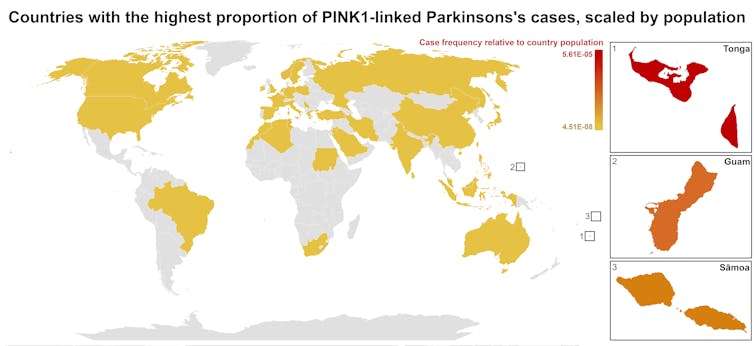
A world map shows the incidence of PINK1-linked Parkinson’s, adjusted for population.
This world map shows people in some Polynesian communities have a much higher rate of PINK1-linked Parkinson’s than the global population. Eden Yin, CC BY-SA

Traditional understanding says PINK1-linked Parkinson’s is both rare and typically strikes younger people, mostly in their 30s or 40s, if they inherit two faulty copies of the gene. In other words, it’s considered a recessive condition, needing two matching puzzle pieces before the disease can unfold.

Our work challenges this view. We show that even one defective PINK1 gene can cause Parkinson’s at an average age of 43, much earlier than the typical onset after 65. That’s a significant departure from the standard belief that only people with two defective gene copies are at risk.

Why this matters for people with the disease

It’s not just genetics that challenge long-held views. Historically, PINK1-linked Parkinson’s was thought to lack some of the classic features of the disease, such as toxic clumps of alpha-synuclein protein.

In typical Parkinson’s, alpha-synuclein builds up in the brain, forming sticky clumps known as Lewy bodies. Our results, contrary to prior beliefs, show that alpha-synuclein pathology is present in 87.5% of PINK1 cases. This finding opens up a promising new avenue for future treatment development.

The biggest concern is early onset. PINK1-linked Parkinson’s can begin as early as 11 years old, although a more common starting point is around the mid-30s. This early onset means living longer with the disease, which can profoundly affect education, work opportunities and family life.

Current treatments (such as levodopa, a precursor of dopamine) help manage symptoms, but they’re not designed to address the root cause. If we know someone has a PINK1 mutation, scientists and clinicians can explore therapies for specific genetic pathways, potentially delivering relief beyond symptom management.

Sex differences add a layer of complexity

In Parkinson’s, generally, men are at higher risk and tend to develop symptoms earlier. However, our findings suggest the opposite pattern for PINK1-linked cases. Particularly, women with two defective copies of the gene experience onset earlier than men.

This highlights the need to consider sex-related factors in Parkinson’s research. Overlooking them risks missing key elements of the disease.

Genetic testing could be a game-changer for PINK1-linked Parkinson’s. Because it often appears earlier, doctors may not recognise it immediately, especially if they are more familiar with the common, later-onset form of Parkinson’s.

Early genetic testing could lead to a faster, more accurate diagnosis, allowing treatment to begin when interventions are most effective. It would help families understand how the disease is inherited, enabling relatives to get tested.

In some cases, where appropriate and culturally acceptable, embryo screening may be considered to prevent the passing of the faulty gene.

Knowing you have a PINK1 mutation could also make finding the right treatment more efficient. Instead of a lengthy trial-and-error process with different medications, doctors could use emerging therapies designed to target the underlying PINK1 mutation rather than relying on general Parkinson’s treatments meant for the broader population.

Addressing research gaps

These findings underscore how crucial it is to include diverse populations in health research.

Many communities, such as those in Samoa, Tonga and other Pacific nations, have had little to no involvement in global Parkinson’s genetics studies. This has created gaps in knowledge and real-world consequences for people who may not receive timely or accurate diagnoses.

Researchers, funding bodies and policymakers must prioritise projects beyond the usual focus on European or industrialised countries to ensure research findings and treatments are relevant to all affected populations.

To better diagnose and treat Parkinson’s, we need a more inclusive approach. Recognising that PINK1-linked Parkinson’s is not as rare as previously thought – and that genetics, sex differences and cultural factors all play a role – allows us to improve care for everyone.

By expanding genetic testing, refining treatments and ensuring research reflects the full spectrum of Parkinson’s, we can move closer to more precise diagnoses, targeted therapies and better support systems for all.

Victor Dieriks, Research Fellow in Health Sciences, University of Auckland, Waipapa Taumata Rau and Eden Paige Yin, PhD candidate in Health Sciences, University of Auckland, Waipapa Taumata Rau

This article is republished from The Conversation under a Creative Commons license. Read the original article.

Don’t Forget…

Did you arrive here from our newsletter? Don’t forget to return to the email to continue learning!

Learn to Age Gracefully

Join the 98k+ American women taking control of their health & aging with our 100% free (and fun!) daily emails:

  • Cranberries vs Gooseberries – Which is Healthier?

    10almonds is reader-supported. We may, at no cost to you, receive a portion of sales if you purchase a product through a link in this article.

    Our Verdict

    When comparing cranberries to gooseberries, we picked the gooseberries.

    Why?

    It wasn’t close:

    In terms of macros, cranberries have more carbs while gooseberries have more fiber, so that’s a win for gooseberries. A nominal win as the differences aren’t huge, but clear enough to be a win nevertheless.

    In the category of vitamins, cranberries have more vitamin E, while gooseberries have more of vitamins A, B1, B2, B3, B5, B6, B7, B9, and C, winning easily.

    Looking at minerals next, cranberries have more manganese, while gooseberries have more calcium, copper, iron, magnesium, phosphorus, potassium, selenium, and zinc, scoring their third win in a row by quite a margin.

    In other considerations, cranberries have some special properties that amount to a mixed bag of pros and cons (see details in the “learn more” below), while gooseberries are higher in polyphenols. Since cranberries have good and bad things in this round while gooseberries have just good, we say gooseberries in this round, too.

    Adding up the sections makes for a clear overall win for gooseberries, but by all means enjoy either or both, as diversity is best (unless one of the contraindications for cranberries applies, in which case, skip those)!

    Want to learn more?

    You might like:

    Health Benefits Of Cranberries (But: You’d Better Watch Out) ← cranberries’ bonus properties (including: famously very good at decreasing UTI risk) come with some warnings, including that they may increase the risk of kidney stones if you are prone to such, and also that cranberries have anti-clotting effects, which are great for heart health but can be a risk of you’re on blood thinners or have a bleeding disorder.

    Enjoy!

    Share This Post

  • Walking can prevent low back pain, a new study shows

    10almonds is reader-supported. We may, at no cost to you, receive a portion of sales if you purchase a product through a link in this article.

    Do you suffer from low back pain that recurs regularly? If you do, you’re not alone. Roughly 70% of people who recover from an episode of low back pain will experience a new episode in the following year.

    The recurrent nature of low back pain is a major contributor to the enormous burden low back pain places on individuals and the health-care system.

    In our new study, published today in The Lancet, we found that a program combining walking and education can effectively reduce the recurrence of low back pain.

    PeopleImages.com – Yuri A/Shutterstock

    The WalkBack trial

    We randomly assigned 701 adults who had recently recovered from an episode of low back pain to receive an individualised walking program and education (intervention), or to a no treatment group (control).

    Participants in the intervention group were guided by physiotherapists across six sessions, over a six-month period. In the first, third and fifth sessions, the physiotherapist helped each participant to develop a personalised and progressive walking program that was realistic and tailored to their specific needs and preferences.

    The remaining sessions were short check-ins (typically less than 15 minutes) to monitor progress and troubleshoot any potential barriers to engagement with the walking program. Due to the COVID pandemic, most participants received the entire intervention via telehealth, using video consultations and phone calls.

    A health-care professional examines a woman's back.
    Low back pain can be debilitating. Karolina Kaboompics/Pexels

    The program was designed to be manageable, with a target of five walks per week of roughly 30 minutes daily by the end of the six-month program. Participants were also encouraged to continue walking independently after the program.

    Importantly, the walking program was combined with education provided by the physiotherapists during the six sessions. This education aimed to give people a better understanding of pain, reduce fear associated with exercise and movement, and give people the confidence to self-manage any minor recurrences if they occurred.

    People in the control group received no preventative treatment or education. This reflects what typically occurs after people recover from an episode of low back pain and are discharged from care.

    What the results showed

    We monitored the participants monthly from the time they were enrolled in the study, for up to three years, to collect information about any new recurrences of low back pain they may have experienced. We also asked participants to report on any costs related to their back pain, including time off work and the use of health-care services.

    The intervention reduced the risk of a recurrence of low back pain that limited daily activity by 28%, while the recurrence of low back pain leading participants to seek care from a health professional decreased by 43%.

    Participants who received the intervention had a longer average period before they had a recurrence, with a median of 208 days pain-free, compared to 112 days in the control group.

    Two men walking and talking in a park.
    In our study, regular walking appeared to help with low back pain. PeopleImages.com – Yuri A/Shutterstock

    Overall, we also found this intervention to be cost-effective. The biggest savings came from less work absenteeism and less health service use (such as physiotherapy and massage) among the intervention group.

    This trial, like all studies, had some limitations to consider. Although we tried to recruit a wide sample, we found that most participants were female, aged between 43 and 66, and were generally well educated. This may limit the extent to which we can generalise our findings.

    Also, in this trial, we used physiotherapists who were up-skilled in health coaching. So we don’t know whether the intervention would achieve the same impact if it were to be delivered by other clinicians.

    Walking has multiple benefits

    We’ve all heard the saying that “prevention is better than a cure” – and it’s true. But this approach has been largely neglected when it comes to low back pain. Almost all previous studies have focused on treating episodes of pain, not preventing future back pain.

    A limited number of small studies have shown that exercise and education can help prevent low back pain. However, most of these studies focused on exercises that are not accessible to everyone due to factors such as high cost, complexity, and the need for supervision from health-care or fitness professionals.

    On the other hand, walking is a free, accessible way to exercise, including for people in rural and remote areas with limited access to health care.

    Two feet and lower legs in athletic gear walking alongside the water.
    Walking has a variety of advantages. Cast Of Thousands/Shutterstock

    Walking also delivers many other health benefits, including better heart health, improved mood and sleep quality, and reduced risk of several chronic diseases.

    While walking is not everyone’s favourite form of exercise, the intervention was well-received by most people in our study. Participants reported that the additional general health benefits contributed to their ongoing motivation to continue the walking program independently.

    Why is walking helpful for low back pain?

    We don’t know exactly why walking is effective for preventing back pain, but possible reasons could include the combination of gentle movements, loading and strengthening of the spinal structures and muscles. It also could be related to relaxation and stress relief, and the release of “feel-good” endorphins, which block pain signals between your body and brain – essentially turning down the dial on pain.

    It’s possible that other accessible and low-cost forms of exercise, such as swimming, may also be effective in preventing back pain, but surprisingly, no studies have investigated this.

    Preventing low back pain is not easy. But these findings give us hope that we are getting closer to a solution, one step at a time.

    Tash Pocovi, Postdoctoral research fellow, Department of Health Sciences, Macquarie University; Christine Lin, Professor, Institute for Musculoskeletal Health, University of Sydney; Mark Hancock, Professor of Physiotherapy, Macquarie University; Petra Graham, Associate Professor, School of Mathematical and Physical Sciences, Macquarie University, and Simon French, Professor of Musculoskeletal Disorders, Macquarie University

    This article is republished from The Conversation under a Creative Commons license. Read the original article.

    Share This Post

  • Blackberries vs Grapes – Which is Healthier?

    10almonds is reader-supported. We may, at no cost to you, receive a portion of sales if you purchase a product through a link in this article.

    Our Verdict

    When comparing blackberries to grapes, we picked the blackberries.

    Why?

    It’s not even close:

    In terms of macros, blackberries have more than 5x the fiber, for about half the carbs, resulting in a notably lower glycemic index. They also have more than 2x the protein, but unlike the fiber, it’s not much in either fruit, so we might disregard it. Still, an easy win for blackberries either way.

    In the category of vitamins, blackberries have more of vitamins A, B3, B5, B9, C, E, K, and choline, while grapes have more of vitamins B1, B2, and B6. Another clear win for blackberries.

    When it comes to minerals, blackberries have a lot more calcium, copper, iron, magnesium, phosphorus, selenium, and zinc, while grapes have slightly more manganese and potassium. Once again, blackberries emerge victorious.

    Looking at polyphenols, both have an abundance of many polyphenols, but blackberries have more, both in types and in total mass (mg/100g).

    Thus, blackberries overwhelmingly win the day, but by all means enjoy either or both; diversity is good!

    Want to learn more?

    You might like:

    Can We Drink To Good Health? ← while there are polyphenols such as resveratrol in red wine that per se would boost heart health, there’s so little per glass that you may need 100–1000 glasses per day to get the dosage that provides benefits in mouse studies.

    If you’re not a mouse, you might even need more than that!

    To this end, many people prefer resveratrol supplementation ← link is to an example product on Amazon, but there are plenty more so feel free to shop around 😎

    Enjoy!

    Share This Post

  • Pinto Beans vs Fava Beans – Which is Healthier?

    10almonds is reader-supported. We may, at no cost to you, receive a portion of sales if you purchase a product through a link in this article.

    Our Verdict

    When comparing pinto beans to fava beans, we picked the pinto beans.

    Why?

    It wasn’t close!

    In terms of macros, pinto beans have more protein and carbs, and much more fiber, resulting in a much lower glycemic index. We mention this, because while often the GI of two similar foods is similar, in this case pinto beans have a GI of 39 (low), while fava beans have a GI of 79 (high). In other words, not at all close, and pinto beans are the clear winner.

    When it comes to vitamins, pinto beans have more of vitamins B1, B5, B6, B7, B9, C, E, K, and choline, while fava beans have more of vitamins B2 and B3. Once again, not close, and that’s before we take into account the margins of difference for those vitamins; the margins of difference are much greater on the pinto beans’ side of the scale, for example pinto beans having 47x more vitamin E, while fava beans have only 43% more vitamin B2. So, orders of magnitude less. A clear win for pinto beans in all respects.

    In the category of minerals, pinto beans have more calcium, iron, magnesium, manganese, phosphorus, potassium, and selenium, while fava beans have more copper and zinc. This time, the margins of difference were quite moderate across the board, and/but pinto beans win on clear strength of numbers.

    All in all, three clear wins for pinto beans add up to one big clear win for pinto beans.

    Enjoy!

    Want to learn more?

    You might like to read:

    What Matters Most For Your Heart? Eat More (Of This) For Lower Blood Pressure

    Take care!

    Don’t Forget…

    Did you arrive here from our newsletter? Don’t forget to return to the email to continue learning!

    Learn to Age Gracefully

    Join the 98k+ American women taking control of their health & aging with our 100% free (and fun!) daily emails:

  • After The Recent Wave Of Food Recalls…

    10almonds is reader-supported. We may, at no cost to you, receive a portion of sales if you purchase a product through a link in this article.

    The FDA is taking steps to ensure this won’t be a problem (on paper, at least):

    Out of sight, out of mind?

    If you’ve been paying attention to the news, you may have noticed that since food safety testing standards have been lowered, there’s been a major food recall at least once every few weeks this year, due to contaminants that normally would have been noticed before they hit the shelves.

    Now, however, the FDA has been compelled by funding cuts to completely suspend quality control testing, so fewer things will be flagged as dangerous.

    This is not, of course, great for consumers:

    Read in full: US FDA suspends food safety quality checks after staff cuts

    Related: Led by RFK Jr., Conservatives Embrace Raw Milk. Regulators Say It’s Dangerous.

    Lettuce not worry about that

    However, not all food poisoning outbreaks become a source of worry for consumers—because of some of them get a better clean-up job than our food. In this case, an E. coli outbreak was established, noted internally by the FDA, and not reported publicly until it was over, nor did they reveal, even after the fact, which companies or brands were affected:

    ❝The [E. coli] outbreak spread to 15 states and killed at least one person, though the case was not discussed in the FDA’s internal report. The county health department eventually confirmed 115 cases of E. coli, 13 of which sent people to the hospital.

    Federal law does not require the FDA to disclose deadly food-based disease outbreaks, but the agency has customarily released data on all such cases.❞

    On a practical level, this means: now’s a good time to practise extra careful food hygiene at home, washing things thoroughly, and being mindful of cross-contamination risks.

    Read in full: Report suggests the FDA covered up E. coli outbreak that killed 1 person, spread to 15 states

    Related: Frozen/Thawed/Refrozen Meat: How Much Is Safety, And How Much Is Taste?

    A little bird tells us this is still dangerous

    And by “a little bird”, we mean the American Journal of Public Health, whose report shows how public lack of awareness about bird flu, and/or apathy about same, is a big obstacle to containing the virus and avoiding a larger-scale public health crisis.

    And, as for the general American public’s understanding of the risks and mitigation strategies, study results show that things could be worse, but they could definitely be a lot better too:

    ❝The results suggest many respondents were unaware of simple food safety practices that could reduce the risk of HPAI infection. Over half (53.7%) did not know that pasteurized milk is safer than raw milk, although almost three of four respondents (71.3%) did understand that cooking meat at high temperatures could eliminate harmful bacteria and viruses like H5N1.

    Over a quarter (27%) of respondents said they were unwilling to modify their diet to reduce the risk of exposure to the virus, and more than one in four respondents (28.7%) expressed reluctance to take a potential vaccine for H5N1, even if advised by the CDC to do so.❞

    Read in full: Americans don’t think bird flu is a threat, study suggests

    Related: Here’s the latest you need to know about bird flu

    Take care!

    Don’t Forget…

    Did you arrive here from our newsletter? Don’t forget to return to the email to continue learning!

    Learn to Age Gracefully

    Join the 98k+ American women taking control of their health & aging with our 100% free (and fun!) daily emails:

  • Stiff After Sitting? Before You Stand Up, Do This For Easier First Steps

    10almonds is reader-supported. We may, at no cost to you, receive a portion of sales if you purchase a product through a link in this article.

    Dr. Alyssa Kuhn, arthritis expert, shows us how:

    Are you sitting comfortably? Then we’ll begin…

    The answer is as simple as a leg extension warm-up: straighten your knee by kicking your leg out, or sliding your heel forwards, before standing.

    This need not be overly vigorous; keep your movement gentle and within a comfortable range, while aiming to get your knee as straight as possible without forcing it. Even a few repetitions before standing can noticeably improve how your first steps feel!

    The goal here is modest: just move your joints briefly before standing, rather than treating this like a full workout to make standing feel smoother and easier.

    That’s it; that’s the trick!

    For a visual demonstration though, enjoy:

    Click Here If The Embedded Video Doesn’t Load Automatically!

    Want to learn more?

    You might also like:

    How To Get Out Of Any Low Chair Without Help ← for anyone wondering “but what if it’s a low chair?”

    Take care!

    Don’t Forget…

    Did you arrive here from our newsletter? Don’t forget to return to the email to continue learning!

    Learn to Age Gracefully

    Join the 98k+ American women taking control of their health & aging with our 100% free (and fun!) daily emails: