

The 6 Dimensions Of Sleep (And Why They Matter)
10almonds is reader-supported. We may, at no cost to you, receive a portion of sales if you purchase a product through a link in this article.
How Good Is Your Sleep, Really?
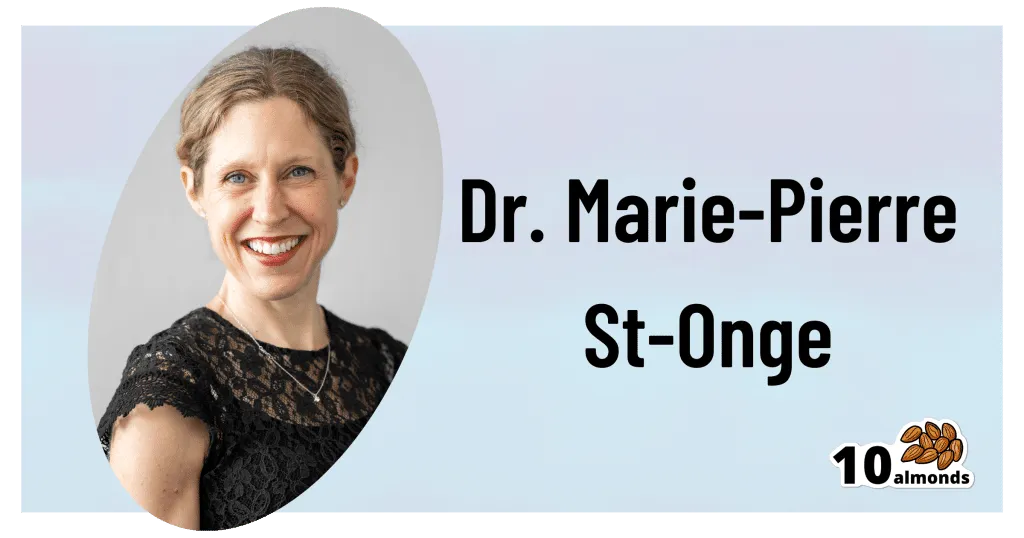
This is Dr. Marie-Pierre St-Onge, Director of Columbia Universityโs Center of Excellence for Sleep and Circadian Research.
The focus of Dr. St-Ongeโs research is the study of the impact of lifestyle, especially sleep and diet, on cardio-metabolic risk factors.
She conducts clinical research combining her expertise on sleep, nutrition, and energy regulation.
What kind of things do her studies look at?
Her work focuses on questions about…
- The role of circadian rhythms (including sleep duration and timing)
- Meal timing and eating patterns
…and their impact on cardio-metabolic risk.
What does she want us to know?
First things first, when not to worry:
โGetting a bad night’s sleep once in a while isnโt anything to worry about. Thatโs what we would describe as transient insomnia. Chronic insomnia occurs when you spend three months or more without regular sleep, and that is when I would start to be concerned.โ
Butโฆ as prevention is (as ever) better than cure, she also advises that we do pay attention to our sleep! And, as for how to do thatโฆ
The Six Dimensions of Sleep
One useful definition of overall sleep health is the RU-Sated framework, which assesses six key dimensions of sleep that have been consistently associated with better health outcomes. These are:
- regularity
- satisfaction with sleep
- alertness during waking hours
- timing of sleep
- efficiency of sleep
- duration of sleep
Youโll notice that some of these things you can only really know if you use a sleep-monitoring app. She does recommend the use of those, and so do we!
We reviewed and compared some of the most popular sleep-monitoring apps! You can check them out here: Time For Some Pillow Talk
You also might likeโฆ
Weโre not all the same with regard to when is the best time for us to sleep, so:
Use This Sleep Cycle Calculator To Figure Out the Optimal Time for You To Go to Bed and Wake Up
AROUND THE WEB
Whatโs happening in the health worldโฆ
- Aspirin may make your breathing worse
- Taking naps for more than 30 minutes may raise your metabolic disease risk
- How to ease back into exercise after surgery
- Study provides evidence that breathing exercises may reduce your Alzheimer’s risk
- No one in movies knows how to swallow a pill
More to come tomorrow!
Don’t Forget…
Did you arrive here from our newsletter? Don’t forget to return to the email to continue learning!
Recommended

Learn to Age Gracefully
Join the 98k+ American women taking control of their health & aging with our 100% free (and fun!) daily emails:
-
Salmon vs Tuna โ Which is Healthier?
10almonds is reader-supported. We may, at no cost to you, receive a portion of sales if you purchase a product through a link in this article.
Our Verdict
When comparing salmon to tuna, we picked the tuna.
Why?
It’s close, and there are merits and drawbacks to both!
In terms of macros, tuna is higher in protein, while salmon is higher in fats. How healthy are the fats, you ask? Well, it’s a mix, because while there are plenty of “good” fats in salmon, salmon is also 10x higher in saturated fat and 150% higher in cholesterol.
So when it comes to fats, if you want to eat fish and have the healthiest fats, one option is to skip the salmon, and instead serve tuna with some extra virgin olive oil.
We’ll call this section a clear win for tuna.
On the vitamin front, they are close to equal. Salmon has more of some vitamins, tuna has more of others; all in all we’d say the balance is in salmon’s favor, but by the time a portion of salmon is giving you 350% of your daily requirement, does it really matter that the same portion of tuna is “only” giving you 294% of the daily requirement? It goes like that for a lot of the vitamins they both contain.
Still, we’ll call this section a nominal win for salmon.
In the category of minerals, tuna is much higher in iron while salmon is higher in calcium. The rest of the minerals they both have, tuna is comfortably higherโand since the “% of RDA in a portion” figures are double-digit here rather than triple, those margins are relevant this time.
We’ll call this section a moderate win for tuna.
Both fish carry a risk of mercury poisoning, but this varies more by location than by fish, so it hasn’t been a consideration in this head-to-head.
Totting up the sections, this a modest but clear win for tuna.
Want to learn more?
You might like to read:
Farmed Fish vs Wild-Caught: Important Differences!
Take care!
Share This Post
-
How Useful Is The Vagus Nerve, Really?
10almonds is reader-supported. We may, at no cost to you, receive a portion of sales if you purchase a product through a link in this article.
Itโs Q&A Day at 10almonds!
Have a question or a request? We love to hear from you!
In cases where weโve already covered something, we might link to what we wrote before, but will always be happy to revisit any of our topics again in the future tooโthereโs always more to say!
No question/request too big or small ๐
โI keep seeing more and more things that vagus nerve stimulation is supposed to improve but I suspect not everything can really be just hummed away, so… How much is science, and how much is more in the realm of healing crystals?โ
The short answer is that there’s a lot of both!
For example, we’ve written before about how vagus nerve stimulation has been researched and found potentially helpful for managing:
- Depression, inflammation, and heart disease
- Diabetes and glycemic issues in general
- Multiple sclerosis and autoimmune disease in general
- Alzheimerโs disease and dementia in general
- Rheumatoid arthritis (we already mentioned inflammation and autoimmune diseases, but this is an interesting paper so we included it)
You can read about these things and more, here: The Vagus Nerve (And How You Can Make Use Of It)
However, at the same time, the vagus nerve cannot necessarily be used to “reset” everything from your anxiety to your reputation at the local pot-luck.
The McGill Office for Science & Society described it thus:
โThe vagus nerve is a great example of what I would call the boogeyman/panacea myth: everything wrong with you, they claim, is due to the vagus nerve, and every cure passes through the vagus nerve as well. In an ever-complex world, believing a simple story of good and evil can bring clarity, but this lucidity is a mirage.
What the wellness community recommends for stimulating the vagus nerveโeye movements, meditation, massage, cold-water immersion, and singing and hummingโ, if it works, is likely to be beneficial through a very simple concept: relaxation. Taking a moment to yourself to pause a stressful situation and focus on your breathing can, indeed, temporarily help with feeling unwell. The vagus nerve trappings are just scientific dressing, meant to transform common sense into a cutting-edge, all-natural body hack.
Faced with so much vagal hype, the best response is to rouse ourselves from our parasympathetic state and fight the temptation of easy answers with a healthy dose of skepticism.โ
Read in full: Resetting the Hype Around the Vagus Nerve
There are also, hitting the market these days, a plethora of devices to do the vagus nerve stimulation for you, rather than using massaging or humming techniques. Some have already been given FDA approval, but only for certain uses (including: epilepsy, migraine, depression, rheumatoid arthritis, stroke rehab), though wellness practitioners of various kinds may recommend them for countless “off-label” purposes.
However, research in such technology is slow and patchy, because studies use widely different stimulation settings (e.g. frequency, intensity, waveform, and location) which makes it difficult to compare results across devices or from one RCT to another.
You read more about this here: Using the vagus nerve to treat disease: Review maps today’s science, points to tomorrow’s therapies
And also here: Ethical Issues in Vagus Nerve Stimulation and Deep Brain Stimulation
Want to learn more?
For a much more comprehensive exploration of the topic than we have room for here, you might consider:
Accessing the Healing Power of the Vagus Nerve โ by Dr. Stanley Rosenberg โ this is a clear, easy, practical guide. Some of the benefits claimed in here are reaching a bit, so do be aware of that, but on the other hand we’d encourage you to not write the rest of the book off because of it. It’d be a bit like someone extolling the (genuine) virtues of kale and adding in a few things that might be true but science doesn’t supportโthe overly bold extra claims don’t mean that kale isn’t healthy and doesn’t have the other actually-proven benefits.
The Polyvagal Theory โ by Dr. Stephen Porges โ this on the other hand is for if you want a really deep understanding of the topic, and are not afraid of dense, technical language (don’t worry, new terms/ideas are explained the book progresses, so a layperson can benefit just fine if you read it cover to cover, it simply means you might not be able to open it at a random page and immediately understand what’s going on).
Enjoy!
Share This Post
-
The Glucose Goddess Method โ by Jessie Inchausspรฉ
10almonds is reader-supported. We may, at no cost to you, receive a portion of sales if you purchase a product through a link in this article.
We’ve previously reviewed Inchausspรฉ’s excellent book โGlucose Revolutionโ. So what does this book add?
This book is for those who found that book a little dense. While this one still gives the same ten “hacks”, she focuses on the four that have the biggest effect, and walks the reader by the hand through a four-week programme of implementing them.
The claim of 100+ recipes is a little bold, as some of the recipes are things like vinegar, vinegar+water, vinegar+water but now we’re it’s in a restaurant, lemon+water, lemon+water but now it’s in a bottle, etc. However, there are legitimately a lot of actual recipes too.
Where this book’s greatest strength lies is in making everything super easy, and motivating. It’s a fine choice for being up-and-running quickly and easily without wading through the 300-odd pages of science in her previous book.
Bottom line: if you’ve already happily and sustainably implemented everything from her previous book, you can probably skip this one. However, if you’d like an easier method to implement the changes that have the biggest effect, then this is the book for you.
Click here to check out The Glucose Goddess Method, and build it into your life the easy way!
Share This Post
Related Posts
-
Fig vs Kiwi โ Which is Healthier?
10almonds is reader-supported. We may, at no cost to you, receive a portion of sales if you purchase a product through a link in this article.
Our Verdict
When comparing figs to kiwi, we picked the figs.
Why?
It was close!
In terms of macros, they’re approximately equal on fiber, carbs, and protein, so the first category’s a tie.
In the category of vitamins, figs have more of vitamins A, B1, B2, B3, B5, B6, and B7, while kiwi has more of vitamins B9, C, E, and (appropriately enough) K, yielding a 7:4 win to figs in this round.
Looking at minerals, figs have more calcium, iron, manganese, selenium, and zinc, while kiwi has more copper, phosphorus, and potassium, making a 5:3 win for figs here.
In other considerations, figs are higher in polyphenols, and/but kiwi has some anticancer properties beyond what figs can boast, so we’ll call this round a tie.
Adding up the sections makes for a moderate overall win for figs, but by all means do enjoy either or both, as diversity is best!
Want to learn more?
You might like:
- From Apples to Bees, and High-Fructose Cs: Which Sugars Are Healthier, And Which Are Just The Same? โ for any wondering about the sugariness of fruits, and why theyโre just fine regardless ๐
- Top 8 Fruits That Prevent & Kill Cancer โ kiwi is top of the list!
Enjoy!
Don’t Forget…
Did you arrive here from our newsletter? Don’t forget to return to the email to continue learning!
Learn to Age Gracefully
Join the 98k+ American women taking control of their health & aging with our 100% free (and fun!) daily emails:
-
Moore’s Clinically Oriented Anatomy โ by Dr. Anne Argur & Dr. Arthur Dalley
10almonds is reader-supported. We may, at no cost to you, receive a portion of sales if you purchase a product through a link in this article.
Imagine, if you will, Greyโs Anatomy but beautifully illustrated in color and formatted in a way thatโs easy to readโboth in terms of layout and searchability, and also in terms of how this book presents anatomy described in a practical, functional context, with summary boxes for each area, so that the primary concepts donโt get lost in the very many details.
(In contrast, if you have a copy of the famous Greyโs Anatomy, youโll know itโs full of many pages of nothing but tiny dense text, a large amount of which is Latin, with occasional etchings by way of illustration)
Another way in which this does a lot better than the aforementioned seminal work is that it also describes and discusses very many common variations and abnormalities, both congenital and acquired, so that itโs not just a text of โwhat a theoretical person looks like insideโ, but rather also reflects the diverse reality of the human form (we werenโt made identically in a production line, and so we can vary quite a bit).
The book is, of course, intended for students and practitioners of medicine and related fields, so what good is it to the lay person? Well, if you ask the average person where the gallbladder is and why we have one, they will gesture in the general direction of the abdomen, and sort of shrug sheepishly. You donโt have to be that person ๐
Bottom line: if youโd like to know your acetabulum from your zygomatic arch, this is the best anatomy book this reviewer has yet seen.
Click here to check out Mooreโs Clinically Oriented Anatomy, and prepare to be amazed!
PS: this one is expensive, but consider it a fair investment in your personal education, if youโre serious about it!
Don’t Forget…
Did you arrive here from our newsletter? Don’t forget to return to the email to continue learning!
Learn to Age Gracefully
Join the 98k+ American women taking control of their health & aging with our 100% free (and fun!) daily emails:
-
Why We Get Fat: And What to Do About It โ by Gary Taubes
10almonds is reader-supported. We may, at no cost to you, receive a portion of sales if you purchase a product through a link in this article.
We’ve previously reviewed Taubes’ “The Case Against Sugar“. What does this one bring differently?
Mostly, it’s a different focus. Unsurprisingly, Taubes’ underlying argument is the same: sugar is the biggest dietary health hazard we face. However, this book looks at it specifically through the lens of weight loss, or avoiding weight gain.
Taubes argues for low-carb in general; he doesn’t frame it specifically as the ketogenic diet here, but that is what he is advocating. However, he also acknowledges that not all carbs are created equal, and looks at several categories that are relatively better or worse for our insulin response, and thus, fat management.
If the book has a fault it’s that it does argue a bit too much for eating large quantities of meat, based on Weston Price’s outdated and poorly-conducted research. However, if one chooses to disregard that, the arguments for a low-carb diet for weight management remain strong.
Bottom line: if you’d like to cut some fat without eating less (or exercising more), this book offers a good, well-explained guide for doing so.
Don’t Forget…
Did you arrive here from our newsletter? Don’t forget to return to the email to continue learning!
Learn to Age Gracefully
Join the 98k+ American women taking control of their health & aging with our 100% free (and fun!) daily emails:


