
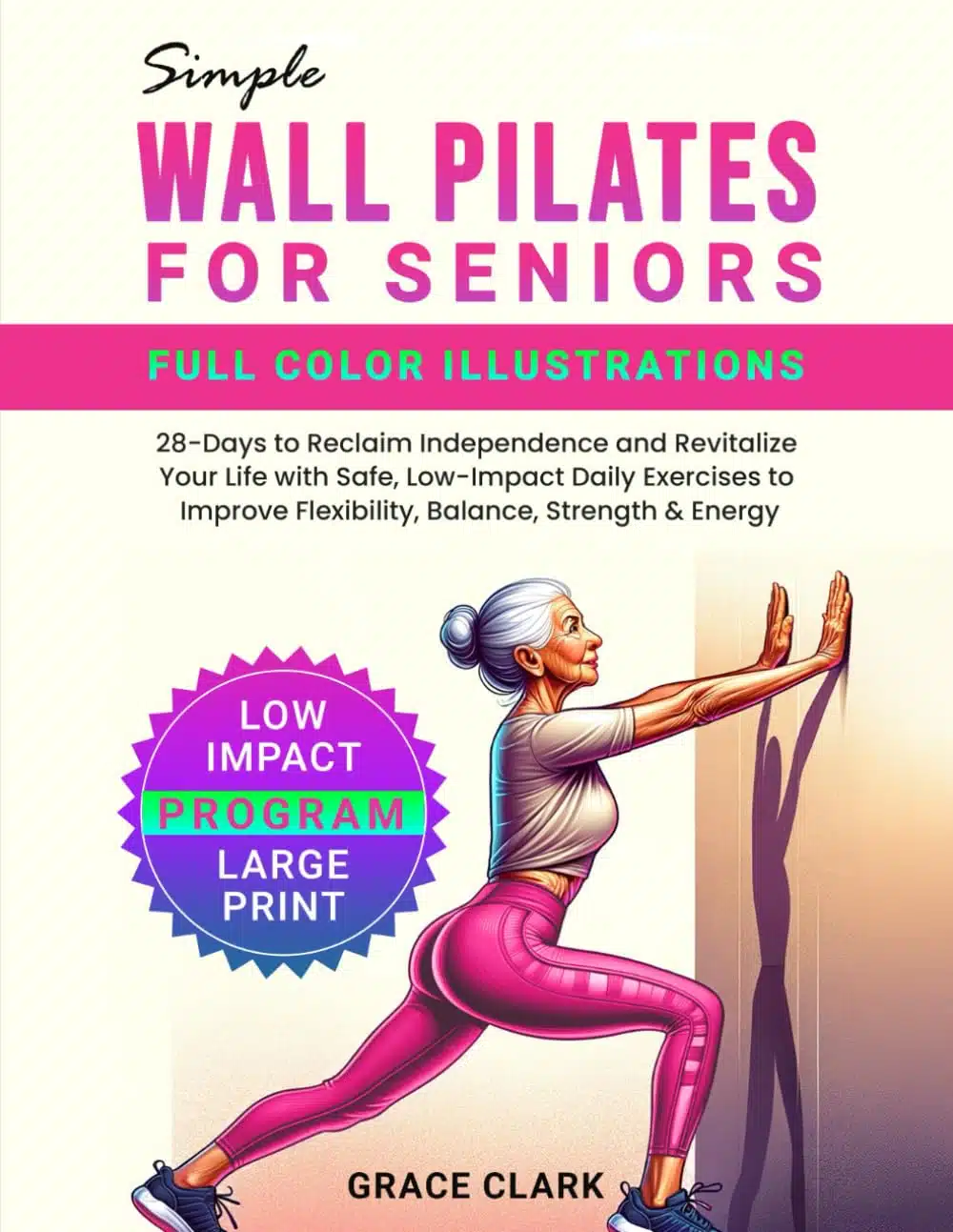
Simple Wall Pilates for Seniors – by Grace Clark

10almonds is reader-supported. We may, at no cost to you, receive a portion of sales if you purchase a product through a link in this article.

While the cover illustration makes this look a little too simple, in fact there’s a lot of value in this book, with exercises ranging from things like that on the cover, to the “wall downward dog”. But the actual exercises (of which there are 29) themselves are only a part of the book (taking about 70 pages of it with clear illustrations).

There’s also a lot about important Pilates principles to apply, such as breathing, correct body alignment (if you don’t already do Pilates, you will not have this, as Pilates alignment is quite specific), flexibility, balance, stability, coordination, range of motion, isometric exercise considerations, endurance, and more.

Unlike a lot of “…for seniors” books, this is not a watered down barely-does-anything version of the “real” exercises, but rather, would present most the same challenges to a 20-year-old reader; it’s just that the focus here is more on matters that tend to concern an older rather than younger demographic. That 20-something may be busy building their butt, for instance, while the 80-year-old is building their bones. No reason both shouldn’t do both, of course, but the focus is age-specific.

The author guides us through working up from easy things to hard, breaking stuff down so that we can progress at our own pace, such that even the most cautious or enthusiastic reader can start at an appropriate point and proceed accordingly.

She also talks us through a 28-day program (as promised by the subtitle), and advice on how to keep it going without plateauing, how to set realistic goals, how to tailor it to our abilities as we go, track our progress, and so forth.

The style is clear and instructional, and one thing that sets this apart from a lot of Pilates books is that the education comes from an angle not of “trust me”, but rather from well-sourced claims with bibliography whose list spans 5 pages at the end.

Bottom line: if you’d like to progressively increase your strength, stability, and more—with no gym equipment, just a wall—then this book will have you see improvements in the 28 days it promises, and thereafter.

Click here to check out Simple Wall Pilates For Seniors, and experience the difference!

Don’t Forget…

Did you arrive here from our newsletter? Don’t forget to return to the email to continue learning!
Learn to Age Gracefully

Join the 98k+ American women taking control of their health & aging with our 100% free (and fun!) daily emails:

  • An Elegant Defense – by Matt Richtel

    10almonds is reader-supported. We may, at no cost to you, receive a portion of sales if you purchase a product through a link in this article.

    In a way, Richtel got the best and worst of the publication date lottery. This book, which he’d obviously been working on for however long, was published in March 2020. Yes, that March 2020. So, it obviously got a huge boost in sales that launced it to bestseller status, and/but it doesn’t actually discuss COVID at all.

    What it does discuss, is—as one might expect—the immune system. Or really, the immune systems, plural, several systems working alongside each other. How we got to have such, how our immune functions work, where all the various immune cells come from and what part they play. What pathogens can do to fight and/or confuse (or even co-opt) our immune response, and what modern medicine can do to counteract the pathogens’ anti-countermeasure countermeasures. And how it can still go wrong.

    The “Four Lives” promised in the subtitle are stories, and Richtel explains the immune system through specific people’s specific battles. In particular, a friend of his who had quite a remarkable battle against cancer, which was of course terrible for him, but illustrative for us.

    The style of the book is very readably journalistic. The author is a Pulitzer-winning NYT journalist, and not normally a science writer. Here at 10almonds, “we like big bibliographies and we cannot lie”, and we didn’t get to enjoy that in this case. The book contained no bibliography (nor appropriate inline citations, nor equivalent footnotes). Maybe a future addition will include this.

    Bottom line: there’s a lot of “science for the lay reader” here. While the lack of references is a big oversight, the book does give a very good overview of what both sides (immune response and pathogenic invasion) bring to the battle of your body.

    Click here to check out Elegant Defense, and demystify immunology!

    Share This Post

  • The Magic Of Mindful Self-Awareness − by Matt Tenny

    10almonds is reader-supported. We may, at no cost to you, receive a portion of sales if you purchase a product through a link in this article.

    As the author is not a Dr. Matt Tenny, you may wonder his qualifications. In this case, the answer is summed up in the title of the first part of the book, “How I discovered unconditional happiness on my journey from prisoner to monk to social entrepreneur”. In other words, this one’s about personal experience of changing his life considerably.

    Part two, however, is where the actual practical content starts, with such topics as:

    • How to be free from your thoughts so you can stop overthinking and enjoy the present moment
    • How to clear your mind and make the practice of self-awareness (almost) effortless
    • How to transform mundane activities into magical moments and be happy 95% of the time

    You may be wondering about the other 5%; i.e. will this not work for some things? The answer is rather that sometimes we will experience emotions that are considered negative, and that’s ok. It need not be much of the time, but if we didn’t experience them at all, we’d just normalize a new set point and consider the least enjoyable 5% of that to be negative.

    And indeed, part three is “how to be at peace during the 5% of life that is truly painful, and live a deeply meaningful life”.

    Which, honestly, is a very important life skill, and this alone is worth the price of the book if you don’t already have this skill (and if you do, then condolences for however you got it, but congratulations on having it).

    The style is quite personal and direct, and—unlike that of a lot of CEO-monk types—surprisingly down-to-earth and (actually!) mindfully self-aware.

    Bottom line: if you’d like to be at peace in life with more practical advice than just “practice some mindfulness meditation”, then this book could be just the turning point you need.

    Click here to check out The Magic Of Mindful Self-Awareness, and be genuinely happy 95% of the time 🙂

    Share This Post

  • Dr. Greger’s Daily Dozen

    10almonds is reader-supported. We may, at no cost to you, receive a portion of sales if you purchase a product through a link in this article.

    Give Us This Day Our Daily Dozen

    This is Dr. Michael Greger. He’s a physician-turned-author-educator, and we’ve featured him and his work occasionally over the past year or so:

    But what we’ve not covered, astonishingly, is one of the things for which he’s most famous, which is…

    Dr. Greger’s Daily Dozen

    Based on the research in the very information-dense tome that his his magnum opus How Not To Die (while it doesn’t confer immortality, it does help avoid the most common causes of death), Dr. Greger recommends that we take care to enjoy each of the following things per day:

    Beans

    • Servings: 3 per day
    • Examples: ½ cup cooked beans, ¼ cup hummus

    Greens

    • Servings: 2 per day
    • Examples: 1 cup raw, ½ cup cooked

    Cruciferous vegetables

    • Servings: 1 per day
    • Examples: ½ cup chopped, 1 tablespoon horseradish

    Other vegetables

    • Servings: 2 per day
    • Examples: ½ cup non-leafy vegetables

    Whole grains

    • Servings: 3 per day
    • Examples: ½ cup hot cereal, 1 slice of bread

    Berries

    • Servings: 1 per day
    • Examples: ½ cup fresh or frozen, ¼ cup dried

    Other fruits

    • Servings: 3 per day
    • Examples: 1 medium fruit, ¼ cup dried fruit

    Flaxseed

    • Servings: 1 per day
    • Examples: 1 tablespoon ground

    Nuts & (other) seeds

    • Servings: 1 per day
    • Examples: ¼ cup nuts, 2 tablespoons nut butter

    Herbs & spices

    • Servings: 1 per day
    • Examples: ¼ teaspoon turmeric

    Hydrating drinks

    • Servings: 60 oz per day
    • Examples: Water, green tea, hibiscus tea

    Exercise

    • Servings: Once per day
    • Examples: 90 minutes moderate or 40 minutes vigorous

    Superficially it seems an interesting choice to, after listing 11 foods and drinks, have the 12th item as exercise but not add a 13th one of sleep—but perhaps he quite reasonably expects that people get a dose of sleep with more consistency than people get a dose of exercise. After all, exercise is mostly optional, whereas if we try to skip sleep for too long, our body will force the matter for us.

    Further 10almonds notes:

    Enjoy!

    Share This Post

  • The Japanese Health Initiative That Lowers Blood Sugars

    10almonds is reader-supported. We may, at no cost to you, receive a portion of sales if you purchase a product through a link in this article.

    We’ve talked before about Good (Or Bad) Health Starts With Your Blood, and how a lot of human disease begins with, or is exacerbated by, diabetes or even pre-diabetes, and that in the US, this is even more strongly true than in the rest of the world, what with the US being #1 for diabetes.

    However! That does not mean if you’re not prediabetic, there is no threat. This is because it is usually insulin resistance, and not the high blood sugar content itself, that is the main driver of disease. It just so happens that blood sugars are a lot quicker and easier to test, and the correlation between them is high. On the other hand, insulin resistance will often go unnoticed for many years, because the pancreas just cranks out more and more extra insulin to compensate and keep the blood sugars balanced—until one day it can’t because the body is so resistant to insulin that the pancreas just can’t produce enough to get it to care adequately, and that’s when the blood sugars will finally rise (and get noticed).

    We reviewed an excellent book about precisely this (very, very common) phenomenon: Why We Get Sick – by Dr. Benjamin Bikman

    The good news is, there are things can be done to Improve Your Insulin Sensitivity.

    And with regard to blood sugars themselves, an excellent list is: 10 Ways To Balance Blood Sugars

    Number 8 in that list was:

    After you eat, move

    The glucose you eat will be used to replace lost muscle glycogen, before any left over is stored as fat… and, while it’s waiting to be stored as fat, just sitting in your bloodstream being high blood sugars. So, this whole thing will go a lot better if you are actively using muscle glycogen (by moving your body).

    Inchauspé gives a metaphor: imagine a steam train worker, shoveling coal into the furnace. Meanwhile, other workers are bringing more coal. If the train is moving quickly, the coal can be shoveled into the furnace and burned and won’t build up so quickly. But if the train is moving slowly or not at all, that coal is just going to build up and build up, until the worker can shovel no more because of being neck-deep in coal.

    Same with your blood sugars!

    But that—sound advice as it is—remains a little vague, leaving us with questions such as:

    • How much movement?
    • For how long?
    • And what’s the window of opportunity to enjoy this effect?

    With those questions in mind…

    Japan’s “Plus 10” Initiative

    The government of Japan has a “plus 10” initiative, whose goal is to encourage everyone to add just 10 minutes of extra activity to each day. You might think that won’t make a big difference, but in fact it all adds up, for example: Cumulative Exercise vs Neurodegeneration ← which shows how it is cumulative exercise over time that matters the most in this regard, which means that “little and often” really does count for a lot.

    We’ve also written before about How Useful Is “Exercise Snacking”, Really?, with some very specific protocols there for those who like to truly optimize everything.

    Most recently, a Japanese research team investigated the effects of two different approaches to post-dinner exercise, on blood sugars:

    1. Walk for 10 minutes, immediately after eating
    2. Walk for 30 minutes, 30 minutes after eating

    There was also a control condition (rest only, no walking).

    They measured the effect of these conditions on blood glucose in three ways:

    • 2‑hour blood glucose area under the curve (AUC)*
    • mean average glucose
    • peak glucose

    *that’s a way of looking at the total impact of it over the course of the recording period

    They additionally measured heart rate, perceived exertion, and gastrointestinal discomfort.

    They found that both walking conditions significantly reduced 2‑hour blood glucose AUC and mean glucose versus control:

    • 10-min walk: the AUC was 15,607 mg·min/dL (control was 16,605), and mean glucose = 127.9 mg/dL (control was 135.8mg/dL)
    • 30-min walk: also effective, but no significant difference compared to the 10‑min walk immediately after eating.

    However! Only the immediate 10‑min walk significantly lowered peak glucose (164.3 mg/dL, compared to the control condition’s 181.9 mg/dL).

    Which means that the immediate 10-minute walk not only equals the delayed 30-minute walk in most ways, but also outright beats that in a third way. And that third way, the peak glucose? That’s where the insulin resistance starts, so this is critical.

    As for the other things they measured: both walking conditions were rated as low perceived effort, with the 10‑min walk feeling the relatively easier of the two. No increase in gastrointestinal discomfort was reported for either walking condition.

    You may be wondering about the pace of this walking:

    ❝The walking speed was self-selected by the participants to be comfortable. The participants were instructed to walk at their usual relaxed pace as in their daily life. The walking speed was set on a treadmill and was implemented at the same speed for the two walking conditions.❞

    You can read the paper in full, here: Positive impact of a 10-min walk immediately after glucose intake on postprandial glucose levels

    If walking isn’t your thing, or you don’t have a treadmill and the weather outside is frightful, then you might like:

    No-Exercise Exercise! ← for a veritable buffet of exercise snacking ideas

    Want to learn more?

    Consider:

    15 Easy Japanese Habits That Will Transform Your Health

    Enjoy!

    Don’t Forget…

    Did you arrive here from our newsletter? Don’t forget to return to the email to continue learning!

    Learn to Age Gracefully

    Join the 98k+ American women taking control of their health & aging with our 100% free (and fun!) daily emails:

  • Loss, Trauma, and Resilience – by Dr. Pauline Boss

    10almonds is reader-supported. We may, at no cost to you, receive a portion of sales if you purchase a product through a link in this article.

    Most books about bereavement are focused on grieving healthily and then moving on healthily. And, while it may be said “everyone’s grief is on their own timescale”… society’s expectation is often quite fixed:

    “Time will heal”, they say.

    But what if it doesn’t? What happens when that’s not possible?

    Ambiguous loss occurs when someone is on the one hand “gone”, but on the other hand, not necessarily.

    This can be:

    • Someone was lost in a way that didn’t leave a body to 100% confirm it
      • (e.g. disaster, terrorism, war, murder, missing persons)
    • Someone remains physically present but in some ways already “gone”
      • (e.g. Alzheimer’s disease or other dementia, brain injury, coma)

    These things stop us continuing as normal, and/but also stop us from moving on as normal.

    When either kind of moving forward is made impossible, everything gets frozen in place. How does one deal with that?

    Dr. Boss wrote this book for therapists, but its content is equally useful for anyone struggling with ambiguous loss—or who has a loved one who is, in turn, struggling with that.

    The book looks at the impact of ambiguous loss on continuing life, and how to navigate that:

    • How to be resilient, in the sense of when life tries to break you, to have ways to bend instead.
    • How to live with the cognitive dissonance of a loved one who is a sort of “Schrödinger’s person”.
    • How, and this is sometimes the biggest one, to manage ambiguous loss in a society that often pushes toward: “it’s been x period of time, come on, get over it now, back to normal”

    Will this book heal your heart and resolve your grief? No, it won’t. But what it can do is give a roadmap for nonetheless thriving in life, while gently holding onto whatever we need to along the way.

    Click here to check out “Ambiguous loss, Trauma, and Resilience” on Amazon—it can really help

    Don’t Forget…

    Did you arrive here from our newsletter? Don’t forget to return to the email to continue learning!

    Learn to Age Gracefully

    Join the 98k+ American women taking control of their health & aging with our 100% free (and fun!) daily emails:

  • Correct An Upper Spine Hump (Simple Stretch & Exercise)

    10almonds is reader-supported. We may, at no cost to you, receive a portion of sales if you purchase a product through a link in this article.

    Generally called a neck hump in this video, it can be in the cervical (neck) vertebrae or it can be in the thoracic (upper back) vertebrae. It’s also known as a dowager’s hump, buffalo hump, or kyphosis.

    However, it can be fixed:

    What to do

    First understand the cause: it generally comes from poor posture, especially from prolonged desk work or phone use.

    With that in mind…

    1. Posture adjustments: lean back in a chair to counter gravity’s pull on your head. Avoid slumping; keep your head aligned with your spine.
    2. Stretching: lie flat on the floor without pillows to restore spinal alignment. Gradually reduce pillow height during sleep to decrease neck hyperflexion.
    3. Neck retraction: pull chin straight back while keeping your eyes looking forwards. Hold for 15 seconds, gradually increasing to 60 seconds. Perform 10 repetitions, resting between sets.
    4. Strengthening: lean forward and pull the chin back against gravity. Hold, or repeat for 10 repetitions. Over time, increase duration to a minute.

    For more on all of this plus visual demonstrations, enjoy:

    Click Here If The Embedded Video Doesn’t Load Automatically!

    Want to learn more?

    You might also like to read:

    The Pains That Good Posture Now Can Help You Avoid Later

    Take care!

    Don’t Forget…

    Did you arrive here from our newsletter? Don’t forget to return to the email to continue learning!

    Learn to Age Gracefully

    Join the 98k+ American women taking control of their health & aging with our 100% free (and fun!) daily emails: