Securely Attached – 

10almonds is reader-supported. We may, at no cost to you, receive a portion of sales if you purchase a product through a link in this article.

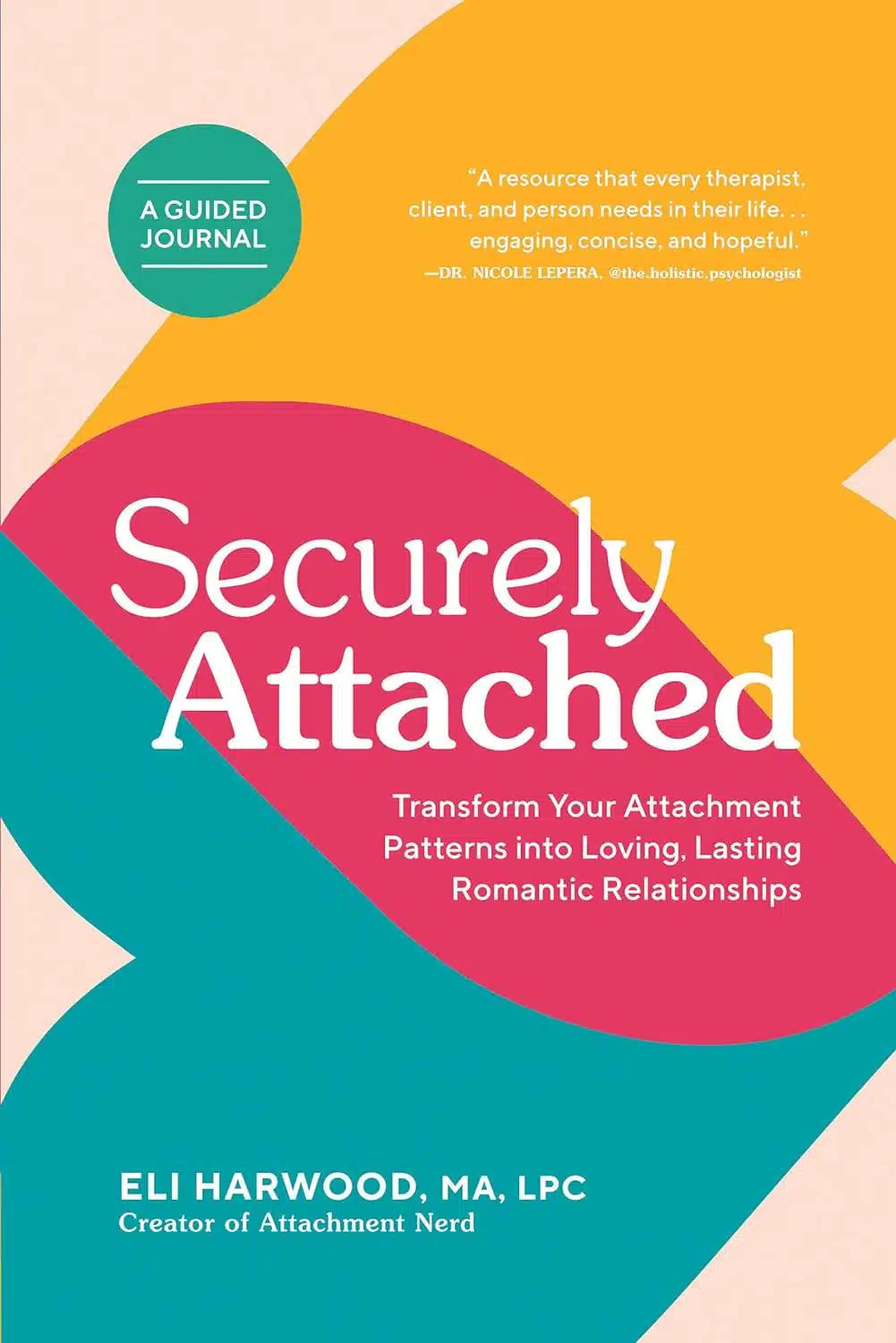
A lot of books on attachment theory are quite difficult to read. They’re often either too clinical with too much jargon that can feel like incomprehensible psychobabble, or else too wishy-washy and it starts to sound like a horoscope for psychology enthusiasts.

This one does it better.

The author gives us a clear overview and outline of attachment theory, with minimal jargon and/but clearly defined terms, and—which is a boon for anyone struggling to remember which general attachment pattern is which—color-codes everything consistently along the way. This is one reason that we recommend getting a print copy of the book, not the e-book.

The other reason to invest in the print copy rather than the e-book is the option to use parts of it as a workbook directly—though if preferred, one can simply take the prompts and use them, without writing in the book, of course.

It’s hard to say what the greatest value of this book is because there are two very strong candidates:

  • Super-clear and easy explanation of Attachment Theory, in a way that actually makes sense and will stick
  • Excellent actually helpful advice on improving how we use the knowledge that we now have of our own attachment patterns and those of others

Bottom line: if you’d like to better understand Attachment Theory and apply it to your life, but have been put off by other presentations of it, this is the most user-friendly, no-BS version that this reviewer has seen.

Click here to check out Securely Attached, and upgrade your relationship(s)!

Don’t Forget…

Did you arrive here from our newsletter? Don’t forget to return to the email to continue learning!

Learn to Age Gracefully

Join the 98k+ American women taking control of their health & aging with our 100% free (and fun!) daily emails:

  • Does running ruin your knees? And how old is too old to start?

    10almonds is reader-supported. We may, at no cost to you, receive a portion of sales if you purchase a product through a link in this article.

    You’ve probably heard that running is tough on your knees – and even that it can cause long-term damage. But is this true?

    Running is a relatively high-impact activity.

    Every time your foot contacts the ground while running, your body absorbs a force that equates to about two to three times your bodyweight.

    It’s easy to imagine this load going straight into your knees, and it sort of does. Your knees absorb three times more load during running than walking.

    But this isn’t a bad thing.

    In fact, running may help keep your knees strong and healthy – here’s what the evidence says.

    muse studio/Shutterstock

    Designed to keep moving

    Your body isn’t simply a pile of bones and cartilage that gets worn down with every step. It is a living dynamic system that grows and adapts in response to the loads that are placed upon it.

    And it needs load to keep functioning.

    Your knee joint is incredibly strong and designed to move. The cartilage inside your knee is a strong, flexible, connective tissue that cushions and protects the bones of your knee joint.

    There is good evidence to show when someone’s load is removed – for example, during prolonged bed rest or immobilisation – their bone and cartilage begins to deteriorate.

    Running’s impact on bones and cartilage

    We know running temporarily reduces the thickness of knee cartilage. This returns to normal a couple of hours after the run is finished.

    Researchers have suggested this may be an important process that facilitates nutrients moving into the cartilage, which can help it adapt and become stronger.

    In support of this idea, evidence shows runners tend to have thicker cartilage than non-runners – especially in their knees.

    Runners also tend to have better bone mineral density than non-runners. It has even been suggested the more you run, the better protected you are against developing of osteoarthritis (although more research is needed to confirm this).

    All of this points to running being good for your knees’ health and longevity – even before we consider the many known benefits it has for heart and metabolic health.

    But am I too old to start running?

    Unfortunately (at least to my knowledge) there is no strong evidence examining what happens when you pick up running later in life. However, other lines of research do suggest it is likely safe and effective.

    A 2020 study demonstrated that older adults (65 years and older) who start high intensity jump training (known as “plyometric” training) not only see improvements in strength and function, but also find it safe and enjoyable.

    And considering this type of training leads to much higher joint loads than running, it gives us a good indication that starting running in later life will also be safe and effective.

    However, you should still start slow.

    Like any type of exercise, your muscles and joints need time to adapt to the new load that is being placed upon them.

    With this in mind, it’s best to start with intervals where you walk for a short period, then jog for a short period. Then you can gradually increase your running distance over time, giving your body time to adapt.

    So, why does running’s bad reputation persist?

    I believe this myth still persists because, despite all its health benefits, almost half of runners will get some kind of injury each year – and injuries to the knee are among the most common.

    However the vast majority of these are known as “overuse” injuries, caused by issues with load management rather than running itself. This means they are caused by people running too much too quickly, without letting their body adapt and get stronger.

    All exercise comes with the risk of injury, so we will never completely eliminate the chance of getting hurt. But with respect to running, a few things can help.

    First, make sure to progress slowly. Large spikes in how much and how often you run can lead to injuries. So, try not to increase your mileage by more than a couple of kilometres per week.

    Second, make sure to eat enough to support your running. Running is an activity that burns a lot of energy. You also need to have adequate energy available to ensure you recover properly after you run.

    Eating enough carbohydrates and protein to meet your energy and recovery needs might help prevent overuse injures such as stress fractures. Some research suggests getting enough calcium and Vitamin D might do the same.

    Finally, there is some evidence to suggest that running on grass means less impact than running on harder surfaces such as concrete. So, doing a couple of your weekly runs on grass when you’re first starting might be a good way to help you adjust to the load.

    For most of us, the health benefits of running will far outweigh the risks – especially if you take it slow, build up strength, and keep listening to your body.

    Hunter Bennett, Lecturer in Exercise Science, University of South Australia

    This article is republished from The Conversation under a Creative Commons license. Read the original article.

    Share This Post

  • How Many Days Of Saturated Fats Does It Take To Deplete Gut Defenses?

    10almonds is reader-supported. We may, at no cost to you, receive a portion of sales if you purchase a product through a link in this article.

    For dieters and athletes alike, the idea of “a cheat day” is common—a day during which one deviates from one’s normal dietary plan (specifically: where one has specific dietary rules, and chooses to break them for day).

    Now, at 10almonds we don’t generally advocate for restrictive dieting as a rule, though there are some arguments to be made for it; see: What Are The “Bright Lines” Of Bright Line Eating?

    For most people, a flexible dietary approach is more tenable and thus sustainable: What Flexible Dieting Really Means (And What It Doesn’t)

    And it’s quite possible to take an interoceptive approach: Intuitive Eating Might Not Be What You Think

    If you are in the habit of eating healthily, the idea of a “cheat day” from a diet that doesn’t feel restrictive probably isn’t an appealing prospect—because you simply don’t crave junk food; it’s not what your gut is used to.

    Nevertheless, sometimes cheat days, or at least cheat meals, choose us rather than the other way around. If your social group is having a pizza night or meeting up at the burger bar, probably you’re going to be having a meal that’s not ideal.

    So, what to do about that? Check out: How To Out-Cheat “Cheat Days” (Or Even Just “Cheat Meals”)

    Now comes the why:

    The difference that two days make

    A team of researchers in Australia, namely Dr. Shanti Diwakarla et al., investigated the impact of a high-fat diet on gut health, and found that just two days of high-saturated-fat meals in mice led to reduced levels of IL-22, a key gut-protective protein.

    Now, this was a mouse study, but that protein works the same for us, so it’s likely this will be reproduced in human trials (to the point that it’d be strange and surprising if it weren’t).

    Why this matters: the depletion of IL-22 compromises the gut’s ability to control inflammation, even in the absence of visible symptoms like weight gain.

    You may be thinking “oh, it’s good at least that it doesn’t cause weight gain”. And there are two problems with that idea:

    1. This was over the course of two days. Likely weight gain would ensue if this were continued for more than two days. But more importantly…
    2. The study shows how inflammation can develop silently, building up over time and potentially leading to chronic conditions years later.

    Note: this is about a diet high in saturated fats, so it’s not just about junk food, it’s also relevant for the paleo diet and most iterations of the ketogenic diet.

    See also:

    Notably, while saturated fats weaken gut defences and promote inflammation, in contrast unsaturated fats (e.g. in olive oil, nuts, and avocados) boost IL-22 production and are anti-inflammatory.

    You can read the paper in full here: Acute exposure to high-fat diet impairs ILC3 functions and gut homeostasis

    Want to learn more?

    For gut health, a great starting point is:

    Making Friends With Your Gut (You Can Thank Us Later)

    …and for fighting inflammation, a great starting point is:

    How to Prevent (or Reduce) Inflammation

    Take care!

    Share This Post

  • No-Needle Vaccination Against Many Avian/Human Flu Types

    10almonds is reader-supported. We may, at no cost to you, receive a portion of sales if you purchase a product through a link in this article.

    And other items from this week’s health news:

    Intranasal spray provides broad protection

    The flu isn’t fun, and kills many people very year. Needles, meanwhile, are often viewed as a necessary evil when it comes to protection against such. However, this newly-developed intranasal spray vaccinates against a wide variety of flu strains (including the bird flu strains currently rife in some parts of the US).

    Most flu vaccines only target a few strains and (as you’re probably very aware) must be updated every year, as viruses mutate. They also don’t usually protect well against flu viruses that come from animals, like bird flu. The World Health Organization has called for better, more universal flu vaccines, and this research does just that.

    The team used two methods:

    • One method added a human gene to the flu virus, helping the immune system recognize and destroy infected cells more easily.
    • The other method changed parts of the virus’s genetic code to make it weaker in humans but still easy to produce using current vaccine technology.

    Both approaches showed strong results in trials, offering protection against multiple types of flu.

    Read in full: Needle-free, live-attenuated influenza vaccines with broad protection against human and avian virus subtypes

    Related: Flu vaccines are now available for 2025. What’s on offer and which one should I get?

    How pets help in old age

    It’s probably not news to you that pets can be a remedy against feelings of loneliness, but there’s more to it than that: daily routines like feeding, walking, and playing with a pet can bring structure to the day, reduce stress, and boost physical activity.

    Pets also help a lot of older adults connect with their communities, simply because walking a dog or visiting a pet-friendly place often leads to casual conversations and new friendships, which can otherwise sometimes be thin on the ground.

    However, owning a pet inevitably comes with some challenges, so it’s worth bearing them in mind up front. Some people may struggle with caring for pets that need a lot of exercise, or have health issues of their own, for example. It’s therefore especially important to choose a pet that fits your lifestyle and what you’re able to deal with on a daily basis—if indeed a pet is the right option for you at all (it’s not for everyone!).

    Read in full: How pets enrich the lives of the elderly

    Related: How To Beat Loneliness & Isolation

    Beyond statins: a cholesterol-lowering pill that helps reduce heart disease risk

    Heart disease is a leading killer in the US, and stroke is also rising up the “most fatal” list in recent years. Many opt to treat high cholesterol levels (which can contribute to hypertension, and thus cardiovascular disease, and thus also vascular dementia and stroke) with statins, but statins have their side effects too, many of which are very serious, and for some people, they may not even be that effective.

    So, it might be worth knowing about a new contender: Obicetrapib.

    This new drug was tested in a large (n=2,530) clinical trial and was shown to significantly reduce two major causes of heart disease: LDL (“bad”) cholesterol, and lipoprotein(a), also called: Lp(a).

    The study participants were people with heart disease or inherited high cholesterol, and after 12 weeks, those taking Obicetrapib had lowered their LDL cholesterol by over 30%, and Lp(a) by about the same amount. This is important because many people cannot reach safe cholesterol levels with current medications, and there are no widely approved treatments for lowering Lp(a) yet.

    Read in full: Cholesterol pill helps those at high risk of heart attack and stroke: Study

    Related: Lower Cholesterol, Without Statins

    Take care!

    Share This Post

  • Inhaled Eucalyptus’s Immunomodulatory and Antimicrobial Effects

    10almonds is reader-supported. We may, at no cost to you, receive a portion of sales if you purchase a product through a link in this article.

    It’s Q&A Day at 10almonds!

    Have a question or a request? You can always hit “reply” to any of our emails, or use the feedback widget at the bottom!

    In cases where we’ve already covered something, we might link to what we wrote before, but will always be happy to revisit any of our topics again in the future too—there’s always more to say!

    As ever: if the question/request can be answered briefly, we’ll do it here in our Q&A Thursday edition. If not, we’ll make a main feature of it shortly afterwards!

    So, no question/request too big or small

    ❝At the first hint of a cough or a cold, I resort to steam inhalation. Some people add herbs or aromatic oils to the boiling water. What do you recommend?❞

    First of all, please do be careful:

    Severe scalds sustained during steam inhalation therapy in an adult population: Analysis of patient outcomes and the financial burden to healthcare services

    Western science’s view is predominantly “this is popular and/but evidence for its usefulness is lacking”:

    Theoretical effectiveness of steam inhalation against SARS-CoV-2 infection: updates on clinical trials, mechanism of actions, and traditional approaches

    But! Traditional Chinese Medicine indicates shuanghuanglian, yuxingcao and qingkailing, which the China Food and Drug Administration has also approved:

    Chinese Medicine in Inhalation Therapy: A Review of Clinical Application and Formulation Development

    Indian scientists are also looking at modern scientific applications of certain Ayurvedic herbs:

    Promising phytochemicals of traditional Indian herbal steam inhalation therapy to combat COVID-19

    In terms of what is likely more available to you, there are several reasons to choose eucalyptus over popular alternatives:

    Immune-modifying and antimicrobial effects of Eucalyptus oil and simple inhalation devices

    For the sake of being methodical, here’s an example product on Amazon, though we’re sure you’d have no trouble finding this in your local pharmacy if you prefer.

    Take care!

    Don’t Forget…

    Did you arrive here from our newsletter? Don’t forget to return to the email to continue learning!

    Learn to Age Gracefully

    Join the 98k+ American women taking control of their health & aging with our 100% free (and fun!) daily emails:

  • What To Eat, Take, And Do Before A Workout

    10almonds is reader-supported. We may, at no cost to you, receive a portion of sales if you purchase a product through a link in this article.

    What to eat, take, and do before a workout

    We’ve previously written about how to recover quickly after a workout:

    Overdone It? How To Speed Up Recovery After Exercise

    Today we’ll look at the flipside: how to prepare for exercise.

    Pre-workout nutrition

    As per what we wrote (and referenced) above, a good dictum is “protein whenever; carbs after”. See also:

    Pre- versus post-exercise protein intake has similar effects on muscular adaptations

    It’s recommended to have a light, balanced meal a few hours before exercising, though there are nuances:

    International society of sports nutrition position stand: nutrient timing

    Hydration

    You will not perform well unless you are well-hydrated:

    Influence of Dehydration on Intermittent Sprint Performance

    However, you also don’t want to just be sloshing around when exercising because you took care to get in your two litres before hitting the gym.

    For this reason, quality can be more important than quantity, and sodium and other electrolytes can be important and useful, but will not be so for everyone in all circumstances.

    Here’s what we wrote previously about that:

    Are Electrolyte Supplements Worth It?

    Pre-workout supplements

    We previously wrote about the use of creatine specifically:

    Creatine: Very Different For Young & Old People

    Caffeine is also a surprisingly effective pre-workout supplement:

    International society of sports nutrition position stand: caffeine and exercise performance

    Depending on the rate at which you metabolize caffeine (there are genes for this), the effects will come/go earlier/later, but as a general rule of thumb, caffeine should work within about 20 minutes, and will peak in effect 1–2 hours after consumption:

    Nutrition Supplements to Stimulate Lipolysis: A Review in Relation to Endurance Exercise Capacity

    Branched Chain Amino Acids, or BCAAs, are commonly enjoyed as pre-workout supplement to help reduce creatine kinase and muscle soreness, but won’t accelerate recovery:

    The effect of branched-chain amino acid on muscle damage markers and performance following strenuous exercise: a systematic review and meta-analysis

    …but will help boost muscle-growth (or maintenance, depending on your exercise and diet) in the long run:

    Branched-Chain Amino Acid Ingestion Stimulates Muscle Myofibrillar Protein Synthesis following Resistance Exercise in Humans

    Where can I get those?

    We don’t sell them, but here’s an example product on Amazon, for your convenience 

    There are also many multi-nutrient pre-workout supplements on the market (like the secondary product offered with the BCAA above). We’d need a lot more room to go into all of those (maybe we’ll include some in our Monday Research Review editions), but meanwhile, here’s some further reading:

    The 11 Best Pre-Workout Supplements According to a Dietitian

    (it’s more of a “we ranked these commercial products” article than a science article, but it’s a good starting place for understanding about what’s on offer)

    Enjoy!

    Don’t Forget…

    Did you arrive here from our newsletter? Don’t forget to return to the email to continue learning!

    Learn to Age Gracefully

    Join the 98k+ American women taking control of their health & aging with our 100% free (and fun!) daily emails:

  • What’s the difference between a home birth and a free birth?

    10almonds is reader-supported. We may, at no cost to you, receive a portion of sales if you purchase a product through a link in this article.

    If you’re looking on social media for information and experiences of giving birth at home, you’ll find widely varied content.

    On the one hand, you’ll find women who develop a relationship with their midwife over time and eventually have a “home birth” where they feel comfortable and safe.

    Others choose to birth outside the medical system in a “free birth”. They might birth at home but feel compelled to forgo specialist skills and equipment.

    While free births and home births sound similar, they come with very different potential risks.

    Layland Masuda/Getty Images

    What is a home birth?

    Planned home births involve care from registered midwives. They care for women through the pregnancy, support them to give birth at home and continue this care for around six weeks following the birth.

    Registered midwives either work privately or are employed by a hospital to provide home births.

    Around 20 publicly funded home birth programs operate nationally for low-risk women who don’t live far from the hospital. Most set a maximum distance (time or kilometres) from the hospital so women can get there quickly if they need medical care or in an emergency.

    Private midwives work for themselves and charge for care before, during and after a home birth. Women are able to get some money back from Medicare or through some private health funds.

    Midwives are highly skilled and carry resuscitation equipment and medications to deal with emergencies, for instance, if the baby isn’t breathing or the mother is bleeding heavily.

    What is a free birth?

    When a woman chooses to have a free birth they make the decision to have a baby, usually at home, without a registered health professional such as a midwife or doctor in attendance. These are also called unassisted or wild births.

    Those who plan a free birth may hire an unregulated birth worker or doula to support them at the birth. But they don’t have the training, regulation or medical equipment and skills needed to manage emergencies.

    Women may have limited or no antenatal health care, so risk factors such as twins and breech presentations (the baby coming bottom first) aren’t detected beforehand and given the right kind of specialist care.

    Free birth isn’t the same as when a baby comes too fast to make it to hospital. This is called being “born before arrival”.

    How common are home births and free births?

    In 2023, 97% of women give birth in hospital. Of these, three-quarters birthed in a public hospital; the rest went private.

    A small proportion of women gave birth out of hospital, including in birth centres (1.5%), at home (0.7%), or in other settings (such as being before arrival at a hospital) (0.7%).

    There was a slight increase in the number of home births in recent years, from 923 (0.3%) in 2019 to 2,081 (0.7%) in 2023.

    It’s unclear how common free birth is, as data is not collected. But there is some evidence free births increased during the COVID pandemic and this trend has continued.

    Are home births safe?

    The research shows that for women with low-risk pregnancies, planned home births attended by competent midwives (with links to hospitals) are safe.

    Private midwives are required to book a woman into the nearby hospital and share information with the hospital at the start of a pregnancy in case medical care is needed at any time.

    Midwives across Australia follow national referral guidelines and safety and quality guidelines from the Nursing and Midwifery Board about when to consult or refer women for medical care. Around 12-35% of women who plan to give birth at home will be transferred to hospital. Some midwives can continue to care for women who need extra medical support in hospital.

    Women with risk factors are recommended to not give birth at home as there is a greater chance of needing extra medical care for her or her baby. Risk factors include being pregnant with twins, having a baby in a breech position, or having high blood pressure.

    For low-risk women and their babies, there is no difference in the risk of death between planned home and hospital births.

    However, compared with hospital births, women who plan to give birth at home have a lower chance of having an episiotomy (a surgical cut to the perineum), a perineal tear, significant blood loss, or an infection. They are less likely to be induced, have a caesarean section, or have a forceps or vacuum delivery.

    Women who have a home birth more often report positive experiences than in hospitals and tend to make the same choice for the next birth. A home birth can also be healing for women who have experienced a traumatic birth.

    Why would a woman choose to have a free birth?

    The main reason women choose to free birth is a previous traumatic birth or feeling coerced to make certain choices, such as being induced or having an episiotomy or caesarean section.

    Sometimes, women can’t access a midwife to attend them at home. For others, the cost is prohibitive.

    Others are motivated by a strong belief in their own capacity to give birth without professional support, with social media influencers impacting these decisions.

    The risks of free birth are primarily are due to not having a trained midwife in attendance and the lack of skills to detect complications and transfer to a hospital, or to manage complications at home.

    If you choose to birth at home, it’s important to have a registered midwife supporting you during labour to make this option as safe as possible.

    Hannah Dahlen, Professor of Midwifery, Associate Dean Research and HDR, Midwifery Discipline Leader, Western Sydney University

    This article is republished from The Conversation under a Creative Commons license. Read the original article.

    Don’t Forget…

    Did you arrive here from our newsletter? Don’t forget to return to the email to continue learning!

    Learn to Age Gracefully

    Join the 98k+ American women taking control of their health & aging with our 100% free (and fun!) daily emails: