
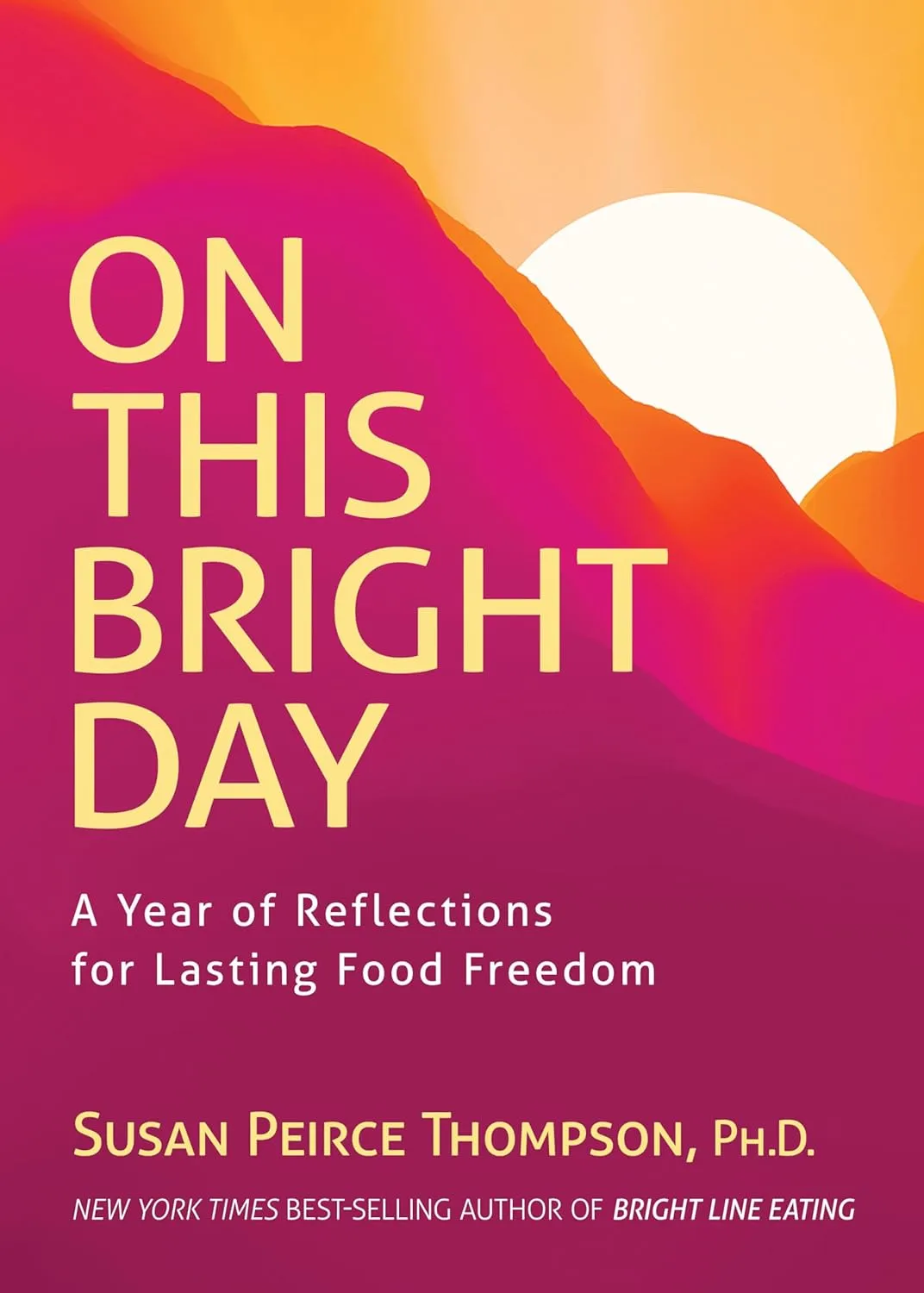
On This Bright Day – by Dr. Susan Thompson
10almonds is reader-supported. We may, at no cost to you, receive a portion of sales if you purchase a product through a link in this article.
This book is principally aimed at those who have struggled with emotional/comfort eating, over-eating, and/or compulsive eating of some kind.
However, its advices go for the “little compulsions” too, the many small unhealthy choices that add up. Thus, this book has value for most if not all of us.
The format is: each day has a little quotation, followed by a short discussion of that, which is then underlined by an affirmation for the day.
The main thrust of the book is to promote mindful eating, and it does this well with daily reminders that are helpful without being preachy.
Bottom line: if you enjoy “daily reader” type books and would like a daily reminder to practice mindful eating, then this book is for you!
Click here to check out On This Bright Day, and enjoy your food mindfully, every day!
Don’t Forget…
Did you arrive here from our newsletter? Don’t forget to return to the email to continue learning!
Recommended
Learn to Age Gracefully
Join the 98k+ American women taking control of their health & aging with our 100% free (and fun!) daily emails:
-
Are You A “Weekend Warrior”?
10almonds is reader-supported. We may, at no cost to you, receive a portion of sales if you purchase a product through a link in this article.
First, let’s define the term: for our purposes today (and indeed, for the science we will discuss), a “weekend warrior” is someone who gets in 150 minutes or more of moderate to vigorous exercise in just one or two sessions per week.
Some more parameters for our discussion today:
- a “regularly active” person also does 150 minutes or more of moderate to vigorous exercise, but spread over three or more sessions
- an “inactive” person is someone who does under 150 minutes of moderate to vigorous exercise per week.
You can probably guess already that the “inactive” person is going to be less healthy, and if you guessed that, then you guessed correctly.
But, what about the other two?
Head to head
Researchers (Dr. Zhiyuan Wu et al.) looked at 51,650 US adults with type 2 diabetes, found that both weekend warrior and regular exercise patterns (per the above definitions) reduced risk of death.
Compared to inactive people…
- weekend warriors had a 21% lower all-cause mortality risk
- regularly active people had a 17% lower all-cause mortality risk
Not only that, but when we look at cardiovascular mortality specifically, the gap widens, and…
- weekend warriors had a 33% lower cardiovascular death risk
- regularly active people had a 19% lower cardiovascular death risk
You can read the paper in full, here: Association of Weekend Warrior and Other Physical Activity Patterns With Mortality Among Adults With Diabetes: A Cohort Study
Why does this happen? What happened to advice such as that from The Doctor Who Wants Us To Exercise Less, & Move More?
It’s unclear, but the researchers hypothesize that weekend activities may be longer, more social, outdoors, or higher intensity compared with weekday gym workouts—all of which can make a difference.
We at 10almonds would also not that the limitations listed in the paper,
❝Physical activity was self-reported and assessed at a single time point❞
…may play a part too. The kind of person who spends their weekends mountain-biking may well say “No, I don’t really do any exercise in the rest of the week” because, comparatively to the weekend, they’re not—even if in fact, due in part to their extra fitness, they’re quite possibly moving more than their non-weekend-warrioring counterparts who, not having the weekend of mountain-biking to point to, start totting up all the other things they do during the week, that the weekend warriors also did but left unmentioned as superfluous. But this too is just a hypothesis, to be clear.
What is clear, and is not hypothetical, is that both exercise patterns significantly reduce all-cause mortality.
In short, it is best to go with which ever works for you and your preferred lifestyle, because ultimately, the best exercise is the exercise that you’ll actually do.
For example:
- How Useful Is “Exercise Snacking”, Really? ← for light bites
- How To Do HIIT (Without Wrecking Your Body) ← for getting intense
Want to learn more?
If you don’t love organized, intentional workouts, then consider:
No-Exercise Exercise! ← for how to get in a lot of exercise without it feeling like it
Enjoy!
Share This Post
-
How does the drug abemaciclib treat breast cancer?
10almonds is reader-supported. We may, at no cost to you, receive a portion of sales if you purchase a product through a link in this article.
The anti-cancer drug abemaciclib (also known as Vernezio) has this month been added to the Australian Pharmaceutical Benefits Scheme (PBS) to treat certain types of breast cancer.
This significantly reduces the cost of the drug. A patient can now expect to pay A$31.60 for a 28-day supply ($7.70 with a health care concession card). The price of abemaciclib without government subsidy is $4,250.
So what is abemaciclib, and how did we get to this point?
It stops cells dividing
Researchers at the pharmaceutical company Eli Lilly developed abemaciclib and published the first study on the drug (then known as LY2835219) in 2014.
Abemaciclib is a type of drug known as a “cyclin-dependent kinase inhibitor”. It’s taken as a pill twice a day.
To maintain our health, many of the cells in our bodies need to grow and divide to produce new cells. Cancers develop when cells grow and divide out of control. Therefore, stopping cells from dividing into new cells is one way that cancer can be fought.
When cells divide, they have to make a copy of their DNA to pass onto the new cell. “Cyclin-dependent kinases” (CDKs for short) are essential for this process. So, if you stop the CDKs, you stop the DNA copying, you stop cells dividing, and you fight the cancer.
However, there are different types of CDKs, and not all cancers need them all to grow. Abemaciclib specifically targets CDK4 and CDK6. Thankfully, a lot of cancers do need these CDKs, including some breast cancers.
The drug targets CDK4 and CDK6. Photoroyalty/Shutterstock But abemaciclib will only be effective against cancers that rely on CDK4 and CDK6 for continued growth. This specificity also means abemaciclib is fairly unique, so it can’t easily be replaced with a different drug.
Two other CDK4/6 inhibitors were developed around the same time as abemaciclib, and are called ribociclib and palbociclib. Both of these drugs are also on the PBS for specific types of breast cancer. As the drugs differ in their chemical structures, they have slight differences in the way they are taken up and processed by the body. The preferred drug given to a breast cancer patient will depend on their unique circumstances.
What are the side effects?
Research is still ongoing into the differences between each of these CDK4/6 inhibitors, but it is known that the side effects are largely similar, but can differ in severity.
The most common side effects of abemaciclib are fatigue, diarrhoea and neutropenia (reduced white blood cells). The gastrointestinal issues are generally more severe with abemaciclib.
If these side effects are too severe, abemaciclib treatment can be stopped.
What types of cancer has abemaciclib been approved for?
In 2017, the United States Food and Drug Administration (FDA) approved abemaciclib for the treatment of patients with metastatic HR+/HER2- (hormone receptor-positive and human epidermal growth factor receptor 2-negative) breast cancer who did not respond to standard endocrine therapy.
Australia’s Therapeutic Goods Administration (TGA) similarly approved abemaciclib in 2022 as an “adjuvant” therapy (after the initial surgery to remove the tumour) for patients with HR+/HER2- invasive early breast cancer which had spread to lymph nodes and was at high risk of returning.
The drug is approved for people with early breast cancer which is at high risk of returning. PeopleImages.com – Yuri A/Shutterstock As of May 1 2024, the PBS covers this use of abemaciclib in combination with endocrine therapy such as fulvestrant, which is also listed on the PBS. Endocrine therapy, also known as hormonal therapy, blocks hormone receptor positive (HR+) cancers from receiving the hormones they need to survive.
Could abemaciclib be used for other cancers in the future?
Abemaciclib is of great interest to scientists and medical practitioners, and testing is ongoing to assess the effectiveness of abemaciclib in treating a range of other cancers, including gastrointestinal cancers and blood cancers.
Abemaciclib may even be usable in brain cancers, as it has long been known to be capable of crossing the blood-brain barrier, a common stumbling block for potential anti-cancer drugs.
Time will tell whether the role of abemaciclib in health care will be expanded. But for now, its inclusion on the PBS is sure to bring some relief to breast cancer patients nationwide.
Sarah Diepstraten, Senior Research Officer, Blood Cells and Blood Cancer Division, Walter and Eliza Hall Institute and John (Eddie) La Marca, Senior Resarch Officer, Walter and Eliza Hall Institute
This article is republished from The Conversation under a Creative Commons license. Read the original article.
Share This Post
-
A Surprisingly Easy Weapon Against The Flu
10almonds is reader-supported. We may, at no cost to you, receive a portion of sales if you purchase a product through a link in this article.
It’s that time of year, and flu is on the rise. So is COVID, so is RSV, and so are various other infectious pathogens.
See for example: COVID, flu, RSV: how these common viruses are tracking this winter, and how to protect yourself ← this is news from Australia, which is of more relevance than one might think when it comes to those of us in the Northern hemisphere, as Australia’s flu season being 6 months ahead of ours can give a good indicator of how things are going to go for us when our own winter hits.
Note for any confused: due to axial tilt, seasons in the two hemispheres are mirrored. So while you’re probably familiar with the seasons being tied to specific calendar months and popular media (centred around N. American and European experiences) can make that seem very one-sided, it’s important to remember that June, July, and August are winter months in the Southern hemisphere, and December, January, and February are summer months.
Which brings us to our main topic today…
It’s about time!
There’s a lot that can be done to improve one’s chances against the flu et al., and we’ve written about that from time to time before, for example:
Why Some People Get Sick More (And How To Not Be One Of Them) ← including some very important things that many people don’t know!
But more recently, researchers (Dr. Martina Towers et al.) have found that a person’s underlying circadian rhythm can directly influence how well the body responds to flu infection (and, presumably, other infections too, but this was about influenza A.
This is not too surprising, because circadian rhythms regulate biological processes in individual organs and cells, and external cues—especially light and mealtimes—help synchronize these clocks, and thus play a part in regulating immune response.
You may be wondering: why does the body care what time it is when it comes to fighting an infection? Isn’t a flu infection casus belli for total war, and thus around-the-clock wave after wave of immune defense deployments?
And yes, it is. But consider: we’ve previously used the example of firefighters, when talking about acute vs chronic inflammation (we’ll link that article at the bottom of this section, for your references). That the problem with chronic inflammation is that the firefighters are overworked and exhausted after responding to a bajillion false alarms or trivial things that were not really the business of the fire service, so that when an actual fire breaks out, they’re not in good shape to combat it.
Let us add to this metaphor a little, and ask the question: what happens if all the firefighters are confused about what time it is? Will they coordinate well together, show up to shift on time, get a good night’s sleep after a day’s work, and so forth? No, there will be big gaps in the service; there will be times when there are too many firefighters trying to crowd into one place, and times when there’s a nobody around to answer the calls.
So it is with your immune system too.
Dr. Towers and her team tested this, and in so doing, showed how disrupting normal lighting patterns during a critical window removed the usual time-of-day protections (i.e., that immune response is usually better in the morning, for example) and produced an abnormal immune response, including excess inflammatory cells in the lungs. They also found that keeping a rhythmic meal schedule at least somewhat reduced the harm caused by disrupted light cues. Thus, it’s clear that both light/dark and appropriate regular mealtimes are important for this kind of regulation, and that while they work best if you have everything correct, getting one aspect correct (e.g. just the dark/light, or just the meal schedule) is already better than nothing.
You can read the paper in full, here: Effect of external cues on clock-driven protection from influenza A infection
This is also consistent, of course, with the generally good advice of “try to get good sleep”, which was item #1 in a previous main feature of ours:
Beyond Supplements: The Real Immune-Boosters!
And see also, for that matter: What Harm Can One Sleepless Night Do? ← this is about how bad sleep ruins immune response, and is where we used to firefighters metaphor previously
In summary…
If you want to be able to fight the flu, then you need to take care of your circadian rhythm. For more on that, see:
The Circadian Rhythm: Far More Than Most People Know
…and:
Want to learn more?
Check out:
The Pathogens That Came In From The Cold: The Cold Truth About Respiratory Infections
Take care!
Share This Post
Related Posts
-
Heart Health Calculator Entry Issue
10almonds is reader-supported. We may, at no cost to you, receive a portion of sales if you purchase a product through a link in this article.
It’s Q&A Day at 10almonds!
Have a question or a request? You can always hit “reply” to any of our emails, or use the feedback widget at the bottom!
In cases where we’ve already covered something, we might link to what we wrote before, but will always be happy to revisit any of our topics again in the future too—there’s always more to say!
As ever: if the question/request can be answered briefly, we’ll do it here in our Q&A Thursday edition. If not, we’ll make a main feature of it shortly afterwards!
So, no question/request too big or small
❝I tried to use your calculator for heart health, and was unable to enter in my height or weight. Is there another way to calculate? Why will that field not populate?❞
(this is in reference to yesterday’s main feature “How Are You, Really? And How Old Is Your Heart?“)
How strange! We tested it in several desktop browsers and several mobile browsers, and were unable to find any version that didn’t work. That includes switching between metric and imperial units, per preference; both appear to work fine. Do be aware that it’ll only take numerical imput, though.
Don’t Forget…
Did you arrive here from our newsletter? Don’t forget to return to the email to continue learning!
Learn to Age Gracefully
Join the 98k+ American women taking control of their health & aging with our 100% free (and fun!) daily emails:
-
No, your aches and pains don’t get worse in the cold. So why do we think they do?
10almonds is reader-supported. We may, at no cost to you, receive a portion of sales if you purchase a product through a link in this article.
It’s cold and wet outside. As you get out of bed, you can feel it in your bones. Your right knee is flaring up again. That’ll make it harder for you to walk the dog or go to the gym. You think it must be because of the weather.
It’s a common idea, but a myth.
When we looked at the evidence, we found no direct link between most common aches and pains and the weather. In the first study of its kind, we found no direct link between the temperature or humidity with most joint or muscle aches and pains.
So why are so many of us convinced the weather’s to blame? Here’s what we think is really going on.
fongbeerredhot/Shutterstock Weather can be linked to your health
The weather is often associated with the risk of new and ongoing health conditions. For example, cold temperatures may worsen asthma symptoms. Hot temperatures increase the risk of heart problems, such as arrhythmia (irregular heartbeat), cardiac arrest and coronary heart disease.
Many people are also convinced the weather is linked to their aches and pains. For example, two in every three people with knee, hip or hand osteoarthritis say cold temperatures trigger their symptoms.
Musculoskeletal conditions affect more than seven million Australians. So we set out to find out whether weather is really the culprit behind winter flare-ups.
What we did
Very few studies have been specifically and appropriately designed to look for any direct link between weather changes and joint or muscle pain. And ours is the first to evaluate data from these particular studies.
We looked at data from more than 15,000 people from around the world. Together, these people reported more than 28,000 episodes of pain, mostly back pain, knee or hip osteoarthritis. People with rheumatoid arthritis and gout were also included.
We then compared the frequency of those pain reports between different types of weather: hot or cold, humid or dry, rainy, windy, as well as some combinations (for example, hot and humid versus cold and dry).
Bad back on a cold day? We wanted to know if the weather was really to blame. Pearl PhotoPix/Shutterstock What we found
We found changes in air temperature, humidity, air pressure and rainfall do not increase the risk of knee, hip or lower back pain symptoms and are not associated with people seeking care for a new episode of arthritis.
The results of this study suggest we do not experience joint or muscle pain flare-ups as a result of changes in the weather, and a cold day will not increase our risk of having knee or back pain.
In order words, there is no direct link between the weather and back, knee or hip pain, nor will it give you arthritis.
It is important to note, though, that very cold air temperatures (under 10°C) were rarely studied so we cannot make conclusions about worsening symptoms in more extreme changes in the weather.
The only exception to our findings was for gout, an inflammatory type of arthritis that can come and go. Here, pain increased in warmer, dry conditions.
Gout has a very different underlying biological mechanism to back pain or knee and hip osteoarthritis, which may explain our results. The combination of warm and dry weather may lead to increased dehydration and consequently increased concentration of uric acid in the blood, and deposition of uric acid crystals in the joint in people with gout, resulting in a flare-up.
Why do people blame the weather?
The weather can influence other factors and behaviours that consequently shape how we perceive and manage pain.
For example, some people may change their physical activity routine during winter, choosing the couch over the gym. And we know prolonged sitting, for instance, is directly linked to worse back pain. Others may change their sleep routine or sleep less well when it is either too cold or too warm. Once again, a bad night’s sleep can trigger your back and knee pain.
Likewise, changes in mood, often experienced in cold weather, trigger increases in both back and knee pain.
So these changes in behaviour over winter may contribute to more aches and pains, and not the weather itself.
Believing our pain will feel worse in winter (even if this is not the case) may also make us feel worse in winter. This is known as the nocebo effect.
When it’s cold outside, we may be less active. Anna Nass/Shutterstock What to do about winter aches and pains?
It’s best to focus on risk factors for pain you can control and modify, rather than ones you can’t (such as the weather).
You can:
- become more physically active. This winter, and throughout the year, aim to walk more, or talk to your health-care provider about gentle exercises you can safely do at home, with a physiotherapist, personal trainer or at the pool
- lose weight if obese or overweight, as this is linked to lower levels of joint pain and better physical function
- keep your body warm in winter if you feel some muscle tension in uncomfortably cold conditions. Also ensure your bedroom is nice and warm as we tend to sleep less well in cold rooms
- maintain a healthy diet and avoid smoking or drinking high levels of alcohol. These are among key lifestyle recommendations to better manage many types of arthritis and musculoskeletal conditions. For people with back pain, for example, a healthy lifestyle is linked with higher levels of physical function.
Manuela Ferreira, Professor of Musculoskeletal Health, Head of Musculoskeletal Program, George Institute for Global Health and Leticia Deveza, Rheumatologist and Research Fellow, University of Sydney
This article is republished from The Conversation under a Creative Commons license. Read the original article.
Don’t Forget…
Did you arrive here from our newsletter? Don’t forget to return to the email to continue learning!
Learn to Age Gracefully
Join the 98k+ American women taking control of their health & aging with our 100% free (and fun!) daily emails:
-
Watch Out For Furanocoumarins!
10almonds is reader-supported. We may, at no cost to you, receive a portion of sales if you purchase a product through a link in this article.
This class of organic compounds can affect many different medications, in some cases stopping them from working, and in some cases causing you to overdose.
It’s naturally occurring, and found in certain fruit.
Agent of chaos
The fact that furanocoumarins can have very different (often opposite) effects on different drugs, makes it a lot harder to predict in its behavior than, for example, alcohol.
In particular, we’ve talked before about the very high furanocoumarin content of grapefruit (including: grapefruit juice), which has come up sometimes in our This or That section.
For example:
❝Another thing to bear in mind is that grapefruit contains furanocoumarin, which can inhibit cytochrome P-450 3A4 isoenzyme and P-glycoptrotein transporters in the intestine and liver—slowing down their drug metabolism capabilities, thus effectively increasing the bioavailability of many drugs manifold.
This may sound superficially like a good thing (improving bioavailability of things we want), but in practice it means that in the case of many drugs, if you take them with (or near in time to) grapefruit or grapefruit juice, then congratulations, you just took an overdose.
This happens with a lot of meds for blood pressure, cholesterol (including statins), calcium channel-blockers, anti-depressants, benzo-family drugs, beta-blockers, and more. Oh, and Viagra, too. Which latter might sound funny, but remember, Viagra’s mechanism of action is blood pressure modulation, and that is not something you want to mess around with unduly.
So, do check with your pharmacist to know if you’re on any meds that would be affected by grapefruit or grapefruit juice!
PS: the same substance is quite available in pummelos and sour oranges (but not meaningfully in sweet oranges); you can see a chart here showing the relative furanocoumarin contents of many citrus fruits, or lack thereof as the case may be, as it is for lemons and most limes).❞
Other drugs, however, will be decreased in their effects.
For example, for antihistamines like fexofenadine, grapefruit juice inhibits transport proteins that help absorb the drug, reducing its effectiveness
Here’s a cheatsheet
Caveat: this is a non-exhaustive list!
Medicines whose effects can INCREASE Medicines whose effects can DECREASE Cholesterol-lowering statins: simvastatin, lovastatin, atorvastatin (higher risk of muscle pain or damage) Antihistamines: e.g: fexofenadine (less effective) Blood pressure-lowering drugs: felodipine, nifedipine, nicardipine, nisoldipine, amlodipine, verapamil Blood pressure meds: e.g: aliskiren (levels drop sharply, making it less effective) Anti-anxiety and sleep medicines: midazolam, triazolam, alprazolam, diazepam, clonazepam Beta-blockers: celiprolol, talinolol, acebutolol (weaker heart-rate control) Erectile-dysfunction drugs: sildenafil, tadalafil, vardenafil Chemotherapy: e.g: etoposide (reduced absorption, which lowers effectiveness) Heart-rhythm drugs: amiodarone, dronedarone, quinidine, disopyramide, propafenone (increased risk of irregular heartbeat or toxicity) Thyroid medicine: levothyroxine (delayed absorption, usually not a huge problem) Immune-suppressing drugs: cyclosporine, tacrolimus, sirolimus Mental-health medicines: buspirone, quetiapine, sertraline (increased side effects) Pain medicines: oxycodone, methadone (overdose risk) Source: Expanded List Of Medications That Interact With Grapefruit ← as you can see, we had to clip the “increase” list for brevity; we kept it short by a) grouping them the way we did b) prioritizing the medications that are most common and whose interactions have the strongest adverse effect
Important note on timing
Of the many ways these interactions can occur, the two most common are:
- Blocking the enzyme (CYP3A4) in the gut that normally helps break down many drugs—this causes increases in drug levels.
- Blocking the transporter protein (OATP1A2) that helps the body absorb other medicines—this causes decreases in drug levels.
The enzyme-blocking effect can last up to 3 days, so skipping grapefruit for only a few hours won’t help! You need to avoid it entirely.
See: Drug-grapefruit juice interactions: two mechanisms are clear but individual responses vary
For medicines affected by OATP inhibition (like fexofenadine), leaving a 4-hour gap usually* avoids the problem.
See: Fruit juice inhibition of uptake transport: a new type of food–drug interaction
*Not a guarantee, because individuals’ physiology can and sometimes will vary.
Want to learn more?
That’s all we have room to say about furanocoumarins for now, but let’s quickly mention a very common (and very affective!) herbal supplement that has almost as many medication interactions as grapefruit does (albeit, for completely different reasons, many of which mechanisms of action are not yet fully understood):
St. John’s wort can weaken the effects of many medicines, including crucially important medicines such as:
- Antidepressants
- Birth control pills
- Cyclosporine, which prevents the body from rejecting transplanted organs
- Some heart medications, including digoxin and ivabradine
- Some HIV drugs, including indinavir and nevirapine
- Some cancer medications, including irinotecan and imatinib
- Warfarin, an anticoagulant (blood thinner)
- Certain statins, including simvastatin
And for our main article on St. John’s Wort, check out:
Flower Power: St. John’s Wort’s Drug-Level Effectiveness (The Herbal Supplement That Rivals Prozac)
Take care!
Don’t Forget…
Did you arrive here from our newsletter? Don’t forget to return to the email to continue learning!
Learn to Age Gracefully
Join the 98k+ American women taking control of their health & aging with our 100% free (and fun!) daily emails:


