
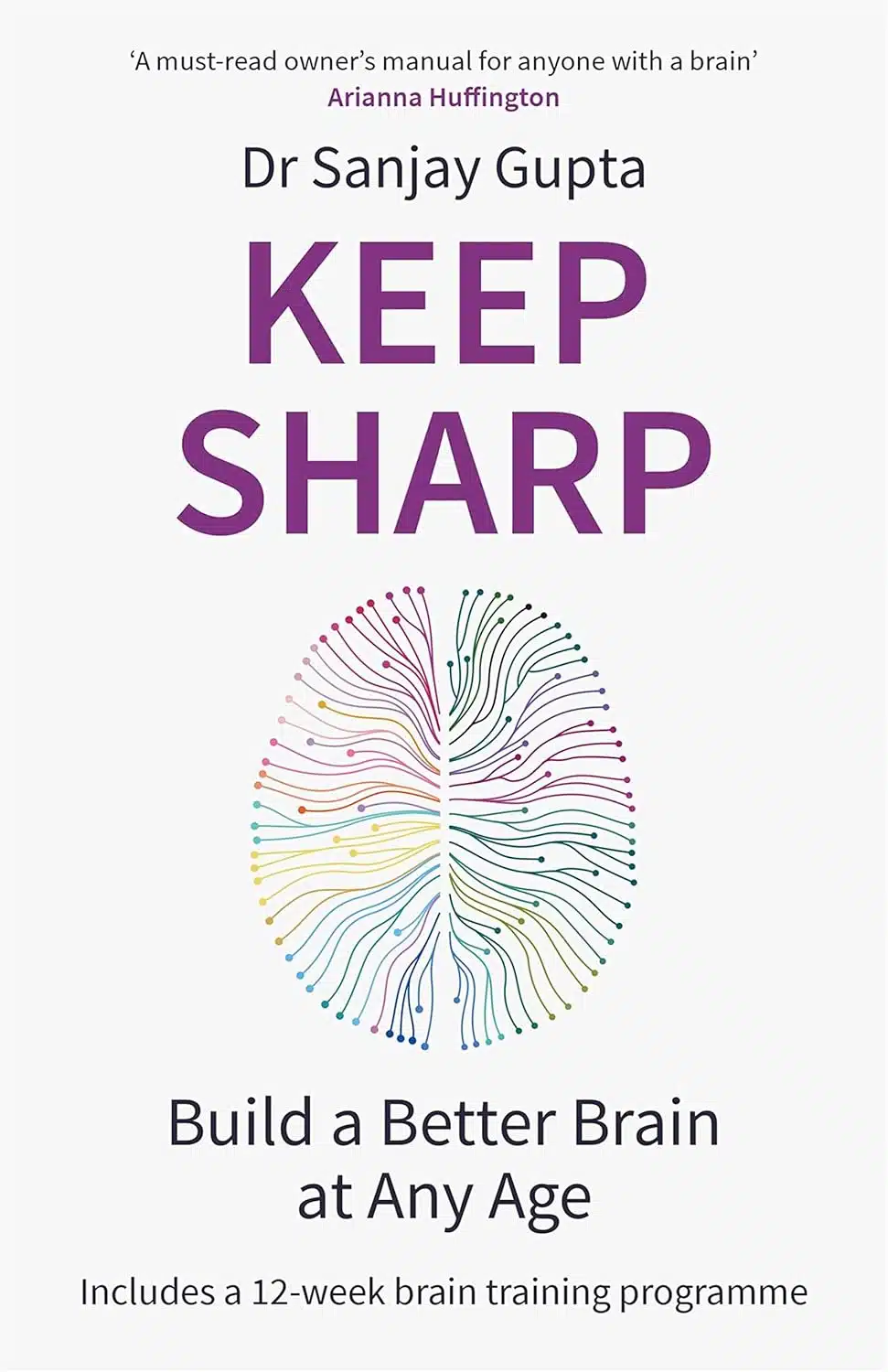
Keep Sharp – by Dr. Sanjay Gupta

10almonds is reader-supported. We may, at no cost to you, receive a portion of sales if you purchase a product through a link in this article.

The author, a neurosurgeon, explains the practical realities of cognitive decline and the battle against same.

After an initial self-assessment quiz, he covers the foundational knowledge needed to get started, and also does some necessary mythbusting, before the majority of the book is given over to the various angles by which to approach his “5 Pillars”, which we’ll not keep a secret; they are:

  1. Move
  2. Discover
  3. Relax
  4. Nourish
  5. Connect

…which may seem self-explanatory, but he does a good job of highlighting the pitfalls and mistakes of many, as well as how to optimize our choices while implementing all 5 of those things in such a way as each supports the others.

This latter he does by means of his 12-week step-by-step plan, so for those who like to have everything laid out in front of you, you’ll enjoy that here.

It doesn’t stop there though! While many similar books have some kind of roadmap at the end, Dr. Gupta also covers, in a third part of the book, how to proceed if all is not going well; that is to say, if you or a loved one has a diagnosis of a neurodegenerative disorder, and/or even “just” Mild Cognitive Impairment (MCI), which is more a descriptor of the state that’s often a prelude to full-blown dementia. This he discusses in compassionate yet practical terms, including how to navigate the path forwards financially and emotionally, too—how to be aware of the threats while still maintaining hope and optimism.

The style is personal and engaging, well-written and easy to read, while including plenty of references to the hard science if one wants to dive deeper—exactly what we love to see in all regards!

Bottom line: if you’d like to proof your brain against cognitive decline, then this book can surely help.

Click here to check out Keep Sharp, and indeed keep sharp!

Don’t Forget…

Did you arrive here from our newsletter? Don’t forget to return to the email to continue learning!
Learn to Age Gracefully

Join the 98k+ American women taking control of their health & aging with our 100% free (and fun!) daily emails:

  • Dogs Paired With Providers at Hospitals Help Ease Staff and Patient Stress

    10almonds is reader-supported. We may, at no cost to you, receive a portion of sales if you purchase a product through a link in this article.

    DENVER — Outside HCA HealthONE Rose medical center, the snow is flying. Inside, on the third floor, there’s a flurry of activity within the labor and delivery unit.

    “There’s a lot of action up here. It can be very stressful at times,” said Kristina Fraser, an OB-GYN in blue scrubs.

    Nurses wheel a very pregnant mom past.

    “We’re going to bring a baby into this world safely,” Fraser said, “and off we go.”

    She said she feels ready in part due to a calming moment she had just a few minutes earlier with some canine colleagues.

    A pair of dogs, tails wagging, had come by a nearby nursing station, causing about a dozen medical professionals to melt into a collective puddle of affection. A yellow Lab named Peppi showered Fraser in nuzzles and kisses. “I don’t know if a human baby smells as good as that puppy breath!” Fraser had said as her colleagues laughed.

    The dogs aren’t visitors. They work here, too, specifically for the benefit of the staff. “I feel like that dog just walks on and everybody takes a big deep breath and gets down on the ground and has a few moments of just decompressing,” Fraser said. “It’s great. It’s amazing.”

    Hospital staffers who work with the dogs say there is virtually no bite risk with the carefully trained Labradors, the preferred breed for this work.

    The dogs are kept away from allergic patients and washed regularly to prevent germs from spreading, and people must wash their hands before and after petting them.

    Doctors and nurses are facing a growing mental health crisis driven by their experiences at work. They and other health care colleagues face high rates of depression, anxiety, stress, suicidal ideation, and burnout. Nearly half of health workers reported often feeling burned out in 2022, an increase from 2018, according to the Centers for Disease Control and Prevention. And the percentage of health care workers who reported harassment at work more than doubled over that four-year period. Advocates for the presence of dogs in hospitals see the animals as one thing that can help.

    That includes Peppi’s handler, Susan Ryan, an emergency medicine physician at Rose.

    Ryan said years working as an emergency room doctor left her with symptoms of PTSD. “I just was messed up and I knew it,” said Ryan, who isolated more at home and didn’t want to engage with friends. “I shoved it all in. I think we all do.”

    She said doctors and other providers can be good at hiding their struggles, because they have to compartmentalize. “How else can I go from a patient who had a cardiac arrest, deal with the family members telling them that, and go to a room where another person is mad that they’ve had to wait 45 minutes for their ear pain? And I have to flip that switch.”

    To cope with her symptoms of post-traumatic stress disorder, Ryan started doing therapy with horses. But she couldn’t have a horse in her backyard, so she got a Labrador. 

    Ryan received training from a national service dog group called Canine Companions, becoming the first doctor trained by the group to have a facility dog in an emergency room. Canine Companions has graduated more than 8,000 service dogs.

    The Rose medical center gave Ryan approval to bring a dog to work during her ER shifts. Ryan’s colleagues said they are delighted that a dog is part of their work life.

    “When I have a bad day at work and I come to Rose and Peppi is here, my day’s going to be made better,” EMT Jasmine Richardson said. “And if I have a patient who’s having a tough day, Peppi just knows how to light up the room.”

    Nursing supervisor Eric Vaillancourt agreed, calling Peppi “joyful.”

    Ryan had another dog, Wynn, working with her during the height of the pandemic. She said she thinks Wynn made a huge difference. “It saved people,” she said. “We had new nurses that had never seen death before, and now they’re seeing a covid death. And we were worried sick we were dying.”

    She said her hospital system has lost a couple of physicians to suicide in the past two years, which HCA confirmed to KFF Health News and NPR. Ryan hopes the canine connection can help with trauma. “Anything that brings you back to the present time helps ground you again. A dog can be that calming influence,” she said. “You can get down on the ground, pet them, and you just get calm.”

    Ryan said research has shown the advantages. For example, one review of dozens of original studies on human-animal interactions found benefits for a variety of conditions including behavioral and mood issues and physical symptoms of stress. 

    Rose’s president and CEO, Casey Guber, became such a believer in the canine connection he got his own trained dog to bring to the hospital, a black Lab-retriever mix named Ralphie.

    She wears a badge: Chief Dog Officer.

    Guber said she’s a big morale booster. “Phenomenal,” he said. “It is not uncommon to see a surgeon coming down to our administration office and rolling on the ground with Ralphie, or one of our nurses taking Ralphie out for a walk in the park.”

    This article is from a partnership that includes CPR News, NPR, and KFF Health News.

    KFF Health News is a national newsroom that produces in-depth journalism about health issues and is one of the core operating programs at KFF—an independent source of health policy research, polling, and journalism. Learn more about KFF.

    Subscribe to KFF Health News’ free Morning Briefing.

    This article first appeared on KFF Health News and is republished here under a Creative Commons license.

    Share This Post

  • Small Changes For A Healthier Life

    10almonds is reader-supported. We may, at no cost to you, receive a portion of sales if you purchase a product through a link in this article.

    It’s Q&A Day at 10almonds!

    Have a question or a request? You can always hit “reply” to any of our emails, or use the feedback widget at the bottom!

    In cases where we’ve already covered something, we might link to what we wrote before, but will always be happy to revisit any of our topics again in the future too—there’s always more to say!

    As ever: if the question/request can be answered briefly, we’ll do it here in our Q&A Thursday edition. If not, we’ll make a main feature of it shortly afterwards!

    So, no question/request too big or small

    I am interested in what I can substitute for ham in bean soup?

    Well, that depends on what the ham was like! You can certainly buy ready-made vegan lardons (i.e. small bacon/ham bits, often in tiny cubes or similar) in any reasonably-sized supermarket. Being processed, they’re not amazing for the health, but are still an improvement on pork.

    Alternatively, you can make your own seitan! Again, seitan is really not a health food, but again, it’s still relatively less bad than pork (unless you are allergic to gluten, in which case, definitely skip this one).

    Alternatively alternatively, in a soup that already contains beans (so the protein element is already covered), you could just skip the ham as an added ingredient, and instead bring the extra flavor by means of a little salt, a little yeast extract (if you don’t like yeast extract, don’t worry, it won’t taste like it if you just use a teaspoon in a big pot, or half a teaspoon in a smaller pot), and a little smoked paprika. If you want to go healthier, you can swap out the salt for MSG, which enhances flavor in a similar fashion while containing less sodium.

    Wondering about the health aspects of MSG? Check out our main feature on this, from last month:

    What’s the deal with MSG?

    I thoroughly enjoy your daily delivery. I’d love to see one for teens too!

    That’s great to hear! The average age of our subscribers is generally rather older, but it’s good to know there’s an interest in topics for younger people. We’ll bear that in mind, and see what we can do to cater to that without alienating our older readers!

    That said: it’s never too soon to be learning about stuff that affects us when we’re older—there are lifestyle factors at 20 that affect Alzheimer’s risk at 60, for example (e.g. drinking—excessive drinking at 20* is correlated to higher Alzheimer’s risk at 60).

    *This one may be less of an issue for our US readers, since the US doesn’t have nearly as much of a culture of drinking under 21 as some places. Compare for example with general European practices of drinking moderately from the mid-teens, or the (happily, diminishing—but historically notable) British practice of drinking heavily from the mid-teens.

    How much turmeric should I take each day?

    Dr. Michael Greger’s research (of “Dr. Greger’s Daily Dozen” and “How Not To Die” fame) recommends getting at least ¼ tsp turmeric per day

    Remember to take it with black pepper though, for a 2000% absorption bonus!

    A great way to get it, if you don’t want to take capsules and don’t want to eat spicy food every day, is to throw a teaspoon of turmeric in when making a pot of (we recommend wholegrain!) rice. Turmeric is very water-soluble, so it’ll be transferred into the rice easily during cooking. It’ll make the rice a nice golden yellow color, and/but won’t noticeably change the taste.

    Again remember to throw in some black pepper, and if you really want to boost the nutritional content,some chia seeds are a great addition too (they’ll get cooked with the rice and so it won’t be like eating seeds later, but the nutrients will be there in the rice dish).

    You can do the same with par-boiled potatoes or other root vegetables, but because cooking those has water to be thrown away at the end (unlike rice), you’ll lose some turmeric in the water.

    Request: more people need to be aware of suicidal tendencies and what they can do to ward them off

    That’s certainly a very important topic! We’ll cover that properly in one of our Psychology Sunday editions. In the meantime, we’ll mention a previous special that we did, that was mostly about handling depression (in oneself or a loved one), and obviously there’s a degree of crossover:

    The Mental Health First-Aid That You’ll Hopefully Never Need

    Share This Post

  • Why PCOS IS Now PMOS (What It Means In Practical Terms)

    10almonds is reader-supported. We may, at no cost to you, receive a portion of sales if you purchase a product through a link in this article.

    It’s Q&A Day at 10almonds!

    Have a question or a request? We love to hear from you!

    In cases where we’ve already covered something, we might link to what we wrote before, but will always be happy to revisit any of our topics again in the future too—there’s always more to say!

    No question/request too big or small 😎

    ❝Is there anything that’s actually changed with PCOS now being PMOS, or is it just a name change?❞

    Yes and yes! That is to say:

    • Yes, it is technically just a name change
    • Yes, there are expected positive knock-on effects of this change

    First, let’s quickly recap what the name change actually is, so that we can talk about why the change was made and what we can expect to see in the category of positive effects resulting from this change:

    The name was: polycystic ovary syndrome (PCOS)

    The name is now: polyendocrine metabolic ovarian syndrome (PMOS)

    The old name is a little bit misleading, since not only are ovarian cysts not a required symptom, but there isn’t even, on average, an increase in abnormal ovarian cysts.

    The new name, in contrast, de-emphasizes that aspect and instead brings attention to the endocrine and metabolic aspects.

    This was talked about before, for example in this guest article on our own site: PCOS affects 1 in 8 women worldwide, yet it’s often misunderstood. A name change might help

    This is important, because PMOS is linked to infertility, pregnancy complications, acne, excess hair growth, depression, anxiety, eating disorders, Type 2 diabetes, heart disease, and reduced quality of life, with metabolic complications occurring earlier and more frequently than in people without the condition.

    Almost all of these things have far more to do with the hormonal and metabolic side of things, rather than being anything to do with cysts (which, when they do occur, are also a result of those things, being characterized by disrupted follicle development caused by hormonal signalling disturbances).

    As for how this change is expected to help, advocates hope the new terminology will reduce stigma, improve understanding among physicians, encourage more whole-body treatment approaches, and ensure patients with varying symptoms receive better long-term support.

    Of these things, probably the “whole-body treatment approaches” are going to have the biggest positive impact on people’s lives.

    Want to learn more?

    If you will kindly overlook that these articles were written with the old name, then do check out:

    Take care!

    Share This Post

  • Come Together – by Dr. Emily Nagoski

    10almonds is reader-supported. We may, at no cost to you, receive a portion of sales if you purchase a product through a link in this article.

    From Dr. Emily Nagoski, author of the bestseller “Come As You Are” (which we reviewed very favorably before) we now present: Come Together.

    What it is not about: simultaneous orgasms. The title is just a play on words.

    What it is about: improving sexual wellbeing, particularly in long-term relationships where one or more partner(s) may be experiencing low desire.

    Hence: come together, in the closeness sense.

    A lot of books (or advice articles) out there take the Cosmo approach of “spicing things up”, and that can help for a night perhaps, but relying on novelty is not a sustainable approach.

    Instead, what Dr. Nagoski outlines here is a method for focusing on shared comfort and pleasure over desire, creating the right state of mind that’s more conducive to sexuality, and reducing things that put the brakes on sexuality.

    She also covers things whereby sexuality can often be obliged to change (for example, with age and/or disability), but that with the right attitude, change can sometimes just be growth in a different way, as you explore the new circumstances together, and continue to find shared pleasure in the ways that best suit your changing circumstances,

    Bottom line: if you and/or your partner(s) would like to foster and maintain intimacy and pleasure, then this is a top-tier book for you.

    Click here to check out Come Together, and, well, come together!

    Don’t Forget…

    Did you arrive here from our newsletter? Don’t forget to return to the email to continue learning!

    Learn to Age Gracefully

    Join the 98k+ American women taking control of their health & aging with our 100% free (and fun!) daily emails:

  • Going to the dentist is expensive. Here are 3 things you can do to protect your oral health – and 3 things to avoid

    10almonds is reader-supported. We may, at no cost to you, receive a portion of sales if you purchase a product through a link in this article.

    Around one in three Australians delayed their visit to a dentist in the last financial year – or didn’t go at all – due to cost.

    Given it doesn’t look like dental treatment is being added to Medicare any time soon, what can you do?

    Most oral and dental diseases are preventable, if you take care of your teeth and mouth. In-between visits to the dentist, here’s what you can do to avoid preventable issues – and blow-out costs.

    Jiri Hera/Shutterstock

    What causes diseases in your mouth?

    More than 1,000 species of microbes live in the mouth. Most dental and oral diseases are due to an imbalance or overgrowth in these microbes within the plaque (or “biofilm”).

    Plaque gathers on the hard surfaces inside the mouth (your teeth), as well as soft surfaces (such as your tongue). Removing plaque manually with brushing and flossing is the most effective way to maintain oral health.

    Plaque starts to form immediately after brushing, which is why you should remove it regularly.

    Things to do

    1. Brush twice a day

    Use a toothbrush with soft bristles (either electric or manual). Soft bristles remove plaque without damaging the teeth or gums. A fluoridated toothpaste will help strengthen the teeth.

    Brush for at least two minutes, using a sweeping and scrubbing motion, away from the gums. It’s a good idea to start at the back teeth and work your way through to the front teeth. Don’t forget to scrub the biting surface of the teeth.

    2. Floss

    Don’t skip this step – it’s crucial to clean in-between the teeth where a toothbrush can’t reach. Once a day should be enough.

    Whether you use floss, a pick, a bottle brush or other devices may depend on the space between your teeth.

    3. Clean your tongue

    To completely remove the microbes, it’s also important to clean your tongue regularly (twice daily). You can use a toothbrush while you’re already brushing, or a special tongue scraper – just don’t brush or scrape too hard.

    Little boy and father brush teeth in mirror.
    Brushing twice a day is important to remove bacteria in the mouth and on the teeth. PeopleImages.com – Yuri A/Shutterstock

    Things to avoid

    1. Sugary drinks and refined food

    What we eat and drink can affect the mouth’s pH.

    When bacteria in the mouth break down sugars, they produce acids. The acidity can dissolve minerals in the teeth and lead to decay.

    Refined foods – such as white bread, cakes and pastries – can easily be broken down by the mouth’s bacteria. So, having a lot of them, as well as sugary drinks, can damage the teeth and cause cavities.

    Water is the best choice to drink with your meals. Sparkling and soda water are acidic and can lead to mineral loss from the teeth, even when they are unflavoured. There is evidence flavoured sparkling water can be as harmful as orange juice.

    2. Tobacco and vaping

    Smoking or using smokeless tobacco (such as chewed tobacco or snuff pouches) is linked to oral cancer.

    Nicotine is also known to increase the severity of gum diseases – even when inflammation isn’t visible.

    This is true for both smoking and smokeless tobacco (such as chewed tobacco or snuff pouches).

    Vaping also increases your risk of developing cavities and gum disease.

    3. Too much alcohol, tea and coffee

    Drinking a lot of coffee, tea or red wine can stain your teeth. So if you’re concerned about your teeth appearing yellow or brown, it’s best to limit your intake.

    Drinking alcohol is also linked to an increased risk of developing oral cancers, which most commonly affect the tongue, floor of the mouth, cheek and palate.

    Close up of cola with ice.
    Drinks that are fizzy and sugary can damage the teeth. Svetlana Foote/Shutterstock

    Your mouth’s health is linked to your overall health

    Leaving oral diseases untreated (such as gum disease) has been linked to developing other conditions, such as liver disease, and pre-existing conditions getting worse.

    This is particularly evident if you have diabetes. Evidence shows it’s easier to manage blood sugar levels when gum diseases are properly treated.

    You can keep an eye on symptoms such as bleeding gums, which may be an early sign of gum disease. If symptoms worry you, talk to your GP or diabetes educator. They may be able to refer you to a dentist if needed.

    Dileep Sharma, Professor and Head of Discipline – Oral Health, University of Newcastle

    This article is republished from The Conversation under a Creative Commons license. Read the original article.

    Don’t Forget…

    Did you arrive here from our newsletter? Don’t forget to return to the email to continue learning!

    Learn to Age Gracefully

    Join the 98k+ American women taking control of their health & aging with our 100% free (and fun!) daily emails:

  • Apple vs Lychee – Which is Healthier?

    10almonds is reader-supported. We may, at no cost to you, receive a portion of sales if you purchase a product through a link in this article.

    Our Verdict

    When comparing apples to lychees, we picked the lychees.

    Why?

    Both have their strengths!

    In terms of macros, apples have more fiber, while lychees have more protein and carbs. Given the relative differences, we say this round’s a modest win for apples, on balance.

    In the category of vitamins, apples have more of vitamins B1, E, and K, while lychees have more of vitamins B2, B3, B6, B7, B9, and C, winning convincingly.

    Looking at minerals, apples are slightly higher in calcium, while lychees are much higher in copper, iron, magnesium, manganese, phosphorus, potassium, selenium, and zinc, winning by a large margin.

    Adding up the sections makes for a clear overall win for lychees, but by all means enjoy either or both, as diversity is best!

    Want to learn more?

    You might like:

    What’s Your Plant Diversity Score?

    Enjoy!

    Don’t Forget…

    Did you arrive here from our newsletter? Don’t forget to return to the email to continue learning!

    Learn to Age Gracefully

    Join the 98k+ American women taking control of their health & aging with our 100% free (and fun!) daily emails: