
‘I went out and I had a cry’: what aged-care staff say about their grief when residents die
10almonds is reader-supported. We may, at no cost to you, receive a portion of sales if you purchase a product through a link in this article.
As our population ages, we’re living longer and dying older. End-of-life care is therefore an increasingly important part of aged care. In Australia, around 50% of people aged over 85 die in an aged care home.
But what does this mean for those who work in aged care? Research suggests aged-care staff experience a unique type of grief when residents die. However, their grief often goes unrecognised, and they may be left with insufficient support.
Forming relationships over time
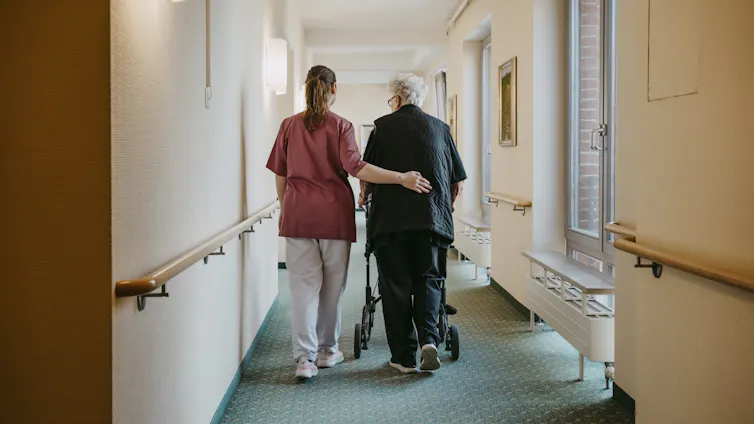
Aged-care staff don’t just do tasks such as helping with showering or delivering meals, but engage actively and connect with residents.
In our own research we’ve spoken with aged-care staff who care for older people both in aged-care facilities and in their own homes.
Aged-care staff are aware many of those they look after will die, and that they have a role in supporting older people as they come to the end of their life. In their caring role, they will often form meaningful and rewarding relationships with the older people in their care.
As a result, when the older person dies, this can be a source of profound loss for aged-care workers. As one told us:
I know I cry over some of them that die […] You spend time with them and you love them.
Some aged-care workers we interviewed talked about being present with the older person, talking to them or holding their hands as they died. Others spoke of how they shed tears for the person who had died, but that the tears were also for their loss, because they have known the older person and been involved in their life.
I think what made it worse was when her breathing got very shallow, and I knew she was coming to the end. I did go out. I told her I was going out for a minute. I went out and I had a cry because I wish that I could have saved her, but I knew that I couldn’t.
Sometimes aged-care staff indicated there wasn’t an opportunity for them to say goodbye or be acknowledged as someone who had suffered a loss, even if they had been providing care to the person for a number of months or years. One aged-care worker noted:
If people die in hospital, that’s another grief. Because they don’t get to say goodbye. Often the hospital won’t tell you.
Aged-care staff often must also support families and loved ones as they come to terms with the death of a parent, relative or friend. This can add to the to the emotional toll for staff who may be experiencing their own feelings of grief.
Cumulative grief
Repeated experiences of death can lead to cumulative grief and emotional strain. While staff saw meaning and value in their work, they also found regular exposure to death challenging.
One staff member told us that with time and seeing multiple deaths, you can “feel a little robotic. Because you’ve had to become that way to manage”.
Organisational issues such as staff shortages or high workloads can also exacerbate these feelings of burnout and dissatisfaction. Staff highlighted the need for support in coping.
Sometimes all you want to do is talk. You don’t need someone to solve anything for you. You just want to be heard.
Supporting aged-care staff to manage their grief
Aged-care organisations must take steps to support the wellbeing of their workforce, including acknowledging the grief many feel when older people die.
Following the death of an older person, offering support to staff who have worked closely with that person and acknowledging the emotional bonds that existed are powerful ways of recognising and validating staff grief. Simply asking the staff member how they are going or giving them the chance to take some time to process that the person has died is a good place to start.
Workplaces should also encourage self-care more broadly, promoting activities such as taking scheduled breaks, connecting with colleagues, and prioritising time for relaxation and physical activities. Staff value workplaces that encourage, normalise, and support their self-care practices.
We also need to look at how we can normalise the ability to talk about death and dying within our families and communities. A reluctance to recognise death as part of life can add to the emotional load staff carry, especially if families see dying as a failure of care.
Conversely, aged-care staff have consistently told us how meaningful it is to receive positive feedback and acknowledgement from families. As one worker recalled:
We had a death over the weekend. A really long-term resident here. And the daughter drove in especially this morning to tell me what fantastic care she had. That makes me feel better, that what we’re doing is right.
As members of families and communities, we need to recognise aged-care workers are uniquely vulnerable to feelings of grief and loss, often having built relationships with those in their care over months or years. Supporting the wellbeing of this important workforce supports them to continue to care for us and our loved ones as we age and come to the end of our lives.
Jennifer Tieman, Matthew Flinders Professor and Director of the Research Centre for Palliative Care, Death and Dying, Flinders University and Priyanka Vandersman, Senior Research Fellow, College of Nursing and Health Sciences, Flinders University
This article is republished from The Conversation under a Creative Commons license. Read the original article.
Don’t Forget…
Did you arrive here from our newsletter? Don’t forget to return to the email to continue learning!
Recommended

Learn to Age Gracefully
Join the 98k+ American women taking control of their health & aging with our 100% free (and fun!) daily emails:
-
Grapes vs Watermelon – Which is Healthier?
10almonds is reader-supported. We may, at no cost to you, receive a portion of sales if you purchase a product through a link in this article.
Our Verdict
When comparing grapes to watermelon, we picked the watermelon.
Why?
In terms of macros, there’s really nothing between them; grapes have slightly more carbs and fiber, but the difference are minimal and they effectively cancel each other out anyway, so the fairest conclusion for this first round is a tie.
In the category of vitamins, grapes have more of vitamins B1, B2, B6, and K, while watermelon has more of vitamins A, B5, B7, and C, for a 4:4 tie.
Looking at minerals, grapes have more calcium, iron, manganese, and potassium, while watermelon has more copper, magnesium, phosphorus, selenium, and zinc, for a marginal win in this round.
When it comes to antioxidants, both fruits are good, but watermelon is the more potent source. Grapes famously contain resveratrol, and they also contain quercetin, albeit you’d have to eat quite a lot of grapes to get a large portion. Now, having to eat a lot of grapes might not sound like a terrible fate (who else finds that the grapes are gone by the time the groceries are put away?), but we are comparing the fruits here, and on a list of “100 best foods for quercetin”, for example, grapes took 99th place. Watermelon’s main antioxidant meanwhile is lycopene, and watermelon is one of the best sources of lycopene in existence (better even than tomatoes). So this round’s another win for watermelon.
Adding up the sections makes for a modest overall win for watermelon, but by all means do enjoy either or both, as diversity is best!
Want to learn more?
You might like:
- Lycopene’s Benefits For The Gut, Heart, Brain, & More
- Can We Drink To Good Health? ← while there are polyphenols such as resveratrol that makes it through the process of turning into red wine that per se would boost heart health, there’s so little per glass that you may need 100–1000 glasses per day to get the dosage that provides benefits in mouse studies*.
*If you’re not a mouse, you might even need more than that!
To this end, many people prefer resveratrol supplementation ← link is to an example product on Amazon, but there are plenty more so feel free to shop around 😎
Share This Post
-
Brown Rice vs Rye – Which is Healthier?
10almonds is reader-supported. We may, at no cost to you, receive a portion of sales if you purchase a product through a link in this article.
Our Verdict
When comparing brown rice to rye, we picked the rye.
Why?
It’s a simple one today, and it wasn’t close:
In terms of macros, rye has nearly 4x the fiber for the same carbs and slightly more protein, winning easily in this category.
In the category of vitamins, brown rice has more of vitamins B1, B3, and B6, while rye has more of vitamins A, B2, B5, B7, B9, E, and K, winning another round easily.
Looking at minerals next, brown rice has more selenium, while rye has more calcium, copper, iron, potassium, and zinc, winning its third round in a row.
Adding up the sections makes for a clear overall win for rye, but by all means do still enjoy either or both, as diversity is best!
Want to learn more?
You might like:
- Why You’re Probably Not Getting Enough Fiber (And How To Fix It)
- What Do The Different Kinds Of Fiber Do? 30 Foods That Rank Highest
- What Matters Most For Your Heart? Eat More (Of This) For Lower Blood Pressure ← Spoiler: it’s fiber
Enjoy!
Share This Post
-
The Epigenetics Revolution – by Dr. Nessa Carey
10almonds is reader-supported. We may, at no cost to you, receive a portion of sales if you purchase a product through a link in this article.
If you enjoyed the book “Inheritance” that we reviewed a couple of days ago, you might love this as a “next read” book. But you can also just dive straight in here, if you like!
This one, as the title suggests, focuses entirely on epigenetics—how our life events can shape our genetic expression, and that of our descendants. Or to look at it in the other direction, how our genetic expression can be shaped by the life experiences of, for example, our grandparents.
The style of this book is very much pop-science, but contains a lot of information from hard science throughout. We learn not just about longitudinal population studies as one might expect, but also about the intricacies of DNA methylation and histone modifications, for example.
Depending on your outlook, you may find some of this very bleak (“great, I am shackled by what my grandparents did”) or very optimism-inducing (“oh wow, I’m not nearly so constrained by genetics as I thought; this stuff is so malleable!”). This is also the same author who wrote “Hacking The Code of Life“, by the way, but we’ll review that another day.
Bottom line: this book is the best one-shot primer on epigenetics that this reviewer has read (you may be wondering how many that is, and the answer is… about seven or so? I’m not good at counting).
Click here to check out The Epigenetics Revolution, and learn how dynamic you really are!
Share This Post
Related Posts
-
Dentists Debunk 15 Teeth Myths
10almonds is reader-supported. We may, at no cost to you, receive a portion of sales if you purchase a product through a link in this article.
Dentists Dr. John Yoo and Dr. Jason Lin leave no gaps in the truth:
The tooth, the whole tooth, and nothing but the tooth
Not only is there no tooth fairy (we are shocked), but also…
- “Baby teeth aren’t important.”
False! Baby teeth act as space holders for permanent teeth, affect speech development, and influence a child’s psychological well-being. - “Acidic fruits will whiten your smile.”
False! In any practical sense, anyway: acidic fruits may temporarily make teeth appear whiter by dispersing stains but cause enamel erosion and weaken teeth over time. - “Fillings last forever.”
False! Fillings can wear down, fail, or develop cavities underneath if oral hygiene isn’t maintained, requiring replacement over time. - “Cavities are irreversible.”
False! Cavities in the enamel can be reversed with fluoride and good oral hygiene, but cavities that reach the dentin are typically irreversible. - “Braces are just for crooked teeth.”
False! Braces also correct functional issues like overbites, underbites, crossbites, and prevent future complications like tooth impaction. - “A knocked-out tooth is gone for good.”
False! A knocked-out tooth can be reimplanted if done quickly (ideally within an hour); storing it in whole milk or saliva helps preserve it. - “Diet sodas won’t give you cavities.”
False! Diet sodas can still cause cavities due to their acidic pH, which erodes enamel, even without sugar. - “Dental cleanings aren’t necessary.”
False! Dental cleanings help remove plaque and tartar that regular brushing can’t, and allow for regular oral health checkups. - “Retainers aren’t for life.”
False! To maintain teeth alignment after braces, retainers should be worn long-term as teeth can shift even years later. - “You should floss before brushing.”
False! The order doesn’t matter, but do floss regularly. - “Everyone has wisdom teeth.”
False! Not everyone is born with wisdom teeth; they are the most commonly missing teeth, and not everyone needs them removed. - “Hydrogen peroxide and baking soda are good toothpaste replacements.”
False! While they are common components in toothpaste, they lack fluoride, which is essential for remineralizing and protecting enamel. - “You’re too old to get braces.”
False! There’s no age limit for braces or aligners; adults often seek them for both aesthetic and functional reasons. - “Teeth that have had root canals can’t feel.”
False! Teeth with root canals can’t feel pain from nerves, but you can still sense pressure due to surrounding ligaments. - “You’ll inevitably lose all your teeth when you’re old.”
False! Good oral hygiene and regular dental care can preserve natural teeth into old age, though genetics also play a role.
For more on each of these, enjoy:
Click Here If The Embedded Video Doesn’t Load Automatically!
Want to learn more?
You might also like to read:
Take care!
Don’t Forget…
Did you arrive here from our newsletter? Don’t forget to return to the email to continue learning!
Learn to Age Gracefully
Join the 98k+ American women taking control of their health & aging with our 100% free (and fun!) daily emails:
- “Baby teeth aren’t important.”
-
Bell Pepper vs Onion – Which is Healthier?
10almonds is reader-supported. We may, at no cost to you, receive a portion of sales if you purchase a product through a link in this article.
Our Verdict
When comparing bell pepper to onion, we picked the bell pepper.
Why?
First, you might remember that different color bell peppers have different nutritional profiles. So, you might be wondering why we didn’t specify the color.
The reason is: the things that differ from one color to another are important differences between the respective bell peppers, but they make no difference to this comparison, as for any given nutrient that changes from one color to another, it doesn’t change the outcome, because the numbers are still on the same side relative to onions.
With that in mind…
It was close!
In terms of macros, everything in these “mostly water with enough fiber to hold them together” foods is close enough to call this first round a tie.
In the category of vitamins, things are a little clearer; bell peppers have lot more of vitamins A, B1, B2, B3, B6, C, E, and K, while onions have slightly more of vitamins B5 and B9, yielding to bell peppers an 8:2 victory here.
Looking at minerals, bell peppers have more copper, iron, magnesium, and potassium, while onions have more calcium, phosphorus, selenium, and zinc, for a 4:4 tie in this round.
Adding up the sections makes for a modest overall win for bell peppers, but by all means enjoy either or both, as diversity is best!
Want to learn more?
You might like:
Which Bell Peppers To Pick? A Spectrum Of Specialties ← for the differences between the different colors
Enjoy!
Don’t Forget…
Did you arrive here from our newsletter? Don’t forget to return to the email to continue learning!
Learn to Age Gracefully
Join the 98k+ American women taking control of their health & aging with our 100% free (and fun!) daily emails:
-
What are the most common symptoms of menopause? And which can hormone therapy treat?
10almonds is reader-supported. We may, at no cost to you, receive a portion of sales if you purchase a product through a link in this article.
Despite decades of research, navigating menopause seems to have become harder – with conflicting information on the internet, in the media, and from health care providers and researchers.
Adding to the uncertainty, a recent series in the Lancet medical journal challenged some beliefs about the symptoms of menopause and which ones menopausal hormone therapy (also known as hormone replacement therapy) can realistically alleviate.
So what symptoms reliably indicate the start of perimenopause or menopause? And which symptoms can menopause hormone therapy help with? Here’s what the evidence says.
Remind me, what exactly is menopause?
Menopause, simply put, is complete loss of female fertility.
Menopause is traditionally defined as the final menstrual period of a woman (or person female at birth) who previously menstruated. Menopause is diagnosed after 12 months of no further bleeding (unless you’ve had your ovaries removed, which is surgically induced menopause).
Perimenopause starts when menstrual cycles first vary in length by seven or more days, and ends when there has been no bleeding for 12 months.
Both perimenopause and menopause are hard to identify if a person has had a hysterectomy but their ovaries remain, or if natural menstruation is suppressed by a treatment (such as hormonal contraception) or a health condition (such as an eating disorder).
What are the most common symptoms of menopause?
Our study of the highest quality menopause-care guidelines found the internationally recognised symptoms of the perimenopause and menopause are:
- hot flushes and night sweats (known as vasomotor symptoms)
- disturbed sleep
- musculoskeletal pain
- decreased sexual function or desire
- vaginal dryness and irritation
- mood disturbance (low mood, mood changes or depressive symptoms) but not clinical depression.
However, none of these symptoms are menopause-specific, meaning they could have other causes.
In our study of Australian women, 38% of pre-menopausal women, 67% of perimenopausal women and 74% of post-menopausal women aged under 55 experienced hot flushes and/or night sweats.
But the severity of these symptoms varies greatly. Only 2.8% of pre-menopausal women reported moderate to severely bothersome hot flushes and night sweats symptoms, compared with 17.1% of perimenopausal women and 28.5% of post-menopausal women aged under 55.
So bothersome hot flushes and night sweats appear a reliable indicator of perimenopause and menopause – but they’re not the only symptoms. Nor are hot flushes and night sweats a western society phenomenon, as has been suggested. Women in Asian countries are similarly affected.
You don’t need to have night sweats or hot flushes to be menopausal.
Maridav/ShutterstockDepressive symptoms and anxiety are also often linked to menopause but they’re less menopause-specific than hot flushes and night sweats, as they’re common across the entire adult life span.
The most robust guidelines do not stipulate women must have hot flushes or night sweats to be considered as having perimenopausal or post-menopausal symptoms. They acknowledge that new mood disturbances may be a primary manifestation of menopausal hormonal changes.
The extent to which menopausal hormone changes impact memory, concentration and problem solving (frequently talked about as “brain fog”) is uncertain. Some studies suggest perimenopause may impair verbal memory and resolve as women transition through menopause. But strategic thinking and planning (executive brain function) have not been shown to change.
Who might benefit from hormone therapy?
The Lancet papers suggest menopause hormone therapy alleviates hot flushes and night sweats, but the likelihood of it improving sleep, mood or “brain fog” is limited to those bothered by vasomotor symptoms (hot flushes and night sweats).
In contrast, the highest quality clinical guidelines consistently identify both vasomotor symptoms and mood disturbances associated with menopause as reasons for menopause hormone therapy. In other words, you don’t need to have hot flushes or night sweats to be prescribed menopause hormone therapy.
Often, menopause hormone therapy is prescribed alongside a topical vaginal oestrogen to treat vaginal symptoms (dryness, irritation or urinary frequency).
You don’t need to experience hot flushes and night sweats to take hormone therapy.
Monkey Business Images/ShutterstockHowever, none of these guidelines recommend menopause hormone therapy for cognitive symptoms often talked about as “brain fog”.
Despite musculoskeletal pain being the most common menopausal symptom in some populations, the effectiveness of menopause hormone therapy for this specific symptoms still needs to be studied.
Some guidelines, such as an Australian endorsed guideline, support menopause hormone therapy for the prevention of osteoporosis and fracture, but not for the prevention of any other disease.
What are the risks?
The greatest concerns about menopause hormone therapy have been about breast cancer and an increased risk of a deep vein clot which might cause a lung clot.
Oestrogen-only menopause hormone therapy is consistently considered to cause little or no change in breast cancer risk.
Oestrogen taken with a progestogen, which is required for women who have not had a hysterectomy, has been associated with a small increase in the risk of breast cancer, although any risk appears to vary according to the type of therapy used, the dose and duration of use.
Oestrogen taken orally has also been associated with an increased risk of a deep vein clot, although the risk varies according to the formulation used. This risk is avoided by using estrogen patches or gels prescribed at standard doses
What if I don’t want hormone therapy?
If you can’t or don’t want to take menopause hormone therapy, there are also effective non-hormonal prescription therapies available for troublesome hot flushes and night sweats.
In Australia, most of these options are “off-label”, although the new medication fezolinetant has just been approved in Australia for postmenopausal hot flushes and night sweats, and is expected to be available by mid-year. Fezolinetant, taken as a tablet, acts in the brain to stop the chemical neurokinin 3 triggering an inappropriate body heat response (flush and/or sweat).
Unfortunately, most over-the-counter treatments promoted for menopause are either ineffective or unproven. However, cognitive behaviour therapy and hypnosis may provide symptom relief.
The Australasian Menopause Society has useful menopause fact sheets and a find-a-doctor page. The Practitioner Toolkit for Managing Menopause is also freely available.
Susan Davis, Chair of Women’s Health, Monash University
This article is republished from The Conversation under a Creative Commons license. Read the original article.
Don’t Forget…
Did you arrive here from our newsletter? Don’t forget to return to the email to continue learning!
Learn to Age Gracefully
Join the 98k+ American women taking control of their health & aging with our 100% free (and fun!) daily emails:


