
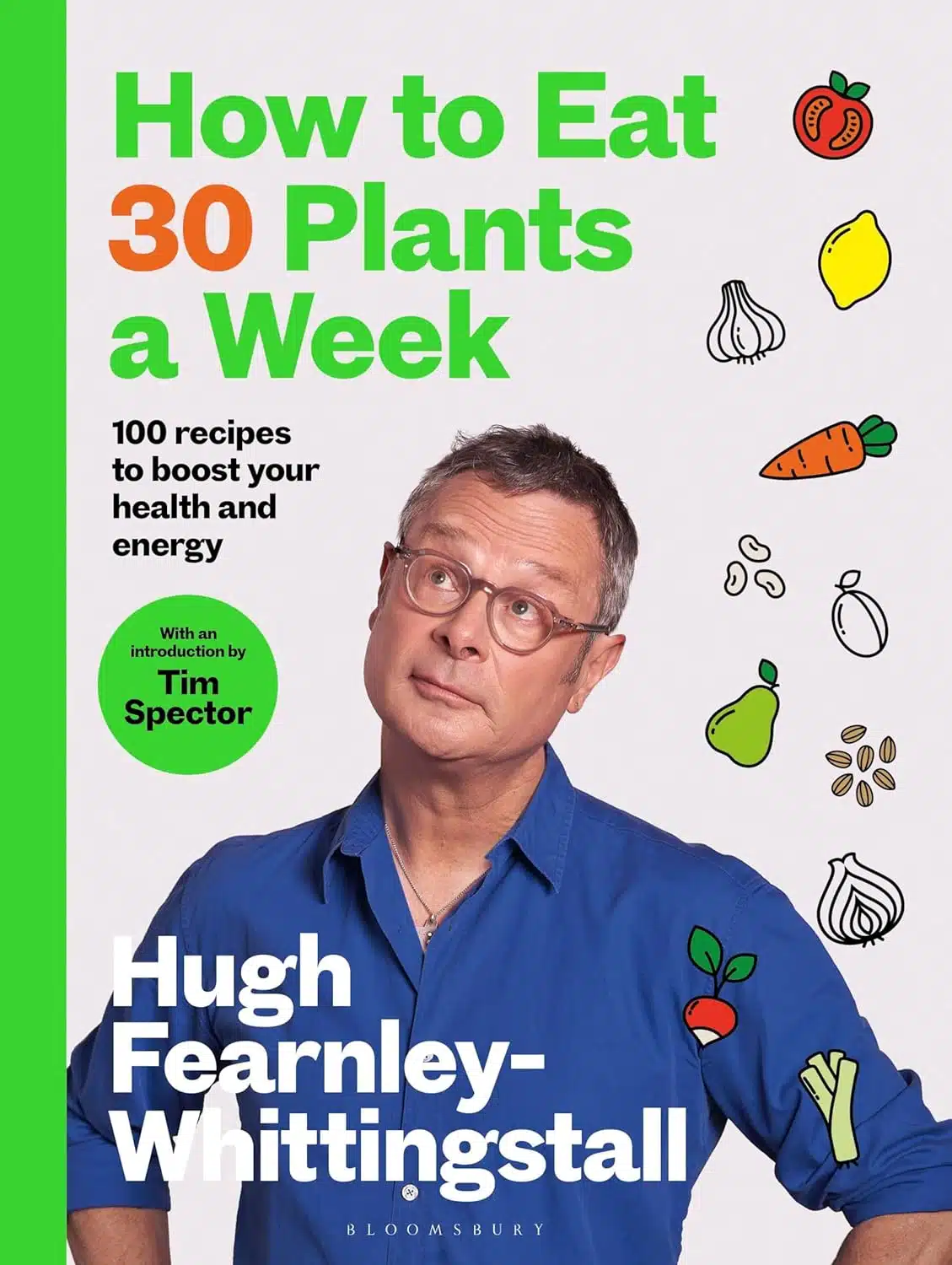
How to Eat 30 Plants a Week – by Hugh Fearnley-Whittingstall
10almonds is reader-supported. We may, at no cost to you, receive a portion of sales if you purchase a product through a link in this article.
If you’re used to eating the same two fruits and three vegetables in rotation, the “gold standard” evidence-based advice to “eat 30 different plants per week” can seem a little daunting.
Where this book excels is in reminding the reader to use a lot of diverse plants that are readily available in any well-stocked supermarket, but often get forgotten just because “we don’t buy that”, so it becomes invisible on the shelf.
It’s not just a recipe book (though yes, there are plenty of recipes here); it’s also advice about stocking up and maintaining that stock, advice on reframing certain choices to inject a little diversity into every meal without it become onerous, meal-planning rotation advice, and a lot of recipes that are easy but plant-rich, for example “this soup that has these six plants in it”, etc.
He also gives, for those eager to get started, “10 x 3 recipes per week to guarantee your 30”, in other words, 10 sets of 3 recipes, wherein each set of 3 recipes uses >30 different plants between them, such that if we have each of these set-of-three meals over the course of the week, then what we do in the other 4–18 meals (depending on how many meals per day you like to have) is all just a bonus.
The latter is what makes this book an incredibly stress-free approach to more plant-diverse eating for life.
Bottom line: if you want to be able to answer “do you get your five-a-day?” with “you mean breakfast?” because you’ve already hit five by breakfast each day, then this is the book for you.
Click here to check out How To Eat 30 Plants A Week, and indeed eat 30+ different plants per week!
Don’t Forget…
Did you arrive here from our newsletter? Don’t forget to return to the email to continue learning!
Recommended
Learn to Age Gracefully
Join the 98k+ American women taking control of their health & aging with our 100% free (and fun!) daily emails:
-
Top 11 Supplements For Women’s Healthy Aging
10almonds is reader-supported. We may, at no cost to you, receive a portion of sales if you purchase a product through a link in this article.
Dr. Shereene Idris explains her top picks:
Idris’ Eleven
How many of these do you take?
- Vitamin D3 and K2 support bone, mood, and DNA protection by improving calcium absorption, strengthening bones, boosting immunity and serotonin balance, and helping keep telomeres longer for better cellular longevity; vitamin K2 directs calcium into bones and teeth instead of arteries (aim for 1,000–2,000 IU of D3 with 180 µg of K2 daily)
- Omega-3s reduce inflammation and support brain, heart, and skin health by keeping cell membranes hydrated, lowering triglycerides, stabilizing mood, and reducing brain fog; they also keep skin healthy and slow down inflammatory aging (take about 1,000 mg of combined EPA and DHA with meals)
- Magnesium promotes sleep and calm by supporting over 300 reactions related to muscle relaxation, melatonin, and GABA production; it helps lower cortisol, relieves cramps, and aids recovery (use 200–400 mg daily, choosing glycinate for maintenance or citrate against constipation)
- Probiotics and prebiotics improve gut, hormone, and immune balance by restoring good bacteria, enhancing digestion and nutrient absorption, regulating estrogen, and reducing bloating and inflammation (take 10–20 billion CFUs of mixed strains daily)
- A general multivitamin-and-minerals supplement fills dietary gaps and supports energy by providing essential micronutrients like zinc, iodine, selenium, and folate; it helps counter nutrient depletion from stress and protects cells from oxidative aging (take one daily with food)
- Iron restores vitality and oxygen delivery by supporting hemoglobin and energy for muscles, brain, and hair growth; it’s especially important for women with heavy periods or fatigue (take about 18 mg daily, or 50–100 mg under medical guidance, with vitamin C and without coffee, dairy, or calcium)
- Coenzyme Q10 fuels mitochondria and heart health by boosting ATP production and acting as a protective antioxidant; it’s key for people on statins and supports longevity through mitochondrial resilience (take 100–200 mg daily with food)
- Adaptogens (e.g. ashwagandha and rhodiola) balance stress hormones and energy by regulating cortisol, supporting thyroid and adrenal health, and reducing anxiety, mood swings, and hot flashes; they also protect telomeres and lower inflammation (use 600 mg ashwagandha or 200–400 mg rhodiola daily)
- Evening primrose oil (GLA) supports hormones and skin hydration by supplying gamma-linolenic acid, which eases PMS, improves elasticity, and maintains moisture during perimenopause (take 500–1,000 mg daily)
- Curcumin and resveratrol fight inflammation and promote longevity by activating antioxidant and longevity pathways that reduce joint stiffness, protect neurons, and slow inflammatory aging (take 500–1,000 mg curcumin (with black pepper) and 100–250 mg resveratrol daily)
- Creatine maintains muscle, strength, and brain function by recycling ATP in muscles and neurons, preserving lean mass, mental clarity, and recovery—especially during perimenopause (take 3–5 g daily mixed into a glass of water)
Yes, some of those are bundled so it could be called more than 11, but that’s how she counted them, so we’ll keep her count here 🙂
For more on all of this, enjoy:
Click Here If The Embedded Video Doesn’t Load Automatically!
Want to learn more?
You might also like:
12 Most Powerful Supplements and Foods to Increase Energy & Slow Down Aging
Take care!
Share This Post
-
Prozac’s Effect On Neuroplasticity
10almonds is reader-supported. We may, at no cost to you, receive a portion of sales if you purchase a product through a link in this article.
Neuroplasticity is the brain’s ability to change over time, in accordance with our experiences, and what things we practise.
For example, before the ubiquity of GPS, taxi-drivers tended to get unusually well-developed in areas of the brain associated with memory and spatial reasoning. In contrast, your writer here, a person who does a lot of reading and writing and also uses at least 3+ languages daily, doubtlessly has overdeveloped language centers. A visual artist might develop much better visual centers. And so forth.
These changes are in large part physical, and very easy to measure (with the right equipment). It’s not hard to see when a certain part of the brain has proportionally more volume than usual, for example.
So, what does Prozac have to do with it?
More than a mood-brightener
Aside from the obvious primary intended effect of antidepressants (i.e., to treat depression by increasing relevant neurotransmitter levels), antidepressants have a bad reputation for side effects.
For example: How Serious Are Antidepressant Side Effects?
Some side effects are often exaggerated in popular (mis)understanding, such as: How Much Weight Gain Do Antidepressants Cause? ← the answer being: often less weight than people gain per year when not on antidepressants (although weight gain can happen, especially if one was previously under-eating while depressed)
When it comes to Prozac (the most well-known brand name for fluoxetine, a selective serotonin reuptake inhibitor (SSRI), which works by increasing serotonin levels in the brain by decreasing the rate at which the brain “loses” serotonin), it’s worth initially noting that while serotonin is mostly associated with happiness, it does other things too; see: Serotonin For More Than Just Happiness
The study we wrote about in that article found that it’s not just a matter of how much serotonin we have, but also where in the brain in accumulates, and which parts of the brain get prioritized. Sound familiar?
Recently, researchers (Dr. Ilida Suleymanova et al.) investigated the effects of serotonin on neuroplasticity, and found that indeed fluoxetine (Prozac) does more than boost serotonin—it also reshapes how certain brain cells manage energy and plasticity.
This happens as quickly as the first two weeks; for example, parvalbumin interneurons in the prefrontal cortex, which normally keep brain activity balanced, became less rigid after two weeks of treatment (which makes further changes much more possible), bearing in mind that since depression is linked to overly rigid brain circuits, this means that fluoxetine can “soften” these networks, allowing rewiring and flexibility.
- Specifically, mitochondria in these rigidity-inducing braincells got disempowered by reduced expression of energy-production genes (remember, people think of genes as unchangeable, but they can be turned on and off by hormones/neurotransmitters, amongst other things).
- Even more specifically, genes tied to adaptability were upregulated, and perineuronal nets that restrict plasticity were weakened.
To read this paper in full, see: Chronic treatment with fluoxetine regulates mitochondrial features and plasticity-associated transcriptomic pathways in parvalbumin-positive interneurons of prefrontal cortex
This becomes extra important as we age, because neurogenesis (the brain’s ability to produce new brain cells) is an important factor in neuroplasticity.
Contrary to popular belief, we continue to do this all the way through life, albeit it does usually slow down in older age, but there are things that affect how much this happens, and when.
To learn more about that, see: Building Your Brain At Every Age
Finally, if you’ve been considering antidepressants but haven’t been sure if they’d be right for you, then before you rush to your doctor to get a prescription for Prozac, you might want to check out: Antidepressants: Personalization Is Key! ← because it makes a difference which one you pick
Alternatively, if you don’t love the idea of having to keep taking something, you might consider: Psychedelics: Yes Even Once? ← since a single dose can have a lasting (positive!) effect on cognitive flexibility
Want to learn more?
You might like this book we reviewed a little while ago:
Take care!
Share This Post
-
How Does Fat Actually Leave The Body? Where Does It Go?
10almonds is reader-supported. We may, at no cost to you, receive a portion of sales if you purchase a product through a link in this article.
Fat loss is often misunderstood, with many believing it simply “vanishes” through exercise, is simply excreted in solid form in the bathroom, or materially disappears when converted for energy. However, the principle of conservation of mass plays out here, in that the mass in fat doesn’t disappear—it changes its arrangement:
In and out
Fat is composed of carbon, hydrogen, and oxygen atoms, with an example common form of fat in the body being C55H104O6. That’s a lot of Cs and Hs, and a few Os.
When fat leaves the body, it has been primarily converted into carbon dioxide (CO2) and water (H2O).
According to a 2014 study by the University of South Wales, 84% of the mass of fat exits the body as CO2 exhaled through breathing, while 16% leaves as water through sweat, urine, and other bodily fluids (all of which contain H2O).
You’ll notice there are a lot more Os going out, proportionally, than we originally had in the C55H104O6. For this reason, the process requires oxygen intake; for every 10 kilograms of fat burned, by simple mathematics the body needs around 29 kilograms of oxygen.
Physical activity plays a crucial role in fat loss. When the body exerts itself, it naturally switches to a higher oxygen metabolism necessary for fat breakdown. This effect is amplified during intermittent fasting, which boosts human growth hormone (HGH), a hormone that aids in fat metabolism.
However, simply hyperventilating won’t work; exercise is essential to activate these processes—otherwise it’s just a case of oxygen in, oxygen out, without involving the body’s chemical energy reserves.
Consequently, one of the best diet-and-exercise combinations for fat loss is intermittent fasting with high-intensity interval training.
And, as for what to eat, this video says raw vegan, but honestly, that’s not scientific consensus. However, a diet rich in unprocessed (or minimally processed) fruits and vegetables definitely is where it’s at, with the plant-heavy Mediterranean diet generally scoring highest—which can be further improved by skipping the mammals to make it pesco-Mediterranean. Current scientific consensus does not give any extra benefits for also omitting moderate consumption of fish and fermented dairy products, so include those if you want, or skip those if you prefer.
For more on all of this, enjoy:
Click Here If The Embedded Video Doesn’t Load Automatically!
Want to learn more?
You might also like to read:
Are You A Calorie-Burning Machine? (Calorie Mythbusting)
Take care!
Share This Post
Related Posts
-
9 Easy Tips To Stop Hair Loss & Regrow Hair Naturally
10almonds is reader-supported. We may, at no cost to you, receive a portion of sales if you purchase a product through a link in this article.
Bad news: there are many things that can cause hair loss or contribute to such.
Good news: that means there are many ways to fix it (many of them quick and easy)!
Locking in the locks
Nine things to use to your advantage:
- Establish your hair-shedding baseline: if your hairbrush or shower drain is suddenly accumulating alarming amounts of hair, you’ll know that “something wrong is not right” and be able to take action—but only if you’ve been paying attention to how much you usually shed.
- Find the cause: because there’s no one-size-fits-all hair loss treatment, it is worth investing (time and energy, if not money) in identifying the specific cause before trying solutions, and avoid wasting money on generic products that might help at all against your specific thing.
- Know when you just need time to recover: especially bearing in mind that surgeries and other physical trauma can shock the body, leading to temporary hair loss. In such cases, usually no additional action is required, but you do need to take it easy for a while.
- Manage anxiety and stress: because chronic stress or psychological trauma can also trigger hair loss. The solution in such cases is stress management, not topical treatments.
- Be aware of female pattern baldness: thinning on the top and temples usually indicates this. Minoxidil is the most effective treatment if started early.
- Nourish your hair from the inside: because poor nutrition, especially low iron or caloric restriction, can weaken hair. Thus, he recommends a balanced, nutrient-rich diet (which hopefully you aim for anyway, but it’s a thing to bear in mind).
- Keep an eye on medications: some meds can cause hair loss, which if people don’t know that, they can often blame unrelated things like their shampoo. So, be particularly attentive to this when starting/stopping any given medication, or changing a dosage.
- Treat your menopause: hormonal changes during menopause often lead to thinning hair. Hormone replacement therapy (HRT) can restore that balance and improve hair health, along with reducing other health risks associated with untreated menopause.
- Be mindful of undiagnosed medical conditions: this may seem like a hard one to put into practice, what with not knowing about undiagnosed medical conditions, but common issues like thyroid disorders can cause unexplained hair loss. If the other causes mentioned above don’t fit and/or you’re tending to those and still seeing hair loss, see a doctor and get bloodwork done.
For more on each of these, enjoy:
Click Here If The Embedded Video Doesn’t Load Automatically!
Want to learn more?
You might also like:
What Different Kinds of Hair Loss/Thinning Say About Your Health ← Dr. Siobhan Deshauer discusses (and shows) 15 specific diagnosable things
Take care!
Don’t Forget…
Did you arrive here from our newsletter? Don’t forget to return to the email to continue learning!
Learn to Age Gracefully
Join the 98k+ American women taking control of their health & aging with our 100% free (and fun!) daily emails:
-
Why PCOS IS Now PMOS (What It Means In Practical Terms)
10almonds is reader-supported. We may, at no cost to you, receive a portion of sales if you purchase a product through a link in this article.
It’s Q&A Day at 10almonds!
Have a question or a request? We love to hear from you!
In cases where we’ve already covered something, we might link to what we wrote before, but will always be happy to revisit any of our topics again in the future too—there’s always more to say!
No question/request too big or small 😎
❝Is there anything that’s actually changed with PCOS now being PMOS, or is it just a name change?❞
Yes and yes! That is to say:
- Yes, it is technically just a name change
- Yes, there are expected positive knock-on effects of this change
First, let’s quickly recap what the name change actually is, so that we can talk about why the change was made and what we can expect to see in the category of positive effects resulting from this change:
The name was: polycystic ovary syndrome (PCOS)
The name is now: polyendocrine metabolic ovarian syndrome (PMOS)
The old name is a little bit misleading, since not only are ovarian cysts not a required symptom, but there isn’t even, on average, an increase in abnormal ovarian cysts.
The new name, in contrast, de-emphasizes that aspect and instead brings attention to the endocrine and metabolic aspects.
This was talked about before, for example in this guest article on our own site: PCOS affects 1 in 8 women worldwide, yet it’s often misunderstood. A name change might help
This is important, because PMOS is linked to infertility, pregnancy complications, acne, excess hair growth, depression, anxiety, eating disorders, Type 2 diabetes, heart disease, and reduced quality of life, with metabolic complications occurring earlier and more frequently than in people without the condition.
Almost all of these things have far more to do with the hormonal and metabolic side of things, rather than being anything to do with cysts (which, when they do occur, are also a result of those things, being characterized by disrupted follicle development caused by hormonal signalling disturbances).
As for how this change is expected to help, advocates hope the new terminology will reduce stigma, improve understanding among physicians, encourage more whole-body treatment approaches, and ensure patients with varying symptoms receive better long-term support.
Of these things, probably the “whole-body treatment approaches” are going to have the biggest positive impact on people’s lives.
Want to learn more?
If you will kindly overlook that these articles were written with the old name, then do check out:
Take care!
Don’t Forget…
Did you arrive here from our newsletter? Don’t forget to return to the email to continue learning!
Learn to Age Gracefully
Join the 98k+ American women taking control of their health & aging with our 100% free (and fun!) daily emails:
-
What Happens To Your Body When You Plank 1 Minute Every Day
10almonds is reader-supported. We may, at no cost to you, receive a portion of sales if you purchase a product through a link in this article.
Planks improve strength, flexibility, balance, posture, reduce chronic back pain, lower blood pressure, and enhance physique. But can we really get benefits from just 1 minute per day?
To the core
The benefits that can be expected, according to the science cited in this video, include:
- Within 2–3 weeks, daily planking of just 1 minute per day activates deep core muscles, enhancing balance, which helps in everyday tasks and prevents muscle imbalances.
- Strengthening core muscles through planks also helps alleviate lower back pain, with research supporting its effectiveness within 3 weeks.
- Posture is important for good health, and planks align the spine and hips, improving posture naturally, which also helps alleviate back issues. So, there’s a good kind of synergy to this exercise.
- Of course, many people exercising have the goal of a more toned body; regular planking leads to a toned core, sculpted shoulders, and leaner legs.
- For those who care more about mobility, though, planking enhances flexibility in hamstrings, feet, and toes within 4–6 weeks.
- Anything else? Yes, isometric exercises like planks are highly effective at reducing blood pressure, and, counterintuitively, more so than aerobic exercises.
The video also looks at a study in which participants did 20 minutes per day instead of 1, which predictably also significantly improved strength, endurance, flexibility, and reduced body fat.
However, another study cited gives the stats for just 1 minute daily, and that was not even a whole minute, so much as 30 seconds hold, 1 minute rest, 30 seconds hold—and still showed very good improvements.
For more on all this, plus links to three studies mentioned in the video, enjoy:
Click Here If The Embedded Video Doesn’t Load Automatically!
Want to learn more?
You might also like to read:
Isometric Exercises That Are Good If You Have Osteoporosis (or if you don’t, but the point is, they are safe and beneficial for people with osteoporosis)
Take care!
Don’t Forget…
Did you arrive here from our newsletter? Don’t forget to return to the email to continue learning!
Learn to Age Gracefully
Join the 98k+ American women taking control of their health & aging with our 100% free (and fun!) daily emails:


