
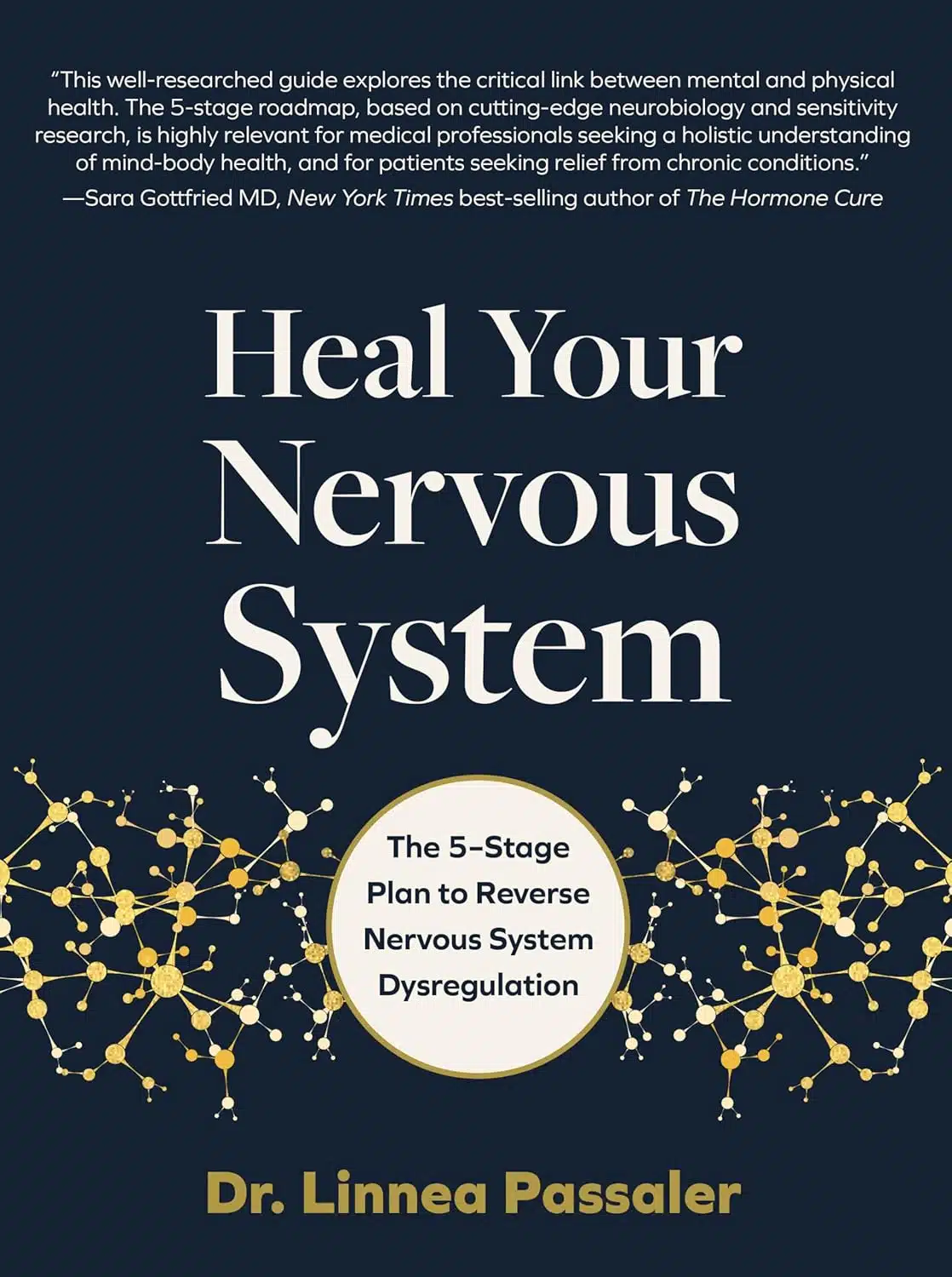
Heal Your Nervous System – by Dr. Linnea Passaler
10almonds is reader-supported. We may, at no cost to you, receive a portion of sales if you purchase a product through a link in this article.
This book focuses on the oft-overlooked connection between nervous system dysregulation (i.e. sympathetic nervous system dominance, keeping the brain in “may have to fight for my life at any moment” mode) and the many symptoms—mental and physical—that can arise as a result.
While there is a lot of theory explained in here, there’s practicality too, providing the reader with tools to assess our own levels of nervous system dysregulation and what factors affect that.
In particular in that category, a lot of value is delivered in terms of practical guidance on avoiding common pitfalls in the healing journey. Dr. Passaler discusses the four biggest mistakes people make when attempting to heal, and gives clear strategies to sidestep each of them, with exercises to do and habits to implement.
Another thing that sets this book apart from many of its genre is her emphasis on the importance of sequencing healing practices in the right order. By offering a structured approach, the book helps us implement healing practices without getting overwhelmed or hitting the proverbial brick wall and getting frustrated, which makes a big difference.
The style is easy-to-understand pop-science, albeit with a reassuring 20 pages of references at the back.
Bottom line: if you feel like “peace of mind” is something that’s always just out of reach, this book can help you to get where you need to be, physically as well as mentally.
Click here to check out Heal Your Nervous System, and get things into much better order!
Don’t Forget…
Did you arrive here from our newsletter? Don’t forget to return to the email to continue learning!
Recommended
Learn to Age Gracefully
Join the 98k+ American women taking control of their health & aging with our 100% free (and fun!) daily emails:
-
5 Proven Tips To Walk Longer Without Pain Or Discomfort
10almonds is reader-supported. We may, at no cost to you, receive a portion of sales if you purchase a product through a link in this article.
Dr. Alyssa Kuhn, arthritis expert, explains how to reduce joint pain and improve mobility:
Be in tune with your body
There’s a step-by-step approach here:
- Warm up before walking: (caveat: only works if you actually do it!) because warming up your joints and muscles helps prevent stiffness, pain, and early fatigue. Do a few minutes of gentle movements such as:
- Forward and backward steps: step one foot forwards and backwards without pausing, about 10–20 times per side, to loosen your hips and improve blood flow.
- Side steps: step side to side 20–30 times to activate your outer hip muscles and stabilize your knees.
- Heel and toe raises: lift both your heels, then both sets of toes (you’re allowed to put your heels down in order to lift your toes!), to warm up your calves and shin muscles, 10–20 times total.
- Writer’s note: if you dance something like Salsa, you can get those all in very quickly and easily with a 2–3 minute song! You don’t even have to setenta complicado or anything, the basic step is fine 😉
- Activate your core: a strong core improves posture, balance, and walking confidence. So: stand with your back against a wall, feet slightly forwards. Flatten your lower back into the wall and raise one arm, then the other, without letting your back arch.
- Strengthen (generally) your other key muscles: muscle strength supports your joints and endurance. Prioritize squats, which can include chair squats—standing up and sitting down—because they work your thighs, glutes, and hamstrings.
- Increase your distance gradually: add only 1–2 minutes to your walk each time to help your body adapt and avoid flare-ups. This may seem impractical when walking often has a particular fixed destination in mind, but you can make your route slightly longer, or pace at home a little before setting out, that kind of thing.
- Listen to your body: pain, stiffness, or tightness are signals to modify your approach, not to push through. Pause or stretch briefly if discomfort arises. Recognize that your capacity may vary from day to day—especially with joint issues—so adapt accordingly to prevent setbacks and be content make steady progress in the big picture.
For more on all of this, including visual demonstrations of the exercises, enjoy:
Click Here If The Embedded Video Doesn’t Load Automatically!
Want to learn more?
You might also like:
How To Make Downhill Walking Easier On The Knees
Take care!
Share This Post
- Warm up before walking: (caveat: only works if you actually do it!) because warming up your joints and muscles helps prevent stiffness, pain, and early fatigue. Do a few minutes of gentle movements such as:
-
A Surprisingly Powerful Tool: Eye Movement Desensitization & Reprocessing
10almonds is reader-supported. We may, at no cost to you, receive a portion of sales if you purchase a product through a link in this article.
Eye Movement Desensitization & Reprocessing (EMDR)
What skeletons are in your closet? As life goes on, most of accumulate bad experiences as well as good ones, to a greater or lesser degree. From clear cases of classic PTSD, to the widely underexamined many-headed beast that is C-PTSD*, our past does affect our present. Is there, then, any chance for our future being different?
*PTSD is typically associated with military veterans, for example, or sexual assault survivors. There was a clear, indisputable, Bad Thing™ that was experienced, and it left a psychological scar. When something happens to remind us of that—say, there are fireworks, or somebody touches us a certain way—it’ll trigger an immediate strong response of some kind.
These days the word “triggered” has been popularly misappropriated to mean any adverse emotional reaction, often to something trivial.
But, not all trauma is so clear. If PTSD refers to the result of that one time you were smashed with a sledgehammer, C-PTSD (Complex PTSD) refers to the result of having been hit with a rolled-up newspaper every few days for fifteen years, say.
This might have been…
- childhood emotional neglect
- a parent with a hair-trigger temper
- bullying at school
- extended financial hardship as a young adult
- “just” being told or shown all too often that your best was never good enough
- the persistent threat (real or imagined) of doom of some kind
- the often-reinforced idea that you might lose everything at any moment
If you’re reading this list and thinking “that’s just life though”, you might be in the estimated 1 in 5 people with (often undiagnosed) C-PTSD.
For more on C-PTSD, see our previous main feature:
So, what does eye movement have to do with this?
Eye Movement Desensitization & Reprocessing (EMDR) is a therapeutic technique whereby a traumatic experience (however small or large; it could be the memory of that one time you said something very regrettable, or it could be some horror we couldn’t describe here) is recalled, and then “detoothed” by doing a bit of neurological jiggery-pokery.
How the neurological jiggery-pokery works:
By engaging the brain in what’s called bilateral stimulation (which can be achieved in various ways, but a common one is moving the eyes rapidly from side to side, hence the name), the event can be re-processed, in much the same way that we do when dreaming, and relegated safely to the past.
This doesn’t mean you’ll forget the event; you’d need to do different exercises for that.
See also our previous main feature:
The Dark Side Of Memory (And How To Make Your Life Better)
That’s not the only aspect of EMDR, though…
EMDR is not just about recalling traumatic events while moving your eyes from side-to-side. What an easy fix that would be! There’s a little more to it.
The process also involves (ideally with the help of a trained professional) examining what other memories, thoughts, feelings, come to mind while doing that. Sometimes, a response we have today associated with, for example, a feeling of helplessness, or rage in conflict, or shame, or anything really, can be connected to previous instances of feeling the same thing. And, each of those events will reinforce—and be reinforced by—the others.
An example of this could be an adult who struggles with substance abuse (perhaps alcohol, say), using it as a crutch to avoid feelings of [insert static here; we don’t know what the feelings are because they’re being avoided], that were first created by, and gradually snowballed from, some adverse reaction to something they did long ago as a child, then reinforced at various times later in life, until finally this adult doesn’t know what to do, but they do know they must hide it at all costs, or suffer the adverse reaction again. Which obviously isn’t a way to actually overcome anything.
EMDR, therefore, seeks to not just “detooth” a singular traumatic memory, but rather, render harmless the whole thread of memories.
Needless to say, this kind of therapy can be quite an emotionally taxing experience, so again, we recommend trying it only under the guidance of a professional.
Is this an evidence-based approach?
Yes! It’s not without its controversy, but that’s how it is in the dog-eat-dog world of academia in general and perhaps psychotherapy in particular. To give a note to some of why it has some controversy, here’s a great freely-available paper that presents “both sides” (it’s more than two sides, really); the premises and claims, the criticisms, and explanations for why the criticisms aren’t necessarily actually problems—all by a wide variety of independent research teams:
Research on Eye Movement Desensitization & Reprocessing (EMDR) as a Treatment for PTSD
To give an idea of the breadth of applications for EMDR, and the evidence of the effectiveness of same, here are a few additional studies/reviews (there are many):
- An Eye Movement Desensitization and Reprocessing (EMDR) Group Intervention for Syrian Refugees With Post-traumatic Stress Symptoms: Results of a Randomized Controlled Trial
- Cognitive Behavioral Therapy vs. Eye Movement Desensitization and Reprocessing for Treating Panic Disorder: A Randomized Controlled Trial
- Eye movement desensitization and reprocessing (EMDR) therapy in the treatment of depression: a matched pairs study in an inpatient setting
- Emergency room intervention to prevent post concussion-like symptoms and post-traumatic stress disorder. A pilot randomized controlled study of a brief eye movement desensitization and reprocessing intervention versus reassurance or usual care
As for what the American Psychiatric Association says about it:
❝After assessing the 120 outcome studies pertaining to the focus areas, we conclude that for two of the areas (i.e., PTSD in children and adolescents and EMDR early interventions research) the strength of the evidence is rated at the highest level, whereas the other areas obtain the second highest level.❞
Source: The current status of EMDR therapy, specific target areas, and goals for the future
Want to learn more?
To learn a lot more than we could include here, check out the APA’s treatment guidelines (they are written in a fashion that is very accessible to a layperson):
APA | Eye Movement Desensitization and Reprocessing (EMDR) Therapy
Take care!
Share This Post
-
Nanotechnology vs Alcohol Damage!
10almonds is reader-supported. We may, at no cost to you, receive a portion of sales if you purchase a product through a link in this article.
One Thing That Does Pair Well With Alcohol…
Alcohol is not a healthy thing to consume. That shouldn’t be a controversial statement, but there is a popular belief that it can be good for the heart:
Red Wine & The Heart: Can We Drink To Good Health?
The above is an interesting and well-balanced article that examines the arguments for health benefits (including indirectly, e.g. social aspects).
Ultimately, though, as the World Health Organization puts it:
WHO: No level of alcohol consumption is safe for our health
There is some good news:
We can somewhat reduce the harm done by alcohol by altering our habits slightly:
How To Make Drinking Less Harmful
…and we can also, of course, reduce our alcohol consumption (ideally to zero, but any reduction is an improvement already):
And, saving the best news (in this section, anyway) for last, it is almost always possible to undo the harm done specifically to one’s liver:
Nanotechnology to the rescue?
Remember when we had a main feature about how colloidal gold basically does nothing by itself (and that that’s precisely why gold is used in medicine, when it is used)?
Now it has an extra bit of nothing to do, for our benefit (if we drink alcohol, anyway), as part of a gel that detoxifies alcohol before it can get to our liver:
Gold is one of the “ingredients” in a gel containing a nanotechnology lattice of protein fibrils coated with iron (and the gold is there as an inert catalyst, which is chemistry’s way of saying it doesn’t react in any way but it does cheer the actual reagents on). There’s more chemistry going on than we have room to discuss in our little newsletter, so if you like the full details, you can read about that here:
Single-site iron-anchored amyloid hydrogels as catalytic platforms for alcohol detoxification
The short and oversimplified explanation is that instead of alcohol being absorbed from the gut and transported via the bloodstream to the liver, where it is metabolized (poisoning the liver as it goes, and poisoning the rest of the body too, including the brain), the alcohol is degraded while it is still in the gastrointestinal tract, converted by the gel’s lattice into acetic acid (which is at worst harmless, and actually in moderation a good thing to have).
Even shorter and even more oversimplified: the gel turns the alcohol into vinegar in the stomach and gut, before it can get absorbed into the blood.
But…
Of course there’s a “but”…
There are some limitations:
It doesn’t get it all (tests so far found it only gets about half of the alcohol), and so far it’s only been tested on mice, so it’s not on the market yet—while the researchers are sufficiently confident about it that a patent application has now been made, though, so it’ll probably show up on the market in the near future.
You can read a pop-science article about it (with diagrams!) here:
New gel breaks down alcohol in the body
Want to read more…
…about how to protect your organs (including your brain) from alcohol completely?
We’ve reviewed quite a number of books about quitting alcohol, so it’s hard to narrow it down to a single favorite, but after some deliberation, we’ll finish today with recommending:
Quit Drinking – by Rebecca Dolton ← you can read our review here
Take care!
Share This Post
Related Posts
-
The Sugar That Blocks COVID
10almonds is reader-supported. We may, at no cost to you, receive a portion of sales if you purchase a product through a link in this article.
Vaccines are considered the “gold standard” against COVID and similar pathogens, for their very high rate of efficacy, clear science, and at least moderately lasting effects (i.e., it’s not something like handwashing*, which must be redone very frequently). Since vaccines are not without their popular misunderstanders, we have written a little about that, here: Vaccine Mythbusting
*See also: The Truth About Handwashing ← for another mythbusting edition, covering what actually works against what, and what doesn’t—as well as the disparity between people’s self-reports of handwashing, and how often/well they actually wash their hands!
These are not the only things we can do; consider for example: Beyond Supplements: The Real Immune-Boosters! ← most people don’t know these things and the huge difference they make
And for that matter: Why Some People Get Sick More (And How To Not Be One Of Them) ← for a very prophylactic approach
So… What’s this about a sugar that blocks COVID?
A sweet distraction
What if, rather than triggering immune responses as vaccines do, we could provide a physical shield?
Of course, masks do that, but are more important on an epidemiological level than personal (i.e. they protect society more than they protect the wearer), and they are impractical in many circumstances, and use of them is very low in most countries. So in other words: they’re good! But may be a lost cause at least for the time being.
See also: Mythbusting The Mask Debate
And, for that matter: Do We Simply Not Care About Old People?
So… How about a nanotech version, that you can squirt up your nose and then it’s done, you’re protected?
Researchers (Dr. Daniela Niemeyer et al.) have developed a synthetic sugar-coated polymer nanoparticle that blocks Covid-19 from infecting human cells!
How it works: it’s two things in one:
- a decoy
- a trap
The particle mimics the virus’s natural target (sialic acid chains) acting as a decoy. It then binds to the virus’s spike protein 500 times more strongly, preventing it from binding with cells (something the virus needs to do in order to replicate itself).
How well it works: at low doses, reduced infection in human lung cells by 98.6%, working against both the original SARS-CoV-2 strain and the D614G variant.
Now, there are two things to bear in mind here.
Firstly, you may be wondering: what about the other 1.4%? And well, nothing is perfect, but 98.6% is good, and assuming you do have a functioning immune system, your immune system will be much more likely to throw off a pathogen that is able to affect only a few cells at a time, than one that is infecting almost every cell it touches, and multiplying exponentially as it does so.
Secondly, about those human lung cells: they were in a petri dish, so we can’t say for sure yet that this will be safe and effective in vivo (i.e. in actual humans). However, the researchers are cautiously optimistic and are looking forward to the next testing stage.
You can read the paper itself, here: Polysialosides Outperform Sulfated Analogs for Binding with SARS-CoV-2 ← not the most exciting title
Lastly, you may be wondering: doesn’t this mean I will be left with live COVID viruses in my respiratory tract, stuck in these molecular traps? And the answer is: sort of, at least for a while. The virus will still be theoretically active insofar as it remains viable, not destroyed, but as it’s already bound to something it can’t infect, it can’t do any harm. Further, a virus that has been trapped in this fashion is much easier for our own immune system to locate and destroy, or even just locate and remove. Think of it like a fly trapped on a flypaper. It’s technically still viable, but it’s not going anywhere, and is easy to get rid of.
On the flipside, that does raise an extra question of how long the protection will last—it’s currently being posited as a medium-term solution, but the timescales have not yet been worked out, as that’ll need to be studied in vivo.
Want to learn more?
Check out:
The Minerals That Neutralize Viruses (While Being Harmless To Humans) ← for a similar approach with a very common food additive
Take care!
Don’t Forget…
Did you arrive here from our newsletter? Don’t forget to return to the email to continue learning!
Learn to Age Gracefully
Join the 98k+ American women taking control of their health & aging with our 100% free (and fun!) daily emails:
-
Bacopa Monnieri: A Well-Evidenced Cognitive Enhancer
10almonds is reader-supported. We may, at no cost to you, receive a portion of sales if you purchase a product through a link in this article.
Bacopa monnieri: a powerful nootropic
Bacopa monnieri is one of those “from traditional use” herbs that has made its way into science.
It’s been used for at least 1,400 years in Ayurvedic medicine, for cognitive enhancement, against anxiety, and some disease-specific treatments.
See: Pharmacological attributes of Bacopa monnieri extract: current updates and clinical manifestation
What are its claimed health benefits?
Bacopa monnieri is these days mostly sold and bought as a nootropic, and that’s what the science supports best.
Nootropic benefits claimed:
- Improves attention, learning, and memory
- Reduces depression, anxiety, and stress
- Reduces restlessness and impulsivity
Other benefits claimed:
- Antioxidant properties
- Anti-inflammatory properties
- Anticancer properties
What does the science say?
Those last three, the antioxidant / anti-inflammatory / anticancer properties, when something has one of those qualities it often has all three, because there are overlapping systems at hand when it comes to oxidative stress, inflammation, and cellular damage.
Bacopa monnieri is no exception to this “rule of thumb”, and/but studies to support these benefits have mostly been animal studies and/or in vitro studies (i.e., cell cultures in a petri dish in lab conditions).
For example:
- Inhibition of lipoxygenases and cyclooxygenase-2 enzymes by extracts isolated from Bacopa monnieri
- Assessing the anti-inflammatory effects of Bacopa-derived bioactive compounds using network pharmacology and in vitro studies
- The evolving roles of Bacopa monnieri as potential anticancer agent: a review
In the category of antioxidant and anti-inflammatory effects in the brain, sometimes results differ depending on the test population, for example:
- Neuroprotective effects of Bacopa monnieri in experimental model of dementia (it worked for rats)
- Use of Bacopa monnieri in the treatment of dementia due to Alzheimer’s disease: systematic review of randomized controlled trials (it didn’t work for humans)
Anything more promising than that?
Yes! The nootropic effects have been much better-studied in humans, and with much better results.
For example, in this 12-week study in healthy adults, taking 300mg/day significantly improved visual information processing, learning, and memory (tested against placebo):
The chronic effects of an extract of Bacopa monnieri on cognitive function in healthy human subjects
Another 12-week study showed older adults enjoyed the same cognitive enhancement benefits as their younger peers:
Children taking 225mg/day, meanwhile, saw a significant reduction in ADHD symptoms, such as restlessness and impulsivity:
And as for the mood benefits, 300mg/day significantly reduced anxiety and depression in elderly adults:
In summary
Bacopa monnieri, taken at 300mg/day (studies ranged from 225mg/day to 600mg/day, but 300mg is most common) has well-evidenced cognitive benefits, including:
- Improved attention, learning, and memory
- Reduced depression, anxiety, and stress
- Reduced restlessness and impulsivity
It may also have other benefits, including against oxidative stress, inflammation, and cancer, but the research is thinner and/or not as conclusive for those.
Where to get it
As ever, we don’t sell it (or anything else), but for your convenience, here is an example product on Amazon.
Enjoy!
Don’t Forget…
Did you arrive here from our newsletter? Don’t forget to return to the email to continue learning!
Learn to Age Gracefully
Join the 98k+ American women taking control of their health & aging with our 100% free (and fun!) daily emails:
-
Drug companies pay doctors over A$11 million a year for travel and education. Here’s which specialties received the most
10almonds is reader-supported. We may, at no cost to you, receive a portion of sales if you purchase a product through a link in this article.
Drug companies are paying Australian doctors millions of dollars a year to fly to overseas conferences and meetings, give talks to other doctors, and to serve on advisory boards, our research shows.
Our team analysed reports from major drug companies, in the first comprehensive analysis of its kind. We found drug companies paid more than A$33 million to doctors in the three years from late 2019 to late 2022 for these consultancies and expenses.
We know this underestimates how much drug companies pay doctors as it leaves out the most common gift – food and drink – which drug companies in Australia do not declare.
Due to COVID restrictions, the timescale we looked at included periods where doctors were likely to be travelling less and attending fewer in-person medical conferences. So we suspect current levels of drug company funding to be even higher, especially for travel.
Monster Ztudio/Shutterstock What we did and what we found
Since 2019, Medicines Australia, the trade association of the brand-name pharmaceutical industry, has published a centralised database of payments made to individual health professionals. This is the first comprehensive analysis of this database.
We downloaded the data and matched doctors’ names with listings with the Australian Health Practitioner Regulation Agency (Ahpra). We then looked at how many doctors per medical specialty received industry payments and how much companies paid to each specialty.
We found more than two-thirds of rheumatologists received industry payments. Rheumatologists often prescribe expensive new biologic drugs that suppress the immune system. These drugs are responsible for a substantial proportion of drug costs on the Pharmaceutical Benefits Scheme (PBS).
The specialists who received the most funding as a group were cancer doctors (oncology/haematology specialists). They received over $6 million in payments.
This is unsurprising given recently approved, expensive new cancer drugs. Some of these drugs are wonderful treatment advances; others offer minimal improvement in survival or quality of life.
A 2023 study found doctors receiving industry payments were more likely to prescribe cancer treatments of low clinical value.
Our analysis found some doctors with many small payments of a few hundred dollars. There were also instances of large individual payments.
Why does all this matter?
Doctors usually believe drug company promotion does not affect them. But research tells a different story. Industry payments can affect both doctors’ own prescribing decisions and those of their colleagues.
A US study of meals provided to doctors – on average costing less than US$20 – found the more meals a doctor received, the more of the promoted drug they prescribed.
Pizza anyone? Even providing a cheap meal can influence prescribing. El Nariz/Shutterstock Another study found the more meals a doctor received from manufacturers of opioids (a class of strong painkillers), the more opioids they prescribed. Overprescribing played a key role in the opioid crisis in North America.
Overall, a substantial body of research shows industry funding affects prescribing, including for drugs that are not a first choice because of poor effectiveness, safety or cost-effectiveness.
Then there are doctors who act as “key opinion leaders” for companies. These include paid consultants who give talks to other doctors. An ex-industry employee who recruited doctors for such roles said:
Key opinion leaders were salespeople for us, and we would routinely measure the return on our investment, by tracking prescriptions before and after their presentations […] If that speaker didn’t make the impact the company was looking for, then you wouldn’t invite them back.
We know about payments to US doctors
The best available evidence on the effects of pharmaceutical industry funding on prescribing comes from the US government-run program called Open Payments.
Since 2013, all drug and device companies must report all payments over US$10 in value in any single year. Payment reports are linked to the promoted products, which allows researchers to compare doctors’ payments with their prescribing patterns.
Analysis of this data, which involves hundreds of thousands of doctors, has indisputably shown promotional payments affect prescribing.
Medical students need to know about this. LightField Studios/Shutterstock US research also shows that doctors who had studied at medical schools that banned students receiving payments and gifts from drug companies were less likely to prescribe newer and more expensive drugs with limited evidence of benefit over existing drugs.
In general, Australian medical faculties have weak or no restrictions on medical students seeing pharmaceutical sales representatives, receiving gifts, or attending industry-sponsored events during their clinical training. They also have no restrictions on academic staff holding consultancies with manufacturers whose products they feature in their teaching.
So a first step to prevent undue pharmaceutical industry influence on prescribing decisions is to shelter medical students from this influence by having stronger conflict-of-interest policies, such as those mentioned above.
A second is better guidance for individual doctors from professional organisations and regulators on the types of funding that is and is not acceptable. We believe no doctor actively involved in patient care should accept payments from a drug company for talks, international travel or consultancies.
Third, if Medicines Australia is serious about transparency, it should require companies to list all payments – including those for food and drink – and to link health professionals’ names to their Ahpra registration numbers. This is similar to the reporting standard pharmaceutical companies follow in the US and would allow a more complete and clearer picture of what’s happening in Australia.
Patients trust doctors to choose the best available treatments to meet their health needs, based on scientific evidence of safety and effectiveness. They don’t expect marketing to influence that choice.
Barbara Mintzes, Professor, School of Pharmacy and Charles Perkins Centre, University of Sydney and Malcolm Forbes, Consultant psychiatrist and PhD candidate, Deakin University
This article is republished from The Conversation under a Creative Commons license. Read the original article.
Don’t Forget…
Did you arrive here from our newsletter? Don’t forget to return to the email to continue learning!
Learn to Age Gracefully
Join the 98k+ American women taking control of their health & aging with our 100% free (and fun!) daily emails:


