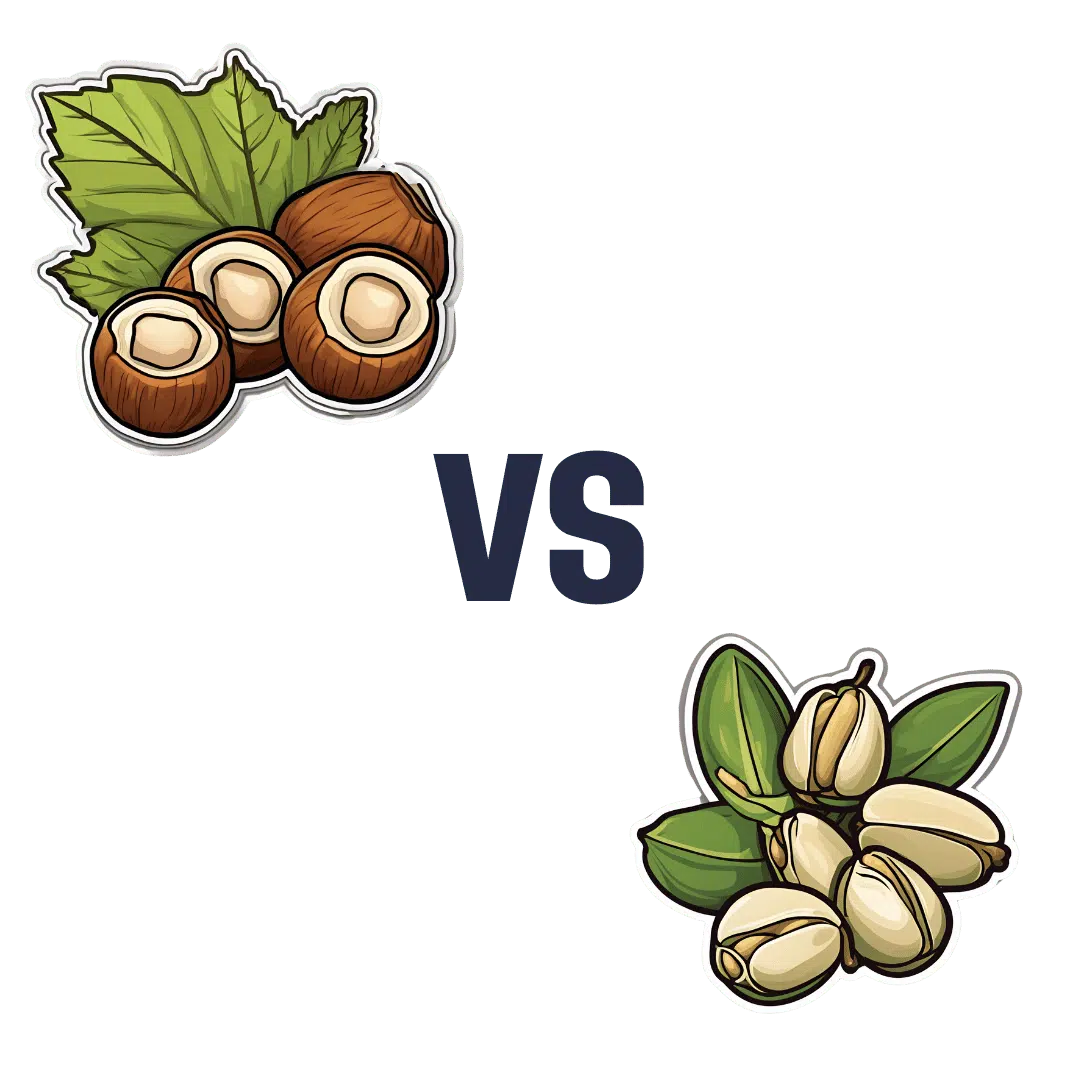
Hazelnuts vs Pistachios – Which is Healthier?

10almonds is reader-supported. We may, at no cost to you, receive a portion of sales if you purchase a product through a link in this article.

Our Verdict

When comparing hazelnuts to pistachios, we picked the hazelnuts.

Why?

An argument could be made for either, depending on what we prioritize! So there was really no wrong answer here today, but it is good to know what each nut’s strengths are:

In terms of macros, pistachios have more fiber, carbs, protein, and (mostly healthy) fat. That does make them the “more food per food” option, but it’s worth noting that while hazelnuts have more fiber, they also have a higher margin of difference when it comes to their greater carb count, and resultantly, hazelnuts do have the lower glycemic index. That said, they’re still both low-GI foods, so we’ll call this section a win for pistachios overall.

When it comes to vitamins, hazelnuts have more of vitamins B3, B5, B9, C, E, K, and choline, while pistachios have more of vitamins A, B1, B2, and B6. So, a fair 7:4 win for hazelnuts here.

In the category of minerals, hazelnuts have more calcium, copper, iron, magnesium, manganese, and zinc, while pistachios have more phosphorus, potassium, and selenium. A clear 6:3 win for hazelnuts.

In short, both are good sources of many nutrients, so choose according to what you want to prioritize, or better yet, enjoy both.

Want to learn more?

You might like to read:

Why You Should Diversify Your Nuts

Take care!

Don’t Forget…

Did you arrive here from our newsletter? Don’t forget to return to the email to continue learning!

Learn to Age Gracefully

Join the 98k+ American women taking control of their health & aging with our 100% free (and fun!) daily emails:

  • SMOL Bowl With Sautéed Greens

    10almonds is reader-supported. We may, at no cost to you, receive a portion of sales if you purchase a product through a link in this article.

    Whole grains are good, and gluten is bad for some people. Today’s dish has four whole grains, and no gluten (assuming no cross-contamination, so look for the gluten-free label if that’s important to you). Breafast? Brunch? Lunch? Supper, even? This is good at any time of day, packed with nutrients and full of flavor!

    You will need (per person)

    • 1 cup mixed cooked grains of equal parts sorghum, millet, oats, lentils (SMOL)—these can be cooked in bulk in advance and frozen in portions, as it’s often good to used mixed grains, and these four are a great combination for many purposes.
    • ½ cup low sodium vegetable stock (ideally you made this yourself from vegetable offcuts you kept in the freezer until you had enough for this purpose, but failing that, low-sodium stock cubes can be bought at most large supermarkets).
    • ½ cup finely chopped red onion
    • 6 oz cavolo nero, finely chopped
    • 1 small carrot, finely chopped
    • 3 cloves garlic, finely chopped
    • 1 tbsp nutritional yeast
    • 1 tsp black pepper, coarse ground
    • 1 tsp white miso paste
    • To serve: 1 lemon wedge

    Method

    (we suggest you read everything at least once before doing anything)

    1) Add the stock to a sauté pan over a medium heat, and add the onion, garlic, and carrot. Stir frequently for about 7 minutes.

    2) Add the cavolo nero and miso paste, stirring for another 4 minutes. If there is any liquid remaining, drain it off now.

    3) Warm the SMOL mixture (microwave is fine) and spoon it into a bowl, topping with the nutritional yeast and black pepper. Finally, add the hot cavolo nero mixture.

    4) Serve with the lemon wedge on the side, to add a dash of lemon at will.

    Enjoy!

    Want to learn more?

    For those interested in some of the science of what we have going on today:

    Take care!

    Share This Post

  • 15 “Life-Changing” Quotes To Build Your Strongest Self (Or Are They?)

    10almonds is reader-supported. We may, at no cost to you, receive a portion of sales if you purchase a product through a link in this article.

    Words of wisdom, or just platitudes? How many of these do you live by?

    Mind & body

    Here they are in text form:

    1. Mel Robbins: “You can’t control how you feel, but you can always choose how you act.”
    2. Brené Brown: “Vulnerability is the birthplace of innovation, creativity, and change.”
    3. James Clear: “Success is the product of daily habits, not once-in-a-lifetime transformations.”
    4. Angela Duckworth: “Enthusiasm is common. Endurance is rare.”
    5. Adam Grant: “The hallmark of an open mind is not letting your ideas become your identity.”
    6. Abby Wambach: “Failure is not something to be ashamed of. It’s something to be powered by.”
    7. Lisa Bilyeu: “There’s always going to be somebody that doesn’t believe in your dream. The only thing you have to ask yourself is, do you believe in your dream?”
    8. Martha Beck: “The way that other people judge me is none of my business.”
    9. Todd Herman: “You become what you practice, not what you preach.”
    10. Simon Sinek: “Dream big, start small, but most of all, start.”
    11. Jane Fonda: “Stay curious, keep learning, and keep growing.”
    12. Oprah Winfrey: “Turn your wounds into wisdom.”
    13. Elizabeth Gilbert: “Fear can have a voice, but it doesn’t get a vote.”
    14. Cheryl Strayed: “You don’t have a right to the cards you believe you should have been dealt. You have an obligation to play the hell out of the ones you’re holding.”
    15. Michelle Obama: “You don’t have to be somebody different to be important.”

    And for Cori Lefkowitz’s commentary on these, enjoy:

    Click Here If The Embedded Video Doesn’t Load Automatically!

    Want to learn more?

    You might also like:

    I Will Make You Passionate About Exercise – by Bevan Eyles

    Take care!

    Share This Post

  • 7 Tips To Start Back In The Gym After A Break

    10almonds is reader-supported. We may, at no cost to you, receive a portion of sales if you purchase a product through a link in this article.

    Whether we had an injury or illness, or life just got in the way, we’ve all had breaks from dedicated exercise sometimes. So, how to restart best?

    Slow and steady

    The way to do it is easier than you might think:

    1. Work up to everything: don’t jump back in at your previous level—rebuild from the basics, reestablish form, and focus on gradual progression.
    2. Do less than you think you need: avoid doing too much too soon; start small so that you don’t overdo it in your optimism and then need to take another break to recover.
    3. Don’t add weights first: progress through other methods like range of motion, tempo, or reps before increasing resistance; this allows your body time to adapt safely.
    4. Focus on what you feel working: prioritize mind-muscle connection to activate the correct muscles and improve movement quality; this is more important than external factors like how much weight you used.
    5. Prioritize your warm-up: include foam rolling, dynamic stretching, and activation exercises; they really do help improve the quality of the rest of your workout.
    6. Move in every direction: incorporate exercises across multiple planes of motion to improve mobility, stability, and functional strength, without leaving gaps in development (which invite injury).
    7. Stay consistent: follow a focused plan and avoid jumping between programs; repetition and routine are the keys to progress.

    For more on each of these, enjoy:

    Click Here If The Embedded Video Doesn’t Load Automatically!

    Want to learn more?

    You might also like:

    How To Always Follow Through

    Take care!

    Share This Post

  • Is Your Menopause App Spying On You?

    10almonds is reader-supported. We may, at no cost to you, receive a portion of sales if you purchase a product through a link in this article.

    In your opinion, do companies collecting your data respect the notion of consent?

    Or perhaps, like most of us, you’re getting a little jaded of being presented with options such as:

    Let it also not go without mentioning, the number of times we, upon clicking to “personalize” privacy options (i.e., do damage limitation within what they allow), we see a text along the lines of:

    “We at Company Inc. value your privacy. We and our 1,917 partners with whom we share your data—”

    So, if that’s the baseline, what’s this about menopause apps now?

    Periods may stop, but privacy violations sure don’t

    While period/ovulation-tracking apps have come under much scrutiny lately for their privacy violations, menopause apps have received comparatively little regulatory (or research) attention.

    So, researchers (Dr. Maryam Mehrnezhad et al.) conducted a modest yet significantly-sized survey (n=310) to examine privacy and safety issues in menopause-related digital technologies.

    The problem is similar to that of the period/ovulation-tracking apps, in that most collect intimate health information—including emotional symptoms and sexual activity history—which could potentially be accessed or misused by employers, insurers, or scammers.

    What Dr. Mehrnezhad and her team found is that many platforms lack adequate safeguards and are often rife with misinformation, to potentially add injury to insult (insofar as incorrect information can result in material harm).

    This study was done in Europe, and many current apps fall well short of requirements under General Data Protection Regulation (GDPR) because their privacy policies are difficult to find or understand (see the sort of obfuscations we gave examples of up top), and a cynical person might even say that this is intentional when they’re making money from selling that data (let’s be clear, when they say “we and our 1,917 partners”, they mean “we and the 1,917 companies we sell your data to”).

    So, how about in the US? Well, the US doesn’t have Federal equivalent, although some states have privacy laws of their own (with California’s being the strongest, albeit still not close to GDPR).

    In short: if you have such an app, check your app’s privacy policy, but chances are very high your data is being sold to not just the highest bidder, but really, to every vaguely compelling bidder.

    You can read the study itself, here: User Risk Perceptions and Privacy Attitudes towards Menopause Data Collection and Use

    Writer’s anecdote: not a menopause-tracker exactly, but I used to use the Finch self-care app; it’s a cute interface with a virtual pet that basically does CBT and DBT, as well as being a journalling app. One of the things I liked about it was that all my data stays on my device, and even if I make a manual back-up of my data, I can back it up to a drive of my own, not theirs. However, last year they changed to prompt every day to upload my personal data to “the cloud” (pro tip: “the cloud” is just someone else’s computer; in this case, theirs) and, ironically for a self-care app, weren’t willing to take “no” for an answer. So, I deleted my data and deleted the app.

    What can we do to get the same features without such privacy violations?

    There are tiers of privacy available:

    • Purpose-built apps: negligible privacy. You would get more privacy if you nailed your personal data to your front door, Martin Luther-style.
    • Multipurpose apps: if you go for something like a general purpose journalling app, then there is slightly better privacy, just because when your data is sold or leaked, it’s not already formatted in an easy-to-analyse way. However, on the flipside, it’s not so easy to use for you, either.
    • Offline computer/device: here we mean one that does not have access to the internet and will never have access to the internet at a future point. For example, you bought a tablet without mobile internet, and immediately disabled the WiFi, Bluetooth, etc.
    • Pen and paper: near complete privacy, unless your home is searched (as happened to some American women in the wake of Roe vs. Wade being overturned).
    • Between your ears: perfect privacy, with the caveat that you may not have perfect recall.

    A good compromise is to do something like a monthly self-check of all the aspects of health you find important and can check yourself at home, for example:

    Your Health Audit, From Head To Toe ← these are all excellent areas to pay close attention to

    Take care!

    Don’t Forget…

    Did you arrive here from our newsletter? Don’t forget to return to the email to continue learning!

    Learn to Age Gracefully

    Join the 98k+ American women taking control of their health & aging with our 100% free (and fun!) daily emails:

  • The Joy Of Missing Out

    10almonds is reader-supported. We may, at no cost to you, receive a portion of sales if you purchase a product through a link in this article.

    What this is not going to be: a sour grapes thing.

    What this is going to be: an exploration of how the grass is greener on the other side of the fence wherever you water it

    It’s easy to feel lonely and isolated, even in today’s increasingly-connected world. We’ve tackled that topic before:

    How To Beat Loneliness & Isolation

    One of the more passive (but still reasonable) ways of reducing isolation is to simply say “yes” more, which we discussed (along with other more active strategies) here:

    When The World Moves Without Us… Can We Side-Step Age-Related Alienation?

    But, is there any benefit to be gained from not being in the thick of things?

    Sometimes some things associated with isolation are not, in reality, necessarily isolating. See for example:

    Singledom & Healthy Longevity

    But, the implications of embracing the “joy of missing out” are much more wide-reaching:

    Wherever you are, there you are

    You’ve probably read before the phrase “wherever you go, there you are”, but this phrasing brings attention to the fact that you already are where you are.

    There are quite possibly aspects of your current life/situation that are not ideal, but take a moment to appreciate where you are in life. At the very least, you are probably in a safe warm dry house with plenty of food available; chances are you have plenty of luxuries too.

    See also: How To Get Your Brain On A More Positive Track (Without Toxic Positivity)

    And yet, it’s easy to have a fear of missing out. Even billionaires fear they do not have enough and must acquire more in order to be truly secure and fulfilled.

    As it goes for material wealth, so it also goes for social wealth—in other words, we may worry about such questions as: on whom can we rely, and who will be there for us if we need them? Do we, ultimately, have enough social capital to be secure?

    • For social media influencers, it’ll be follower counts and engagement.
    • For the family-oriented, it might be the question of whose house a given holiday gets celebrated at, and who attends, and who does it best.
    • In more somber matters, think about funerals, and those where “there was such a huge turnout” vs “almost nobody attended”.

    It sure sounds a lot like a dog-eat-dog world in which missing out sucks! But it doesn’t have to.

    So let’s recap: your current situation is probably, all things considered, not bad. There is probably much in life to enjoy. If people do not come to your holiday event, then those are not people who would have improved things for you. If people do not attend your funeral even, then well, you yourself will be late, so hey.

    Right now though, you are alive, so…

    Enjoy the moment; enjoy your life for you.

    Invest in yourself. Better yourself. Improve your environment for yourself little by little.

    We spend a lot of time in life living up to everyone’s expectations, often without stopping to question whether it is what we want, or sometimes putting aside what we want in favor of what is wanted of us.

    • Sometimes, such ostensible altruism is laudable and good (the point of today’s article is not “be a selfish jerk”; sometimes we should indeed shelve our self-interest in favour of doing something for the common good)
    • Sometimes, it’s just pointless sacrifice that benefits nobody (the point of today’s article is “there is no point in playing stressful, stacked games when you could have a better time not doing that”)

    If you are about to embark on an endeavor that you don’t really want to, take a moment to seriously consider which of the above two situations this is, and then act accordingly.

    For a deeper dive into that, you might like this book that we reviewed a while back:

    The Joy of Saying No – by Natalie Lue

    Enjoy!

    Don’t Forget…

    Did you arrive here from our newsletter? Don’t forget to return to the email to continue learning!

    Learn to Age Gracefully

    Join the 98k+ American women taking control of their health & aging with our 100% free (and fun!) daily emails:

  • Metabolical – by Dr. Robert Lustig

    10almonds is reader-supported. We may, at no cost to you, receive a portion of sales if you purchase a product through a link in this article.

    The premise of this book itself is not novel: processed food is bad, food giants lie to us, and eating better makes us less prone to disease (especially metabolic disease).

    What this book does offer that’s less commonly found is a comprehensive guide, a walkthrough of each relevant what and why and how, with plenty of good science and practical real-world examples.

    In terms of unique selling points, perhaps the greatest strength of this book is its focus on two things in particular that affect many aspects of health: looking after our liver, and looking after our gut.

    The style is… A little dramatic perhaps, but that’s just the style; there’s no hyperbole, he is stating well-established scientific facts.

    Bottom line: very much of chronic disease would be a lot less diseasey if we all ate with these aspects of our health in mind. This book’s a comprehensive guide to that.

    Click here to check out Metabolical, and let food be thy medicine!

    Don’t Forget…

    Did you arrive here from our newsletter? Don’t forget to return to the email to continue learning!

    Learn to Age Gracefully

    Join the 98k+ American women taking control of their health & aging with our 100% free (and fun!) daily emails: