
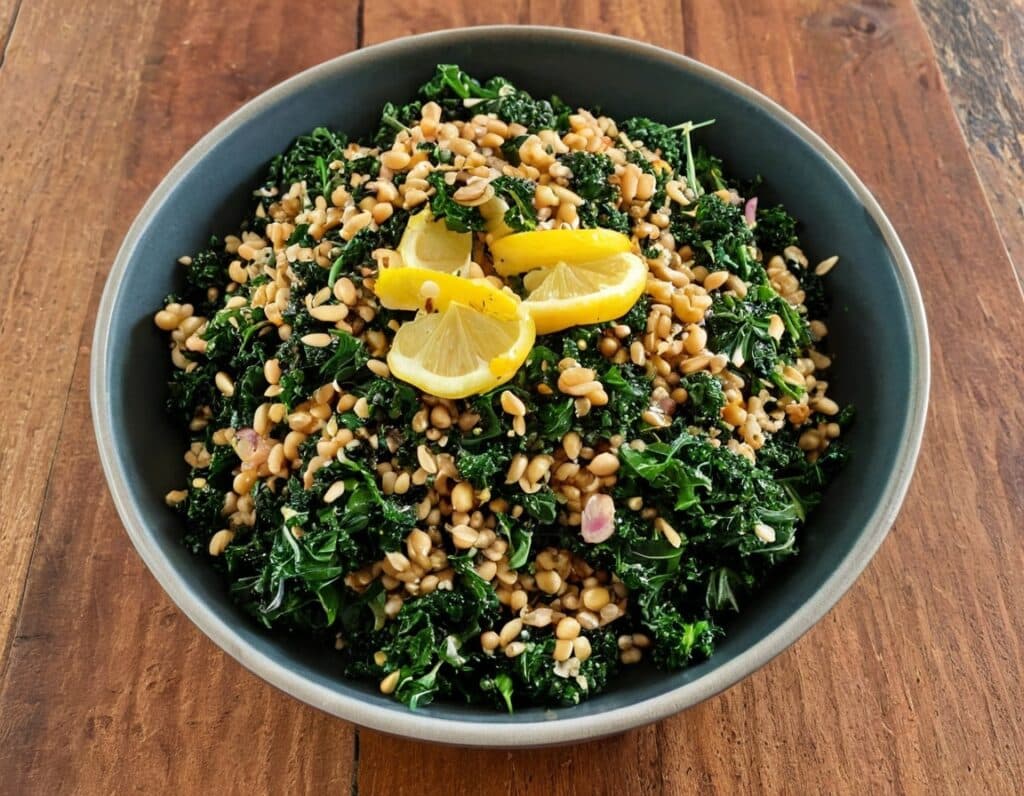
SMOL Bowl With Sautéed Greens
10almonds is reader-supported. We may, at no cost to you, receive a portion of sales if you purchase a product through a link in this article.
Whole grains are good, and gluten is bad for some people. Today’s dish has four whole grains, and no gluten (assuming no cross-contamination, so look for the gluten-free label if that’s important to you). Breafast? Brunch? Lunch? Supper, even? This is good at any time of day, packed with nutrients and full of flavor!
You will need (per person)
- 1 cup mixed cooked grains of equal parts sorghum, millet, oats, lentils (SMOL)—these can be cooked in bulk in advance and frozen in portions, as it’s often good to used mixed grains, and these four are a great combination for many purposes.
- ½ cup low sodium vegetable stock (ideally you made this yourself from vegetable offcuts you kept in the freezer until you had enough for this purpose, but failing that, low-sodium stock cubes can be bought at most large supermarkets).
- ½ cup finely chopped red onion
- 6 oz cavolo nero, finely chopped
- 1 small carrot, finely chopped
- 3 cloves garlic, finely chopped
- 1 tbsp nutritional yeast
- 1 tsp black pepper, coarse ground
- 1 tsp white miso paste
- To serve: 1 lemon wedge
Method
(we suggest you read everything at least once before doing anything)
1) Add the stock to a sauté pan over a medium heat, and add the onion, garlic, and carrot. Stir frequently for about 7 minutes.
2) Add the cavolo nero and miso paste, stirring for another 4 minutes. If there is any liquid remaining, drain it off now.
3) Warm the SMOL mixture (microwave is fine) and spoon it into a bowl, topping with the nutritional yeast and black pepper. Finally, add the hot cavolo nero mixture.
4) Serve with the lemon wedge on the side, to add a dash of lemon at will.
Enjoy!
Want to learn more?
For those interested in some of the science of what we have going on today:
Take care!
Don’t Forget…
Did you arrive here from our newsletter? Don’t forget to return to the email to continue learning!
Recommended

Learn to Age Gracefully
Join the 98k+ American women taking control of their health & aging with our 100% free (and fun!) daily emails:
-
The Cough Doctor
10almonds is reader-supported. We may, at no cost to you, receive a portion of sales if you purchase a product through a link in this article.
The Cough Doctor
This is Dr. Peter Small, who worked in epidemiology since the beginning of HIV epidemic. He became a pioneer in the field of molecular epidemiology. As such, his work was a guiding beacon for the public health response to the resurgence of tuberculosis. He’s travelled the world spending years in various institutions studying all manner of respiratory illnesses…. These have ranged from tuberculosis to pneumonia to lung cancer and (back to epidemiology) Covid-19.
He’s now the Chief Medical Officer at…
Hyfe
Hyfe, a medical AI company, was founded in 2020. Its objective: to build acoustic tools for respiratory diagnostics and monitoring.
In other words: it records coughs and collects data about coughing.
❝It’s ironic how much people focus on counting steps while ignoring cough, which is far more consequential. Hyfe is a science-driven company with the technology to make cough count. Particularly now, with increased awareness of cough and the rapid growth of digital health driven by Covid-19, this technology can improve the lives of patients, the care provided by doctors, and the efficiency of health systems.❞
~ Dr. Peter Small, CMO, Hyfe
How does it do it?
Hyfe’s AI monitors the number of times a person coughs and the sound of the cough through any smartphone or other smart device.
This data collected over time provides increasingly more reliable information than a single visit to the doctor! By constantly listening and analyzing, it can detect patterns that might otherwise go unnoticed.
How big is this “big data” effort?
Hyfe maintains the largest cough dataset in the world. This means it can compare the sound of a patient’s cough with more than 400 million cough-like sounds from 83 countries across all continents.
The human brain doesn’t handle big numbers well. So, just to illustrate: if the average cough is 1 second long, that means it’d take more than 12 years to listen to them all.
Hyfe, meanwhile, can:
- listen to many things simultaneously
- index them all against user and location,
- use its ever-growing neural net to detect and illustrate patterns.
It’s so attentive, that it can learn to distinguish between different people’s coughs in the same household.
❝Companies like Google Health see even basic information such as getting an accurate count of the number of times a person coughs a day as a useful resource, and part of a larger need to collect and chronicle more health information to refine the way doctors diagnose disease and manage treatments in the future.❞
What are the public health implications?
The most obvious application is to note when there’s a spike in coughing, and see how such spikes grow and spread (if they do), to inform of contagion risks.
Another is to cross-reference it with data about local environmental allergens. Knowing how things like pollution and even pollen affect individuals differently could be helpful in identifying (and managing) chronic conditions like asthma.
What are the private health implications?
❝It’s going to transform the whole clinical approach for this common and chronic symptom. Patients will come in, have the data on how much they are coughing, and the physician can suggest a treatment based on that information to see if it makes the coughs better❞
~ Dr. Peter Small
Dr. Small’s colleague Dr. Cai, speaking for Google Health on this project, sees even more utility for diagnostics:
❝When I was in medical school, never ever did they teach us that we could listen to somebody cough and identify whether that person has TB (tuberculosis), COPD, or a tumor. But I keep seeing more and more studies of people coughing into a microphone, and an algorithm can detect whether somebody has TB with 95% specificity and sensitivity, or if someone has pneumonia or an exacerbation of COPD❞
~ Dr. Lawrence Cai
And the privacy implications?
Perhaps you don’t quite fancy the idea of not being able to cough without Google knowing about it. Hyfe’s software is currently opt-in, but…
If you cough near someone else’s Hyfe app, their app will recognize you’re not the app’s user, and start building a profile for you. Of course, that won’t be linked to your name, email address, or other IDs, as it would if you were the app’s user.
Hyfe will ask to connect to your social media, to collect more information about you and your friends.
Whether you’d like to try this or perhaps you’re just curious to learn more about this fascinating project, you can check out:
Share This Post
-
Apricot vs Kiwi – Which is Healthier?
10almonds is reader-supported. We may, at no cost to you, receive a portion of sales if you purchase a product through a link in this article.
Our Verdict
When comparing apricots to kiwi, we picked the kiwi.
Why?
Both are great! But…
In terms of macros, kiwi has more fiber and carbs, as well as the better ratio of fiber:carbs, and so wins this round.
In the category of vitamins, apricot has more of vitamins A, B1, B2, B3, and B5, while kiwi has more of vitamins B6, B7, B9, C, E, K, and choline. Yes, it’s a little unusual the distribution of vitamins were divided alphanumerically like that (from A to B5 for apricots, then B6 onwards for kiwi, as though they were neighboring sections in a library), but nature can be strange like that sometimes. It’s also fun apricots are a really good source of vitamin A (24x more) and kiwis are a really good source of vitamin K (12x more), but when all the vitamins are added up, kiwi has a clear numerical advantage over all, and wins this round.
When it comes to minerals, things are no longer distributed alphabetically, because apricots have more iron and zinc, while kiwis have more calcium, copper, magnesium, manganese, phosphorus, potassium, and selenium. Another win for kiwis.
Both of these fruits have abundant polyphenols and specific anticancer properties, so there’s nothing between them here in that regard.
Adding up the sections makes for a clear overall win for kiwis, but by all means enjoy either or both; diversity is good!
Want to learn more?
You might like:
Top 8 Fruits That Prevent & Kill Cancer
Enjoy!
Share This Post
-
The Spice Of Life
10almonds is reader-supported. We may, at no cost to you, receive a portion of sales if you purchase a product through a link in this article.
It’s Q&A Day at 10almonds!
Have a question or a request? You can always hit “reply” to any of our emails, or use the feedback widget at the bottom!
In cases where we’ve already covered something, we might link to what we wrote before, but will always be happy to revisit any of our topics again in the future too—there’s always more to say!
As ever: if the question/request can be answered briefly, we’ll do it here in our Q&A Thursday edition. If not, we’ll make a main feature of it shortly afterwards!
So, no question/request too big or small
❝Great newsletter. Am taking turmeric for inflammation of hips and feet. Works like magic. Would like to know how it works, and what tumeric is best combined with – also whether there any risks in longterm use.❞
Glad you’re enjoying! As for turmeric, it sure is great, isn’t it? To answer your questions in a brief fashion:
- How it works: it does a lot of things, but perhaps its most key feature is its autoxidative metabolites that mediate its anti-inflammatory effect. Thus, it slows or inhibits oxidative stress that would otherwise cause inflammation, increase cancer risk, and advance aging.
- Best combined with: black pepper
- Any risks in long-term use: there are no known risks in long-term use ← that’s just one study, but there are lots. Some studies were prompted by reported hepatotoxicity of curcumin supplements, but a) the reports themselves seem to be without evidence b) the reported hepatoxicity was in relation to contaminants in the supplements, not the curcumin itself c) clinical trials were unable to find any hepatotoxicity (or other) risks anyway. Here’s an example of such a study.
You might also like our previous main feature: Why Curcumin (Turmeric) Is Worth Its Weight In Gold
Share This Post
Related Posts
-
Edamame vs Red Lentils – Which is Healthier?
10almonds is reader-supported. We may, at no cost to you, receive a portion of sales if you purchase a product through a link in this article.
Our Verdict
When comparing edamame to red lentils, we picked the edamame.
Why?
In terms of macros, edamame has slightly more protein while red lentils have slightly more fiber as well as about 2x the carbs; this category could thus be considered a tie or a win for either, depending on how the carbs fit into your general diet. For simplicity, we’ll call it a tie here, but those are things to bear in mind.
In the category of vitamins, edamame has more of vitamins A, B1, B2, B9, C, E, K, and choline, while red lentils have more of vitamins B3, B5, and B6. An uncontentious win for edamame here.
When it comes to minerals, edamame has more calcium, copper, magnesium, manganese, potassium, and zinc, while red lentils have more iron, phosphorus, and selenium. Another win for edamame.
Finally, edamame has more polyphenols, though both are good. Still, a win for edamame by the numbers.
Adding up the sections makes for an overall win for edamame, but do enjoy either or both; diversity is good!
Want to learn more?
You might like:
Plant vs Animal Protein: Head to Head
Enjoy!
Don’t Forget…
Did you arrive here from our newsletter? Don’t forget to return to the email to continue learning!
Learn to Age Gracefully
Join the 98k+ American women taking control of their health & aging with our 100% free (and fun!) daily emails:
-
Unlimited Memory – by Kevin Horsley
10almonds is reader-supported. We may, at no cost to you, receive a portion of sales if you purchase a product through a link in this article.
Premise: there are easily learnable techniques to rapidly (and greatly) improve one’s memory. We’ve touched on some of these methods before at 10almonds, but being a newsletter rather than a book, we’ve not been able to go as deeply into it as Horsley!
Your memory is far, far, far more powerful than you might realize, and this book will help unlock that. To illustrate…
Some of the book is given over to what are for most purposes “party tricks”, such as remembering pi to 10,000 places. Those things are fun, even if not as practical in today’s world of rarely needing to even know the actual digits of a phone number. However, they do also serve as a good example of just how much of “super memory” isn’t a matter of hard work, so much as being better organized about it.
Most of the book is focused on practical methods to improve the useful aspects of memory—including common mistakes!
If the book has any flaw it’s that the first chapter or so is spent persuading the reader of things we presumably already believe, given that we bought the book. For example, that remembering things is a learnable skill and that memory is functionally limitless. However, we still advise to not skip those chapters as they do contain some useful reframes as well.
Bottom line: if you read this book you will be astonished by how much you just learned—because you’ll be able to recall whole sections in detail! And then you can go apply that whatever areas of your life you wanted to when you bought the book.
Don’t Forget…
Did you arrive here from our newsletter? Don’t forget to return to the email to continue learning!
Learn to Age Gracefully
Join the 98k+ American women taking control of their health & aging with our 100% free (and fun!) daily emails:
-
Corn Chips vs Potato Chips: Which is Healthier?
10almonds is reader-supported. We may, at no cost to you, receive a portion of sales if you purchase a product through a link in this article.
Our Verdict
When comparing corn chips to potato chips, we picked the corn chips.
Why?
First, let it be said, this was definitely a case of “lesser evil voting” as there was no healthy choice here. But as for which is relatively least unhealthy…
Most of the macronutrient and micronutrient profile is quite similar. Both foods are high carb, moderately high fat, negligible protein, and contain some trace minerals and even some tiny amounts of vitamins. Both are unhealthily salty.
Exact numbers will of course vary from one brand’s product to another, but you can see some indicative aggregate scores here in the USDA’s “FoodData Central” database:
The biggest health-related difference that doesn’t have something to balance it out is that the glycemic index of corn chips averages around 63, whereas the glycemic index of potato chips averages around 70 (that is worse).
That’s enough to just about tip the scales in favor of corn chips.
The decision thus having been made in favor of corn chips (and the next information not having been part of that decision), we’ll mention one circumstantial extra benefit to corn chips:
Corn chips are usually eaten with some kind of dip (e.g. guacamole, sour cream, tomato salsa, etc) which can thus deliver actual nutrients. Potato chips meanwhile are generally eaten with no additional nutrients. So while we can’t claim the dip as being part of the nutritional make-up of the corn chips, we can say:
If you’re going to have a habit of eating one or the other, then corn chips are probably the least unhealthy of the two.
And yes, getting vegetables (e.g. in the dips) in ways that are not typically associated with “healthy eating” is still better than not getting vegetables at all!
Check out: Level-Up Your Fiber Intake! (Without Difficulty Or Discomfort)
Don’t Forget…
Did you arrive here from our newsletter? Don’t forget to return to the email to continue learning!
Learn to Age Gracefully
Join the 98k+ American women taking control of their health & aging with our 100% free (and fun!) daily emails:


