
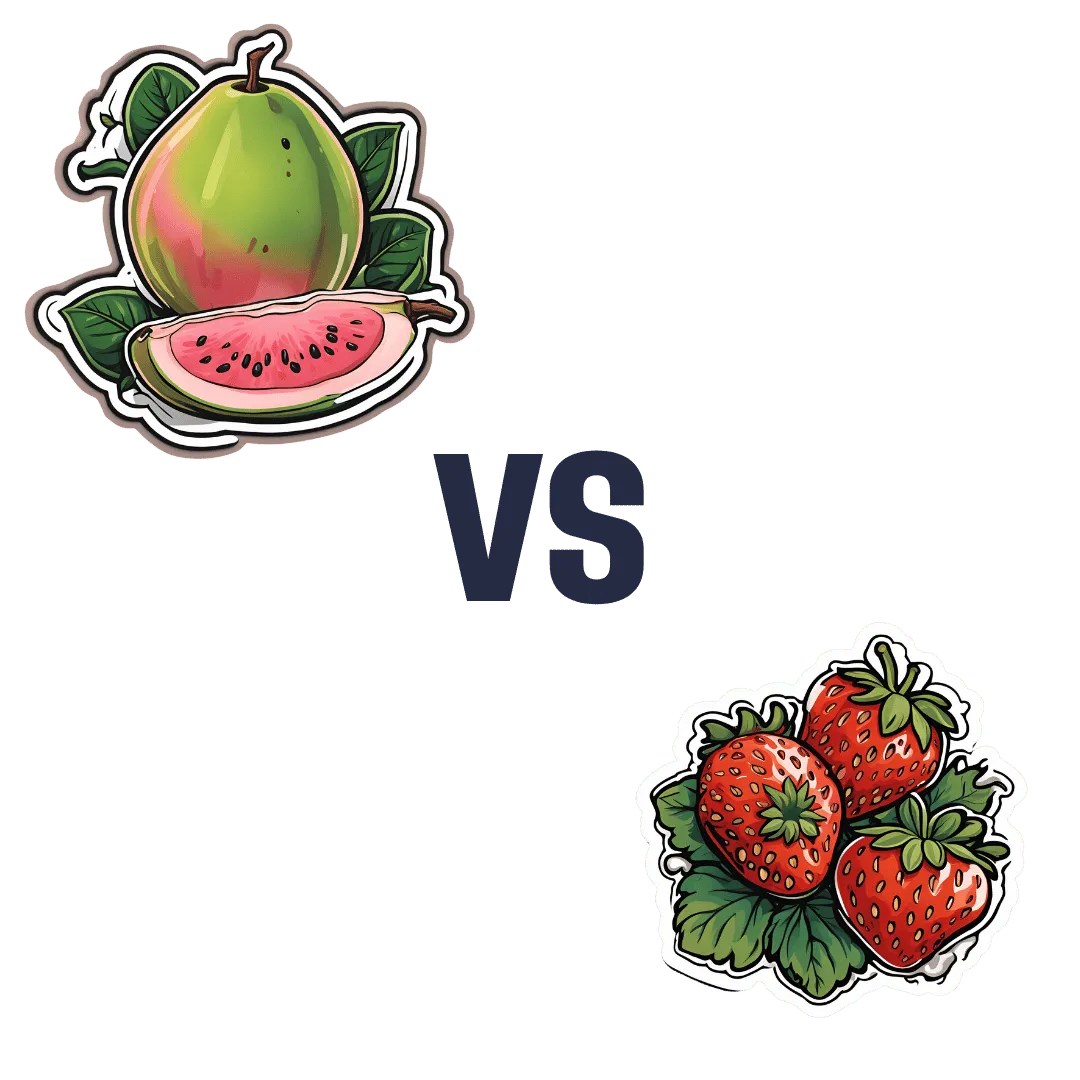
Guava vs Strawberries – Which is Healthier?

10almonds is reader-supported. We may, at no cost to you, receive a portion of sales if you purchase a product through a link in this article.

Our Verdict

When comparing guava to strawberries, we picked the guava.

Why?

A straightforward one today:

In terms of macros, guava has nearly 3x the fiber, approximately 2x the carbs, and more than 2x the protein, making it the all-round more nutrient-dense option in the macros category.

In the category of vitamins, guava has more of vitamins A, B1, B2, B3, B5, B6, B7, B9, C, E, K, and choline, while strawberries are not higher in any vitamin. A complete win for guava.

When it comes to minerals, guava has more calcium, copper, magnesium, phosphorus, potassium, selenium, and zinc, while strawberries have more iron and manganese. Another overwhelming win for guava.

Looking at phytochemicals, both are very good, but guava has more polyphenols in total by far.

Adding up the sections makes for a clear overall win for guava, but by all means enjoy either or both; diversity is good!

Want to learn more?

You might like:

What’s Your Plant Diversity Score?

Enjoy!

Don’t Forget…

Did you arrive here from our newsletter? Don’t forget to return to the email to continue learning!

Learn to Age Gracefully

Join the 98k+ American women taking control of their health & aging with our 100% free (and fun!) daily emails:

  • Asparagus vs Beetroot – Which is Healthier?

    10almonds is reader-supported. We may, at no cost to you, receive a portion of sales if you purchase a product through a link in this article.

    Our Verdict

    When comparing asparagus to beetroot, we picked the asparagus.

    Why?

    Both are great! But one comes out better, on balance:

    In terms of macros, asparagus has a little more protein, while beetroot has a little more fiber and 2x the carbs, but the numbers are all quite low, meaning doesn’t make much difference, so all in all, we’re calling this round a tie.

    In the category of vitamins, however, asparagus has a lot more of vitamins A, B1, B2, B3, B5, B6, B7, C, E, and K, including 21x more vitamin K, of which it’s a very good source, while beetroot boasts only more vitamin B9. So, an overwhelming win for asparagus here.

    Looking at minerals next, asparagus has more calcium, copper, iron, phosphorus, selenium, and zinc, while beetroot has more magnesium, manganese, and potassium, yielding a 6:3 win to asparagus in this round.

    In other considerations, asparagus has more polyphenols, especially quercetin, while beetroot has betalains, especially betanin, and plenty of benefits therefrom (see the “learn more” link below). So we’ll call this round a tie.

    Adding up the sections makes for a clear overall win for asparagus, but by all means enjoy either or both, as both have their strong merits, and diversity is good!

    Want to learn more?

    You might like:

    Enjoy!

    Share This Post

  • Brown Rice vs Rye – Which is Healthier?

    10almonds is reader-supported. We may, at no cost to you, receive a portion of sales if you purchase a product through a link in this article.

    Our Verdict

    When comparing brown rice to rye, we picked the rye.

    Why?

    It’s a simple one today, and it wasn’t close:

    In terms of macros, rye has nearly 4x the fiber for the same carbs and slightly more protein, winning easily in this category.

    In the category of vitamins, brown rice has more of vitamins B1, B3, and B6, while rye has more of vitamins A, B2, B5, B7, B9, E, and K, winning another round easily.

    Looking at minerals next, brown rice has more selenium, while rye has more calcium, copper, iron, potassium, and zinc, winning its third round in a row.

    Adding up the sections makes for a clear overall win for rye, but by all means do still enjoy either or both, as diversity is best!

    Want to learn more?

    You might like:

    Enjoy!

    Share This Post

  • Antiviral Gum Gives Epidemiologists Something To Chew On

    10almonds is reader-supported. We may, at no cost to you, receive a portion of sales if you purchase a product through a link in this article.

    With viruses on the rise, of course one of our biggest weapons against them is vaccination, but that approach has its limitations:

    • In some places such as the US, anti-vaccine sentiments are high, and a vaccine is only as good as its uptake (i.e. if people don’t take it, they will more likely catch the disease and pass it on, including to some people who cannot be vaccinated, so non-vaccinators create a hole in herd immunity)
    • Many vaccines can become outdated when viruses mutate more quickly than vaccines can be developed (we’ve seen a lot of this with COVID and Flu viruses, and that’s why we keep needing new ones)
    • There are some viruses for which we simply do not yet have vaccines; sometimes this is the case even for very common viruses like Herpes simplex. or, indeed, the common cold (Rhinovirus sp.).

    So, antivirals definitely have their place too. To be clear about the difference:

    • A vaccine forewarns the immune system “watch out for this thing that you might encounter in the future, and prepare a defense for it according to these specifications” (it only helps if you aren’t already infected with the thing it’s vaccinating against, because otherwise the warning is too late and your body is already trying to mount a defense)
    • An antiviral kills, inactivates, or otherwise severely inconveniences the virus directly (it only helps if there is a virus there to fight)

    How the antiviral gum works

    In few words: you chew it, the antiviral substance is then in your saliva, and it kills/inactivates/inconveniences the virus at the site of infection (e.g. your respiratory tract)

    In the case of this specific antiviral gum, it’s more in the category of “severely inconveniences”, because the antiviral substance is a protein trap that binds to the virus, rendering it near-harmless.

    In essence, therefore, it works less like a vaccine and more like a facemask (except it’s trapping the virus on the molecular level, rather than trying to stop aerosolized droplets from moving around on the macro level).

    This was first developed as a possible tool against COVID:

    Debulking SARS-CoV-2 in saliva using angiotensin converting enzyme 2 in chewing gum to decrease oral virus transmission and infection

    …and this in turn was based on previous work quite early in 2020:

    A Carbohydrate-Binding Protein from the Edible Lablab Beans Effectively Blocks the Infections of Influenza Viruses and SARS-CoV-2

    And yes, those are lablab beans, as in Lablab purpureus, also called hyacinth beans, which may not be available in all supermarkets, but are not very obscure either (common throughout most of Africa and the tropics).

    Most recently, researchers have found that 40mg of the broad-spectrum (as in, it affects many viruses) antiviral trap protein, as delivered by a 2g piece of gum, was sufficient to reduce viral loads by more than 95%, including for SARS-CoV-2 as well as H5N1, H3N2, and H7N9 (various kinds of bird flu that affect humans), and HSV-1 and HSV-2 (the two most common variants of herpes, including cold sores):

    Debulking influenza and herpes simplex virus strains by a wide-spectrum anti-viral protein formulated in clinical grade chewing gum

    You can also read a pop-science article about it, with links to more details, here:

    Antiviral chewing gum shows promise in reducing influenza and herpes spread

    Want to learn more?

    Check out:

    Winning The Biological Arms Race: Could This Be “The Ultimate Booster”?

    Take care!

    Share This Post

  • Can I Eat That? – by Jenefer Roberts

    10almonds is reader-supported. We may, at no cost to you, receive a portion of sales if you purchase a product through a link in this article.

    The answer to the question in the title is: you can eat pretty much anything, if you’re prepared for the consequences!

    This book looks to give you the information to make your own decisions in that regard. There’s a large section on the science of glucose metabolism in the context of food (other aspects of glucose metabolism aren’t covered), so you will not simply be told “raw carrots are good; mashed potatoes are bad”, you’ll understand many factors that affect it, e.g:

    • Macronutrient profiles of food and resultant base glycemic indices
    • How the glycemic index changes if you cut something, crush it, mash it, juice it, etc
    • How the glycemic index changes if you chill something, heat it, fry it, boil it, etc
    • The many “this food works differently in the presence of this other food” factors
    • How your relative level of insulin resistance affects things itself

    …and much more.

    The style is simple and explanatory, without deep science, but with good science and comprehensive advice.

    There are also the promised recipes; they’re in an appendix at the back and aren’t the main meat of the book, though.

    Bottom line: if you’ve ever found it confusing working out what works how in the mysterious world of diabetes nutrition, this book is a top tier demystifier.

    Click here to check out Can I Eat That?, and gain confidence in your food choices!

    Don’t Forget…

    Did you arrive here from our newsletter? Don’t forget to return to the email to continue learning!

    Learn to Age Gracefully

    Join the 98k+ American women taking control of their health & aging with our 100% free (and fun!) daily emails:

  • The Galveston Diet – by Dr. Mary Claire Haver

    10almonds is reader-supported. We may, at no cost to you, receive a portion of sales if you purchase a product through a link in this article.

    We’ve previously reviewed “It’s Not You, It’s Your Hormones” by nutritionist Nikki Williams, and noted at the time that it was very similar to the bestselling “The Galveston Diet”, not just in its content but all the way down its formatting. Some Amazon reviewers have even gone so far as to suggest that “It’s Not You, It’s Your Hormones” (2017) brazenly plagiarized “The Galveston Diet” (2023). However, after carefully examining the publication dates, we feel quite confident that the the earlier book did not plagiarize the later one.

    Of course, we would not go so far as to make a counter-accusation of plagiarism the other way around; it was surely just a case of Dr. Haver having the same good ideas 6 years later.

    Still, while the original book by Nikki Williams did not get too much international acclaim, the later one by Dr. Mary Claire Haver has had very good marketing and thus received a lot more attention, so let’s review it:

    Dr. Haver’s basic principle is (again) that we can manage our hormonal fluctuations, by managing our diet. Specifically, in the same three main ways:

    • Intermittent fasting
    • Anti-inflammatory diet
    • Eating more protein and healthy fats

    Why should these things matter to our hormones? The answer is to remember that our hormones aren’t just the sex hormones. We have hormones for hunger and satedness, hormones for stress and relaxation, hormones for blood sugar regulation, hormones for sleep and wakefulness, and more. These many hormones make up our endocrine system, and affecting one part of it will affect the others.

    Will these things magically undo the effects of the menopause? Well, some things yes, other things no. No diet can do the job of HRT. But by tweaking endocrine system inputs, we can tweak endocrine system outputs, and that’s what this book is for.

    The style is once again very accessible and just as clear, and Dr. Haver also walks us just as skilfully through the changes we may want to make, to avoid the changes we don’t want. The recipes are also very similar, so if you loved the recipes in the other book, you certainly won’t dislike this book’s menu.

    In the category of criticism, there is (as with the other book by the other author) some extra support that’s paywalled, in the sense that she wants the reader to buy her personally-branded online plan, and it can feel a bit like she’s holding back in order to upsell to that.

    Bottom line: this book is (again) aimed at peri-menopausal and post-menopausal women. It could also (again) definitely help a lot of people with PCOS too, and, when it comes down to it, pretty much anyone with an endocrine system. It’s (still) a well-evidenced, well-established, healthy way of eating regardless of age, sex, or (most) physical conditions.

    Click here to check out The Galveston Diet, and enjoy its well-told, well-formatted advice!

    Don’t Forget…

    Did you arrive here from our newsletter? Don’t forget to return to the email to continue learning!

    Learn to Age Gracefully

    Join the 98k+ American women taking control of their health & aging with our 100% free (and fun!) daily emails:

  • Here’s Looking At Ya!

    10almonds is reader-supported. We may, at no cost to you, receive a portion of sales if you purchase a product through a link in this article.

    This Main Feature Should Take You Two Minutes (and 18 Seconds) To Read*

    *Or at least, that’s what we’re told by this software that checks things for readability!

    There’s a problem nobody wants to talk about when it comes to speed-reading

    If you’re not very conscientious in your method, information does get lost. Especially, anything over 500 words per minute is almost certainly skimming and not true speed-reading.

    One of the reasons information gets lost is because of a weird and wonderful feature of our eyes and brain: saccades.

    Basically, our eyes can either collect visual information or they can move; they can’t do both at once. And as you may know, our eyes are almost always moving. So why aren’t we blind most of the time?

    We actually are.

    Did you know: your eyes take two upside-down 2D images and your brain presents you one 3D image the right way around instead? You probably did know that. So: it’s a bit like that.

    Your brain takes a series of snapshots from whenever your eyes weren’t moving, and mentally fills in the blanks for you, just like a studio animation. We have a “frame rate” of about 60 frames per second, by the way—that’s why many computer monitors use that frequency. Lower frequencies can result in a noticeable flicker, and higher frequencies are wasted on us mere mortals!

    Our eyes do some super-speedy movements called saccades (up to 500º per second! Happily no, our eyes don’t rotate 500º, but that’s the “per second” rate) and our brain fills in the gaps with its best guesses. The more you push it, the more it’ll guess wrong.

    We’re not making this up, by the way! See for yourself:

    Eye Movements In Reading And Information Processing: 20 Years Of Research

    Fortunately, it is possible to use your eyes in a way that reduces the brain’s need to guess. That also means it has more processing power left over to guess correctly when it does need to.

    Yes, There’s An App For That

    Actually there are a few! But we’re going to recommend Spreeder as a top-tier option, with very rapid improvement right from day one.

    It works by presenting the text with a single unmoving focal point. This is the opposite of traditional speed-reading methods that involve a rapidly moving pacer (such as your finger on the page, or a dot on the screen).

    This unmoving focal point (while the words move instead) greatly reduces the number of saccades needed, and so a lot less information is lost to optical illusions and guesswork.

    Try Spreeder (any platform) Here Now!

    If you find that easy to use and would like something with a few more features, you might like another app that works on the same principle: Spritz.

    It can take a bit more getting-used-to, but allows for greater integrations with all your favourite content in the long-run:

    Check Out Spritz: Android App / iOS App / Free Chrome Extension

    Lastly, if you don’t want any of those fancy apps and would just like to read more quickly and easily with less eye-strain, Beeline has you covered.

    For free, unless you want to unlock some premium features!

    How Beeline works is by adding a color gradient to text on websites and in documents. This makes it a lot easier for the eye to track without going off-piste, skipping a line, or re-reading the same bit again, etc.

    Try Out Beeline Reader (any platform) Here Now!

    Don’t Forget…

    Did you arrive here from our newsletter? Don’t forget to return to the email to continue learning!

    Learn to Age Gracefully

    Join the 98k+ American women taking control of their health & aging with our 100% free (and fun!) daily emails: