
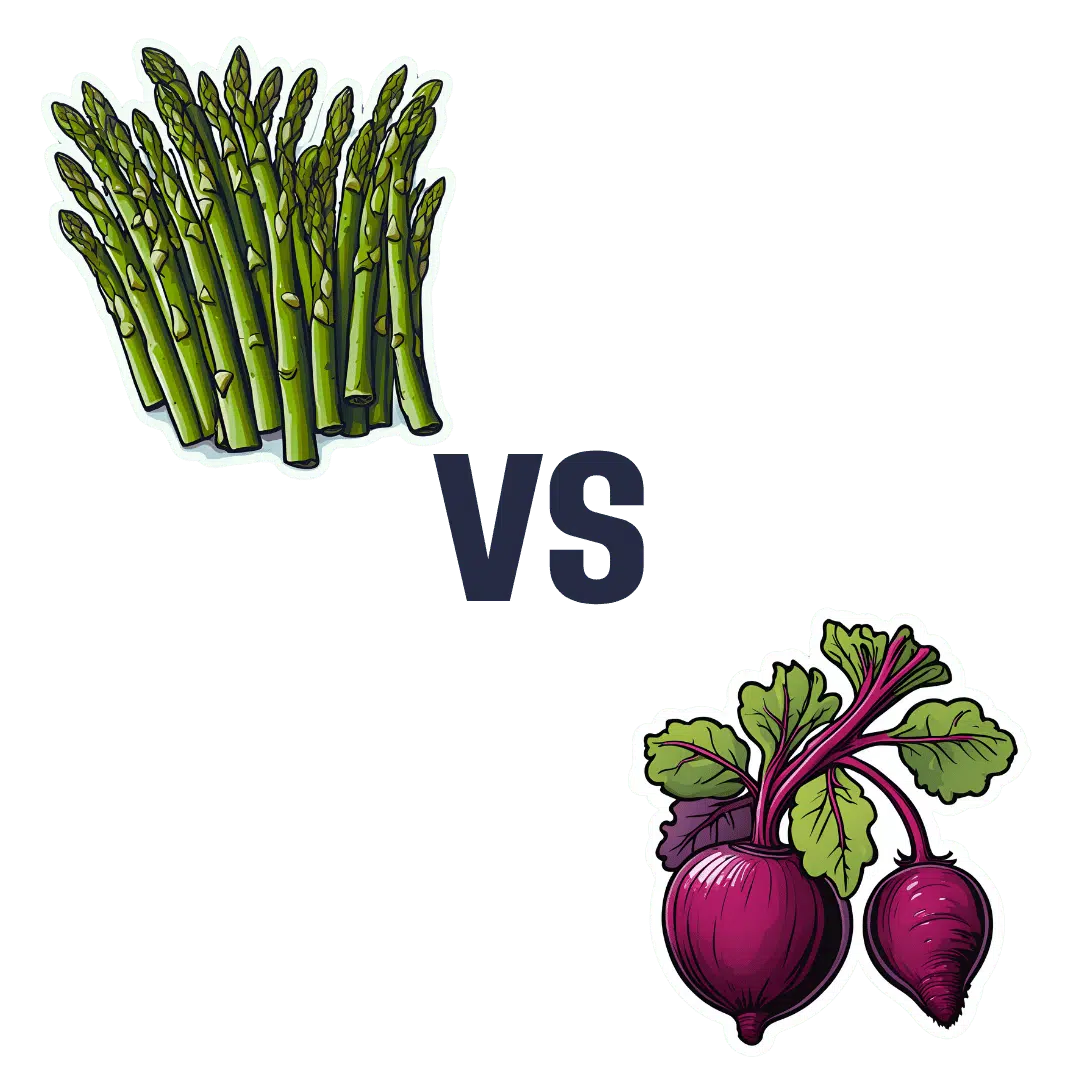
Asparagus vs Beetroot – Which is Healthier?
10almonds is reader-supported. We may, at no cost to you, receive a portion of sales if you purchase a product through a link in this article.
Our Verdict
When comparing asparagus to beetroot, we picked the asparagus.
Why?
Both are great! But one comes out better, on balance:
In terms of macros, asparagus has a little more protein, while beetroot has a little more fiber and 2x the carbs, but the numbers are all quite low, meaning doesn’t make much difference, so all in all, we’re calling this round a tie.
In the category of vitamins, however, asparagus has a lot more of vitamins A, B1, B2, B3, B5, B6, B7, C, E, and K, including 21x more vitamin K, of which it’s a very good source, while beetroot boasts only more vitamin B9. So, an overwhelming win for asparagus here.
Looking at minerals next, asparagus has more calcium, copper, iron, phosphorus, selenium, and zinc, while beetroot has more magnesium, manganese, and potassium, yielding a 6:3 win to asparagus in this round.
In other considerations, asparagus has more polyphenols, especially quercetin, while beetroot has betalains, especially betanin, and plenty of benefits therefrom (see the “learn more” link below). So we’ll call this round a tie.
Adding up the sections makes for a clear overall win for asparagus, but by all means enjoy either or both, as both have their strong merits, and diversity is good!
Want to learn more?
You might like:
- Fight Inflammation & Protect Your Brain, With Quercetin
- Beetroot For More Than Just Your Blood Pressure
Enjoy!
Don’t Forget…
Did you arrive here from our newsletter? Don’t forget to return to the email to continue learning!
Recommended
Learn to Age Gracefully
Join the 98k+ American women taking control of their health & aging with our 100% free (and fun!) daily emails:
-
Intermittent Fasting for Women Over 50 – by Emma Sanchez
10almonds is reader-supported. We may, at no cost to you, receive a portion of sales if you purchase a product through a link in this article.
Intermittent fasting is promoted as a very healthful (evidence-based!) way to trim the fat and slow aging, along with other health benefits. But, physiologically and especially metabolically, the average woman is quite different from the average man! And most resources are aimed at men. So, what’s the difference?
Emma Sanchez gives an overview not just of intermittent fasting, but also, how it goes with specifically female physiology. From hormonal cycles, to different body composition and fat distribution, to how we simply retain energy better—which can be a mixed blessing!
We’re given advice about how to optimize all those things and more.
She also covers issues that many writers on the topic of intermittent fasting will tend to shy away from, such as:
- mood swings
- risk of eating disorder
- impact on cognitive thinking
…and she does this evenly and fairly, making the case for intermittent fasting while acknowledging potential pitfalls that need to be recognized in order to be managed.
Lastly, the “over 50” thing. This is covered in detail quite late in the book, but there are a lot of changes that occur (beyond the obvious!), and once again, Sanchez has tips and tricks for holding back the clock where possible, and working with it rather than against it, when appropriate.
All in all, a great book for any woman over 50, or really also for women under 50, especially if that particular milestone is on the horizon.
Get your copy of Intermittent Fasting for Women over 50 from Amazon today!
Share This Post
-
How To Unchoke Yourself If You Are Dying Alone
10almonds is reader-supported. We may, at no cost to you, receive a portion of sales if you purchase a product through a link in this article.
The first things that most people think of, won’t work. This firefighter advises on how to actually do it:
Steps to take
Zero’th step: he doesn’t mention this, but try coughing first. You might think coughing will be a natural reaction anyway, but that tends only to happen automatically with small partial obstructions, not a complete blockage. Either way, try to cough forcefully to see if it dislodges whatever you’re choking on. If that doesn’t work…
Firstly: don’t rely on calling for help if you’re alone and cannot speak; you’re unlikely to be able to communicate and you will just waste time (when you don’t have time to waste). Even if you call emergency services and they trace your location, chances are that, at most, a cop car will show up some hours later to see what it was about. They will not dispatch an ambulance on the strength of “someone called and said nothing”.
Secondly, it is probable that will not be able to perform an abdominal thrust (also called Heimlich maneuvre in the US) on yourself the way you could on another person, and hitting your chest with your hand will produce insufficient force even if you’re quite strong. Nor are you likely to be able to slap yourself on the back to way you might another person.
Instead, he advises:
- Find a sturdy object: use a chair, table, countertop, or another firm surface that has an edge.
- Use gravity to perform self-Heimlich: position yourself with the edge of the object just below your sternum (he says ribcage, but the visuals show he clearly means the bottom of the sternum, where the diaphragm is, not the lower ribs). Fall onto the object forcefully to create pressure and dislodge the obstruction. This will not be fun.
- If it doesn’t work indoors: move to a visible outdoor location like your yard or a neighbor’s lawn. Falling visibly on the ground will likely alert someone to call for help.
While doing the above, remain as calm as possible, as this will not only increase the length of time you have before passing out, but will also help avoid your throat muscles tightening even more, worsening the choking.
After doing the above, seek medical attention now that you can communicate; you’ve probably broken some ribs and you might have organ damage.
For more on all this plus visual demonstrations, enjoy:
Click Here If The Embedded Video Doesn’t Load Automatically!
Want to learn more?
You might also like to read:
How To Survive A Heart Attack When You’re Alone ← very different advice for this scenario!
Take care!
Share This Post
-
When “Sleeping It Off” Helps, & When It Harms
10almonds is reader-supported. We may, at no cost to you, receive a portion of sales if you purchase a product through a link in this article.
At 10almonds, we’re often encouraging our readers to get more sleep, and especially in the context of the common myth that older people require less sleep; the reality is that sleeping less and not dying of it does not equate to needing less.
See also: Sleep: Yes, You Really Do Still Need It! and How Sleep-Deprived Are You, Really?
As well as ensuring to get in a good quantity of Zs, we also urge you to get good quality, too—see: The 6 Dimensions Of Sleep (And Why They Matter) ← duration is just one dimension out of the six!
Sleep & stress (or rather: stress & sleep)
❝Sleep that knits up the ravell’d sleave of care,
The death of each day’s life, sore labour’s bath,
Balm of hurt minds, great nature’s second course,
Chief nourisher in life’s feast.❞~ William Shakespeare (Macbeth, Act 2 Sc. 2)
It’s very reasonable that after stressful events have exhausted us, whatever their nature or cause, we will at some point crash (energywise), and want to sleep.
But watch out! Because that can turn out to be a bad idea, sometimes. More on that later.
First, let’s examine the situation before the sleep: stress can both disrupt and promote sleep; the outcome depends on stress type, context, and timing.
Sometimes, some kinds of stress will keep us at night and thus prevent us from getting restorative rest. That’s usually a bad thing. See: What’s Really Keeping You Awake? The Brain’s Role in Sleepless Nights ← in other words: when things might well be “all in your head”, and/but that’s the worst place for things to be when you’re trying to sleep
Sometimes, on the other hand, other types of stress (including psychological or purely physical stressors, such as emotional or immune issues, respectively) can lead to sleep that helps us to recover and build resilience. This isn’t a vague wishy-washy thing or a nod to the broadly restorative effect of sleep; it has to do with specific brain-things we can point to, in the ventral tegmental area (VTA) and lateral habenula; we’ll link to the science for this shortly.
Notably, stress-activated sleep-promoting neurons reduce anxiety, too; this has to do with GABA-signalling; see: A Neurotransmitter Less Talked-About: GABA Against Stress/Anxiety
Practical tip: it’s important to try to get good, healthy, complete sleep cycles in after stress, because both REM and non-REM sleep have important parts to play;
- Non-REM sleep: for physiological repair while autonomic nervous system activity is reduced
- REM sleep: for emotional processing and memory consolidation.
You can read all about these things here: Sleep and the recovery from stress ← whose short title belies the fact that it’s a very comprehensive review of many kinds of evidence from human and animal studies; we particularly recommend checking out figure 3 for a graphical representation, too
Now comes the “but watch out”….
The researchers note that improving sleep after stress (per CBT, sleep hygiene, etc) can reduce our vulnerability to anxiety, depression, or PTSD. They also note that poor sleep after stress can (and often will) worsen these conditions.
However, paradoxically: immediate sleep deprivation after trauma can reduce formation of traumatic memories—meaning that there is nuance to how we must go about this, as sometimes it can do more harm than good, when trying to “sleep it off” can effectively do the opposite, and engrain a traumatic experience permanently.
This goes for PTSD-inducing events of the kind that might come to mind when PTSD is mentioned, but it’s also another point in favor of the common marital advice to “never go to bed on an argument“, too. It’s better to process those kinds of things healthily before sleeping, rather than let your brain decide that you need a permanent easy-access record of such unpleasantries, to regularly replay it in your mind later—which is usually neither fun nor beneficial.
Learn more: How Your Brain Chooses What To Remember ← this is about the neurophysiology of sleep and memory consolidation
Want to learn more?
Here are some resources that might help with this, depending on your individual situation, of course:
- Ruminating (Bad) vs Processing (Good), & How To Tell The Difference
- How To Stop Revisiting Those Unwanted Memories ← a powerful tool to keep yourself from accessing certain memories accidentally
- The Off-Button For Your Brain (sometimes this is what’s needed, in the moment)
Take care!
Share This Post
Related Posts
-
Just one man survived the Air India crash. What’s it like to survive a mass disaster?
10almonds is reader-supported. We may, at no cost to you, receive a portion of sales if you purchase a product through a link in this article.
Viswashkumar Ramesh, a British citizen returning from a trip to India, has been confirmed as the only survivor of Thursday’s deadly Air India crash.
“I don’t know how I am alive,” Ramesh told family, according to his brother Nayan, in a video call moments after emerging from the wreckage. Another brother Ajay, seated elswhere on the plane, was killed.
The Boeing 787-7 Dreamliner crashed into a medical college less than a minute after taking off in the city of Ahmedabad, killing the other 229 passengers and 12 crew. At least five people were killed on the ground.
Surviving a mass disaster of this kind may be hailed as a kind of “miracle”. But what is it like to survive – especially as the only one?
Surviving a disaster
Past research has shown disaster survivors may experience an intense range of emotions, from grief and anxiety to feelings of loss and uncertainty.
These are common reactions to an extraordinary situation.
Some people may develop post-traumatic stress disorder (PTSD) and have difficulty adjusting to a new reality after bearing witness to immense loss. They may also be dealing with physical recovery from injuries sustained in the disaster.
Most people recover after disasters by drawing on their own strengths and the support of others. Recovery rates are high: generally less than one in ten of those affected by disasters develop chronic, long-term problems.
However, being a sole survivor of a mass casualty may have its own complex psychological challenges.
Survivor’s guilt
Survivors can experience guilt they lived when others died.
My friend, Gill Hicks, spoke to me for this article about the ongoing guilt she still feels, years after surviving the 2005 bombings of the London underground.
Lying trapped in a smoke-filled train carriage, she was the last living person to be rescued after the attack. Gill lost both her legs.
Yet she still wonders, “Why me? Why did I get to go home, when so many others didn’t?”
In the case of a sole survivor, this guilt may be particularly acute. However, research addressing the impact of sole survivorship is limited. Most research that looks at the psychological impact of disaster focuses on the impact of disasters more broadly.
Those interviewed for a 2013 documentary about surviving large plane crashes, Sole Survivor, express complex feelings – wanting to share their stories, but fearing being judged by others.
Being the lone survivor can be a heavy burden.
“I didn’t think I was worthy of the gift of being alive,” George Lamson Jr. told the documentary, after surviving a 1985 plane crash in Nevada that killed all others on board.
Looking for meaning
People who survive a disaster may also be under pressure to explain what happened and relive the trauma for the benefit of others.
Vishwashkumar Ramesh was filmed and interviewed by media in the minutes and hours following the Air India crash. But as he told his brother: “I have no idea how I exited the plane”.
It can be common for survivors themselves to be plagued by unanswerable questions. Did they live for a reason? Why did they live, when so many others died?
These kinds of unaswerable questions reflect our natural inclination to look for meaning in experiences, and to have our life stories make sense.
For some people, sharing a traumatic experience with others who’ve been through it or something similar can be a beneficial part of the recovery process, helping to process emotions and regain some agency and control.
However, this may not always be possible for sole survivors, potentially compounding feelings of guilt and isolation.
Coping with survivor guilt
Survivor guilt can be an expression of grief and loss.
Studies indicate guilt is notably widespread among individuals who have experienced traumatic events, and it is associated with heightened psychopathological symptoms (such as severe anxiety, insomnia or flashbacks) and thoughts of suicide.
Taking time to process the traumatic event can help survivors cope, and seeking support from friends, family and community or faith leaders can help an individual work through difficult feelings.
My friend Gill says the anxiety rises as the anniversary of the disaster approaches each year. Trauma reminders such as anniversaries are different to unexpected trauma triggers, but can still cause distress.
Media attention around collectively experienced dates can also amplify trauma-related distress, contributing to a cycle of media consumption and increased worry about future events.
On the 7th of July each year, Gill holds a private remembrance ritual. This allows her to express her grief and sense of loss, and to honour those who did not survive. These types of rituals can be a valuable tool in processing feelings of grief and guilt, offering a sense of control and meaning and facilitating the expression and acceptance of loss.
But lingering guilt and anxiety – especially when it interferes with day-to-day life – should not be ignored. Ongoing survivor guilt is associated with significantly higher levels of post-traumatic symptoms.
Survivors may need support from psychologists or mental health professionals in the short and long term.
Erin Smith, Associate Professor and Discipline Lead (Paramedicine), La Trobe University
This article is republished from The Conversation under a Creative Commons license. Read the original article.
Don’t Forget…
Did you arrive here from our newsletter? Don’t forget to return to the email to continue learning!
Learn to Age Gracefully
Join the 98k+ American women taking control of their health & aging with our 100% free (and fun!) daily emails:
-
Creamy Zucchini, Edamame, & Asparagus Linguine
10almonds is reader-supported. We may, at no cost to you, receive a portion of sales if you purchase a product through a link in this article.
Protein, fiber, and polyphenols are the dish of the day here:
You will need
- 1½ cups milk (your choice what kind; we recommend soy for its neutral taste, though hazelnut’s nutty flavor would also work in this recipe)
- 6 oz wholegrain linguine (or your pasta of choice)
- 2 zucchini, thinly sliced
- 5 oz edamame beans (frozen is fine)
- 5 oz asparagus tips, cut into 2″ lengths
- ½ bulb garlic, crushed
- 1 tbsp chia seeds
- 1 small handful arugula
- 1 small handful parsley, chopped
- A few mint leaves, chopped
- Juice of ½ lemon
- 2 tsp black pepper, coarse ground
- ½ tsp MSG or 1 tsp low-sodium salt
- Extra virgin olive oil
Method
(we suggest you read everything at least once before doing anything)
1) Heat some oil in a sauté pan or similar, over a low to medium heat. Add the zucchini and cook for 5 minutes until they start to soften.
2) Add the garlic and continue cooking for 1 minute, stirring gently.
3) Add the milk, bring to the boil, and add the past, chia seeds (the resistant starch from the pasta will help thicken the sauce, as will the chia seeds), and MSG or salt.
4) Reduce the heat, cover, and simmer for 8 minutes.
5) Add the edamame beans and asparagus, and cook for a further 2 minutes, or until the pasta is cooked but still firm to the bite. The sauce should be quite thick now.
6) Stir in the remaining ingredients and serve, adding a garnish if you wish.
Enjoy!
Want to learn more?
For those interested in some of the science of what we have going on today:
- The Many Health Benefits Of Garlic
- Black Pepper’s Impressive Anti-Cancer Arsenal (And More)
- If You’re Not Taking Chia, You’re Missing Out
Take care!
Don’t Forget…
Did you arrive here from our newsletter? Don’t forget to return to the email to continue learning!
Learn to Age Gracefully
Join the 98k+ American women taking control of their health & aging with our 100% free (and fun!) daily emails:
-
Mythbusting The Big O
10almonds is reader-supported. We may, at no cost to you, receive a portion of sales if you purchase a product through a link in this article.
“Early To Bed…”
In yesterday’s newsletter, we asked you for your (health-related) views on orgasms.
But what does the science say?
Orgasms are essential to good health: True or False?
False, in the most literal sense. One certainly won’t die without them. Anorgasmia (the inability to orgasm) is a condition that affects many postmenopausal women, some younger women, and some men. And importantly, it isn’t fatal—just generally considered unfortunate:
Anorgasmia Might Explain Why You’re Not Orgasming When You Want To
That article focuses on women; here’s a paper focusing on men:
Orgasms are good for the health, but marginally: True or False?
True! They have a wide array of benefits, depending on various factors (including, of course, one’s own sex). That said, the benefits are so marginal that we don’t have a flock of studies to cite, and are reduced to pop-science sources that verbally cite studies that are, alas, nowhere to be found, for example:
- For women: 9 Orgasm Benefits That Might Surprise You
- For men: 9 Ways Orgasms May Benefit Your Health
Doubtlessly the studies do exist, but are sparse enough that finding them is a nightmare as the keywords for them will bring up a lot of studies about orgasms and health that aren’t answering the above question (usually: health’s affect on orgasms, rather than the other way around).
There is some good science for post-menopausal women, though! Here it is:
Misconceptions About Sexual Health in Older Women
(if you have the time to read this, this also covers many very avoidable things that can disrupt sexual function, in ways that people will errantly chalk up to old age, not knowing that they are missing out needlessly)
Orgasms are good or bad, depending on being male or female: True or False
False, broadly. The health benefits are extant and marginal for almost everyone, as indicated above.
What’s that “almost” about, then?
There are a very few* people (usually men) for whom it doesn’t go well. In such cases, they have a chronic and lifelong problem whereby orgasm is followed by 2–7 days of flu-like and allergic symptoms. Little is known about it, but it appears to be some sort of autoimmune disorder.
Read more: Post-orgasmic illness syndrome: history and current perspectives
*It’s hard to say for sure how few though, as it is surely under-reported and thus under-diagnosed; likely even misdiagnosed if the patient doesn’t realize that orgasms are the trigger for such episodes, and the doctor doesn’t think to ask. Instead, they will be busy trying to eliminate foods from the diet, things like that, while missing this cause.
Orgasms are better avoided for optimal health: True or False?
Aside from the above, False. There is a common myth for men of health benefits of “semen retention”, but it is not based in science, just tradition. You can read a little about it here:
The short version is: do it if you want; don’t if you don’t; the body will compensate either way so it won’t make a meaningful difference to anything for most people, healthwise.
Small counterpoint: while withholding orgasm (and ejaculation) is not harmful to health, what does physiologically need draining sometimes is prostate fluid. But that can also be achieved mechanically through prostate milking, or left to fend for itself (as it will in nocturnal emissions, popularly called wet dreams). However, if you have problems with an enlarged prostate, it may not be a bad idea to take matters into your own hands, so to speak. As ever, do check with your doctor if you have (or think you may have) a condition that might affect this.
One final word…
We’re done with mythbusting for today, but we wanted to share this study that we came across (so to speak) while researching, as it’s very interesting:
On which note: if you haven’t already, consider getting a “magic wand” style vibe; you can thank us later (this writer’s opinion: everyone should have one!).
Top tip: do get the kind that plugs into the wall, not rechargeable. The plug-into-the-wall kind are more powerful, and last much longer (both “in the moment”, and in terms of how long the device itself lasts).
Enjoy!
Don’t Forget…
Did you arrive here from our newsletter? Don’t forget to return to the email to continue learning!
Learn to Age Gracefully
Join the 98k+ American women taking control of their health & aging with our 100% free (and fun!) daily emails:


