
First it was ‘protein goals’, now TikTok is on about ‘fibre goals’. How can you meet yours?
10almonds is reader-supported. We may, at no cost to you, receive a portion of sales if you purchase a product through a link in this article.
“Protein goals” have long been a thing on TikTok and Instagram. But now social media users are also talking about “fibre goals”. This reflects a positive broader shift toward overall health and wellbeing rather than a narrow focus on weight loss or muscle gain.
Foods high in fibre are among the healthiest we can eat. Not getting enough can lead to constipation, haemorrhoids and boost the risk of chronic diseases such as heart disease, type 2 diabetes, and bowel cancer.
So what’s the expert evidence say about “fibre goals” and how to hit them?
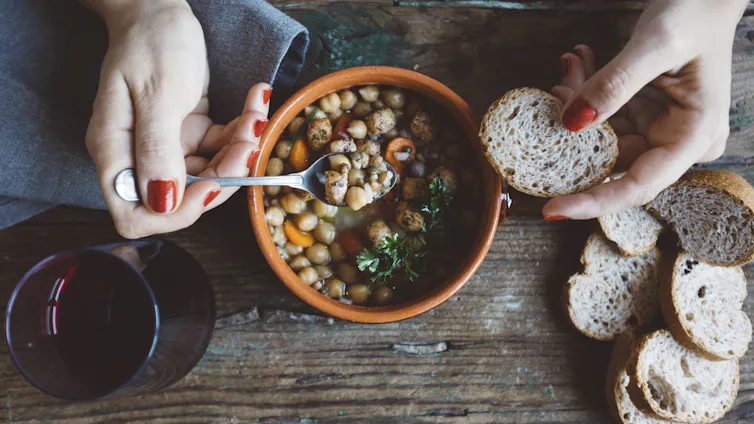
Different types of fibre
Dietary fibres are indigestible parts of plant foods. Unlike other carbohydrates that break down into sugar, these complex carbs pass through our digestive tract mostly unchanged.
There are two main types of dietary fibre:
Soluble fibres dissolve in water to form gel-like substances. You can find these in fruits such as apples and berries, vegetables such as sweet potatoes and carrots, as well a legumes and oats.
Soluble fibres can slow down digestion and help us feel fuller for longer. They support heart health, lower blood cholesterol and help regulate blood sugar levels.
Insoluble fibres don’t dissolve in water, but add bulk to food. You can get this type of fibre from wheat bran, fruits and vegetable skins, nuts and seeds, beans and whole grain foods.
Insoluble fibres add bulk to the stool and help regulate bowel movements and reduce constipation.
Resistant starch is also a type of complex carb that isn’t technically a fibre, but behaves like one; it resists digestion and feeds gut bacteria. These are found in legumes, cooked potato, and undercooked pasta.
Unlike many fibre supplements (which often only offer one type of fibre) most sources of fibre we eat contain both soluble and insoluble forms. For example, oats, apples and avocado have both.
Both soluble and insoluble fibre benefit our gut and overall health.
Both can be fermented by good gut bacteria, although soluble dietary fibres (and resistant starches) tend to ferment more readily.
Our gut bacteria rely on fermenting these fibres as a fuel to help digest foods, fight against pathogenic microbes such as germs and viruses, and improve physical and mental health.

What should my fibre goal should be?
Sadly, there’s no quick lab test to measure it.
A simple indicator is how well your digestion works. If you’re rarely constipated, you’re likely getting enough fibre.
The National Health and Medical Research Council recommends daily fibre intakes vary by age and gender.
But in general, adult men should have about 30 grams of fibre per day. Women should have about 25 grams.
There are many apps and websites to help you calculate your current fibre intake.
It’s hard to have too much dietary fibre; even eating 50g per day is not considered harmful.
How do I meet that goal without overthinking it?
Foods rich in fibre include:
- fruits
- vegetables
- nuts
- seeds
- legumes
- beans
- wholegrain or wholemeal breads and cereals.
Aim for variety in your diet, so you don’t get bored of the same foods.
The federal government’s Australian Dietary Guidelines suggest a daily intake of:
- two serves of medium-sized fruits
- five serves of vegetables (one serve is half a cup of cooked veggies or one cup of salad greens)
- two to three serves of nuts and seeds (where one serve is about 30g or a handful) or two to three serves of legumes/beans (where one serve is a cup of cooked beans, lentils, chickpeas, split peas).
What not to do
Here are some important things to remember:
- avoid drastic changes such as cutting out entire food groups or nutrients (such as carbohydrates) unless advised by your health practitioner. Even low-fibre food groups (such as dairy or lean meats) provide important nutrients. Avoiding them can potentially cause other health problems
- avoid focusing on just one type of fibre (soluble or insoluble). Each has different benefits, so incorporating both is best
- avoid a sudden increase in fibre. It can cause abdominal pain and increased flatulence. Start by adding just one or two high-fibre foods each day and slowly increase this over a few weeks
- fibre needs water to work effectively, so drink plenty of fluids. Aim for at least eight to ten glasses of water per day.
How do I hit my goal without being a weirdo about it?
Eating well doesn’t need to be a competition.
It’s great people are sharing ideas on social media about increasing fibre intake and setting fibre goals, but we can do it without constantly obsessing over food.
Focus on gradual changes and incorporating fibre-rich foods naturally into your diet. Start by eating more fresh fruit and vegetables, and adding legumes and pulses (such as kidney beans and chickpeas) to meals.
Simple switches can go a long way. For example, swap refined grain products (such as white rice or white bread) for wholemeal or wholegrain varieties. If you like breakfast cereals, choose one with at least 5g of fibre per serve (read the nutrition panel on the packet).
Finally, listen to your body. If you experience any digestive discomfort or have certain conditions, such as irritable bowel syndrome that requires managing your fibre intake, consult with a health-care professional.
Saman Khalesi, Senior Lecturer and Head of Course Nutrition, HealthWise Research Group Lead, Appleton Institute,, CQUniversity Australia; Chris Irwin, Senior Lecturer in Nutrition and Dietetics, School of Health Sciences & Social Work, Griffith University, and Seyed Farhang Jafari, PhD candidate of Public Health (Nutrition), CQUniversity Australia
This article is republished from The Conversation under a Creative Commons license. Read the original article.
Don’t Forget…
Did you arrive here from our newsletter? Don’t forget to return to the email to continue learning!
Recommended

Learn to Age Gracefully
Join the 98k+ American women taking control of their health & aging with our 100% free (and fun!) daily emails:
-
What is childhood dementia? And how could new research help?
10almonds is reader-supported. We may, at no cost to you, receive a portion of sales if you purchase a product through a link in this article.
“Childhood” and “dementia” are two words we wish we didn’t have to use together. But sadly, around 1,400 Australian children and young people live with currently untreatable childhood dementia.
Broadly speaking, childhood dementia is caused by any one of more than 100 rare genetic disorders. Although the causes differ from dementia acquired later in life, the progressive nature of the illness is the same.
Half of infants and children diagnosed with childhood dementia will not reach their tenth birthday, and most will die before turning 18.
Yet this devastating condition has lacked awareness, and importantly, the research attention needed to work towards treatments and a cure.
More about the causes
Most types of childhood dementia are caused by mutations (or mistakes) in our DNA. These mistakes lead to a range of rare genetic disorders, which in turn cause childhood dementia.
Two-thirds of childhood dementia disorders are caused by “inborn errors of metabolism”. This means the metabolic pathways involved in the breakdown of carbohydrates, lipids, fatty acids and proteins in the body fail.
As a result, nerve pathways fail to function, neurons (nerve cells that send messages around the body) die, and progressive cognitive decline occurs.
Childhood dementia is linked to rare genetic disorders. maxim ibragimov/Shutterstock What happens to children with childhood dementia?
Most children initially appear unaffected. But after a period of apparently normal development, children with childhood dementia progressively lose all previously acquired skills and abilities, such as talking, walking, learning, remembering and reasoning.
Childhood dementia also leads to significant changes in behaviour, such as aggression and hyperactivity. Severe sleep disturbance is common and vision and hearing can also be affected. Many children have seizures.
The age when symptoms start can vary, depending partly on the particular genetic disorder causing the dementia, but the average is around two years old. The symptoms are caused by significant, progressive brain damage.
Are there any treatments available?
Childhood dementia treatments currently under evaluation or approved are for a very limited number of disorders, and are only available in some parts of the world. These include gene replacement, gene-modified cell therapy and protein or enzyme replacement therapy. Enzyme replacement therapy is available in Australia for one form of childhood dementia. These therapies attempt to “fix” the problems causing the disease, and have shown promising results.
Other experimental therapies include ones that target faulty protein production or reduce inflammation in the brain.
Research attention is lacking
Death rates for Australian children with cancer nearly halved between 1997 and 2017 thanks to research that has enabled the development of multiple treatments. But over recent decades, nothing has changed for children with dementia.
In 2017–2023, research for childhood cancer received over four times more funding per patient compared to funding for childhood dementia. This is despite childhood dementia causing a similar number of deaths each year as childhood cancer.
The success for childhood cancer sufferers in recent decades demonstrates how adequately funding medical research can lead to improvements in patient outcomes.
Dementia is not just a disease of older people. Miljan Zivkovic/Shutterstock Another bottleneck for childhood dementia patients in Australia is the lack of access to clinical trials. An analysis published in March this year showed that in December 2023, only two clinical trials were recruiting patients with childhood dementia in Australia.
Worldwide however, 54 trials were recruiting, meaning Australian patients and their families are left watching patients in other parts of the world receive potentially lifesaving treatments, with no recourse themselves.
That said, we’ve seen a slowing in the establishment of clinical trials for childhood dementia across the world in recent years.
In addition, we know from consultation with families that current care and support systems are not meeting the needs of children with dementia and their families.
New research
Recently, we were awarded new funding for our research on childhood dementia. This will help us continue and expand studies that seek to develop lifesaving treatments.
More broadly, we need to see increased funding in Australia and around the world for research to develop and translate treatments for the broad spectrum of childhood dementia conditions.
Dr Kristina Elvidge, head of research at the Childhood Dementia Initiative, and Megan Maack, director and CEO, contributed to this article.
Kim Hemsley, Head, Childhood Dementia Research Group, Flinders Health and Medical Research Institute, College of Medicine and Public Health, Flinders University; Nicholas Smith, Head, Paediatric Neurodegenerative Diseases Research Group, University of Adelaide, and Siti Mubarokah, Research Associate, Childhood Dementia Research Group, Flinders Health and Medical Research Institute, College of Medicine and Public Health, Flinders University
This article is republished from The Conversation under a Creative Commons license. Read the original article.
Share This Post
-
The Doctor’s Kitchen – by Dr. Rupy Aujla
10almonds is reader-supported. We may, at no cost to you, receive a portion of sales if you purchase a product through a link in this article.
We’ve featured Dr. Aujla before as an expert-of-the-week, and now it’s time to review a book by him. What’s his deal, and what should you expect?
Dr. Aujla first outlines the case for food as medicine. Not just “eat nutritionally balanced meals”, but literally, “here are the medicinal properties of these plants”. Think of some of the herbs and spices we’ve featured in our Monday Research Reviews, and add in medicinal properties of cancer-fighting cruciferous vegetables, bananas with dopamine and dopamine precursors, berries full of polyphenols, hemp seeds that fight cognitive decline, and so forth.
Most of the book is given over to recipes. They’re plant-centric, but mostly not vegan. They’re consistent with the Mediterranean diet, but mostly Indian. They’re economically mindful (favoring cheap ingredients where reasonable) while giving a nod to where an extra dollar will elevate the meal. They don’t give calorie values etc—this is a feature not a bug, as Dr. Aujla is of the “positive dieting” camp that advocates for us to “count colors, not calories”. Which, we have to admit, makes for very stress-free cooking, too.
Dr. Aujla is himself an Indian Brit, by the way, which gives him two intersecting factors for having a taste for spices. If you don’t share that taste, just go easier on the pepper etc.
As for the medicinal properties we mentioned up top? Four pages of references at the back, for any who are curious to look up the science of them. We at 10almonds do love references!
Bottom line: if you like tasty food and you’re looking for a one-stop, well-rounded, food-as-medicine cookbook, this one is a top-tier choice.
Share This Post
-
Seriously Useful Communication Skills!
10almonds is reader-supported. We may, at no cost to you, receive a portion of sales if you purchase a product through a link in this article.
What Are Communication Skills, Really?
Superficially, communication is “conveying an idea to someone else”. But then again…
Superficially, painting is “covering some kind of surface in paint”, and yet, for some reason, the ceiling you painted at home is not regarded as equally “good painting skills” as Michaelangelo’s, with regard to the ceiling of the Sistine Chapel.
All kinds of “Dark Psychology” enthusiasts on YouTube, authors of “Office Machiavelli” handbooks, etc, tell us that good communication skills are really a matter of persuasive speaking (or writing). And let’s not even get started on “pick-up artist” guides. Bleugh.
Not to get too philosophical, but here at 10almonds, we think that having good communication skills means being able to communicate ideas simply and clearly, and in a way that will benefit as many people as possible.
The implications of this for education are obvious, but what of other situations?
Conflict Resolution
Whether at work or at home or amongst friends or out in public, conflict will happen at some point. Even the most well-intentioned and conscientious partners, family, friends, colleagues, will eventually tread on our toes—or we, on theirs. Often because of misunderstandings, so much precious time will be lost needlessly. It’s good for neither schedule nor soul.
So, how to fix those situations?
I’m OK; You’re OK
In the category of “bestselling books that should have been an article at most”, a top-tier candidate is Thomas Harris’s “I’m OK; You’re OK”.
The (very good) premise of this (rather padded) book is that when seeking to resolve a conflict or potential conflict, we should look for a win-win:
- I’m not OK; you’re not OK ❌
- For example: “Yes, I screwed up and did this bad thing, but you too do bad things all the time”
- I’m OK; you’re not OK ❌
- For example: “It is not I who screwed up; this is actually all your fault”
- I’m not OK; you’re OK ❌
- For example: “I screwed up and am utterly beyond redemption; you should immediately divorce/disown/dismiss/defenestrate me”
- I’m OK; you’re OK ✅
- For example: “I did do this thing which turned out to be incorrect; in my defence it was because you said xyz, but I can understand why you said that, because…” and generally finding a win-win outcome.
So far, so simple.
“I”-Messages
In a conflict, it’s easy to get caught up in “you did this, you did that”, often rushing to assumptions about intent or meaning. And, the closer we are to the person in question, the more emotionally charged, and the more likely we are to do this as a knee-jerk response.
“How could you treat me this way?!” if we are talking to our spouse in a heated moment, perhaps, or “How can you treat a customer this way?!” if it’s a worker at Home Depot.
But the reality is that almost certainly neither our spouse nor the worker wanted to upset us.
Going on the attack will merely put them on the defensive, and they may even launch their own counterattack. It’s not good for anyone.
Instead, what really happened? Express it starting with the word “I”, rather than immediately putting it on the other person. Often our emotions require a little interrogation before they’ll tell us the truth, but it may be something like:
“I expected x, so when you did/said y instead, I was confused and hurt/frustrated/angry/etc”
Bonus: if your partner also understands this kind of communication situation, so much the better! Dark psychology be damned, everything is best when everyone knows the playbook and everyone is seeking the best outcome for all sides.
The Most Powerful “I”-Message Of All
Statements that start with “I” will, unless you are rules-lawyering in bad faith, tend to be less aggressive and thus prompt less defensiveness. An important tool for the toolbox, is:
“I need…”
Softly spoken, firmly if necessary, but gentle. If you do not express your needs, how can you expect anyone to fulfil them? Be that person a partner or a retail worker or anyone else. Probably they want to end the conflict too, so throw them a life-ring and they will (if they can, and are at least halfway sensible) grab it.
- “I need an apology”
- “I need a moment to cool down”
- “I need a refund”
- “I need some reassurance about…” (and detail)
Help the other person to help you!
Everything’s best when it’s you (plural) vs the problem, rather than you (plural) vs each other.
Apology Checklist
Does anyone else remember being forced to write an insincere letter of apology as a child, and the literary disaster that probably followed? As adults, we (hopefully) apologize when and if we mean it, and we want our apology to convey that.
What follows will seem very formal, but honestly, we recommend it in personal life as much as professional. It’s a ten-step apology, and you will forget these steps, so we recommend to copy and paste them into a Notes app or something, because this is of immeasurable value.
It’s good not just for when you want to apologize, but also, for when it’s you who needs an apology and needs to feel it’s sincere. Give your partner (if applicable) a copy of the checklist too!
- Statement of apology—say “I’m sorry”
- Name the offense—say what you did wrong
- Take responsibility for the offense—understand your part in the problem
- Attempt to explain the offense (not to excuse it)—how did it happen and why
- Convey emotions; show remorse
- Address the emotions/damage to the other person—show that you understand or even ask them how it affected them
- Admit fault—understand that you got it wrong and like other human beings you make mistakes
- Promise to be better—let them realize you’re trying to change
- Tell them how you will try to do it different next time and finally
- Request acceptance of the apology
Note: just because you request acceptance of the apology doesn’t mean they must give it. Maybe they won’t, or maybe they need time first. If they’re playing from this same playbook, they might say “I need some time to process this first” or such.
Want to really superpower your relationship? Read this together with your partner:
Hold Me Tight: Seven Conversations for a Lifetime of Love, and, as a bonus:
The Hold Me Tight Workbook: A Couple’s Guide for a Lifetime of Love
Share This Post
- I’m not OK; you’re not OK ❌
Related Posts
-
Cannabis & Mental Health: Good Or Bad?
10almonds is reader-supported. We may, at no cost to you, receive a portion of sales if you purchase a product through a link in this article.
When it comes to readily-available non-prescription legal “downer” drugs (that is to say, drugs that promote relaxation rather than “uppers” that promote stimulation), the most popular are of course alcohol and cannabis.
We’ve written a lot more about alcohol than we have about cannabis—partly because there’s simply much more research available. While alcohol has been legal (and thus easy to research) throughout many wealthy nations for a long time, the “War on Drugs”—which did not at all reduce the use of drugs—really curtailed research for a long time, and now there’s a lot of catching-up to do.
As a result, we know that alcohol is very bad for pretty much everything, including mental health—in which category it promotes/worsens mood disorders, including depression, and while often used to self-medicate against stress/anxiety, its numbing effects are short-lived and soon give the user extra reasons to be stressed and/or anxious. And, of course, it’s addictive, which is not fabulous.
So, is cannabis better?
Let’s address the topic of addictiveness first. Contrary to popular belief, it is indeed possible to become addicted to cannabis, though the likelihood of developing a substance abuse disorder is lower than for alcohol, and much lower than for nicotine.
See: Prevalence of Marijuana Use Disorders in the United States Between 2001–2002 and 2012–2013
If you prefer just the stats without the science, here’s the CDC’s rendering of that:
Addiction (Marijuana or Cannabis Use Disorder)
However, there is an interesting complicating factor, which is age. One is 4–7 times more likely to develop a substance abuse disorder (any substance abuse disorder), if one starts use as an adolescent, rather than later as an adult:
So, if you’re in the older age group, that’s a point in favor of reduced risk.
Does cannabis increase psychiatric disease risk?
It depends. Is it occasional use, or regular? There is a difference between using it relax and unwind once in a while, and relying on it all the time.
In the US, A 2021 report from the National Survey on Drug Use and Health showed (if we extrapolate the data to a population level):
- 52,000,000 people reported cannabis use in the previous year, of whom,
- 16,300,000 met the criteria for cannabis use disorder in the previous year
So, we may assume that around 1 in 3 cannabis users meet the criteria for cannabis use disorder.
Curious about who qualifies? The DSM-5 defines cannabis use disorder as the presence of at least 2 of the following:
- Withdrawal symptoms when not using cannabis
- Cannabis is taken in larger amounts or used over a longer period than intended
- Persistent desire to cut down with unsuccessful attempts
- Excessive time spent acquiring cannabis, using cannabis, or recovering from its effects
- Cravings for cannabis use
- Recurrent use resulting in neglect of social obligations
- Continued use despite social or interpersonal problems
- Important social, occupational, or recreational activities foregone to be able to use cannabis
- Continued use despite physical harm
- Continued use despite physical or psychological problems associated with cannabis use
- Tolerance
Source: DSM-5 Criteria for Substance Use Disorders: Recommendations and Rationale
Now, with that in mind…
Researchers examined the genetic links between cannabis use, cannabis use disorder, and psychiatric conditions, and found:
- Cannabis use disorder showed strong associations with nearly all psychiatric disorders, while
- Cannabis use (not disorder) had much weaker associations, and/but showed significant links with openness and conscientiousness.
So, that’s quite a difference. But since this is a matter of genetic links (i.e. people with these genetic marks tend to have these matching traits), it’s not always immediately clear which way the causality goes, if any:
- Does the genetic marker promote cannabis use / cannabis use disorder / linked psychiatric condition(s)?
- Does the the cannabis use / cannabis use disorder cause the psychiatric condition?
- Does the psychiatric condition promote the cannabis use / cannabis use disorder?
Using a statistical technique called Mendelian randomization, some of the causality can be determined (depending on the data available, of course). Using this method, it can be known that:
- Cannabis use disorder has bidirectional causal links with psychiatric disorders, especially schizophrenia and related disorders, as well as ADHD, BPD, and PTSD.
- Major depressive disorder has the strongest reverse causal effect on cannabis use disorder. This means that people with major depressive disorder were more likely to go on to also develop cannabis use disorder.
- Cannabis use without disorder showed far fewer causal links—mostly just the non-causal links with the traits of openness and conscientiousness*.
*we might hypothesize that a person scoring highly (so to speak) on openness is more likely to try cannabis than those with lower scores on openness, and a person scoring highly (as it were) on conscientiousness is less likely to go on to develop a substance use disorder than someone with lower scores on same. However, the statistical modelling was not able to conclusively demonstrate this.
You can read the paper in full, here: The genetic relationship between cannabis use disorder, cannabis use and psychiatric disorders
Are there benefits?
The biggest benefit is “it’s a lot safer than alcohol” when one wants a way to relax and wind down, which means that it can indeed alleviate stress and anxiety—occasionally. If you’re using it all the time, however, then you may start running into the problems of feeling more stressed and anxious in its absence, of course.
Many use it for pain relief, and if that’s you, only you can judge whether the benefits outweigh the risks (and presumably you’ve concluded they do).
Many use it for sleep (indeed, it’s even sometimes prescribed for some sleep disorders), and we’ve written about that here: Sweet Dreams Are Made of THC (Or Are They?)
In the latter case, it’s worth bearing in mind that CBD alone (without THC) does seem to improve sleep (as discussed in the above-linked article), and has additional benefits too:
CBD Oil: What Does The Science Say?
Prefer a drug-free way to relax?
We recommend:
- No-Frills, Evidence-Based Mindfulness
- Meditation Games That You’ll Actually Enjoy
- Which Style Of Yoga Is Best For You?
- 7 Kinds Of Rest When Sleep Is Not Enough
- Better Sex = Longer Life (Here’s How)
Enjoy!
Don’t Forget…
Did you arrive here from our newsletter? Don’t forget to return to the email to continue learning!
Learn to Age Gracefully
Join the 98k+ American women taking control of their health & aging with our 100% free (and fun!) daily emails:
-
Childhood Vaccination Rates, a Rare Health Bright Spot in Struggling States, Are Slipping
10almonds is reader-supported. We may, at no cost to you, receive a portion of sales if you purchase a product through a link in this article.
Jen Fisher can do only so much to keep her son safe from the types of infections that children can encounter at school. The rest, she said, is up to other students and parents in their hometown of Franklin, Tennessee.
Fisher’s son Raleigh, 12, lives with a congenital heart condition, which has left him with a weakened immune system. For his protection, Raleigh has received all the recommended vaccines for a child his age. But even with his vaccinations, a virus that might only sideline another child could sicken him and land him in the emergency room, Fisher said.
“We want everyone to be vaccinated so that illnesses like measles and things that have basically been eradicated don’t come back,” Fisher said. “Those can certainly have a very adverse effect on Raleigh.”
For much of Raleigh’s life, Fisher could take comfort in the high childhood vaccination rate in Tennessee — a public health bright spot in a conservative state with poor health outcomes and one of the shortest life expectancies in the nation.
Mississippi and West Virginia, two similarly conservative states with poor health outcomes and short life expectancies, also have some of the highest vaccination rates for kindergartners in the nation — a seeming contradiction that stems from the fact that childhood vaccination requirements don’t always align with states’ other characteristics, said James Colgrove, a Columbia University professor who studies factors that influence public health.
“The kinds of policies that states have don’t map neatly on to ‘red’ versus ‘blue’ or one region or another,” Colgrove said.
Advocates, doctors, public health officials, and researchers worry such public health bright spots in some states are fading: Many states have recently reported an increase in people opting out of vaccines for their kids as Americans’ views shift.
During the 2023-24 school year, the percentage of kindergartners exempted from one or more vaccinations rose to 3.3%, the highest ever reported, with increases in 40 states and Washington, D.C., according to Centers for Disease Control and Prevention data. Tennessee and Mississippi were among those with increases. Nearly all exemptions nationally were for nonmedical reasons.
Vaccine proponents worry anti-vaccine messaging could accelerate a growing “health freedom” movement that has been pushed by leaders in states such as Florida. Momentum against vaccines is likely to continue to grow with the election of Donald Trump as president and his proposed nomination of anti-vaccine activist Robert F. Kennedy Jr. as secretary of the Department of Health and Human Services.
Pediatricians in states with high exemption rates, such as Florida and Georgia, say they’re concerned by what they see — declining immunization levels for kindergartners, which could lead to a resurgence in vaccine-preventable diseases such as measles. The Florida Department of Health reported nonmedical exemption rates as high as 50% for children in some areas.
“The religious exemption is huge,” said Brandon Chatani, a pediatric infectious disease doctor in Orlando. “That has allowed for an easy way for these kids to enter schools without vaccines.”
In many states, it’s easier to get a religious exemption than a medical one, which often requires signoff from a doctor.
Over the past decade, California, Connecticut, Maine, and New York have removed religious and philosophical exemptions from school vaccination requirements. West Virginia has not had them.
Idaho, Alaska, and Utah had the highest exemption rates for the 2023-24 school year, according to the CDC. Those states allow parents or legal guardians to exempt their children for religious reasons by submitting a notarized form or a signed statement.
Florida and Georgia, with some of the lowest reported minimum vaccination rates for kindergartners, allow parents to exempt their children by submitting a form with the child’s school or day care.
Both states have reported declines in uptake of the measles, mumps, and rubella vaccine, which is one of the most common childhood shots. In Georgia, MMR coverage for kindergartners dropped to 88.4% in the 2023-24 school year from 93.1% in 2019-20, according to the CDC. Florida dropped to 88.1% from 93.5% during the same period.
Andi Shane, a pediatric infectious disease specialist in Atlanta, traces Georgia’s declining rates to families who lack access to a pediatrician. State policies on exemptions are also key, she said.
“There’s lots of data to support the fact that when personal belief exemptions are not permitted, that vaccination rates are higher,” she said.
In December, Georgia public health officials put out an advisory saying the state had recorded significantly more whooping cough cases than in the prior year. According to CDC data, Georgia reported 280 cases in 2024 compared with 96 the year before.
Until 2023, Mississippi was one of the few states that allowed parents to opt out of vaccinating their kids only for medical reasons — and only with the approval of a doctor. That gave it among the highest vaccination rates in the nation as of the 2023-24 school year.
“It’s one of the few things Mississippi has done well,” said Anita Henderson, a pediatrician who has practiced in the southern part of the state for nearly 30 years. In terms of health, she said, childhood vaccination rates were the state’s one “shining star.”
But that changed in April 2023 when a federal judge ordered state officials to start allowing religious exemptions. The ruling has emboldened many families, Henderson said.
“We are seeing more and more skepticism, more and more vaccine hesitancy, and a lack of confidence because of this ruling,” she said.
State officials have granted more than 5,000 religious exemptions since the court order allowing them, according to the state health department. Daniel Edney, the state health officer, said most of the requests have come from “more affluent” residents in “pockets” of the state.
“Most people listen to the expert opinions of their pediatricians and family medicine doctors to stay on the vaccine schedule, because it’s what is best to protect their children,” he said.
West Virginia’s vaccine law — which hasn’t allowed nonmedical exemptions — also could soon change, Matthew Christiansen said in December before he resigned as the state’s health officer.
A bill that would have broadened exemptions made it through the legislature last year but was vetoed by outgoing Republican Gov. Jim Justice. The new governor, Republican Pat Morrisey, has been a vocal critic of vaccine mandates. And just a day after being inaugurated, he issued an executive order to propose provisions by Feb. 1 that could allow religious and conscientious exemptions.
“I want to send a message that if you have a religious belief, then we’re going to have an exception,” he said at a Jan. 14 press conference. “We’re not going to be the outlier.”
People asserting their personal freedoms to decline vaccines for their kids can ultimately curtail the ability of others to live full lives, Christiansen said. “Kids getting measles and mumps and polio and being paralyzed for their whole life is an impediment on personal freedom and autonomy for those kids,” he said.
Since the covid pandemic, anti-vaccine sentiment has been growing in Tennessee. One organization, Stand for Health Freedom, drafted a letter for constituents to send to their state lawmakers calling for the resignation of the medical director of Tennessee’s Vaccine-Preventable Diseases and Immunization Program. The group said she demonstrated a “lack of respect for the informed consent rights” of the people.
“They feel emboldened by the idea that this presidential administration seems to feel very strongly that a lot of these issues should be taken back to the states,” said Emily Delikat, director of Tennessee Families for Vaccines, a pro-vaccine group.
Ultimately, like many effective public health interventions, vaccines are a victim of their own success, said Henderson, the Mississippi pediatrician. Most people haven’t seen outbreaks of measles or polio, so they forget how dangerous the diseases are, she said.
“It may unfortunately take a resurgence of those diseases to raise awareness to the fact that these are dangerous, these are deadly, these are preventable,” she said. “I hope it doesn’t come to that.”
KFF Health News is a national newsroom that produces in-depth journalism about health issues and is one of the core operating programs at KFF—an independent source of health policy research, polling, and journalism. Learn more about KFF.
USE OUR CONTENT
This story can be republished for free (details).
KFF Health News is a national newsroom that produces in-depth journalism about health issues and is one of the core operating programs at KFF—an independent source of health policy research, polling, and journalism. Learn more about KFF.
Subscribe to KFF Health News’ free Morning Briefing.
This article first appeared on KFF Health News and is republished here under a Creative Commons license.
Don’t Forget…
Did you arrive here from our newsletter? Don’t forget to return to the email to continue learning!
Learn to Age Gracefully
Join the 98k+ American women taking control of their health & aging with our 100% free (and fun!) daily emails:
-
Digestive Wellness – by Dr. Elizabeth Lipski
10almonds is reader-supported. We may, at no cost to you, receive a portion of sales if you purchase a product through a link in this article.
First of all, beyond just digestive wellness, this book can help strengthen your arms. At 560 pages and several pounds of weight, this is a comprehensive tome, and covers a lot more than “eat a vegetable once in a while and maybe a probiotic”.
Dr. Lipski takes us on a tour through the digestive system, discussing all of the ins and outs in great detail—not just physically, but physiologically, taking a holistic approach to gut health, examining all aspects of “what affects what”.
Since gut health affects most other kinds of health, there’s a lot to cover there, and when it comes to input, she explains not only the default “these things are good/bad for gut health”, but also the many small impacts (often in and of themselves neutral in value) that can end up making a big difference to how we experience our health on a day-to-day basis.
As such, you can expect to learn a lot about many topics ranging from systemic health to acute pathologies, from thrush and dyspepsia to Behçet’s disease and ankylosing spondylitis.
The style is surprisingly readable for such a lot of science, often conversational in tone, and yet unafraid of diving into clinical topics in a way that’ll be comprehensible to the lay reader. As another point in its favor, it’s all well-referenced with 44 pages of bibliography.
Bottom line: this book can go into that category of books that get called “The Bible of…”, and in this case, it’s digestive wellness.
Click here to check out Digestive Wellness, and boost (almost?) every aspect of your health!
Don’t Forget…
Did you arrive here from our newsletter? Don’t forget to return to the email to continue learning!
Learn to Age Gracefully
Join the 98k+ American women taking control of their health & aging with our 100% free (and fun!) daily emails:


