

Cuddle therapy sounds like what we all need right now – but will it actually help?
10almonds is reader-supported. We may, at no cost to you, receive a portion of sales if you purchase a product through a link in this article.
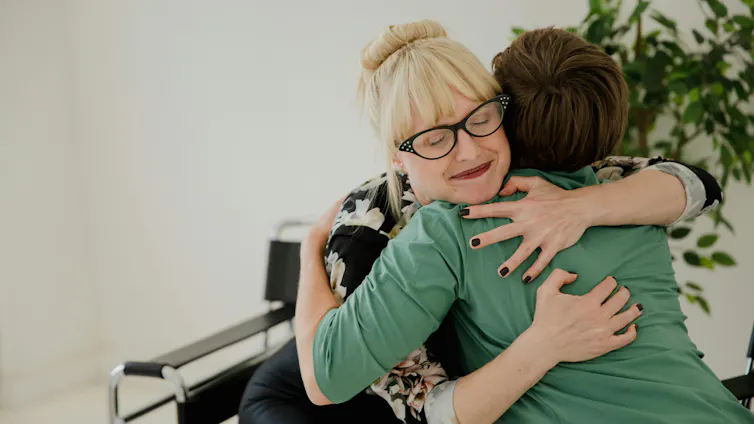
Cuddle therapy is having a moment. The idea for this emerging therapy is for you to book in a specified time with a “professional cuddler”.
Websites promote cuddle therapists as specialists in platonic touch, offering a service to people who wish to cuddle for friendship, to relax or manage emotional challenges.
The aim is to find connection and improve your mental health and wellbeing.
But does it actually work?
Here’s what you need to think about before booking in.
What is cuddle therapy?
Cuddle therapists offer consensual, non-sexual cuddles in a structured and safe environment, designed to be free from criticism, bias, conflict and any behaviour or conversation that may feel unsafe or threatening.
Cuddle therapists are not official or regulated professionals. There do not appear to be any accredited training programs or professional bodies that oversee and regulate cuddle therapy.
However, there are numerous people who promote themselves as professional cuddlers, and whose services are said to offer a range of psychological and physiological benefits.
These include reductions in depression, anxiety and loneliness, improvements in social skills and immune functioning, lowered blood pressure and a decreased risk of heart disease.
Providers suggest cuddle therapy can also lessen symptoms of post‑traumatic stress disorder, enhance a person’s capacity to recover from experiences of sexual or physical abuse, and reduce cravings associated with substance use.
Comforting claims, sparse science
Despite such claims, there do not appear to be any published peer‑reviewed studies that directly examine the psychological or physiological effects of engaging a professional cuddler.
There is, however, a broader body of research exploring the benefits of non‑sexual physical touch, including hugging and gentle, sustained contact.
Such touch has been associated with reductions in daily stress and improvements in overall wellbeing. Physical touch has also been identified as a way of conveying empathy, social bonding, and care.
Most of this research focuses on touch in close relationships – such as with partners, parents or friends – rather than touch delivered by a practitioner as part of a paid service. So, we don’t know if these findings translate to cuddle therapy.
There are however, known impacts of physical touch, including prompting the release of the hormone oxytocin. Oxytocin interacts with other neurochemicals, most notably dopamine, which supports feelings of comfort and connection.
Together, these neurochemical responses help explain why sustained touch can have a calming and soothing effect.
Professional cuddles need professional boundaries
Because cuddle therapy involves physical touch, emotional vulnerability and power dynamics between therapist and client, it raises a number of important ethical and professional issues.
1. Provide informed consent
If you’re thinking about cuddle therapy, ask what the service does and does not involve. Get a clear explanation about the boundaries of the service, where touch is and is not permitted, and the structure of the session.
You’ll need to provide explicit and informed consent before proceeding, and you can withdraw consent at any time.
2. Professional boundaries must be clear
A cuddle therapy relationship should remain professional at all times.
It is not OK for your cuddle therapist to express personal or romantic interest, or that the connection is becoming “special” or exclusive in ways that go beyond the agreed‑upon service.
Likewise, a practitioner should never pressure you to share personal information or disclose more than you are comfortable with.
Maintaining firm boundaries helps ensure the interaction remains safe, respectful and centred on your wellbeing rather than blurring into a personal relationship.
3. Watch you’re not becoming dependent
You may seek cuddle therapy because you are vulnerable, including but not limited to being lonely, depressed or in emotional pain. It is understandable that a touch‑based session may help you feel cared for, grounded or safe in the moment.
However, you should also watch for signs you are becoming dependent on a practitioner for emotional stability or comfort. This might include believing you can only feel calm, safe or OK after seeing that specific practitioner or wanting increasing contact or more cuddle therapy sessions.
4. It’s no cure for complex issues
Similarly, while cuddle therapy can offer temporary relief and a sense of connection, it is not designed to resolve underlying psychological issues or replace professional mental health care.
So cuddle therapy should be viewed as a supportive experience, but not a cure for broader or more complex emotional challenges.
Key takeaways
Taken together, cuddle therapy is an emerging practice centred on consensual, non‑sexual physical touch delivered in a structured environment. It’s promoted online as a way to reduce distress and enhance emotional wellbeing.
Cuddle therapy remains unregulated, with no formal training pathways or governing bodies overseeing professional standards. So service providers, rather than empirical evidence, largely shape public information about cuddle therapy.
Evidence suggests a range of benefits of physical touch. However, if you do pursue cuddle therapy you should ensure there are clear boundaries, you provide informed consent, and know you can withdraw that consent at any time.
Glen Hosking, Clinical Psychologist and Associate Professor of Psychology, La Trobe University
This article is republished from The Conversation under a Creative Commons license. Read the original article.
Don’t Forget…
Did you arrive here from our newsletter? Don’t forget to return to the email to continue learning!
Recommended
Learn to Age Gracefully
Join the 98k+ American women taking control of their health & aging with our 100% free (and fun!) daily emails:
-
The Simple Six – by Clinton Dobbins
10almonds is reader-supported. We may, at no cost to you, receive a portion of sales if you purchase a product through a link in this article.
We at 10almonds don’t believe in keeping things a mystery, so…
“The Simple Six” are:
- the squat
- the goblet squat
- the hinge
- the kettlebell swing
- the push
- the push-up
- the kettle-bell press
- the pull
- the chin-up
- the gait, and
- walking.
Ok, we’re being a little glib here because to be fair, those are chunked into six groups, but the point is: don’t let the title fool you into thinking the book could have been an article; there’s plenty of valuable content here.
That said, it is a short book (64 pages), but with an average of 10 pages per exercise type, it’s a lot more than for example we could ever put into our newsletter.
Bottom line: we know that 10almonds readers like simple, clear, evidence-based, to-the-point health information, and that’s what this book is, so we do recommend it.
Click here to check out The Simple Six, and streamline your workouts!
Share This Post
-
Bright Line Eating – by Dr. Susan Peirce Thompson
10almonds is reader-supported. We may, at no cost to you, receive a portion of sales if you purchase a product through a link in this article.
This is a great title! It’s a great book too, but let’s talk about the title for a moment:
The “Bright Line” referenced (often used in the plural within the book) is the line one draws between what one will and will not do. It’s a line one doesn’t cross, and it’s a bright line, because it’s not a case of “oh woe is me I cannot have the thing”, but rather “oh yay is me for I being joyously healthy”.
And as for living happy, thin, and free? The author makes clear that “thin” is only a laudable goal if it’s bookended by “happy” and “free”. Eating things because we want to, and being happy about our choices.
To this end, while some of the book is about nutrition (and for example the strong recommendation to make the first “bright lines” one draws cutting out sugar and flour), the majority of it is about the psychology of eating.
This includes, hunger and satiety, willpower and lack thereof, disordered eating and addictions, body image issues and social considerations, the works. She realizes and explains, that if being healthy were just a matter of the right diet plan, everyone would be healthy. But it’s not; our eating behaviors don’t exist in a vacuum, and there’s a lot more to consider.
Despite all the odds, however, this is a cheerful and uplifting book throughout, while dispensing very practical, well-evidenced methods for getting your brain to get your body to do what you want it to.
Bottom line: this isn’t your average diet book, and it’s not just a motivational pep talk either. It’s an enjoyable read that’s also full of science and can make a huge difference to how you see food.
Click here to check out Bright Line Eating, and enjoy life, healthily!
Share This Post
-
The Menopause Manifesto – by Dr. Jen Gunter
10almonds is reader-supported. We may, at no cost to you, receive a portion of sales if you purchase a product through a link in this article.
From the subtitle, you may wonder: with facts and feminism? Is this book about biology or sociology?
And the answer is: both. It’s about biology, principally, but without ignoring the context. We do indeed “live in a society”, and that affects everything from our healthcare options to what is expected of us as women.
So, as a warning: if you dislike science and/or feminism, you won’t like this book.
Dr. Jen Gunter, herself a gynaecologist, is here to arm us with science-based facts, to demystify an important part of life that is commonly glossed over.
She talks first about the what/why/when/how of menopause, and then delivers practical advice. She also talks about the many things we can (and can’t!) usefully do about symptoms we might not want, and how to look after our health overall in the context of menopause. We learn what natural remedies do or don’t work and/or can be actively harmful, and we learn the ins and outs of different hormone therapy options too.
Bottom line: no matter whether you are pre-, peri-, or post-menopausal, this is the no-BS guide you’ve been looking for. Same goes if you’re none of the above but spend any amount of time close to someone who is.
Share This Post
Related Posts
-
Why do some people need less sleep than others? A gene variation could have something to do with it
10almonds is reader-supported. We may, at no cost to you, receive a portion of sales if you purchase a product through a link in this article.
Have you ever noticed how some people bounce out of bed after just a few hours of sleep, while others can barely function without a solid eight hours?
Take Margaret Thatcher, for example. The former British prime minister was known for sleeping just four hours a night. She worked late, rose early, and seemed to thrive on little sleep.
But for most of us, that kind of sleep schedule would be disastrous. We’d be groggy, unfocused, and reaching for sugary snacks and caffeinated drinks by mid-morning.
So why do some people seem to need less sleep than others? It’s a question that’s fascinated scientists for years. Here’s what we know so far.
Maria Korneeva/Getty Images Natural short sleepers
There is a small group of people who don’t need much sleep. We call them natural short sleepers. They can function perfectly well on just four to six hours of sleep each night, often for their entire lives.
Generally they don’t feel tired, they don’t nap, and they don’t suffer the usual negative consequences of sleep deprivation. Scientists call this the natural short sleep phenotype – a biological trait that allows people to get all the benefits of sleep in less time.
In 2010 researchers discovered genetic mutations that help explain this phenomenon. Natural short sleepers carry rare variants in certain genes, which seem to make their sleep more efficient.
More recently, a 2025 study assessed a woman in her 70s with one of these rare mutations. Despite sleeping just six hours a night for most of her life, she remained physically healthy, mentally sharp, and led a full, active life. Her body, it seems, was simply wired to need less sleep.
We’re still learning about how common these genetic mutations are and why they occur.
Not everyone who sleeps less is a natural short sleeper
But here’s the catch: most people who think they’re natural short sleepers aren’t. They’re just chronically sleep-deprived. Often, their short sleep is due to long work hours, social commitments, or a belief sleeping less is a sign of strength or productivity.
In today’s hustle culture, it’s common to hear people boast about getting by on only a few hours of sleep. But for the average person, that’s not sustainable.
The effects of short sleep build up over time, creating what’s known as a “sleep debt”. This can lead to poor concentration, mood swings, micro-sleeps (brief lapses into sleep), reduced performance and even long-term health risks. For example, short sleep has been linked to an increased risk of obesity, diabetes, high blood pressure and cardiovascular disease (heart disease and stroke).
The weekend catch-up dilemma
To make up for lost sleep during the week, many people try to “catch up” on weekends.
This can help repay some of the sleep debt that has accumulated in the short term. Research suggests getting one to two extra hours of sleep on the weekend or taking naps when possible may help reduce the negative effects of short sleep.
However, it’s not a perfect fix. Weekend catch-up sleep and naps may not fully resolve sleep debt. The topic remains one of ongoing scientific debate.
A recent large study suggested weekend catch-up sleep may not offset the cardiovascular risks associated with chronic short sleep.
Catching up on sleep on the weekends may not fully resolve your ‘sleep debt’. Ground Picture/Shutterstock What’s more, large swings in sleep timing can disrupt your body’s internal clock, and sleeping in too much on weekends may make it harder to fall asleep on Sunday night, which can mean starting the working week less rested.
Increasing evidence indicates repeated cycles of irregular sleep may have an important influence on general health and the risk of early death, potentially even more so than how long we sleep for.
Ultimately, while moderate catch-up sleep might offer some benefits, it’s no substitute for consistent, high-quality sleep throughout the week. That said, maintaining such regularity can be particularly challenging for people with non-traditional schedules, such as shift workers.
So, was Thatcher a true natural short sleeper?
It’s hard to say. Some reports suggest she napped during the day in the back of a car between meetings. That could mean she was simply sleep-deprived and compensating for an accumulated sleep debt when she could.
Separate to whether someone is a natural short sleeper, there are a range of other reasons people may need more or less sleep than others. Factors such as age and underlying health conditions can significantly influence sleep requirements.
For example, older adults often experience changes in their circadian rhythms and are more likely to suffer from fragmented sleep due to conditions such as arthritis or cardiovascular disease.
Sleep needs vary from person to person, and while a lucky few can thrive on less, most of us need seven to nine hours a night to feel and function our best. If you’re regularly skimping on sleep and relying on weekends to catch up, it might be time to rethink your routine. After all, sleep isn’t a luxury – it’s a biological necessity.
Kelly Sansom, Research Associate, College of Medicine and Public Health, Flinders University; Research Associate, Centre for Healthy Ageing, Murdoch University and Peter Eastwood, Deputy Vice Chancellor, Research and Innovation, Murdoch University
This article is republished from The Conversation under a Creative Commons license. Read the original article.
Don’t Forget…
Did you arrive here from our newsletter? Don’t forget to return to the email to continue learning!
Learn to Age Gracefully
Join the 98k+ American women taking control of their health & aging with our 100% free (and fun!) daily emails:
-
Dealing With Hearing Loss
10almonds is reader-supported. We may, at no cost to you, receive a portion of sales if you purchase a product through a link in this article.
Hearing is important, not only for convenience, but also for cognitive health—as an inability to participate in what for most people is an important part of social life, has been shown to accelerate cognitive decline:
14 Powerful Strategies To Prevent Dementia ← one of them is looking after your hearing
To this end, we’ve written before about ways to retain (or at least slow the loss of) your hearing, here:
But, what if, despite our best efforts, your hearing is declining regardless, or is already impaired in some way?
Working with the hand we’ve been dealt
So, your hearing is bad and/or deteriorating. Assuming you’ve ruled out possibilities of fixing it, the next step is how to manage this new state of affairs.
One thing to seriously consider, sooner than you think you need to, is using hearing aids. This is because they will not only help you in the obvious practical way, but also, they will slow the associated decline of the parts of your brain that process the language you hear:
ACHIEVE study finds hearing aids cut cognitive decline by 48%
…and here’s the paper itself:
Furthermore, hearing aid use can significantly reduce all-cause mortality:
Your ears are not the only organs
Remember, today’s about dealing with hearing loss, not preventing it (for preventing it, see the second link we dropped up top).
With this in mind: do not underestimate the usefulness of learning to lipread.
Lipreading is not a panacea; it has its limitations:
- You can’t lipread an audio-only phonecall, or a podcast, or the radio
- You can’t lipread a video call if the video quality is poor
- You can’t lipread if someone is wearing a mask (as in many healthcare settings)
- You can’t lipread multiple people at once; you have to choose whose mouth to watch (or at least, you will miss the first word(s) each time while switching)
- You can’t lipread during sex if your/their face is somewhere else (may seem like a silly example, but actually communication can be important in sex, and the number of times this writer has had to say “Say again?” in intimate moments is ridiculous)
However, it can also make a huge difference the rest of the time, and can even be a superpower in times/places when other people’s hearing is nullified, such as a noisy environment, or a video call in which someone’s mic isn’t working.
The good news is, it’s really very easy to learn to lipread. There are many valid ways (often involving consciously memorizing mouth-shapes from charts, and then putting them together one by one to build a vocabulary), but this writer recommends a more organic, less effort-intensive approach:
- Choose a video of someone who speaks clearly, and for which video you already know what is being said (such as by using subtitles first, or a transcript, or perhaps the person is delivering a famous speech or reciting a poem that you know well, or it’s your favorite movie that you’ve watched many times).
- Now watch it with the sound off (assuming you do normally have some hearing; if you don’t, then you’re probably ahead of the game here) and just pay close attention to the lips. Do this on repeat; soon you’ll be able to “hear” the sounds as you see them made.
- Now choose a video of someone who speaks clearly, for which video you do not already know what is being said. You’ll probably only get parts of it at first; that’s ok.
- Now learn the rest of what they said in that video (by reading a transcript or such), and use it like you used the first video.
- Now repeat steps 3 and 4 until you are lipreading most people easily unless there is some clear obfuscation preventing you.
This process should not take long, as there are only about 44 phonemes (distinct sounds) in English, and once you’ve learned them, you’re set. If you speak more languages, those same 44 phonemes should cover most of most of them, but if not, just repeat the above process with the next language.
Remember, if you have at least some hearing, then most of the time your lipreading and your hearing are going to be working together, and neither will be as strong without the other—but if necessary, well-practised lipreading can indeed often stand in for hearing when hearing isn’t available.
A note on sign language:
Sign language is great, and cool, and useful. However, it’s only as useful as the people who know it, which means that it’s top-tier in the Deaf community (where people will dodge hearing-related cognitive decline entirely, because their social interaction is predominantly signed rather than spoken), and can be useful with close friends or family members who learn it (or at least learn some), but isn’t as useful in most of the wider world when people don’t know it. But if you do want to learn it, don’t let that hold you back—be the change you want to see!
Most of our readers are American, so here’s a good starting place for American Sign Language ← this is a list of mostly-free resources
Enjoy!
Don’t Forget…
Did you arrive here from our newsletter? Don’t forget to return to the email to continue learning!
Learn to Age Gracefully
Join the 98k+ American women taking control of their health & aging with our 100% free (and fun!) daily emails:
-
Water Fluoridation, Atheroma, & More
10almonds is reader-supported. We may, at no cost to you, receive a portion of sales if you purchase a product through a link in this article.
It’s Q&A Day at 10almonds!
Have a question or a request? You can always hit “reply” to any of our emails, or use the feedback widget at the bottom!
In cases where we’ve already covered something, we might link to what we wrote before, but will always be happy to revisit any of our topics again in the future too—there’s always more to say!
As ever: if the question/request can be answered briefly, we’ll do it here in our Q&A Thursday edition. If not, we’ll make a main feature of it shortly afterwards!
So, no question/request too big or small 😎
❝I watched a documentary recently on Fluoride in our drinking water & the dangers of it. Why are we poisoning our water?❞
This is a great question, and it certainly is controversial. It sounds like the documentary you watched was predominantly or entirely negative, but there’s a lot of science to back both sides of this, and it’s not even that the science is contradictory (it’s not). It’s that what differs is people’s opinions about whether benefiting one thing is worth creating a risk to another, and that means looking at:
- What is the risk associated with taking no action (error of omission)?
- What is the risk associated with taking an action (error of commission)?
The whole topic is worth a main feature, but to summarize a few key points:
- Water fluoridation is considered good for the prevention of dental cavities
- Water fluoridation aims to deliver fluoride and doses far below dangerous levels
- This requires working on consumer averages, though
- ”Where do we put the safety margins?” is to some extent a subjective question, in terms of trading off one aspect of health for another
- Too much fluoride can also be bad for the teeth (at least cosmetically, creating little white* spots)
- Detractors of fluoride tend to mostly be worried about neurological harm
- However, the doses in public water supplies are almost certainly far below the levels required to cause this harm.
- That said, again this is working on consumer averages, though.
- However, the doses in public water supplies are almost certainly far below the levels required to cause this harm.
- A good guide is: watch your teeth! Those white* spots will be “the canary in the coal mine” of more serious harm that could potentially come from higher levels due to overconsumption of fluorine.
*Teeth are not supposed to be pure white. The “Hollywood smile” is a lie. Teeth are supposed to be a slightly off-white, ivory color. Anything whiter than that is adding something else that shouldn’t be there, or stripping something off that should be there.
❝How does your diet change clean out your arteries of the bad cholesterol?❞
There’s good news and bad news here, and they can both be delivered with a one-word reply:
Slowly.
Or rather: what’s being cleaned out is mostly not the LDL (bad) cholesterol, but rather, the result of that.
When our diet is bad for cardiovascular health, our arteries get fatty deposits on their walls. Cholesterol gets stuck here too, but that’s not the main physical problem.
Our body’s natural defenses come into action and try to clean it up, but they (for example macrophages, a kind of white blood cell that consumes invaders and then dies, before being recycled by the next part of the system) often get stuck and become part of the buildup (called atheroma), which can lead to atherosclerosis and (if calcium levels are high) hardening of the arteries, which is the worst end of this.
This can then require medical attention, precisely because the body can’t remove it very well—especially if you are still maintaining a heart-unhealthy diet, thus continuing to add to the mess.
However, if it is not too bad yet, yes, a dietary change alone will reverse this process. Without new material being added to the arterial walls, the body’s continual process of rejuvenation will eventually fix it, given time (free from things making it worse) and resources.
In fact, your arteries can be one of the quickest places for your body to make something better or worse, because the blood is the means by which the body moves most things (good or bad) around the body.
All the more reason to take extra care of it, since everything else depends on it!
You might also like our previous main feature:
Don’t Forget…
Did you arrive here from our newsletter? Don’t forget to return to the email to continue learning!
Learn to Age Gracefully
Join the 98k+ American women taking control of their health & aging with our 100% free (and fun!) daily emails:


