
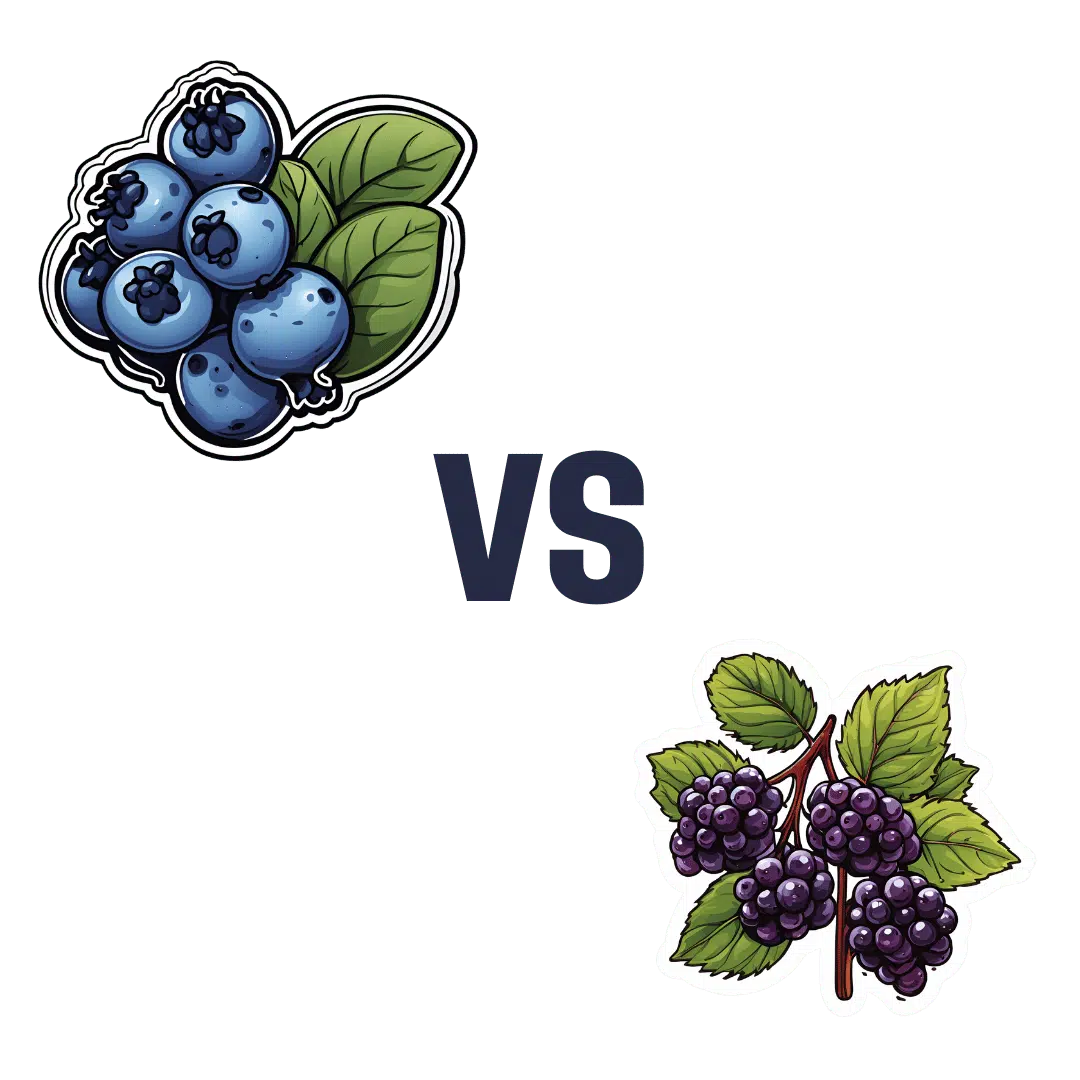
Blueberries vs Elderberries – Which is Healthier?

10almonds is reader-supported. We may, at no cost to you, receive a portion of sales if you purchase a product through a link in this article.

Our Verdict

When comparing blueberries to elderberries, we picked the elderberries.

Why?

Both are certainly top-tier fruits! But…

In terms of macros, elderberries have more than 2x the fiber, while the two berries are approximately equal on other macros. An easy win for elderberries in this category.

In the category of vitamins, blueberries have more of vitamins E, K, and choline, while elderberries have more of vitamins A, B1, B2, B3, B5, B6, B7, B9, and C, scoring another win for elderberries here.

When it comes to minerals, blueberries have more magnesium, manganese, and zinc, while elderberries have more calcium, copper, iron, phosphorus, potassium, and selenium—one more win for elderberries.

In terms of phytochemicals, both berries are (like most berries) an abundant source of polyphenols, but elderberries have more, including more quercetin, too.

Adding up the sections makes for a convincing win for elderberries, but by all means enjoy either or both; diversity is good!

Want to learn more?

You might like:

Herbs For Evidence-Based Health & Healing ← elderberry significantly hastens recovery from upper respiratory viral infections 😎

Enjoy!

Don’t Forget…

Did you arrive here from our newsletter? Don’t forget to return to the email to continue learning!
Learn to Age Gracefully

Join the 98k+ American women taking control of their health & aging with our 100% free (and fun!) daily emails:

  • The Worst Way to Wake Up (and What to Do Instead)

    10almonds is reader-supported. We may, at no cost to you, receive a portion of sales if you purchase a product through a link in this article.

    Not everyone is naturally inclined to be a morning person, but there are things we can do to make things go more easily for our brains!

    Cause for alarm?

    Dr. Tracey Marks, psychiatrist, explains the impact of our first moments upon awakening, and what that can do to/for us in terms of sleep inertia (i.e. grogginess).

    Sleep inertia is worse when waking from deep sleep—and notably, we don’t naturally wake directly from deep sleep unless we are externally aroused (e.g. by an alarm clock).

    Dr. Marks suggests the use of more gradual alarms, including those with soft melodies, perhaps birdsong or other similarly gentle things (artificial sunlight alarms are also good), to ease our transition from sleeping to waking. It might take us a few minutes longer to be woken from sleep, but we’re not going to spend the next hour in a bleary-eyed stupor.

    For more details on these things and more (including why not to hit “snooze”), enjoy:

    Click Here If The Embedded Video Doesn’t Load Automatically!

    Want to learn more?

    You might also like to read:

    Take care!

    Share This Post

  • This Chair Rocks: A Manifesto Against Ageism – by Ashton Applewhite

    10almonds is reader-supported. We may, at no cost to you, receive a portion of sales if you purchase a product through a link in this article.

    It’s easy to think of ageism as being 80% “nobody will hire me because I am three years away from standard retirement age”, but it’s a lot more pervasive than that. And some of it, perhaps the most insidious, is the ageism that we can sometimes internalize without thinking it through.

    10almonds readers love to avoid/reverse aging (and this reviewer is no different!), but it’s good once in a while to consider our priorities and motivations, for example:

    • There is merit in being able to live without disability or discomfort
    • There is harm in feeling a need to pass for younger than we are

    And yet, even things such as disabilities are, Applewhite fairly argues, not to be feared. Absolutely avoided if reasonably possible of course, yes, but if they happen they happen and it’s good that we be able to make our peace with that, because most people have at least some kind of disability before the end, and can still strive to make the most of the precious gift that is life. The goal can and should be to play the hand we’re dealt and to live as well as we can—whatever that latter means for us personally.

    Many people’s life satisfaction goes up in later years, and Applewhite hypothesizes that while some of that can be put down to circumstances (often no longer overwhelmed with work etc, often more financially stable), a lot is a matter of having come to terms with “losing” youth and no longer having that fear. Thus, a new, freer age of life begins.

    The book does cover many other areas too, more than we can list here (but for example: ranging from pro/con brain differences to sex and intimacy), and the idea that long life is a team sport, and that we should not fall into the all-American trap of putting independence on a pedestal. Reports of how aging works with close-knit communities in the supercentenarian Blue Zones can be considered to quash this quite nicely, for instance.

    The style is casual and entertaining, and yet peppered with scholarly citations, which stack up to 30 pages of references at the back.

    Bottom line: getting older is a privilege that not everyone gets to have, so who are we to squander it? This book shares a vital sense of perspective, and is a call-to-arms for us all to do better, together.

    Click here to check out This Chair Rocks, and indeed rock it!

    Share This Post

  • Kale vs Watercress – Which is Healthier?

    10almonds is reader-supported. We may, at no cost to you, receive a portion of sales if you purchase a product through a link in this article.

    Our Verdict

    When comparing kale to watercress, we picked the kale.

    Why?

    It wasn’t close:

    In terms of macros, kale has 7x the fiber, 6x the carbs, and 2x the protein, winning the first round easily.

    In the category of vitamins, kale has more of vitamins B1, B2, B3, B5, B6, B7, B9, C, E, and K, while watercress has more vitamin B5, that is to say, the vitamin that’s in almost all foods and which it’s nearly impossible to be deficient in unless literally starving to death. A very one-sided win for kale in this second round.

    Looking at minerals next, kale has more calcium, copper, iron, magnesium, manganese, phosphorus, potassium, and zinc, while watercress is not higher in any minerals. Another overwhelming win for kale.

    In other considerations, kale is also much higher in polyphenols, especially kaempferol and quercetin, so that’s another win for kale.

    Adding up the sections is not difficult arithmetic today; it’s a very clear overall win for kale, but still, by all means do enjoy either or both, as diversity is best!

    Want to learn more?

    You might like:

    Enjoy!

    Share This Post

  • What Happens To Your Body When You Do Squats Every Day-Not Just For Legs!

    10almonds is reader-supported. We may, at no cost to you, receive a portion of sales if you purchase a product through a link in this article.

    Squat Every Day? Yes, Please!

    It’s back to basics with this video (below). Passion for Health’s video, “What Happens To Your Body When You Do Squats Every Day-Not Just For Legs!” really brings home how squats aren’t just a one-trick pony for your legs.

    The humble bodyweight squat is shown to contribute to everything from bolstering all-around lower body strength to bettering bone density and increasing metabolism.

    Indeed, squats are so powerful that we reviewed a whole book that focuses just on the topic of squatting. Other, broader books on exercise also focus on the positive impacts that squatting can make.

    A proper squat goes beyond your legs, engaging your core, enhancing joint health, and, some argue, can lead to improved balance and circulation.

    (Plus, they’re easy to execute, given they can be done anywhere, without any equipment).

    This is probably why Luigi Fontana and Dr Rangan Chatterjee have spoken about the benefits of squatting.

    How Should We Start?

    The video goes beyond the ‘why’ and delves into the ‘how’, offering step-by-step squatting techniques.

    It answers the burning question: should you really be doing squats every day? 

    (Hint: the answer is most likely “yes”).

    Of course, some of us may not be able to squat, and for those, we’ll feature alternatives in a future article.

    For beginners, the advice is to start slow, aiming for 10 repetitions. You can gradually increase that count as you feel your muscles strengthen. Experienced gym-goers might push for 20 or more reps, adding variations like jump squats for an extra challenge.

    The key takeaway is to listen to your body and ensure rest days for muscle recovery.

    At the end of the day, Passion for Health’s video is a treasure trove for squat lovers, from novices to the seasoned, and insists on the importance of form, frequency, and listening to one’s body.

    How did you find that video? If you’ve discovered any great videos yourself that you’d like to share with fellow 10almonds readers, then please do email them to us!

    Don’t Forget…

    Did you arrive here from our newsletter? Don’t forget to return to the email to continue learning!

    Learn to Age Gracefully

    Join the 98k+ American women taking control of their health & aging with our 100% free (and fun!) daily emails:

  • After 50, These 3 Habits Slow Aging The Most

    10almonds is reader-supported. We may, at no cost to you, receive a portion of sales if you purchase a product through a link in this article.

    Will Harlow, the over-50s specialist physio, advises:

    The Big Three

    It doesn’t take a lot of time per week:

    1) Resistance training (2–3 sessions per week): builds strength and muscle, which lowers risk of cancer, diabetes, and heart disease. Just two 20-minute routines per week are enough. Example routine: Monday (push): goblet sit-to-stand, chair press, shoulder press; Thursday (pull): Romanian deadlift, dumbbell row, reverse lunge. Do 10–20 reps per exercise, 3 sets each, 1–2 minutes rest, and increase reps or resistance gradually.

    2) Mobility work (10 minutes every morning): reduces pain, stiffness, and improves movement. Suggested bed-friendly routine: ankle pumps (2 min), hip flexion (1 min per side), knee rolls (2 min), book opener (1 min per side), assisted shoulder flexion (1 min per side).

    3) Walking (increase steps or pace gradually): health and longevity benefits rise after about 6,000 daily steps, with diminishing returns past 12,000. Walking speed may be as important as step count. Track baseline for 2 weeks, then increase either steps or speed by a little each month.

    For more on all of this plus visual demonstrations of exercises, enjoy:

    Click Here If The Embedded Video Doesn’t Load Automatically!

    Want to learn more?

    You might also like:

    These Top Few Things Make The Biggest Difference To Health ← on a different level, as “exercise” is one of the 5 things listed

    Take care!

    Don’t Forget…

    Did you arrive here from our newsletter? Don’t forget to return to the email to continue learning!

    Learn to Age Gracefully

    Join the 98k+ American women taking control of their health & aging with our 100% free (and fun!) daily emails:

  • Alcohol vs THC

    10almonds is reader-supported. We may, at no cost to you, receive a portion of sales if you purchase a product through a link in this article.

    It’s Q&A Day at 10almonds!

    Have a question or a request? We love to hear from you!

    In cases where we’ve already covered something, we might link to what we wrote before, but will always be happy to revisit any of our topics again in the future too—there’s always more to say!

    As ever: if the question/request can be answered briefly, we’ll do it here in our Q&A Thursday edition. If not, we’ll make a main feature of it shortly afterwards!

    So, no question/request too big or small 😎

    ❝Can you do the pros and cons of thc vs alcohol?❞

    We can!

    First let’s note: this is certainly a case of “the lesser evil”, as both come with health risks.

    As for the benefits, for both the main reason people take them is for relaxation—or to frame it the other way around: for relief from stress, anxiety, or other psychological woes. In more overt cases of self-medication, it can be in pursuit of alleviating physical pain.

    Taking the “pros” in isolation, it’s reasonable to say that THC is, for most people, the winner. Enjoying the positive effects requires much smaller doses than alcohol, as it’s much more potent, mg for mg.

    It’s also worth noting that for some people (such as those in great pain), it may well be that the benefits subjectively outweigh the risks, and in a subset of those people (such as those with terminal illness and a life expectancy being measured in weeks or days), the benefits may outweigh any risks.

    Writer’s anecdote: once upon a very long time ago, my grandfather was dying—in hospital, and the prognosis was “it’s going to be today or maybe tomorrow”. He (a lifelong lover of Scotch whisky) wanted a Scotch; the hospital staff forbade it. There is a kind of logic there—if it made him sick, they could be blamed for making his last hours miserable and I’m sure they imagined headlines of being blamed for making a dying man sick with strong alcohol. Nevertheless, some Scotch was smuggled in for him by a member of his family. Was he fine? Well, no, he died. But that was already expected, and respecting his choice was deemed more important by the family. Was it the right choice? Who’s to say? But it was certainly an understandable, and contextually rational one, in a “what’s the worst that can happen” setting.

    All this to say, for some people the pros may subjectively outweigh any potential cons.

    See also: Science-Based Alternative Pain Relief: When Painkillers Aren’t Helping, These Things Might

    The other “pros” of THC are more a matter of “it’s less bad than alcohol”, so let’s look at the cons:

    The lesser evil?

    There is a wealth of scientific evidence that alcohol is very bad for pretty much everything. Yes, even for heart health, yes, even the famous “small glass of red”: Can We Drink To Good Health?

    For how that myth got started, see French biochemist Jessie Inchauspé’s explanation: Are You Making This Alcohol Mistake?

    Alcohol also increases all-cause mortality at any dose (even “low-risk drinking”): Alcohol Consumption Patterns and Mortality Among Older Adults

    …and the World Health Organization has declared that the only safe amount of alcohol is zero: WHO: No level of alcohol consumption is safe for our health

    But what of alcohol and cancer? According to the American Association of Cancer Research’s latest report, more than half of Americans do not know that alcohol increases the risk of cancer, which you can read more about here: How Much Alcohol Does It Take To Increase Cancer Risk?

    Meanwhile, there is a paucity of high-quality evidence for THC (good or bad). That’s not to say that the science hasn’t been done at all, but it is to say that while decades of “the war on drugs” might have done nothing to curtail drug use, the illegality of such in many places (especially the US) really slowed down scientific research to a crawl. So, we have to make do with much weaker evidence, and a lot of unanswered questions.

    One thing we can say is that the risk of developing a substance use disorder is much lower for THC than for alcohol:

    See: Prevalence of Marijuana Use Disorders in the United States Between 2001–2002 and 2012–2013

    If you prefer just the stats without the science, here’s the CDC’s rendering of that: Addiction (Marijuana or Cannabis Use Disorder)

    So, that’s a point in THC’s favor.

    What about heart health? Both substances are popularly considered relaxing, and as such, by “common sense”, good for the heart. We’ve shown above how the opposite is true in the case of alcohol, so how does THC stack up?

    We discussed, a little while back, new research that showed that cannabis users have a higher risk of heart attacks, even among younger and otherwise healthy individuals. This is based on analyzing data from 4,636,628 relatively healthy adults.

    Specifically, the data showed that even young healthy cannabis users get:

    • Sixfold increased risk of heart attack
    • Fourfold increased risk of ischemic stroke
    • Threefold increased risk of cardiovascular death, heart attack, or stroke

    There’s nuance to this (and none of it is favor of cannabis), and you can read about that here: Cannabis & Heart Attacks

    Nevertheless, those numbers are worse than the numbers for alcohol, so that’s a point in alcohol’s favor.

    How about brain health? Well, neither are fabulous in the long-run, but putting them head-to-head in this category is essentially a matter of “it destroys neurons” (alcohol) vs “cannabis use disorder can cause problems especially if for example someone is already prone to psychosis, but occasional use is not* significantly associated with such problems” (THC).

    *On a big data level, anyway. Of course anything can happen for an individual, and science rarely speaks in absolutes in this regard.

    Learn more about each of these: How Does Alcohol Cause Blackouts? vs Cannabis & Mental Health: Good Or Bad?

    So that’s another point in THC’s favor.

    How do they compare for sleep disruption? Since both are used by many people to help get to sleep, but both disrupt the quality of that sleep once there, this can be an important consideration.

    The short version is: alcohol is bad for all aspects of sleep, while THC increases delta-wave deep sleep (restorative rest), but does this at the cost of REM sleep: Sweet Dreams Are Made of THC (Or Are They?)

    So, given that’s “all bad” for alcohol and “mixed bag” for THC, we’re going to say THC wins on this one.

    Yes, there’s a lesser evil:

    On balance, this means that for most people, THC has somewhat more potent benefits, and relatively fewer/lesser risks, than alcohol.

    If you’d like to quit alcohol, check out: How To Reduce Or Quit Alcohol

    If you’d like a reassuring timeline of how long it takes for various body parts/systems to recover from alcohol, see: What Happens To Your Body When You Stop Drinking Alcohol

    Finally, before you take up the use of THC, if you haven’t already, you might want to swing by: Cannabis Myths vs Reality

    …for some important considerations not covered above as they didn’t change the head-to-head comparison.

    Take care!

    Don’t Forget…

    Did you arrive here from our newsletter? Don’t forget to return to the email to continue learning!

    Learn to Age Gracefully

    Join the 98k+ American women taking control of their health & aging with our 100% free (and fun!) daily emails: