
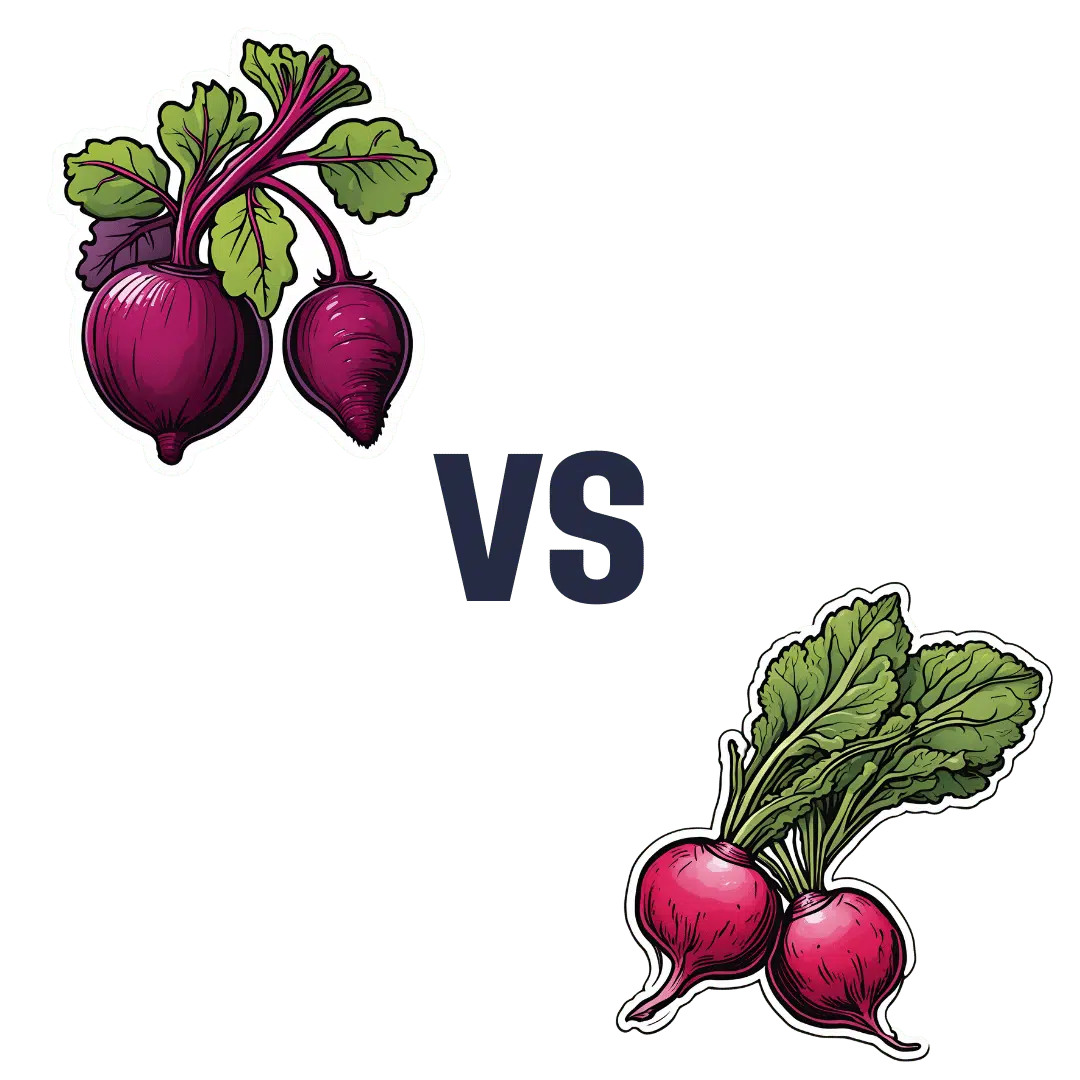
Beetroot vs Radish – Which is Healthier?
10almonds is reader-supported. We may, at no cost to you, receive a portion of sales if you purchase a product through a link in this article.
Our Verdict
When comparing beetroot to radish, we picked the beetroot.
Why?
In terms of macros, beetroot has more fiber, carbs, and protein, making it the more nutrient-dense option in this category.
In the category of vitamins, beetroot has more of vitamins A, B1, B2, B3, B5, B6, B7, B9, and E, while radishes have more of vitamins C and K, giving beetroot a 9:2 victory here.
Looking at minerals, beetroot has more copper, iron, magnesium, manganese, phosphorus, potassium, selenium, and zinc, while radishes have more calcium. An easy 8:1 win for beetroot in this round.
In other considerations, beetroot has many important phytochemical benefits, mostly from its betalain content and especially betanin, while radishes can’t boast much in the phytochemical category.
You may be thinking: but what about radishes’ shiny red bit? Doesn’t that usually mean more of something important, like carotenoids or anthocyanins or something? And the answer is that the red pigment in radishes is so thinly-distributed on the exterior that it’s barely there and if we’re looking at values per 100g, it’s a tiny fraction of a tiny fraction.
Adding up the sections makes for a clear overall win for beetroot, but by all means enjoy either or both, as diversity is good!
Want to learn more?
You might like:
Beetroot For More Than Just Your Blood Pressure
Enjoy!
Don’t Forget…
Did you arrive here from our newsletter? Don’t forget to return to the email to continue learning!
Recommended
Learn to Age Gracefully
Join the 98k+ American women taking control of their health & aging with our 100% free (and fun!) daily emails:
-
Capsaicin For Weight Loss And Against Inflammation
10almonds is reader-supported. We may, at no cost to you, receive a portion of sales if you purchase a product through a link in this article.
Capsaicin’s Hot Benefits
Capsaicin, the compound in hot peppers that makes them spicy, is a chemical irritant and a neurotoxin. However, humans being humans, we decided to eat them for fun.
In contrast to many other ways in which humans recreationally enjoy things that are objectively poisonous, consuming capsaicin (in moderation) is considered to have health benefits, such as aiding weight loss (by boosting metabolism) and reducing inflammation.
Let’s see what the science says…
First: is it safe?
Capsaicin is classified as “Generally Recognized As Safe”. That said, the same mechanism that causes them to boost metabolism, does increase blood pressure:
Mechanisms underlying the hypertensive response induced by capsaicin
If you are in good cardiovascular health, this increase should be slight and not pose any threat, unless for example you enter a chili-eating contest when not acclimated to such:
Capsaicin and arterial hypertensive crisis
As ever, if unsure, do check with your doctor first, especially if you are taking any blood pressure medications, or otherwise have known blood pressure issues.
Does it really boost metabolism?
It certainly does; it works by increasing oxygen consumption and raising body temperature, both of which mean more calories will be burned for the same amount of work:
Dietary capsaicin and its anti-obesity potency: from mechanism to clinical implications
This means, of course, that chili peppers enjoy the status of being functionally a “negative calorie” food, and a top-tier one at that:
Chili pepper as a body weight-loss food
Here’s a good quality study that showed a statistically significant* fat loss improvement over placebo:
*To put it in numbers, the benefit was:
- 5.91 percentage points lower body fat percentage than placebo
- 6.68 percentage points greater change in body fat mass than placebo
See also: Difference between percentages and percentage points
For those who prefer big reviews than single studies, we’ve got you covered:
Does it really reduce inflammation?
Counterintuitive as it may seem, yes. By means of reducing oxidative stress. Given that things that reduce oxidative stress tend to reduce inflammation, and in turn tend to reduce assorted disease risks (from diabetes to cancer to Alzheimer’s), this probably has more knock-on benefits too, but we don’t have room to explore all of those today.
Fresh peppers are best for this, but dried peppers (such as when purchased as a ground spice in the supermarket, or when purchased as a capsule-based supplement) still have a very respectable anti-inflammatory effect:
- Capsaicinoids, Polyphenols and Antioxidant Activities of Capsicum annuum: Comparative Study of the Effect of Ripening Stage and Cooking Methods
- A Review on the Effect of Drying on Antioxidant Potential of Fruits and Vegetables
How much should we take?
It’s recommended to start at a low dose and gradually increase it, but 2–6mg of capsaicin per day is the standard range used in studies.
If you’re getting this from peppers, then for example cayenne pepper (a good source of capsaicin) contains around 2.5mg of capsaicin per 1 gram of cayenne.
In the case of capsules, if for example you don’t like eating hot pepper, this will usually mean taking 2–6 capsules per day, depending on dosage.
Make sure to take it with plenty of water!
Where can we get it?
Fresh peppers or ground spice from your local grocery store is fine. Your local health food store probably sells the supplements, too.
If you’d like to buy it online, here is an example product on Amazon.
Note: options on Amazon were more limited than usual, so this product is not vegan, and probably not halal or kosher, as the capsule contains an unspecified gelatin.
Share This Post
-
The Diet That Doubles Or Triples Your Mortality Risk
10almonds is reader-supported. We may, at no cost to you, receive a portion of sales if you purchase a product through a link in this article.
How much does diet affect our longevity? Looking at the small picture (say, today’s dinner), it’s easy to think “not much”.
But patterns of eating over time tell a different story:
8,231 people died to bring you this information
We often cite longitudinal studies, and when we do, we often mention how many participants there were at the start of the study, and that not all of them survived the duration, because such is the nature of longitudinal studies, especially those investigating factors that affect mortality—people die.
But it’s worth remembering that not only do people die, people die from preventable things.
Preventable things, specifically, that the study in question informs us about.
So in other words, let’s learn from that tragedy.
In this case, it was a study with 151,628 participants aged 45–69, and in terms of mortality, the researchers noted “8,231 deaths were recorded”.
Which… That age bracket, that’s not very old, is it? So, what went wrong?
In few words: it’s about diet, and frailty.
They measured the participants’ habitual diet across 7 indices, all of which we’ve written about before at 10almonds:
- Alternate Healthy Eating Index (AHEI)
- Dietary Approaches to Stop Hypertension (DASH) score
- Mediterranean diet (MED) score
- Dietary Inflammatory Index (DII)
- Three plant-based diet indices (PDI)
- overall PDI
- healthful PDI
- unhealthful PDI
The distinction between those last two is “whole foods plant based diet” vs “ultra-processed foods that just happen to not contain animal ingredients”.
Of the seven, most of them are indices that score how healthily you eat, and two of them (DII and unhealthful PDI) are indices that score how unhealthily you eat.
The findings: over a median 12.2 years,
❝the unhealthier tertile of diet scores exhibited markedly elevated mortality risks, ranging from 1.99 to 2.07 based on the frailty index and 2.79 to 3.06 based on the frailty phenotype, compared to their robust counterparts in the healthier tertile.
Regardless of frailty categories, a healthier diet was associated with longer life expectancy and with lower mortality risk in a dose–response relationship.❞
What this means is: if we ranked every participant individually according to how healthily or unhealthily they ate, those in the bottom third of that list had a mortality rate 2–3x higher than those who scored in the top third of that healthy eating list.
Pre-existing frailty was, of course, a relevant factor, but as that bit where it says “regardless of frailty categories” makes clear, this goes for everyone regardless.
Further, “in a dose-response relationship” means that the more you eat healthily, the longer you live, the more you eat unhealthily, the sooner you die. Now, putting it in those words, this might not seem groundbreaking, but the numbers make this quite stark.
Another way of putting it is that the unhealthiest men with the poorest diets lost 1–4.5 years of life expectancy, and the unhealthiest women lost 0.5–5.1 years, with where one fits into that range depending on diet scores and frailty scores.
You can read the paper itself, here: Combined Effects of Diet Quality Scores and Frailty on All-Cause Mortality and Life Expectancy in Middle-Aged and Older Adults
Want to improve your diet and frailty scores?
Check out:
A New Contender For “Best Diet For Heart & Brain” In Aging
…plus:
100,000 People, 30 Years, One Clear Winner vs Aging
And for a very easy (for most us) boost: Coffee vs Frailty!
Enjoy!
Share This Post
-
Brothy Beans & Greens
10almonds is reader-supported. We may, at no cost to you, receive a portion of sales if you purchase a product through a link in this article.
“Eat beans and greens”, we say, “but how”, you ask. Here’s how! Tasty, filling, and fulfilling, this dish is full of protein, fiber, vitamins, minerals, and assorted powerful phytochemicals.
You will need
- 2½ cups low-sodium vegetable stock
- 2 cans cannellini beans, drained and rinsed
- 1 cup kale, stems removed and roughly chopped
- 4 dried shiitake mushrooms
- 2 shallots, sliced
- ½ bulb garlic, crushed
- 1 tbsp white miso paste
- 1 tbsp nutritional yeast
- 1 tsp rosemary leaves
- 1 tsp thyme leaves
- 1 tsp black pepper, coarse ground
- ½ tsp red chili flakes
- Juice of ½ lemon
- Extra virgin olive oil
- Optional: your favorite crusty bread, perhaps using our Delicious Quinoa Avocado Bread recipe
Method
(we suggest you read everything at least once before doing anything)
1) Heat some oil in a skillet and fry the shallots for 2–3 minutes.
2) Add the nutritional yeast, garlic, herbs, and spices, and stir for another 1 minute.
3) Add the beans, vegetable stock, and mushrooms. Simmer for 10 minutes.
4) Add the miso paste, stirring well to dissolve and distribute evenly.
5) Add the kale until it begins to wilt, and remove the pot from the heat.
6) Add the lemon juice and stir.
7) Serve; we recommend enjoying it with crusty wholegrain bread.
Enjoy!
Want to learn more?
For those interested in some of the science of what we have going on today:
- Dr. Greger’s Daily Dozen ← beans and greens up top!
- The Magic of Mushrooms: “The Longevity Vitamin” (That’s Not A Vitamin)
- Our Top 5 Spices: How Much Is Enough For Benefits?
Take care!
Share This Post
Related Posts
-
Brown Rice vs Millet – Which is Healthier?
10almonds is reader-supported. We may, at no cost to you, receive a portion of sales if you purchase a product through a link in this article.
Our Verdict
When comparing brown rice to millet, we picked the rice.
Why?
In terms of macros, the brown rice has slightly more fiber and carbs, while the millet has slightly more protein. While many may favor the protein, we say the fiber is the most important. That said, the numbers are very close, so it could be fair to call this first round a tie.
In the category of vitamins, brown rice has more of vitmains B1, B3, B5, B6, B7, and E, while millet has more of vitamins B2, B9, and K, yielding a 6:3 win to the rice.
Looking at minerals, the rice has more manganese, potassium, and selenium, while the millet has more copper and zinc, giving a marginal win to brown rice in this round.
Adding up the sections makes for a clear overall win for brown rice, but by all means do enjoy either or both, as diversity is great!
Want to learn more?
You might like:
Grains: Bread Of Life, Or Cereal Killer?
Enjoy!
Don’t Forget…
Did you arrive here from our newsletter? Don’t forget to return to the email to continue learning!
Learn to Age Gracefully
Join the 98k+ American women taking control of their health & aging with our 100% free (and fun!) daily emails:
-
When the Body Says No – by Dr. Gabor Maté
10almonds is reader-supported. We may, at no cost to you, receive a portion of sales if you purchase a product through a link in this article.
We know that chronic stress is bad for us because of what it does to our cortisol levels, so what is the rest of this book about?
Dr. Gabor Maté is a medical doctor, heavily specialized in the impact of psychological trauma on long term physical health.
Here, he examies—as the subtitle promises—the connection between stress and disease. As it turns out, it’s not that simple.
We learn not just about the impact that stress has on our immune system (including increasing the risk of autoimmune disorders like rheumatoid arthritis), the cardiovascular system, and various other critical systems fo the body… But also:
- how environmental factors and destructive coping styles contribute to the onset of disease, and
- how traumatic events can warp people’s physical perception of pain
- how certain illnesses are associated with particular personality types.
This latter is not “astrology for doctors”, by the way. It has more to do with what coping strategies people are likely to employ, and thus what diseases become more likely to take hold.
The book has practical advice too, and it’s not just “reduce your stress”. Ideally, of course, indeed reduce your stress. But that’s a) obvious b) not always possible. Rather, Dr. Maté explains which coping strategies result in the least prevalence of disease.
In terms of writing style, the book is very much easy-reading, but be warned that (ironically) this isn’t exactly a feel-good book. There are lot of tragic stories in it. But, even those are very much well-worth reading.
Bottom line: if you (and/or a loved one) are suffering from stress, this book will give you the knowledge and understanding to minimize the harm that it will otherwise do.
Click here to check out When The Body Says No, and take good care of yourself; you’re important!
Don’t Forget…
Did you arrive here from our newsletter? Don’t forget to return to the email to continue learning!
Learn to Age Gracefully
Join the 98k+ American women taking control of their health & aging with our 100% free (and fun!) daily emails:
-
A person in Texas caught bird flu after mixing with dairy cattle. Should we be worried?
10almonds is reader-supported. We may, at no cost to you, receive a portion of sales if you purchase a product through a link in this article.
The United States’ Centers for Disease Control and Prevention (CDC) has issued a health alert after the first case of H5N1 avian influenza, or bird flu, seemingly spread from a cow to a human.
A farm worker in Texas contracted the virus amid an outbreak in dairy cattle. This is the second human case in the US; a poultry worker tested positive in Colorado in 2022.
The virus strain identified in the Texan farm worker is not readily transmissible between humans and therefore not a pandemic threat. But it’s a significant development nonetheless.
Some background on bird flu
There are two types of avian influenza: highly pathogenic or low pathogenic, based on the level of disease the strain causes in birds. H5N1 is a highly pathogenic avian influenza.
H5N1 first emerged in 1997 in Hong Kong and then China in 2003, spreading through wild bird migration and poultry trading. It has caused periodic epidemics in poultry farms, with occasional human cases.
Influenza A viruses such as H5N1 are further divided into variants, called clades. The unique variant causing the current epidemic is H5N1 clade 2.3.4.4b, which emerged in late 2020 and is now widespread globally, especially in the Americas.
In the past, outbreaks could be controlled by culling of infected birds, and H5N1 would die down for a while. But this has become increasingly difficult due to escalating outbreaks since 2021.
Wild animals are now in the mix
Waterfowl (ducks, swans and geese) are the main global spreaders of avian flu, as they migrate across the world via specific routes that bypass Australia. The main hub for waterfowl to migrate around the world is Quinghai lake in China.
But there’s been an increasing number of infected non-waterfowl birds, such as true thrushes and raptors, which use different flyways. Worryingly, the infection has spread to Antarctica too, which means Australia is now at risk from different bird species which fly here.
H5N1 has escalated in an unprecedented fashion since 2021, and an increasing number of mammals including sea lions, goats, red foxes, coyotes, even domestic dogs and cats have become infected around the world.
Wild animals like red foxes which live in peri-urban areas are a possible new route of spread to farms, domestic pets and humans.
Dairy cows and goats have now become infected with H5N1 in at least 17 farms across seven US states.
What are the symptoms?
Globally, there have been 14 cases of H5N1 clade 2.3.4.4b virus in humans, and 889 H5N1 human cases overall since 2003.
Previous human cases have presented with a severe respiratory illness, but H5N1 2.3.4.4b is causing illness affecting other organs too, like the brain, eyes and liver.
For example, more recent cases have developed neurological complications including seizures, organ failure and stroke. It’s been estimated that around half of people infected with H5N1 will die.
The case in the Texan farm worker appears to be mild. This person presented with conjunctivitis, which is unusual.
Food safety
Contact with sick poultry is a key risk factor for human infection. Likewise, the farm worker in Texas was likely in close contact with the infected cattle.
The CDC advises pasteurised milk and well cooked eggs are safe. However, handling of infected meat or eggs in the process of cooking, or drinking unpasteurised milk, may pose a risk.
Although there’s no H5N1 in Australian poultry or cattle, hygienic food practices are always a good idea, as raw milk or poorly cooked meat, eggs or poultry can be contaminated with microbes such as salmonella and E Coli.
If it’s not a pandemic, why are we worried?
Scientists have feared avian influenza may cause a pandemic since about 2005. Avian flu viruses don’t easily spread in humans. But if an avian virus mutates to spread in humans, it can cause a pandemic.
One concern is if birds were to infect an animal like a pig, this acts as a genetic mixing vessel. In areas where humans and livestock exist in close proximity, for example farms, markets or even in homes with backyard poultry, the probability of bird and human flu strains mixing and mutating to cause a new pandemic strain is higher.
There are a number of potential pathways to a pandemic caused by influenza. Author provided The cows infected in Texas were tested because farmers noticed they were producing less milk. If beef cattle are similarly affected, it may not be as easily identified, and the economic loss to farmers may be a disincentive to test or report infections.
How can we prevent a pandemic?
For now there is no spread of H5N1 between humans, so there’s no immediate risk of a pandemic.
However, we now have unprecedented and persistent infection with H5N1 clade 2.3.4.4b in farms, wild animals and a wider range of wild birds than ever before, creating more chances for H5N1 to mutate and cause a pandemic.
Unlike the previous epidemiology of avian flu, where hot spots were in Asia, the new hot spots (and likely sites of emergence of a pandemic) are in the Americas, Europe or in Africa.
Pandemics grow exponentially, so early warnings for animal and human outbreaks are crucial. We can monitor infections using surveillance tools such as our EPIWATCH platform.
The earlier epidemics can be detected, the better the chance of stamping them out and rapidly developing vaccines.
Although there is a vaccine for birds, it has been largely avoided until recently because it’s only partially effective and can mask outbreaks. But it’s no longer feasible to control an outbreak by culling infected birds, so some countries like France began vaccinating poultry in 2023.
For humans, seasonal flu vaccines may provide a small amount of cross-protection, but for the best protection, vaccines need to be matched exactly to the pandemic strain, and this takes time. The 2009 flu pandemic started in May in Australia, but the vaccines were available in September, after the pandemic peak.
To reduce the risk of a pandemic, we must identify how H5N1 is spreading to so many mammalian species, what new wild bird pathways pose a risk, and monitor for early signs of outbreaks and illness in animals, birds and humans. Economic compensation for farmers is also crucial to ensure we detect all outbreaks and avoid compromising the food supply.
C Raina MacIntyre, Professor of Global Biosecurity, NHMRC L3 Research Fellow, Head, Biosecurity Program, Kirby Institute, UNSW Sydney; Ashley Quigley, Senior Research Associate, Global Biosecurity, UNSW Sydney; Haley Stone, PhD Candidate, Biosecurity Program, Kirby Institute, UNSW Sydney; Matthew Scotch, Associate Dean of Research and Professor of Biomedical Informatics, College of Health Solutions, Arizona State University, and Rebecca Dawson, Research Associate, The Kirby Institute, UNSW Sydney
This article is republished from The Conversation under a Creative Commons license. Read the original article.
Don’t Forget…
Did you arrive here from our newsletter? Don’t forget to return to the email to continue learning!
Learn to Age Gracefully
Join the 98k+ American women taking control of their health & aging with our 100% free (and fun!) daily emails:


