
Art and music therapies can be ‘life changing’ for people with disability
10almonds is reader-supported. We may, at no cost to you, receive a portion of sales if you purchase a product through a link in this article.
From November, music and art therapists will be able to charge the National Disability Insurance Scheme (NDIS) the same as counsellors, after an independent review found they can be effective and “even life changing” for some people with disability.
The National Disability Insurance Agency commissioned the review, led by health economist Stephen Duckett, after widespread criticism of pricing changes it announced last year.
In November last year, the federal government announced it would slash the maximum therapists could bill per hour from A$193.99 to $67.56, citing insufficient evidence they were effective.
This week, the National Disability Insurance Agency (NDIA) has accepted the Duckett Review’s 19 recommendations, and the finding these therapies are effective and beneficial for people with specific conditions and disabilities.
Here’s what we know, and what will change.
What’s changing
Art and music therapies will be restored to the “therapy supports” funding category, following last year’s unexpected announcement they would be restricted to the “community participation” category.
These NDIS funding categories are different in two important ways.
The first relates to the maximum hourly rate for an individual session. Therapy supports can cost a maximum of $193.99 an hour. In contrast, “community participation” costs are capped at $67.56 an hour.
The review recommended a new hourly rate of $156.16 for individual art and music therapy sessions – the same hourly rate as counselling. However this remains significantly lower than other allied health services with similar levels of training, such as occupational therapy.
The second difference is that therapy services and community participation programs have very different requirements for providing evidence they are beneficial, and for providers’ qualifications levels and training.
The review also recommended a clearer distinction between art and music as a therapeutic support, and art and music as an activity.
And it recommended these therapies should be delivered by a qualified and registered music or art therapist.
So, what’s the difference?
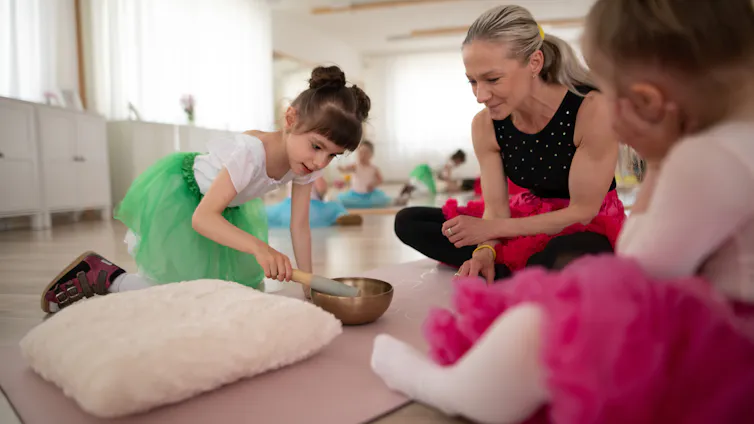
As a music therapy researcher, I am often asked to explain the difference between “music therapy” and “music activity”.
People can be confused because music activities might also make us feel good. For example, music activities such as singing in a community choir can have mental health benefits for adults. Learning to play the ukulele has been shown to build stronger empathic skills in children.
Music activities like these are valuable for many people, but they are not music therapy.
Music therapy practice is informed by research into the benefits of specific methods and techniques for people with disability. These include autistic children, people with profound disabilities, and people recovering from major injury.
For example, if a client is non-speaking, the therapist might use a vocal improvisation technique, creating supportive music to encourage the person to make sounds with their voice. The back-and-forth musical dialogue at first doesn’t rely on words. But the therapist may help the client extend to more expressive vocalisations and even word production.
In Australia, music therapists must complete a two-year master’s degree before they are able to register with the Australian Music Therapy Association, and engage in continuous professional development.
The review said artists or musicians who do not have relevant qualifications to register with their professional bodies should not charge the new hourly rate for therapy.
So, what does the evidence say?
The new review acknowledged that establishing the evidence for therapy and disability is a complex task.
Around one in five Australians live with disability. Each person has unique needs and strengths, and disability occurs across the lifespan, meaning needs can also change. But when studying whether a particular kind of therapy is beneficial, researchers will focus on a particular group of people, such as adults with cerebral palsy.
This means the quantity and quality of evidence available will vary across different age groups and conditions – and there may be gaps. So care needs to be taken when interpreting the research to consider whether findings from one study might be applicable to other people with similar goals, needs, or conditions.
Qualified therapists are trained to interpret this evidence. They may be working with a client whose condition or needs differ from what’s in the existing research literature. So, they will consider whether a study showing benefits for music therapy with one group (such as non-speaking autistic children) could be relevant to another (for example, other people who have limitations in verbal expression).
The Duckett Review acknowledges this challenge of generalising evidence across different therapies. But it also warns of possible discrimination against people with rare conditions that attract limited research funding, and calls for more research.
Grace Thompson, Associate Professor in Music Therapy; Senior Academic Fellow at Melbourne Centre for the Study of Higher Education, The University of Melbourne
This article is republished from The Conversation under a Creative Commons license. Read the original article.
Don’t Forget…
Did you arrive here from our newsletter? Don’t forget to return to the email to continue learning!
Recommended
Learn to Age Gracefully
Join the 98k+ American women taking control of their health & aging with our 100% free (and fun!) daily emails:
-
Okra vs Rhubarb – Which is Healthier?
10almonds is reader-supported. We may, at no cost to you, receive a portion of sales if you purchase a product through a link in this article.
Our Verdict
When comparing okra to rhubarb, we picked the okra.
Why?
It wasn’t close:
In terms of macros, okra has more fiber, carbs, and protein, making it the most nutritionally dense option in this category.
In the category of vitamins, okra has more of vitamins A, B1, B2, B3, B5, B6, B7. B9, C, E, and K, while rhubarb is not higher in any vitamins—a complete win for okra.
Looking at minerals, okra has more copper, iron, magnesium, manganese, phosphorus potassium, and zinc, while rhubarb has (slightly) more calcium and selenium. Another easy win for okra.
In other considerations, both are good sources of polyphenols, but okra has more, scoring it a fourth win in a row.
Adding up the sections makes for a clear overall win for okra, but by all means enjoy either or both, as diversity is good!
Want to learn more?
You might like:
What’s Your Plant Diversity Score?
Enjoy!
Share This Post
-
Why Doctors Skip Breakfast – by Dr. Gregory Charlop
10almonds is reader-supported. We may, at no cost to you, receive a portion of sales if you purchase a product through a link in this article.
This book is what it claims to be in the subtitle: “[a collection of] wellness tips to reverse aging, treat depression, and get a good night’s sleep”. It’s not delivered quite like that though—one might expect this to be a page-a-day reader with one tip per page, for example, and it isn’t.
Instead, Dr. Charlop oscillates between telling stories (of the anecdotal variety, though they do come across as illustrative fictions rather than actual case studies with names changed) and sharing his thoughts on various topics, much as one might if talking to a friend or other small social audience in a casual manner.
As such, it’s very easy-reading, while at the same time not being necessarily conducive to skimming, as then one may miss the information buried in the text.
The knowledge itself is probably not anything that regular readers of 10almonds won’t have read before, but it can be good to have a reminder in any case; it’s easy to let things slip, get distracted from a good habit and then not reprise it, that sort of thing, so books like this can function as a timely prompt to make use of various wellness tools and techniques.
As for practicality, some things can be done quickly and easily (such as the intermittent fasting alluded to by the title, for example) whereas others will require investing more time and/or money, but all are at least worthy of consideration.
The style is, as we say, casual—but there is a bibliography and list of further references, so that’s a point in its favor, especially as the book itself is not very long or information-dense.
Bottom line: while there is nothing groundbreaking here, this book will provide a refresher on what for 10almonds readers might be considered the basics, plus some pet interests of the author’s (such as red light therapy and ketamine, which while they have their place, cannot be described as “the basics” of good health; the former is a very nice extra, and the latter has its pros and cons).
Click here to check out Why Doctors Skip Breakfast, and see how your health habits measure up!
Share This Post
-
Bulletproof Squat: Flow That Improves Depth & Stability
10almonds is reader-supported. We may, at no cost to you, receive a portion of sales if you purchase a product through a link in this article.
Marina Sarenac, mobility coach, shows how to get there:
Let’s get down to it
First of all, we must register our astonishment about this:
❝A few months ago, I couldn’t even hit parallel in my squats. My hips felt tight, weak, and painful.❞
How did this happen? She is a mobility coach; what went wrong?! Was she injured? She doesn’t mention an explanation.
She does go on to say:
❝And honestly, I almost gave up on squats completely. But then I found a simple flow of four exercises that changed everything. My hips opened up, my depth improved, and now I feel stronger and even more stable than ever. And I’m going to show you exactly how you can do it, too.❞
So, maybe, notwithstanding the use of the word “honestly”, it’s possible there was actually a little dishonesty there; that is to say: perhaps she is telling a story she hopes will be relatable in order to get people on board and understand that they can do it too. This is sometimes called “the advertising hero’s journey”, as it’s often used in long-form ads for things, telling “I, dear reader, was just like you, and…” explaining what they were getting wrong, how they learned better, how it changed their life, and how you can do it too, for the low low price of whatever they’re selling.
However! Whether her story is true or not, the exercise are good, so here they are:
- Bear rock: you’ve heard of classic rock, glam rock, and punk rock; now here’s bear rock! Or rather, a bear rock-back. Focus on putting your hips backwards, like you’re rocking into the bottom of a squat. Feel the stretch in your adductors and keep your spine natural.
- “World’s greatest stretch” with a jump switch: step into a deep lunge, put your elbow on the floor, open your chest and put your hand up, then switch sides with a jump.
- Cossack squat with internal hip rotation: set your feet well part, and squat down with one leg or the other, creating a lung-like result, holding a weight in front you (a kettlebell is great for this, but any medium-sized manageable weight is fine) to work that internal hip rotation.
- Squat-knee-hinge flow: start in the lowest squat you can currently do, shift into a kneeling position, then hinge your hips back, and repeat.
For more on all of these plus visual demonstrations, enjoy:
Click Here If The Embedded Video Doesn’t Load Automatically!
Want to learn more?
You might also like:
The Secret To Better Squats: Foot, Knee, & Ankle Mobility
Take care!
Share This Post
Related Posts
-
How To Make Drinking Less Harmful
10almonds is reader-supported. We may, at no cost to you, receive a portion of sales if you purchase a product through a link in this article.
Making Drinking Less Harmful
We often talk of the many ways alcohol harms our health, and we advocate for reducing (or eliminating) its consumption. However, it’s not necessarily as easy as all that, and it might not even be a goal that everyone has. So, if you’re going to imbibe, what can you do to mitigate the harmful effects of alcohol?
There is no magical solution
Sadly. If you drink alcohol, there will be some harmful effects, and nothing will completely undo that. But there are some things that can at least help—read on to learn more!
Coffee
It’s not the magical sober-upperer that some would like it to be, but it is good against the symptoms of alcohol intoxication, and slightly reduces the harm to your body, because it is:
- Hydrating (whereas alcohol is dehydrating)
- A source of antioxidants (whereas alcohol causes oxidative stress, which has nothing to do with psychological stress, and is a kind of cellular damage)
- A stimulant, assuming it is not decaffeinated (it’s worth noting that its stimulant effects work partly by triggering vasoconstriction, which is the opposite of the vasodilation caused by alcohol)
To this end, the best coffee for anti-alcohol effects should be:
- Caffeinated, and strong
- Long (we love espresso, but we need hydration here and that comes from volume!)
- Without sugar (you don’t want to create an adverse osmotic gradient to draw water back out from your body)
As for milk/cream/whatever, have it or don’t, per your usual preference. It won’t make any difference to the alcohol in your system.
Antioxidants, polyphenols, flavonoids, and things with similar mechanisms
We mentioned that coffee contains antioxidants, but if you want to really bring out the heavy guns, taking more powerful antioxidants can help a lot. If you don’t have the luxury of enjoying berries and cacao nibs by the handful, supplements that have some similar benefits are a perfectly respectable choice.
For example, you might want to consider green tea extract:
L-theanine 200mg (available on Amazon)
Specialist anti-alcohol drugs
These are somewhat new and the research is still ongoing, but for example:
Dihydromyricetin (DHM) as a novel anti-alcohol intoxication medication
In short, DHM is a flavonoid (protects against the oxidative stress caused by alcohol, and has been found to reduce liver damage—see the above link) and also works on GABA-receptors (reduces alcohol withdrawal symptoms after cessation of drinking, and thus also reduces hangovers).
Once again: the marketing claims of such drugs may be bold, but there’s a lot that’s not known and they’re not a magic pill. They do NOT mean you can take them alongside drinking and drink what you like with impunity. However, they may help mitigate some of the harmful effects of alcohol. If you wish to try them, these can be purchased at pharmacies or online, for example:
Alcohol Defense Capsules (available on Amazon)
Bottom line
Alcohol is bad for your health and none of the above will eliminate the health risks. But, if you’re going to have alcohol, then having the above things as well may at least somewhat reduce the harm done.
Don’t Forget…
Did you arrive here from our newsletter? Don’t forget to return to the email to continue learning!
Learn to Age Gracefully
Join the 98k+ American women taking control of their health & aging with our 100% free (and fun!) daily emails:
-
Dyslexia Test
10almonds is reader-supported. We may, at no cost to you, receive a portion of sales if you purchase a product through a link in this article.
(and it’s mostly not about reading/writing!)
More than just shuffled letters
This video provides a self-test based on the Bangor Dyslexia Test (BDT). The BDT is 94% accurate in identifying dyslexia, and it includes 9 parts, with a mix of questions and tasks. Answering “yes” or struggling with tasks indicates possible dyslexia. Collecting 4+ indicators suggests dyslexia, but of course is not a replacement for official diagnosis.
It’s best to watch the video if you can, but here’s what to expect:
- Left-Right confusion: point your left hand to your right/left shoulder.
- Family history: any family members with dyslexia or struggles with reading/writing?
- Repeating numbers (order): repeat a given sequence of numbers in order.
- Letter confusion (e.g. b/d): do you confuse letters like “b” and “d” beyond age 8?
- Times tables: recite the 6, 7, and 8 times tables.
- Word manipulation: replace the letters in a word to create a new word, e.g. change “slide” (s ⇾ g) to “glide.”
- Repeating numbers (reversed): repeat a given sequence of numbers in reverse order.
- Months in reverse: recite the months of the year in reverse order.
- Subtraction: do you struggle with subtraction, e.g. 44-9 or 55-12?
Writer’s anecdote: I am not dyslexic, and/but I have an impressive level of dyscalculia (the purely numerical equivalent), to the point I’ll sometimes use a calculator to do single-digit calculations, and I am so bad at calculating ages or other differences between dates (I will have to count on my fingers or else run the severe risk of out-by-one errors). I have also been known to make mistakes counting down from 10, which really ruins dramatic tension.
In contrast, the left-right thing is interesting, because when I was first learning Arabic, I had no trouble reading/writing right-to-left, but I initially struggled so much to remember which way the “backspace” key would take me (in Arabic the backspace key backspaces to the right, despite still pointing to the left).
Anyway, for the test itself, enjoy:
Click Here If The Embedded Video Doesn’t Load Automatically!
Want to learn more?
You might also like to read:
Reading, Better (Reading As A Cognitive Exercise)
Take care!
Don’t Forget…
Did you arrive here from our newsletter? Don’t forget to return to the email to continue learning!
Learn to Age Gracefully
Join the 98k+ American women taking control of their health & aging with our 100% free (and fun!) daily emails:
-
The Underrated Full Body Exercise (That Looks A Little Silly)
10almonds is reader-supported. We may, at no cost to you, receive a portion of sales if you purchase a product through a link in this article.
Sometimes, the best exercises don’t look very impressive, but this one’s a good one:
Shake it up!
You’ll want a heavy blanket of some kind, or a thick towel. Something that won’t whip/snap.
Then:
- Set your stance: stand with your feet about shoulder-width apart, knees slightly bent, and core braced. Hold one end of the towel in each hand.
- Start shaking: explosively shake the towel up and down with both arms, keeping your elbows slightly bent. Focus on powerful, quick movements.
- Add footwork: shuffle side to side, step forwards and backwards, or move in small circles while continuing to shake the towel. Keep your upper and lower body working together, but independently.
- Mix movement planes: alternate between vertical shakes (up and down), horizontal shakes (side to side), or diagonal motions to engage more muscles.
- Adjust intervals: do short bursts (10–20 seconds) going for all-out for conditioning and power; use longer rounds (1–2 minutes), at 65–75% effort for endurance.
The main advantage of this is that it works the body in every direction—lateral, forward, backward, rotational—unlike running, biking, or even burpees that stay in one plane.
It conditions shoulders, arms, and core while improving strength, endurance, balance, and stability. It’s also a good option if lower body impact needs to be reduced (e.g. due to injury, joint problems, etc).
For more on all of this plus a visual demonstration, enjoy:
Click Here If The Embedded Video Doesn’t Load Automatically!
Want to learn more?
You might also like:
Take care!
Don’t Forget…
Did you arrive here from our newsletter? Don’t forget to return to the email to continue learning!
Learn to Age Gracefully
Join the 98k+ American women taking control of their health & aging with our 100% free (and fun!) daily emails:


