
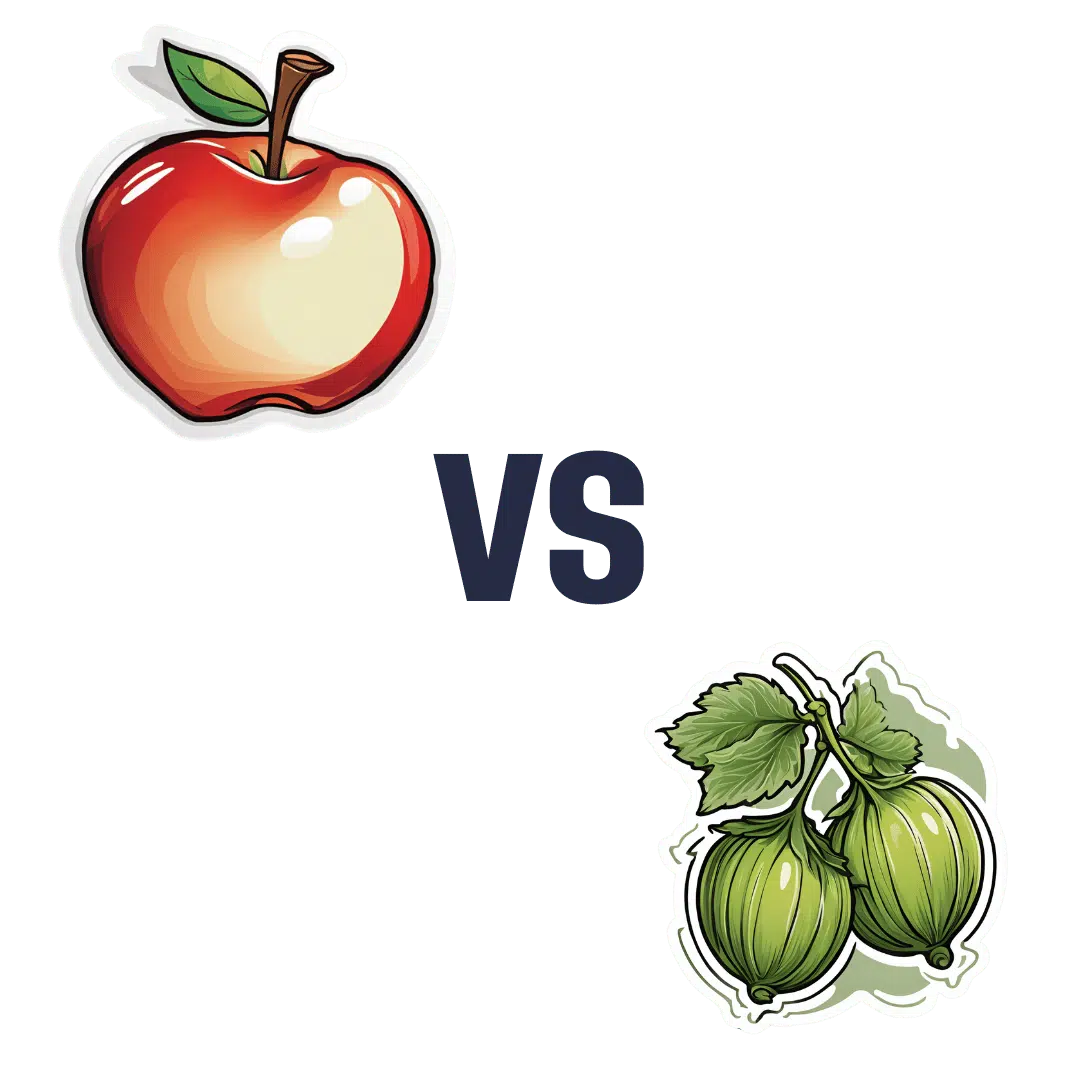
Apple vs Gooseberries – Which is Healthier?

10almonds is reader-supported. We may, at no cost to you, receive a portion of sales if you purchase a product through a link in this article.

Our Verdict

When comparing apple to gooseberries, we picked the apple.

Why?

These two fruits are popular contenders for losing most head-to-head contests on here, but…

In terms of macros, gooseberries have more than 2x the fiber, scoring them a first-round win.

When it comes to vitamins, apples are not higher in any vitamins, while gooseberries are higher in vitamins A, B1, B2, B3, B5, B6, B7, B9, C, E, and K, sweeping this category.

Looking at minerals, apples are not higher in any minerals, while gooseberries have more calcium, copper, iron, magnesium, manganese, phosphorus, potassium, selenium, and zinc, winning overwhelmingly again.

Adding up the sections makes for a clear overall win for gooseberries, but by all means enjoy either or both, as diversity is best!

Want to learn more?

You might like:

Are You Getting The Right Kinds Of Flavonoids? ← while both of these fruits today are quite modest in their polyphenol content, they have different ones, which is another reason to get a variety

Enjoy!

Don’t Forget…

Did you arrive here from our newsletter? Don’t forget to return to the email to continue learning!

Learn to Age Gracefully

Join the 98k+ American women taking control of their health & aging with our 100% free (and fun!) daily emails:

  • Cucumber vs Watermelon – Which is Healthier?

    10almonds is reader-supported. We may, at no cost to you, receive a portion of sales if you purchase a product through a link in this article.

    Our Verdict

    When comparing cucumber to watermelon, we picked the cucumber.

    Why?

    It was close!

    In terms of macros, these two “mostly water” salad items are very similar, though nominally cucumber does have slightly more fiber, and watermelon has slightly more carbs. So, either a tie here, or the very slenderest of first-round wins to cucumber.

    In the category of vitamins, cucumbers have more of vitamins B2, B5, B7, B9, and K (and even, 164x as much vitamin K), while watermelon has more of vitamins A, B1, B3, C, and E, so that’d be a 5:5 tie by the vitamin count alone, but we say the margin of difference on vitamin K, of which cucumbers are a good source, breaks the tie and gives cucumber the win in this round.

    Looking at minerals, cucumber has more calcium, iron, magnesium, manganese, phosphorus, potassium, and zinc, while watermelons have more selenium—an overwhelming win for cucumbers here.

    In other considerations, both have a fair array of beneficial polyphenols, and cucumber extract is particularly potent (see the link in the “learn more” section below), but that’s as an extract—you’d have to eat a remarkable number of cucumbers to get that benefit from the food alone. So, we call this round a tie functionally, or else a super-marginal fourth-round win for cucumber.

    Adding up the sections makes for a compelling overall win for cucumbers, but by all means do enjoy either or both, as diversity is best!

    Want to learn more?

    You might like:

    Cucumber Extract Beats Glucosamine & Chondroitin… At 1/135th Of The Dose?!

    Enjoy!

    Share This Post

  • Cashews vs Peanuts – Which is Healthier?

    10almonds is reader-supported. We may, at no cost to you, receive a portion of sales if you purchase a product through a link in this article.

    Our Verdict

    When comparing cashews to peanuts, we picked the peanuts.

    Why?

    Another one for “that which is more expensive is not necessarily the healthier”! Although, certainly both are good:

    In terms of macros, cashews have about 2x the carbs while peanuts have a little more (healthy!) fat and more than 2x the fiber, meaning that peanuts also enjoy the lower glycemic index. All in all, a fair win for peanuts here.

    When it comes to vitamins, cashews have more of vitamins B6 and K, while peanuts have a lot more of vitamins B1, B2, B3, B5, B7, B9, and E. Another easy win for peanuts.

    In the category of minerals; cashews have more copper, iron, magnesium, phosphorus, and selenium, while peanuts have more calcium, manganese, and potassium. A win for cashews, this time.

    Adding up the sections makes for an overall win for peanuts, but (assuming you are not allergic) enjoy either or both! In fact, enjoying both is best; diversity is good.

    Want to learn more?

    You might like to read:

    Why You Should Diversify Your Nuts!

    Take care!

    Share This Post

  • Breathe; Don’t Vent (At Least In The Moment)

    10almonds is reader-supported. We may, at no cost to you, receive a portion of sales if you purchase a product through a link in this article.

    Zen And The Art Of Breaking Things

    We’ve talked before about identifying emotions and the importance of being able to express them:

    Answering The Most Difficult Question: How Are You?

    However, there can be a difference between “expressing how we feel” and “being possessed by how we feel and bulldozing everything in our path”

    …which is, of course, primarily a problem in the case of anger—and by extension, emotions that are often contemporaneous with anger, such as jealousy, shame, fear, etc.

    How much feeling is too much?

    While this is in large part a subjective matter, clinically speaking the key question is generally: is it adversely affecting daily life to the point of being a problem?

    For example, if you have to spend half an hour every day actively managing a certain emotion, that’s probably indicative of something unusual, but “unusual” is not inherently bad. If you’re managing it safely and in a way that doesn’t negatively affect the rest of your life, then that is generally considered fine, unless you feel otherwise about it.

    A good example of this is complicated grief and/or prolonged grief.

    But what about when it comes to anger? How much is ok?

    When it comes to those around you, any amount of anger can seem like too much. Anger often makes us short-tempered even with people who are not the object of our anger, and it rarely brings out the best in us.

    We can express our feelings in non-aggressive ways, for example:

    When You “Can’t Complain”

    and

    Seriously Useful Communication Skills!

    Sometimes, there’s another way though…

    Breathe; don’t vent

    That’s a great headline, but we can’t take the credit for it, because it came from:

    Breathe, don’t vent: turning down the heat is key to managing anger

    …in which it was found that, by all available metrics, the popular wisdom of “getting it off your chest” doesn’t necessarily stand up to scrutiny, at least in the short term:

    ❝The work was inspired in part by the rising popularity of rage rooms that promote smashing things (such as glass, plates and electronics) to work through angry feelings.

    I wanted to debunk the whole theory of expressing anger as a way of coping with it,” she said. “We wanted to show that reducing arousal, and actually the physiological aspect of it, is really important.❞

    ~ Dr. Brad Bushman

    And indeed, he and his team did find that various arousal-increasing activities (such as hitting a punchbag, breaking things, doing vigorous exercise) did not help as much as arousal-decreasing activities, such as mindfulness-based relaxation techniques.

    If you’d like to read the full paper, then so would we, but we couldn’t get full access to this one yet. However, the abstract includes representative statistics, so that’s worth a once-over:

    A meta-analytic review of anger management activities that increase or decrease arousal: What fuels or douses rage?

    Caveat!

    Did you notice the small gap between their results and their conclusion?

    In a lab or similar short-term observational setting, their recommendation is clearly correct.

    However, if the source of your anger is something chronic and persistent, it could well be that calming down without addressing the actual cause is just “kicking the can down the road”, and will still have to actually be dealt with eventually.

    So, while “here be science”, it’s not a mandate for necessarily suffering in silence. It’s more about being mindful about how we go about tackling our anger.

    As for a primer on mindfulness, feel free to check out:

    No-Frills, Evidence-Based Mindfulness

    Take care!

    Share This Post

  • Getting COMFY – by Jordan Gross

    10almonds is reader-supported. We may, at no cost to you, receive a portion of sales if you purchase a product through a link in this article.

    It’s easy to see how good “morning people” seem to have it; it’s harder, it seems, to become one.

    And, if we’re forced by circumstance to be the morning person we’re not? We all-too-easily find ourselves greeting each coming day without the joy that, in an ideal world, we might.

    So, is it possible to learn this power? Jordan Gross has it mapped out for it us…

    The “COMFY” of the title is indeed an acronym, and it stands for:

    • Calm
    • Openness
    • Movement
    • Funny
    • You

    There’s a chapter explaining each in detail, and they’re bookended with other chapters explaining more about the whys and the hows.

    As you might expect, the key to a good morning starts the night before, but there’s also a formula to follow. Of course, you can change it up, mix and match if you like… but this book provides a base framework to build from, which is something that can make a huge difference!

    Bottom line: it’s a highly enjoyable book to read, and also provides genuine powerful help to bring us the brighter happier mornings we deserve—the set-up to the perfect day!

    Click here to check out “Getting COMFY” and perk up your mornings—you deserve it!

    Don’t Forget…

    Did you arrive here from our newsletter? Don’t forget to return to the email to continue learning!

    Learn to Age Gracefully

    Join the 98k+ American women taking control of their health & aging with our 100% free (and fun!) daily emails:

  • Ozempic Helps People Walk Further

    10almonds is reader-supported. We may, at no cost to you, receive a portion of sales if you purchase a product through a link in this article.

    There’s often a catch-22 when it comes to exercise: it’s important for good health, and/but people with ill health usually cannot exercise much.

    A recent (published today, at time of writing, the 29th of March 2025, never let it be said we don’t bring you the very most up-to-date health science!) study by Dr. Neda Rasouli et al. has shown there is a possible way through that catch-22, depending on the nature of the illness.

    This study followed 792 people across 112 outpatient clinical trial sites in 20 countries in North America, Asia, and Europe, with type 2 diabetes and peripheral artery disease.

    What they found

    Patients taking semaglutide (specifically, 1mg Ozempic) enjoyed a 21% median increase in walking distance, as well as some bonus benefits, namely:

    • Weight reduction: the semaglutide group saw a greater reduction in body weight (–4.1 kg; P < 0 .0001)
    • HbA1c levels: semaglutide lowered HbA1c by 1 percentage point (P < 0.0001)
    • Blood pressure: systolic blood pressure decreased by 3.2 mmHg (P = 0.0042)

    You may be wondering what that “P =” means: it’s the probability of this occurring by random chance, on a scale from zero (impossible outcome) to 1 (unavoidable outcome).

    For example:

    “We hypothesized that singing the happy birthday song before tossing a coin would result in it landing on heads. We sang the happy birthday song and tossed the coin; it landed on heads (P = 0.5)”

    In science, generally speaking anything with a probability of under 0.05 (expressed as: “P < 0.05”) is considered a statistically significant result.

    All this to say, the cited figures of, for example, P < 0.0001, are very significant indeed.

    On which note, that 21% median increase in walking distance? P < 0.0004.

    As for side effects? Serious adverse events related to the drug occurred in 1% of the semaglutide group vs 2% in the placebo group. So, that seems quite safe indeed.

    You can find the paper itself here:

    Semaglutide and walking capacity in people with symptomatic peripheral artery disease and type 2 diabetes (STRIDE): a phase 3b, double-blind, randomised, placebo-controlled trial

    Want to learn more?

    Check out:

    Take care!

    Don’t Forget…

    Did you arrive here from our newsletter? Don’t forget to return to the email to continue learning!

    Learn to Age Gracefully

    Join the 98k+ American women taking control of their health & aging with our 100% free (and fun!) daily emails:

  • What does it mean to be transgender?

    10almonds is reader-supported. We may, at no cost to you, receive a portion of sales if you purchase a product through a link in this article.

    Transgender media coverage has surged in recent years for a wide range of reasons. While there are more transgender television characters than ever before, hundreds of bills are targeting transgender people’s access to medical care, sports teams, gender-specific public spaces, and other institutions.

    Despite the increase in conversation about the transgender community, public confusion around transgender identity remains.

    Read on to learn more about what it means to be transgender and understand challenges transgender people may face.

    What does it mean to be transgender?

    Transgender—or “trans”—is an umbrella term for people whose gender identity or gender expression does not conform to their sex assigned at birth. People can discover they are trans at any age.

    Gender identity refers to a person’s inner sense of being a woman, a man, neither, both, or something else entirely. Trans people who don’t feel like women or men might describe themselves as nonbinary, agender, genderqueer, or two-spirit, among other terms.

    Gender expression describes the way a person communicates their gender through their appearance—such as their clothing or hairstyle—and behavior.

    A person whose gender expression doesn’t conform to the expectations of their assigned sex may not identify as trans. The only way to know for sure if someone is trans is if they tell you.

    Cisgender—or “cis”—describes people whose gender identities match the sex they were assigned at birth.

    How long have transgender people existed?

    Being trans isn’t new. Although the word “transgender” only dates back to the 1960s, people whose identities defy traditional gender expectations have existed across cultures throughout recorded history.

    How many people are transgender?

    A 2022 Williams Institute study estimates that 1.6 million people over the age of 13 identify as transgender in the United States.

    Is being transgender a mental health condition?

    No. Conveying and communicating about your gender in a way that feels authentic to you is a normal and necessary part of self-expression.

    Social and legal stigma, bullying, discrimination, harassment, negative media messages, and barriers to gender-affirming medical care can cause psychological distress for trans people. This is especially true for trans people of color, who face significantly higher rates of violence, poverty, housing instability, and incarceration—but trans identity itself is not a mental health condition.

    What is gender dysphoria?

    Gender dysphoria describes a feeling of unease that some trans people experience when their perceived gender doesn’t match their gender identity, or their internal sense of gender. A 2021 study of trans adults pursuing gender-affirming medical care found that most participants started experiencing gender dysphoria by the time they were 7.

    When trans people don’t receive the support they need to manage gender dysphoria, they may experience depression, anxiety, social isolation, suicidal ideation, substance use disorder, eating disorders, and self-injury.

    How do trans people manage gender dysphoria?

    Every trans person’s experience with gender dysphoria is unique. Some trans people may alleviate dysphoria by wearing gender-affirming clothing or by asking others to refer to them by a new name and use pronouns that accurately reflect their gender identity. The 2022 U.S. Trans Survey found that nearly all trans participants who lived as a different gender than the sex they were assigned at birth reported that they were more satisfied with their lives.

    Some trans people may also manage dysphoria by pursuing medical transition, which may involve taking hormones and getting gender-affirming surgery.

    Access to gender-affirming medical care has been shown to reduce the risk of depression and suicide among trans youth and adults.

    To learn more about the trans community, visit resources from the National Center for Transgender Equality, the Trevor Project, PFLAG, and Planned Parenthood.

    If you or anyone you know is considering suicide or self-harm or is anxious, depressed, upset, or needs to talk, call the Suicide & Crisis Lifeline at 988 or text the Crisis Text Line at 741-741. For international resources, here is a good place to begin.

    This article first appeared on Public Good News and is republished here under a Creative Commons license.

    Don’t Forget…

    Did you arrive here from our newsletter? Don’t forget to return to the email to continue learning!

    Learn to Age Gracefully

    Join the 98k+ American women taking control of their health & aging with our 100% free (and fun!) daily emails: