What is mantle cell lymphoma? Magda Szubanski’s ‘rare and fast-moving’ cancer, explained

10almonds is reader-supported. We may, at no cost to you, receive a portion of sales if you purchase a product through a link in this article.

Beloved Australian actor, Magda Szubanski, has revealed she’s been diagnosed with a “very rare, very aggressive, very serious” blood cancer called mantle cell lymphoma.

In a post on social media on Thursday, Szubanski said she would be starting treatment in a few weeks for the stage 4 cancer, which she called “one of the nasty ones, unfortunately”.

So, what is mantle cell lymphoma? And how is it treated?
Lisa Maree Williams/Getty

What is mantle cell lymphoma?

There are more than 100 subtypes of blood cancers, but they are commonly divided into one of two groups. These are based on where they originate: leukaemias develop in the bone marrow, and lymphomas develop in the lymphatic system.

Lymphomas develop from white blood cells (lymphocytes), which circulate in the blood and lymphatic system and help fight infection.

You may not have heard of the lymphatic system, but it plays a key role in your immune response.

The lymphatic circulatory system is responsible for transporting fluids (lymph) around your body. Lymph comes from blood plasma, and helps remove waste from your tissues.

As part of the lymphatic system, tissues like the spleen and thymus help produce many of the immune cells you use to fight infections.

These cells are then housed in specialised organs called lymph nodes – small pea-sized glands located throughout your body.
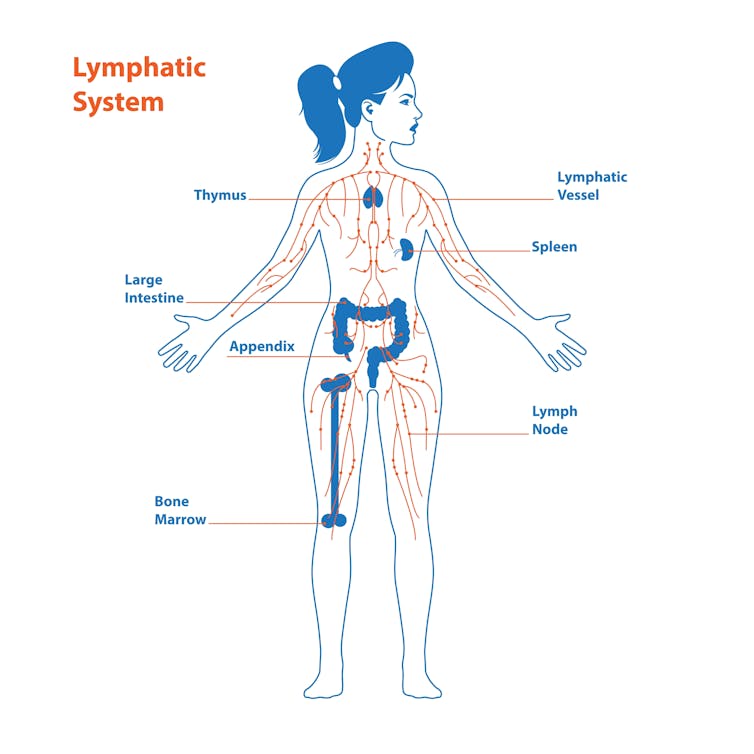
Diagram showing the lymphatic system in the human body.
The lymphatic system plays a key role in your body’s immune response. Clash_Gene/Shutterstock

Lymph nodes are kind of like the “war room” of your immune system.

Your body contains hundreds of lymph nodes, and each contains millions of lymphocytes. These include the T and B cells – the main fighting cells in adaptive immunity.

If B cells in an area of the lymph node known as the “mantle zone” become cancerous, it is called mantle cell lymphoma.

How rare is it?

In 2020, there were 330 cases of mantle cell lymphoma diagnosed in Australia, accounting for a small fraction (5%) of lymphoma cases.

Overall, lymphomas account for around one in twenty new cancer diagnoses. This makes mantle cell lymphoma quite rare.

Mantle cell lymphoma is about three times more common in men than in women, and mostly affects people over the age of 60.

Is there a cure?

Unfortunately, mantle cell lymphoma is largely considered incurable with the therapies currently available.

Like many cancers, mantle cell lymphoma can vary in how quickly it develops and its severity.

As Szubanski’s cancer has been described as “fast-moving” and is already stage 4, it appears that it is a more serious case.

Stage 4 is the most advanced stage – meaning the cancer has spread (metastasised) to other tissues.

Treatment at this stage can be more complicated than when the cancer is caught earlier. But treatment can still help people go on to live for many years.

What does treatment involve?

In her social media post, Szubanski said she will be receiving “one of the best treatments available (the Nordic protocol)”.

This is one of the most common treatments for an aggressive lymphoma.

The main component is “R-CHOP” – a combination therapy. It involves a mixture of different drugs, including chemotherapy, to attack the cancer from multiple angles at the same time.

Different strengths of the drugs can be used (the maximum strength is sometimes called R-maxi-CHOP).

A stem cell transplantation may also be included in the regimen.

How effective this treatment is will depend on many different factors, including the type and stage of the lymphoma.

The aim is to kill as many cancer cells as possible, and therefore extend a patient’s life for as long as possible.

Therapy also focuses on providing a high quality-of-life for patients.

How is it diagnosed?

Szubanski’s mantle cell lymphoma was detected during a breast cancer screen where, she says, “they found my lymph nodes were up”.

Imaging techniques, such as a mammogram or MRI, may detect tell-tale signs of lymphoma, such as swollen lymph nodes.

However a biopsy – a small sample of tissue from the affected area – would then be required to confirm the presence of cancer cells and identify what type.

Blood cancer symptoms can be vague, but it’s good to know what to look for.

As well as swollen lymph nodes, symptoms of lymphoma include nausea, tiredness, loss of appetite, fevers, gastrointestinal issues, unexplained weight loss, and night sweats.

If you have any concerns, you should consult a doctor.

John (Eddie) La Marca, Senior Research Officer, Blood Cells and Blood Cancer, WEHI (Walter and Eliza Hall Institute of Medical Research) and Sarah Diepstraten, Senior Research Officer, Blood Cells and Blood Cancer Division, WEHI (Walter and Eliza Hall Institute of Medical Research)

This article is republished from The Conversation under a Creative Commons license. Read the original article.

Don’t Forget…

Did you arrive here from our newsletter? Don’t forget to return to the email to continue learning!

Learn to Age Gracefully

Join the 98k+ American women taking control of their health & aging with our 100% free (and fun!) daily emails:

  • Does weightlifting improve bone density?

    10almonds is reader-supported. We may, at no cost to you, receive a portion of sales if you purchase a product through a link in this article.

    You may have heard high-impact activity – exercise such as running, jumping, football and basketball – is good at building bone density and strength. But what about when you’re standing still, lifting weights at the gym?

    The good news is weight training is great for bone health. But some exercises are more effective than others. Here’s what the science says.

    Inti St Clair/Getty

    What is bone density?

    Bone density, also known as bone mineral density, is essentially a measure of how many minerals (such as calcium and phosphorus) are packed into your bones.

    It gives you an indication of how solid your bones are, which is important because denser bones are generally less likely to break.

    However, bone density is not quite the same as bone strength.

    Bones also rely on a range of other compounds (such as collagen) to provide support and structure. So, even dense bones can become brittle if they are lacking these key structural components.

    However, bone mineral density (measured with a bone scan) is still considered one of the best indicators of bone health because it is strongly linked to fracture risk.

    While there is likely a genetic component to bone health, your daily choices can have a big impact.

    What affects your bone health?

    Research shows a few factors can influence how strong and dense your bones are:

    Getting older: As we age, our bone mineral density tends to decrease. This decline is generally greater in women after menopause, but it occurs in everyone.

    Nutrition: Eating calcium-rich foods – dairy in particular, but also many vegetables, nuts, legumes, eggs and meat – has been shown to have a small impact on bone density (although the extent to which this reduces fracture risk is unclear).

    Exposure to sun: Sunlight helps your body make vitamin D, which helps you absorb calcium, and has been linked to better bone density.

    Exercise: It is well established that people who do high-impact and high-load exercise (such as sprinting and weight training) tend to have denser and stronger bones than those who don’t.

    Smoking: Older people who smoke tend to have lower bone density than those who don’t smoke.

    Why does movement improve bone density?

    In the same way that your muscles get stronger when you expose them to stress, your bones get stronger when they’re asked to handle more load. This is why exercise is so important for bone health – because it tells your bones to adapt and become stronger.

    Many of us know that people at risk for bone loss – post-menopausal women and older adults – should be focused on exercising for bone health.

    However, everyone can benefit from targeted exercise, and it’s arguably just as important to prevent declines in bone health.

    In fact, whether you are male or female, the younger you start, the more likely you are to have denser bones into your older life. This is crucial for long-term bone health.

    Do weights improve bone density?

    Yes. One of the most effective exercises for bone health is lifting weights.

    When you lift weights, your muscles pull on your bones, sending signals that encourage new bone formation. There is a large body of evidence showing weight training can improve bone density in adults, including in post-menopausal women.

    But not all exercises are created equal. For example, some evidence suggests large compound exercises that place more load on the skeleton – such as squats and deadlifts – are particularly effective at increasing density in the spine and hips, two areas prone to fractures.

    What type of weight training is best?

    Lifting heavier weights is thought to produce better results than lifting lighter ones. This means doing sets of three to eight repetitions using heavy weights is likely to have a greater impact on your bones than doing many repetitions with lighter ones.

    Similarly, it takes a long time for your bones to adapt and become denser – usually six months or more. This means for healthy bones, it’s better to integrate weight training into your weekly routine rather than do it in bursts for a few weeks at a time.

    Exercises that use body weight, such as yoga and pilates, have many health benefits. However they are unlikely to have a significant impact on bone density, as they tend to put only light stress on your bones.

    If you are new to weight training, you might need to start a bit lighter and get used to the movements before adding weight. And if you need help, finding an exercise professional in your local area might be a great first step.

    Exercising for bone health is not complex. Just a couple of (heavy) weight training sessions per week can make a big difference.

    If you’re concerned you have low bone density, speak to your doctor. They can assess whether you need to go for a scan.

    Hunter Bennett, Lecturer in Exercise Science, University of South Australia

    This article is republished from The Conversation under a Creative Commons license. Read the original article.

    Share This Post

  • Tell Yourself a Better Lie – by Marissa Peer

    10almonds is reader-supported. We may, at no cost to you, receive a portion of sales if you purchase a product through a link in this article.

    As humans, we generally lie to ourselves constantly. Or perhaps we really believe some of the things we tell ourselves, even if they’re not objectively necessarily true:

    • I’ll always be poor
    • I’m destined to be alone
    • I don’t deserve good things
    • Etc.

    Superficially, it’s easy to flip those, and choose to tell oneself the opposite. But it feels hollow and fake, doesn’t it? That’s where Marissa Peer comes in.

    Our stories that we tell ourselves don’t start where we are—they’re generally informed by things we learned along the way. Sometimes good lessons, sometimes bad ones. Sometimes things that were absolutely wrong and/or counterproductive.

    Peer invites the reader to ask “What if…”, unravel how the unhelpful lessons got wired into our brains in the first place, and then set about untangling them.

    “Tell yourself a better lie” does not mean self-deceit. It means that we’re the authors of our own stories, so we might as well make them work for us. Many things in life are genuinely fixed; others are open to interpretation.

    Sorting one from the other, and then treating them correctly in a way that’s helpful to us? That’s how we can stop hurting ourselves, and instead bring our own stories around to uplift and fortify us.

    Get Your Copy of “Tell Yourself A Better Lie” on Amazon Today!

    Share This Post

  • Apricot vs Cantaloupe – Which is Healthier?

    10almonds is reader-supported. We may, at no cost to you, receive a portion of sales if you purchase a product through a link in this article.

    Our Verdict

    When comparing apricots to cantaloupe, we picked the apricots.

    Why?

    In terms of macros, apricots have 2x the fiber, for slightly more carbs and protein, winning in this first category.

    In the category of vitamins, apricots have more of vitamins B2, B5, B7, E, and K, while cantaloupe has more of vitamins A, B1, B6, B9, and C, which would be a 5:5 tie, but it’s worth noticing the outlier that is the huge margin of difference when it comes to apricots having nearly 17x more vitamin E, so we say apricots win this round.

    Looking at minerals, apricots have more calcium, copper, iron, manganese, phosphorus, and zinc, while cantaloupe has more magnesium, potassium, and selenium yielding a tidy 6:3 win to apricots here.

    In other considerations, apricots are much higher in polyphenols, and also have some specific anticancer properties that cantaloupe can’t boast, so that’s another round in apricots’ favor.

    Adding up the sections makes for a clear overall win for apricots, but by all means do enjoy either or both, as diversity is best!

    Want to learn more?

    You might like:

    Top 8 Fruits That Prevent & Kill Cancer

    Enjoy!

    Share This Post

  • Pinch of Nom – by Kate Allinson & Kay Allinson

    10almonds is reader-supported. We may, at no cost to you, receive a portion of sales if you purchase a product through a link in this article.

    “Home-style recipes”, because guess where most readers live!

    And: slimming, because trimming the waistline a little is a goal for many after holiday indulgences.

    The key idea here is healthy recipes that “don’t taste like diet food”—often by just switching out a couple of key ingredients, to give a significantly improved nutritional profile while remaining just as tasty, especially when flavors are enhanced with clever spicing and seasoning.

    The food is simple to prepare, while being “special” enough that it could be used very credibly for entertaining too. For that matter, a strength of the book is its potential for use as a creative springboard, if you’re so inclined—there are lots of good ideas in here.

    The recipes themselves are all you’d expect them to be, and presented clearly in an easy-to-follow manner.

    Bottom line: if you’ve ever wanted to cook healthily but you need dinner on the table in the very near future and are stuck for ideas, this book is exactly what you need.

    Click here to check out Pinch of Nom, and liven up your healthy cooking!

    Don’t Forget…

    Did you arrive here from our newsletter? Don’t forget to return to the email to continue learning!

    Learn to Age Gracefully

    Join the 98k+ American women taking control of their health & aging with our 100% free (and fun!) daily emails:

  • Hardcore Self Help: F**k Anxiety – by Dr. Robert Duff

    10almonds is reader-supported. We may, at no cost to you, receive a portion of sales if you purchase a product through a link in this article.

    We’ve reviewed other anxiety books before, so what makes this one different? Mostly, it’s the style.

    Aside from swearing approximately once every two lines (so you might want to skip this one if that would bother you), Dr. Duff’s writing is very down-to-earth in other ways too, making it unpretentiously comfortable and accessible without failing to draw upon the wealth of good-practice, evidence-based advice he has to offer.

    To that end, he talks about what anxiety is and isn’t, and goes over various approaches, explaining them in a “about” fashion, and also a “how to” fashion, covering areas such as CBT, somatic therapies, social support, when talk therapy is most likely to help.

    The book is a quick read (a modest 74 pages), and it’s refreshing that it hasn’t been padded unnecessarily, unlike a lot of books that could have been a fraction of the size without losing value.

    Bottom line: if you (or perhaps someone you care about) would benefit from a straight-to-the-point, no-BS approach to dealing with anxiety (that’s actually evidence-based, not just a “get over it” dismissal), then this is the book for you.

    Click here to check out Hardcore Self Help: F**k Anxiety, and indeed do just that!

    Don’t Forget…

    Did you arrive here from our newsletter? Don’t forget to return to the email to continue learning!

    Learn to Age Gracefully

    Join the 98k+ American women taking control of their health & aging with our 100% free (and fun!) daily emails:

  • 12 Signs Of Liver Disease That You Can See

    10almonds is reader-supported. We may, at no cost to you, receive a portion of sales if you purchase a product through a link in this article.

    “Liver spots” are not, in fact, a sign of liver disease. But here are 12 things that are:

    Making sure your liver isn’t about to defy its name

    Dr. Siobhan Deshauer explains:

    1. Muehrcke’s lines: horizontal white lines under the fingernail that don’t move as the nail grows; associated with low albumin levels due to liver disease.
    2. Terry’s nails: pale nails with a reduced or absent lunula (the half-moon shape at the base); also linked to low albumin from liver dysfunction.
    3. Clubbing: nails curve around enlarged fingertips and lose the diamond-shaped gap when nails are pressed together; associated with various chronic diseases including liver disease.
    4. Ascites: swelling of the abdomen due to fluid buildup caused by portal hypertension from liver scarring.
    5. Caput Medusae: enlarged, visible veins around the navel due to blood rerouting from high pressure in the portal vein.
    6. Varices: dilated veins in the esophagus or stomach that can rupture and bleed dangerously due to portal hypertension.
    7. Palmar erythema: redness on the palms, especially over the thenar and hypothenar areas, due to dangerously elevated estrogen levels being common in liver disease.
    8. Spider nevi: small, spider-like blood vessels on the skin that blanch when pressed; common in liver disease due to very high estrogen.
    9. Muscle wasting: loss of muscle mass, particularly noticeable in the hands and temples, as the body breaks down muscle for energy when the liver fails.
    10. Dupuytren’s contracture: thickening and tightening of the palm fascia leading to curled fingers, especially in the ring and pinky fingers.
    11. Hepatic encephalopathy: brain dysfunction from high ammonia levels due to the liver’s inability to get rid of toxins; includes symptoms like confusion and a flapping tremor (asterixis).
    12. Jaundice & easy bruising: yellowing of skin and eyes from bilirubin buildup, and frequent bruising or bleeding due to reduced clotting factors and platelets from liver dysfunction.

    For more on each of these plus visual illustrations as applicable, enjoy:

    Click Here If The Embedded Video Doesn’t Load Automatically!

    Want to learn more?

    You might also like:

    How To Unfatty A Fatty Liver

    Take care!

    Don’t Forget…

    Did you arrive here from our newsletter? Don’t forget to return to the email to continue learning!

    Learn to Age Gracefully

    Join the 98k+ American women taking control of their health & aging with our 100% free (and fun!) daily emails: