
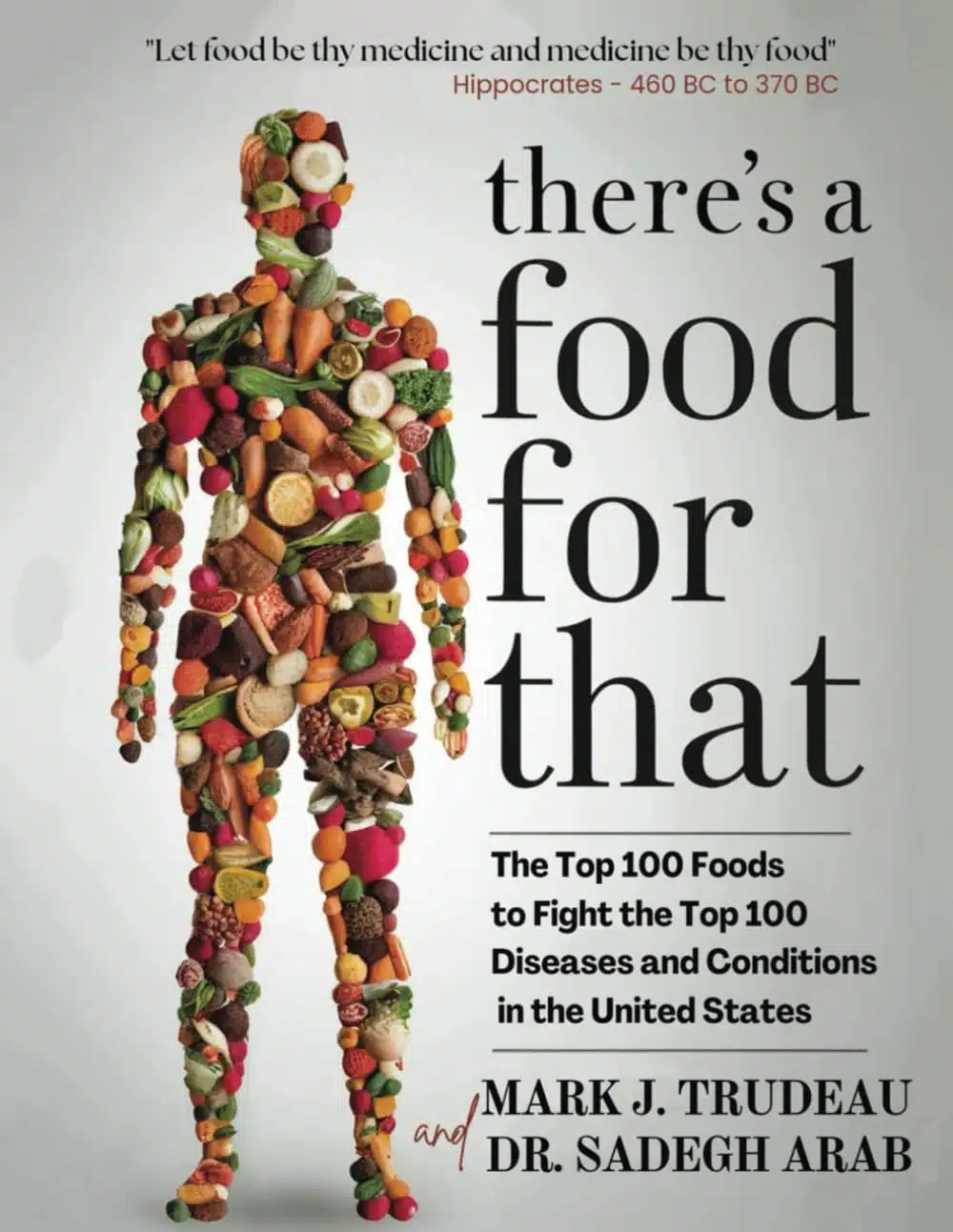
There’s A Food For That! – Dr. Sadegh Arab & Mark Trudeau
10almonds is reader-supported. We may, at no cost to you, receive a portion of sales if you purchase a product through a link in this article.
The premise here is summed up in the subtitle: the top 100 foods to fight the top 100 diseases and [adverse medical] conditions in the US. So, how did they go about that?
They started by establishing the top 100 diseases/conditions, and also what dietary factors contribute to those, and then the top 100 foods, by nutritional values, and then tabulate those together so that we can see what foods fight what maladies.
Because the illness are ranked by prevalence in the US, not severity, we see for example the common cold in the #1 spot (because it sure is common), along with sometimes things we don’t often associated with dietary factors, such as chlamydia or plantar warts. Nevertheless, even in cases such as those, at the very least we can boost our immune systems. Many other conditions are much more serious, and often much more closely related to diet, such as type 2 diabetes, hypertension, and osteoporosis.
The style is quite clinical, yet easily comprehensible, and largely reductive to the data at hand.
Bottom line: if you’d like to tweak your diet to fortify you against some condition or other, then this book will guide you through many.
Click here to check out There’s A Food For That!, and eat your way to long-lasting good health!
Don’t Forget…
Did you arrive here from our newsletter? Don’t forget to return to the email to continue learning!
Recommended
Learn to Age Gracefully
Join the 98k+ American women taking control of their health & aging with our 100% free (and fun!) daily emails:
-
The Surprising Sugar Source In Your Toothpaste
10almonds is reader-supported. We may, at no cost to you, receive a portion of sales if you purchase a product through a link in this article.
Oftentimes, headlines suggest that experts are either wrong about something or have been hiding something, when the reality is a little different, e.g:
- Scientists won’t tell you this! (…because it’s not true)
- Doctors hate this weight loss trick! (…because it is dangerous and the weight lost is not fat)
- Etc
Our headline today, however, is more a matter of “scientists have been saying one thing, and now it turns out that’s not entirely correct”.
If a chemical ends in -ose, it’s a sugar
Sometimes, that has obvious implications for our metabolism, as with glucose, fructose, or the disaccharide of those, sucrose.
You can read more about those, here: From Apples to Bees, and High-Fructose Cs: Which Sugars Are Healthier, And Which Are Just The Same?
Sometimes, it’s a “sugar that doesn’t behave like a sugar”, such as sucralose, which is chemically a sugar, and is sweet, and has been considered to not get metabolized as a sugar, and instead pass through as fiber (though that may now be up for review, in light of what we will share today).
Sucralose does have other potential drawbacks, in any case: The Sucralose News: Scaremongering Or Serious?
And indeed, sweeteners in general have their problems just by virtue of being sweet to the taste: The Problem With Sweeteners
That goes for resistant starches, too
“Resistant” here means that they are resistant to digestion, and pass through as fiber.
“Starch”, however, means that indeed this is a chain of sugars. For example, guar gum, a commonly-used natural thickening agent, is in large part (the galactomannan part) chemically a polymer of d-galactose and d-mannose.
We wrote about it here: The Food Additive You Do Want
What, then, of cellulose, being another -ose chemical, and specifically, a polysaccharide of β(1→4) glucan-linked d-glucose units in a big chain?
Researchers (Dr. Deepesh Panwar et al.) found that cellulose-based thickeners (found in toothpaste, and many food products), previously believed to be indigestible, can be broken down by gut bacteria when enzymes are activated by adjacent natural dietary polysaccharides:
- Previous work: bacteria (Bacteroides and Segatella/Prevotella strains) could not grow on cellulose alone.
- New discovery: when “primed” with natural plant polysaccharides (cereal mixed-linkage β-glucan or dicot xyloglucan), certain strains could metabolize the cellulose.
In other words, previous in vitro lab work had carefully recreated gut conditions including a microbiome, but then added the cellulose alone as a testing agent, without adding anything else (because after all, they didn’t want anything to contaminate the results).
But the reality is, there’s never normally nothing else in our gut!
As for what triggers the breakdown of this “unbreakdownable” cellulose, it turns out that many natural fibers in fruits, vegetables and cereals prime the bacterial enzymes that then also act on the cellulose (including: artificial cellulose derivatives).
So, in other words: the cellulose-based thickener in your toothpaste and many food products is, if ingested, getting broken down as sugar after all, if you have a healthy gut, in any case.
You can read their paper in full, here: Artificial cellulose derivatives are metabolized by select human gut Bacteroidota upon priming with common plant β-glucans
What does this mean for my health?
Must you throw out your toothpaste, and start going through the condiment cupboard?
No, these things are fine, and this discovery doesn’t really change that.
And in particular, there is no threat to your teeth from cellulose-thickened toothpaste, nor from cellulose-based “sugar-free” gum, for that matter.
Technically yes, it may mean that something advertised as containing zero calories technically has a small calorie value, but just how much toothpaste/gum are you eating, really?
And even with that in mind, your teeth themselves remain, as we say, unaffected. After all, the oral microbiome is very different from that of your colon (well, it certainly should be, at least!), so those same strains are not there to digest it.
In fact, the β-glucan mentioned in the study? The kind that, if present in your gut, enables the bacteria to digest the cellulose?
We wrote about it here: The Best Kind Of Fiber For Overall Health? ← it’s β-glucan! Oats are a great source.
See also: What Do The Different Kinds Of Fiber Do? 30 Foods That Rank Highest
Enjoy!
Share This Post
-
Blackberries vs Pineapple – Which is Healthier?
10almonds is reader-supported. We may, at no cost to you, receive a portion of sales if you purchase a product through a link in this article.
Our Verdict
When comparing blackberries to pineapple, we picked the blackberries.
Why?
Both are certainly great! But…
In terms of macros, blackberries have nearly 4x the fiber and slightly more protein, while pineapple has slightly more carbs; a clear win for blackberries.
In the category of vitamins, blackberries have more of vitamins A, B3, B5, B7, B9, E, K, and choline, while pineapple has more of vitamins B1, B2, B6, and C; an 8:4 win for blackberries.
Looking at minerals, blackberries have more calcium, copper, iron, magnesium, phosphorus, potassium, selenium, and zinc, while pineapple has more manganese; a third win for blackberries.
When it comes to other considerations, blackberries have a lot more polyphenols, while pineapple has bromelain (see below for details); so we’ll call this section a tie.
Adding up the sections makes for a clear overall win for blackberries, but by all means enjoy either or both; diversity is good!
Want to learn more?
You might like:
Bromelain vs Inflammation & Much More
Enjoy!
Share This Post
-
Why does my hip hurt? Hip pain can have many causes and mostly doesn’t require surgery
10almonds is reader-supported. We may, at no cost to you, receive a portion of sales if you purchase a product through a link in this article.
You can feel hip pain at any stage of life, including childhood, young adulthood and the middle years.
This can come as a surprise; many people associate hip pain with old age. It can strike fear into the hearts of those in their 40s or 50s, who may suddenly wonder if old age – or even a hip replacement – may be on the horizon much sooner than expected.
The good news is only a minority of people with hip pain will have something medically concerning or actually need surgery. Surgery should only be considered after doing a comprehensive rehabilitation exercise program.
There are lots of complex underlying reasons for hip pain, and there may be plenty you can do before you start jumping to conclusions about needing surgery.
Photo by Yan Krukau/Pexels The stiff hip vs. the overly mobile hip
In young boys and men, a condition known as femoroacetabular impingement syndrome is a common cause of hip pain. This is particularly true for those who play sports (such as football) where you need to change direction quickly and often.
This condition is caused by a bigger hip ball (also known as the femoral head) or the hip socket (the acetabulum).
This may cause pain at the front or side of the hip. The pain may get worse during movements that involve the knee coming towards the chest (such as a squat) or trending across the middle of the body (such as sitting cross-legged).
In young girls and women, hip dysplasia is particularly common.
This happens when the hip socket does not fully cover the ball of the joint. The hip can move too much, and may cause pain at the front, side or back of the hip.
However, excessive hip movement can also be caused when the connective tissue (such as the ligaments and hip capsule) get too elastic or stretchy.
Some people – such as performing artists, yogis and swimmers – may thrive on having more mobility for their artistry and sporting pursuits, but they need to be strong enough to control their excessive motion.
Because people with increased mobility are at risk of injury, it is important to maintain hip muscle strength to support the hip joint.
In middle-aged adults and older people, the most common causes of hip pain are osteoarthritis and gluteal tendinopathy.
People with osteoarthritis often experience hip pain and stiffness, and may find it hard to reach down and put on shoes and socks.
People with gluteal tendinopathy might experience pain on the outside of their hip and have problems with lying on their side, climbing stairs or standing on one leg.
Some people are very flexible in the hip area. GMB Fitness/Unsplash My hip hurts. How worried should I be?
Well, it’s fundamentally about quality of life.
Does your hip pain make it hard to do social or community activities, perform daily tasks, or stay active? If so, then yes – you’re right to be concerned about your hip pain.
However, most hip conditions can be well managed with non-surgical treatments, such as exercises or stretches prescribed by a physiotherapist, doctor or other health-care professional. You may find you’re soon back to taking those long strolls in the park.
Whether your hip is too stiff or too mobile, start by seeking a thorough clinical examination from a trained and registered doctor or healthcare professional (such as a physiotherapist).
They may ask you to get some scans to help diagnose the cause of your hip pain. In most cases, an X-ray is used to understand the shape of the bones that form the hip joint and check for osteoarthritis. In some people, an MRI is ordered to get a more detailed understanding of the different components of the hip joint. However, it is important to remember something might show up on an MRI even in people without pain.
Is your hip pain making it hard to do activities you love? Photo by Elias Strale/Pexels Treatment for hip pain
Hip pain can often be managed with or without surgery.
If you do end up needing surgery, it’s worth knowing there are lots of different types of surgical treatments. The most common are hip arthroscopy (keyhole surgery) and hip replacement. For many people, though, non-surgical treatments are effective.
These might include:
- adjusting how you exercise or do sport
- learning about how to manage symptoms
- muscle strengthening exercises.
In most cases, it’s recommended to try non-surgical treatments for at least three months to see if they help reduce pain and improve hip function before considering surgery.
Whatever you do, stay active. And remember strong bum muscles are important to maintaining healthy hips, so try to find ways to keep your glutes strong.
Charlotte Ganderton, Senior Lecturer (Physiotherapy), RMIT University and Joshua Heerey, Physiotherapist and Research Fellow (hip and knee osteoarthritis), La Trobe University
This article is republished from The Conversation under a Creative Commons license. Read the original article.
Share This Post
Related Posts
-
Broccoli Sprouts & Sulforaphane
10almonds is reader-supported. We may, at no cost to you, receive a portion of sales if you purchase a product through a link in this article.
It’s Q&A Day at 10almonds!
Have a question or a request? We love to hear from you!
In cases where we’ve already covered something, we might link to what we wrote before, but will always be happy to revisit any of our topics again in the future too—there’s always more to say!
As ever: if the question/request can be answered briefly, we’ll do it here in our Q&A Thursday edition. If not, we’ll make a main feature of it shortly afterwards!
So, no question/request too big or small 😎
❝How much science is there behind sulforaphane / broccoli spirits and its health claims??❞
So, first of all, what it is: sulforaphane is a compound found in Brassica oleracea, of which species broccoli is a cultivar. It’s found in the other Brassica oleracea cultivars too (e.g. cauliflower, various cabbages, Brussels sprouts, kale, etc), but for whatever reason*, most research has been on broccoli and broccoli sprouts.
*Likely the reason is: research begets research—it’s easier to get funding to expand upon previous research, than it is to break ground on researching a different plant, where for the first third of your paper you have almost no existing scientific literature to cite. So once they got started on broccoli sprouts, everything else has been broccoli sprouts too.
And for clarity on what broccoli sprouts are: this means that when broccoli seeds have been germinated and just begun to sprout, they are harvested and eaten. That’s the one-line explanation, anyway; there’s a little more to it than that, so anyone interested should check out our previous main feature:
Good Things Come In Small Packages: Sprout Your Seeds, Grains, Beans, Etc
…and for more depth than we have room for in a one-page article, check out this book we reviewed:
The Sprout Book: Tap Into The Power Of The Planet’s Most Nutritious Food – by Doug Evans
One thing that the science is clear on: sprouts of a given plant indeed have much higher general nutritional density than their “adult” siblings. And in the case of sulforaphane specifically, it’s about 100x higher in broccoli sprouts than in adult broccoli:
Broccoli or Sulforaphane: Is It the Source or Dose That Matters? ← we suggest skipping down to the section “broccoli-based clinical trials”
So, that prompts the next question: do we care?
In other words: is sulforaphane really particularly important?
Sulforaphane vs cancer
The most well-evidenced health-giving property of sulforaphane is its anticancer activity:
Brassicaceae-Derived Anticancer Agents: Towards a Green Approach to Beat Cancer
A lot of the research there is epidemiological rather than RCTs, and where there are RCTs, they are mostly small ones, like this 10-person broccoli soup study about bioavailability (rather than the effects themselves):
Bioavailability of Glucoraphanin and Sulforaphane from High-Glucoraphanin Broccoli
To get into sulforaphane’s anticancer potential in seriousness, we have to look at a lot of in-vitro studies trialling it to limit carcinogenesis, or to shrink tumors with it, or specifically targetting cancer stem cells with it, which make for quite compelling reading:
A quick aside: if you’re reading that and thinking “Why is sonic the hedgehog in here?” it’s because after the observation of the influence of certain genes that influence cuticular denticles (the growth of spikes) on fruit fly larvae (bearing in mind the fruit fly Drosophila melanogaster is used for so much first- or second-line genetic research, being either the go-to or the go-to after the nematode C. elegans) caused the whole group of genes to get called “hedgehog genes” and then it became scientific convention to name each newly researched gene in that set after a different kind of hedgehog. One of them, instead of being named after a real-world hedgehog species like the others, got named after the videogame character.
Unfortunately, this now means that because the gene is associated with a certain congenital brain disorder, sometimes a doctor has to explain to a family that the reason their baby has a brain defect is because of a mutated sonic hedgehog.
Ok, back to talking about cancer. Let’s just quickly drop a few more papers so it’s clear that this is well-established:
- Multi-targeted prevention of cancer by sulforaphane ← this shows how it works on the cellular level
- Cruciferous vegetables: dietary phytochemicals for cancer prevention ← this shows how it works on the population level
However, that’s not the only established benefit:
❝SFN has other beneficial effects in addition to cancer protection. SFN exhibits neuroprotective effects and is implemented in treating conditions such as traumatic brain injury, Alzheimer’s disease and Parkinson’s disease.❞
Source: Sulforaphane in broccoli: The green chemoprevention!! Role in cancer prevention and therapy
Now, after the extract we quoted above, the rest of the section “other health benefits of sulforaphane” includes a lot of speculation, weak science, and/or things attributable to other phytochemicals in broccoli, including various polyphenols, vitamins, and minerals.
About those broccoli spirits
Ok, we know it was a typo, but… Actually, there is something worth mentioning here, and that’s that sulforaphane is only activated when glucoraphanin (its inactive form) comes into contact with myrosinase (an enzyme that’s only released when the plant is damaged).
In other words, it’s necessary to injure the broccoli before consuming it, in order to release the
spiritsmyrosinase. Now, while very few people are out there swallowing adult broccoli plants whole, it could well happen that people might wolf down uncut broccoli sprouts, since they are only small, after all.For this reason, it’s best that broccoli, even if it’s broccoli sprouts, be cut while raw before consumption.
In terms of cooking, heat in excess of 140℃ / 284℉ will destroy the glucoraphanin, and less/no glucoraphanin means less/no sulforaphane.
So, enjoying them raw or lightly steaming them seems to be best for this purpose:
Impact of thermal processing on sulforaphane yield from broccoli (Brassica oleracea L. ssp. italica)
Just want a supplement?
Many studies (including some cited by the research reviews we cited above) deal with sulforaphane in extract form, rather than whole plants, so there’s no shame in taking it that way if you’re not a fan of broccoli.
We don’t sell it, but here for your convenience is an example product on Amazon 😎
Enjoy!
Don’t Forget…
Did you arrive here from our newsletter? Don’t forget to return to the email to continue learning!
Learn to Age Gracefully
Join the 98k+ American women taking control of their health & aging with our 100% free (and fun!) daily emails:
-
Nutrivore – by Dr. Sarah Ballantyne
10almonds is reader-supported. We may, at no cost to you, receive a portion of sales if you purchase a product through a link in this article.
The core idea of this book is that foods can be assigned a numerical value according to their total nutritional value, and that this number can be used to guide a person’s diet such that we will eat, in aggregate, a diet that is more nutritious. So far, so simple.
What Dr. Ballantyne also does, besides explaining and illustrating this system (there are chapters explaining the calculation system, and appendices with values), is also going over what to consider important and what we can let slide, and what things we might need more of to address a wide assortment of potential health concerns. And yes, this is definitely a “positive diet” approach, i.e. it focuses on what to add in, not what to cut out.
The premise of the “positive diet” approach is simple, by the way: if we get a full set of good nutrients, we will be satisfied and not crave unhealthy food.
She also offers a lot of helpful “rules of thumb”, and provides a variety of cheat-sheets and suchlike to make things as easy as possible.
There’s also a recipes section! Though, it’s not huge and it’s probably not necessary, but it’s just one more “she’s thinking of everything” element.
Bottom line: if you’d like a single-volume “Bible of” nutrition-made-easy, this is a very usable tome.
Click here to check out Nutrivore, and start filling up your diet!
Don’t Forget…
Did you arrive here from our newsletter? Don’t forget to return to the email to continue learning!
Learn to Age Gracefully
Join the 98k+ American women taking control of their health & aging with our 100% free (and fun!) daily emails:
-
The Best Home Exercise To Improve Circulation In Your Legs
10almonds is reader-supported. We may, at no cost to you, receive a portion of sales if you purchase a product through a link in this article.
Maybe you’d like to reduce varicose veins; maybe you’d like to avoid peripheral artery disease.
Whatever your motivations, here’s how to do it:
Get the pump going
Did you know that you have a “second heart”? It’s not truly another heart, but cardiologists sometimes refer to it that way when explaining things, since it is a vascular pump system in its own right.
Specifically, it’s a system of muscles, veins, and valves in the back of your lower leg that push blood upwards; valves prevent backflow, while muscles squeeze the veins to move blood.
- How to get your “second heart” pumping: lift your toes towards your knees and then point them down to the floor, and repeat—this action activates circulation in your legs.
- How to get gravity working for you: elevate your feet, and otherwise do exactly the same as we just described. Both variations have their merits, since the first kind forces the “pump” muscles to work more (thus improving vascular tone in the long-run), and the second kind will help the circulation more right there and then.
These exercises can also be done while standing in the kitchen, waiting in line, traveling, lying in bed, or many other situations (choosing as appropriate per whether your legs are or reasonably can be elevated in that place at that time)
For more on all of this plus a visual demonstration, enjoy:
Click Here If The Embedded Video Doesn’t Load Automatically!
Want to learn more?
You might also like:
- Remedies To Reduce Varicose Veins (Or Avoid Them Entirely)
- How To Stay A Step Ahead Of Peripheral Artery Disease
Take care!
Don’t Forget…
Did you arrive here from our newsletter? Don’t forget to return to the email to continue learning!
Learn to Age Gracefully
Join the 98k+ American women taking control of their health & aging with our 100% free (and fun!) daily emails:


