
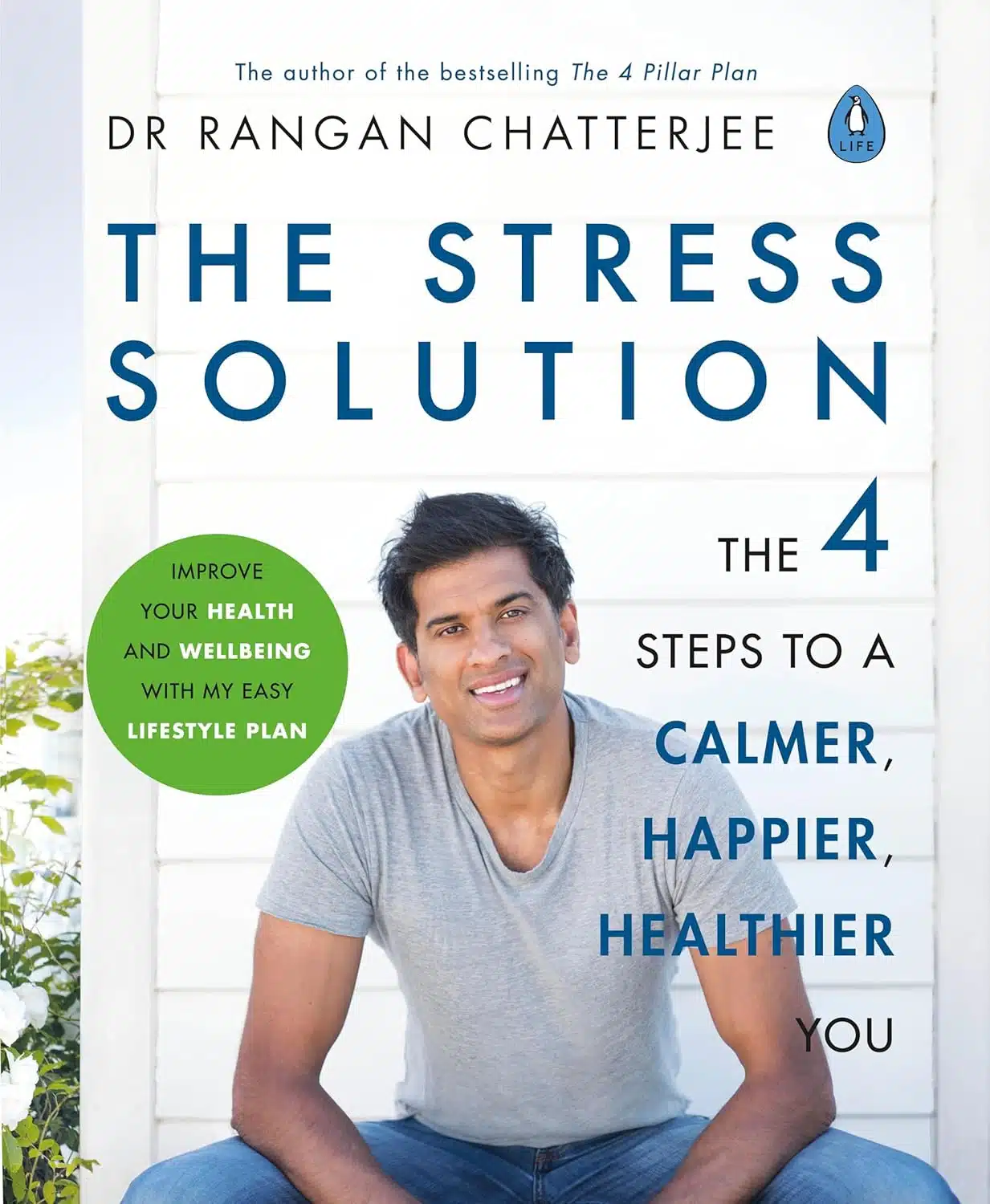
The Stress Solution – by Dr. Rangan Chatterjee

10almonds is reader-supported. We may, at no cost to you, receive a portion of sales if you purchase a product through a link in this article.

You may be wondering: is this a rehash of his bestselling and, if we’re honest, occasionally rehashed work, The Four Pillar Plan?

And the answer is: no, not this time!

This time, the four steps are a matter tending to our:

  1. Purpose
  2. Relationships
  3. Body
  4. Mind

As such, his usual Four Pillar Plan (eat, move, sleep, relax) is contained within the final two steps in this book (body and mind), plus each of those also has extra things this time, and the other two, purpose and relationships, are entirely new material.

Within each of his four steps, he gives 6 things to do to favor them, for a total of 24 things.

If you are living a stressed-out life, you may be wondering where you will find the time and energy to do 24 things, but in many cases they are things you are probably doing badly already and just need a little guidance on how to do better, and the others are things whereby if one makes time for them, somehow, anyhow, they will pay dividends in terms of the freed-up energy and capability that having done them will yield.

The style is Dr. Chatterjee’s trademarked personal-yet-professional, relaxed without shying away from heavy topics, and a focus on communication over technicality.

Bottom line: if you’d like to become a calmer, happier, healthier you, this book can help!

Click here to check out The Stress Solution, and solve your stress!

Don’t Forget…

Did you arrive here from our newsletter? Don’t forget to return to the email to continue learning!

Learn to Age Gracefully

Join the 98k+ American women taking control of their health & aging with our 100% free (and fun!) daily emails:

  • The Doctor’s Kitchen: Healthy High Protein – by Dr. Rupy Aujla

    10almonds is reader-supported. We may, at no cost to you, receive a portion of sales if you purchase a product through a link in this article.

    We previously reviewed another recipe book by the same author, the original “The Doctor’s Kitchen”, and this time it’s more of the same but with a focus on, as the title says, high protein—delivered healthily.

    Before the recipes, we get an overview of the science of protein metabolism, how much we need, and how we can get it from various foods. Because of the emphasis on health, meat isn’t high on the list—but the recipes aren’t all vegan, or even all vegetarian, although there is certainly a “plants-forward” focus throughout.

    Dr. Aujla not being vegan himself is probably a limiting factor on the diversity of the vegan dishes, as he says “if you don’t like soy products or are allergic, you will certainly struggle to get enough protein”. Which is very simply not remotely true (this vegan reviewer gets most of her protein from beans, lentils, and nuts), but he seems to believe it, and for this reason we see a lot of tofu, tempeh, and so forth in the recipes.

    His lack of diversity of experience with vegan cooking notwithstanding, the recipes he does present are very good, so it’s not a problem so much as a limitation, that’s all.

    When he says “healthy high protein”, he not only means that the protein sources will be healthy, but also the rest of the meal too. And, a lot of people think of “healthy” as being “not unhealthy”, but Dr. Aujla cares a lot about positive health—adding in ingredients with many vital nutrients, ensuring that each dish is gut-healthy, anti-inflammatory, and so forth. All these things add up to “healthy”. In short, “healthy” is not merely the absence of unhealthy ingredients, but rather is a matter of vibrant inclusion of things that will actively uplift our health and fortify us against disease.

    Bottom line: if you’d like to cook with plants more, want to get plenty of protein, and do not dislike soy or have an allergy, then this book will be a fine addition to your kitchen.

    Click here to check out The Doctor’s Kitchen: Healthy High Protein, and expand your repertoire!

    Share This Post

  • Mastering Diabetes – by Dr. Cyrus Khambatta & Robby Barbaro

    10almonds is reader-supported. We may, at no cost to you, receive a portion of sales if you purchase a product through a link in this article.

    There are many competing diets out there, for dealing with diabetes. Most focus on different strategies for keeping blood sugar levels even, but that’s only part of the story, and that approach will run into problems if undertaken in isolation, because insulin sensitivity—or as the case may be, insulin resistance—is ultimately the more important factor, and contrary to popular belief, the two things (insulin sensitivity and blood sugar levels) are not so perfectly linked as many might think.

    For this reason, this book focuses on reducing insulin resistance, by minimizing how much insulin-triggering food we consume in favor of foods that help rather than harm. Based on extensive research (discussed in detail in the book), this doesn’t mean “low-carb at all costs”, but rather, sensible carbs (a lot of whole fruits and vegetables) while avoiding insulin triggers (refined carbs, animal products, especially fatty ones, because yes, that triggers insulin too).

    However, this is a lot more than 400 pages to say “eat some fruit”.

    Rather, the authors (Type 1 Diabetics themselves) discuss the different tiers of foods with respect to insulin response, various tests that can and should be done (this is not a “just trust us” approach), and flowcharts to personalize one’s own ideal diet.

    The style is a good balance of being to-the-point and yet comprehensive, with a very heavy weight of evidence and many studies to back every claim. It’s also very easy to read as a reference guide, with many tables of information, callout boxes of key points, and the like.

    Bottom line: if you have any kind of diabetes, or just want to take care of your metabolic health, this book provides not only a blueprint for doing so, but also for personalizing it to your own physiology as you go, so that you can be sure of the results and ongoing beneficial effects, without guesswork.

    Click here to check out Mastering Diabetes, and take control of your insulin sensitivity!

    Share This Post

  • Beetroot vs Tomato – Which is Healthier?

    10almonds is reader-supported. We may, at no cost to you, receive a portion of sales if you purchase a product through a link in this article.

    Our Verdict

    When comparing beetroot to tomato, we picked the beetroot.

    Why?

    Both are great! But we say beetroot comes out on top:

    In terms of macros, beetroot has more protein, carbs, and fiber, making it the more nutritionally dense option. It has a slightly higher glycemic index, but also has specific phytochemicals that lower blood sugars and increase insulin sensitivity, more than cancelling that out. So, a clear win for beetroot in this regard.

    In the category of vitamins, beetroot has more of vitamins B2, B5, B7, and B9, while tomato has more of vitamins A, C, E, and K. We’d call that a 4:4 tie, but tomato’s margins of difference are greater, so we say tomato wins this round.

    When it comes to minerals, beetroot has more calcium, copper, iron, magnesium, manganese, phosphorus, potassium, selenium, and zinc, while tomatoes are not higher in any mineral. An easy win for beetroot here.

    Looking at polyphenols and other remaining phytochemicals, beetroot has most, and especially its betalain content goes a long way. Tomatoes, meanwhile, have a famously high lycopene content (a highly beneficial carotenoid). All in all, it could swing either way based on subjective factors, so we’re saying it’s a tie this time.

    Adding up the sections makes for an overall win for beetroot, but by all means enjoy either or both; diversity is good!

    Want to learn more?

    You might like:

    Enjoy!

    Share This Post

  • Are You Inhaling Microplastics In Your House?

    10almonds is reader-supported. We may, at no cost to you, receive a portion of sales if you purchase a product through a link in this article.

    No, not recreationally. Although if you are doing that, we recommend stopping that, too.

    Rather, we mean accidentally.

    But how?

    It’s not fantastic to breathe plastic

    Our lungs have one job, and they are really really incredibly good at it.

    Seriously, standing out from the rest of the animal kingdom in how good they are at it.

    That one job is gas exchange.

    Oxygen etc in, carbon dioxide etc out. The “etc” usually doesn’t cause any problems (mostly nitrogen, some inert gases, and hopefully minimal pollutants).

    However, if something goes in there that’s not a gas, it’s bad:

    • If what goes in is a liquid, that’s usually bad enough (risk of drowning, pleurisy, pneumonia, etc)
    • If what goes in is a semi-liquid (such as the “tar” residue from smoking) that’s worse, as it’s even harder to clear
    • If something goes in that’s solid, the body has almost* no way to deal with that

    *technically we do have macrophages, but that just changes the nature of the problem slightly, since macrophages usually die upon consuming a foreign body, so if it still can’t be broken down, the end result is it still stays put. Simply, more macrophages will come and try to clean that up, die, then even more macrophages will come and… you get the idea.

    Microplastics are tiny fragments of plastic that can either be manufactured for some purpose (e.g. glitter, body scrubs, etc) or form when larger plastics break down, or appear as fragments of shed fibers from materials such as synthetic clothing, carpets, and household dust.

    Learn more:

    Historically, microplastics have often been talked about in the context of marine contaminants, killing wildlife and also entering the human food chain that way.

    New research by Dr. Nisha Panth et al. shows inhalation can be an equally—or potentially more—troublesome exposure route because our lungs have a truly huge surface area and (as discussed) a limited ability to clear very small particles. And while we don’t all have to eat seafood, we do all have to breathe.

    You may be wondering, what goes wrong when microplastics get into the lungs?

    And the answer is, so many things that we’ll group them into four categories:

    • Inflammation and tissue damage: inhaled microplastics can irritate lung tissue, trigger inflammatory responses (including, but not limited to, that macrophage cascade we talked about), generate reactive oxygen species, deplete antioxidants, disrupt mitochondrial function, and impair tissue repair, contributing to asthma, chronic obstructive pulmonary disease, pulmonary fibrosis, and lung cancer.
    • Cellular and molecular disruption: the review also describes interference with autophagy, ferroptosis, epithelial–mesenchymal transition, and immune signaling, along with increased cellular senescence and weakened lung defenses against infection.
    • Interaction with surfactants: microplastics can bind to lung surfactants, disrupt air sac function, and alter lung mechanics, with certain plastics such as polystyrene showing particular toxicity.
    • Carriers of other toxins: plastic particles can attract and transport pollutants, carcinogens, and microorganisms, delivering them directly into lung tissue and amplifying their harm.

    You can read the paper in full, here: Inhaled microplastics and lung health: Immunopathological effects and disease implications

    Want to look after your lungs more?

    Check out:

    Seven Things To Do For Good Lung Health!

    Take care!

    Don’t Forget…

    Did you arrive here from our newsletter? Don’t forget to return to the email to continue learning!

    Learn to Age Gracefully

    Join the 98k+ American women taking control of their health & aging with our 100% free (and fun!) daily emails:

  • Do You Know Which Supplements You Shouldn’t Take Together? (10 Pairs!)

    10almonds is reader-supported. We may, at no cost to you, receive a portion of sales if you purchase a product through a link in this article.

    Dr. LeGrand Peterson wants us to get the most out of our supplements, so watch out for these…

    Time to split up some pairs…

    In most cases these are a matter of competing for absorption; sometimes to the detriment of both, sometimes to the detriment of one or the other, and sometimes, the problem is entirely different and they just interact in a way that could potentially cause other problems. Dr. Peterson advises as follows:

    1. Vitamin C and vitamin B12: taking these together can reduce the absorption of Vitamin B12, as vitamin C can overpower it.
    2. Vitamin C and copper: high amounts of vitamin C can decrease copper absorption, especially in those who are severely copper deficient.
    3. Magnesium and calcium: these two minerals compete for absorption in the intestines, potentially reducing the effectiveness of both.
    4. Calcium and iron: calcium can decrease iron absorption, so they should not be taken together, especially if you are iron deficient.
    5. Calcium and zinc: calcium also competes with zinc, reducing zinc absorption; they should be taken at different times.
    6. Zinc and copper: zinc and copper compete for absorption, so they should be taken at separate times.
    7. Iron and zinc: iron can decrease zinc absorption, and thus, they should not be taken together.
    8. Iron and green tea: perhaps a surprising one, but green tea can reduce iron absorption, so they should not be taken simultaneously.
    9. Vitamin E and vitamin K: vitamin E increases bleeding risk, while vitamin K promotes clotting, making them opposites and risky to take together.
    10. Fish oil and ginkgo biloba: both are anticoagulants and can increase the risk of bleeding, especially if taken with blood thinners like warfarin.

    If you need to take supplements that compete (or conflict or otherwise potentially adversely interact) with each other, it’s recommended to separate them by at least 4 hours, or better yet, take one in the morning and the other at night. If in doubt, do speak with your pharmacist or doctor for personalized advice

    You may be thinking: half my foods contain half of these nutrients! And yes, assuming you have a nutritionally dense diet, this is probably the case. Foods typically release nutrients more slowly than supplements, and unlike supplements, do not usually contain megadoses (although they can, such as the selenium content of Brazil nuts, or vitamin A in carrots). Basically, food is in most cases safer and gentler than supplements. If concerned, do speak with your nutritionist or doctor for personalized advice.

    For more information on all of these, enjoy:

    Click Here If The Embedded Video Doesn’t Load Automatically!

    Want to learn more?

    You might also like to read:

    Do We Need Supplements, And Do They Work?

    Take care!

    Don’t Forget…

    Did you arrive here from our newsletter? Don’t forget to return to the email to continue learning!

    Learn to Age Gracefully

    Join the 98k+ American women taking control of their health & aging with our 100% free (and fun!) daily emails:

  • Habits of a Happy Brain – by Dr. Loretta Graziano Breuning

    10almonds is reader-supported. We may, at no cost to you, receive a portion of sales if you purchase a product through a link in this article.

    There are lots of books on “happy chemicals” and “how to retrain your brain”, so what makes this one different?

    Firstly, it focuses on four “happy chemicals”, not just one:

    • Serotonin
    • Dopamine
    • Oxytocin
    • Endorphins

    It also looks at the role of cortisol, and how it caps off each of those just a little bit, to keep us just a little malcontent.

    Behavioral psychology tends to focus most on dopamine, while prescription pharmaceuticals for happiness (i.e., most antidepressants) tend to focus on serotonin. Here, Dr. Breuning helps us understand the complex interplay of all of the aforementioned chemicals.

    She also clears up many misconceptions, since a lot of people misattribute the functions of each of these.

    Common examples include “I’m doing this for the serotonin!” when the activity is dopaminergic not serotoninergic, or considering dopamine “the love molecule” when oxytocin, or even something else like phenylethylamine would be more appropriate.

    The above may seem like academic quibbles and not something of practical use, but if we want to biohack our brains, we need to do better than the equivalent of a chef who doesn’t know the difference between salt and sugar.

    Where things are of less practical use, she tends to skip over or at least streamline them. For example, she doesn’t really discuss the role of post-dopamine prolactin in men—but the discussion of post-happiness cortisol covers the same ground anyway, for practical purposes.

    Dr. Breuning also looks at where our evolved neurochemical responses go wrong, and lays out guidelines for such challenges as overcoming addiction, or embracing delayed gratification.

    Bottom line: this book is a great user-manual for the brain. If you’d like to be happier and more effective with fewer bad habits, this is the book for you.

    Click here to check out Habits of a Happy Brain, and get biohacking yours!

    Don’t Forget…

    Did you arrive here from our newsletter? Don’t forget to return to the email to continue learning!

    Learn to Age Gracefully

    Join the 98k+ American women taking control of their health & aging with our 100% free (and fun!) daily emails: