
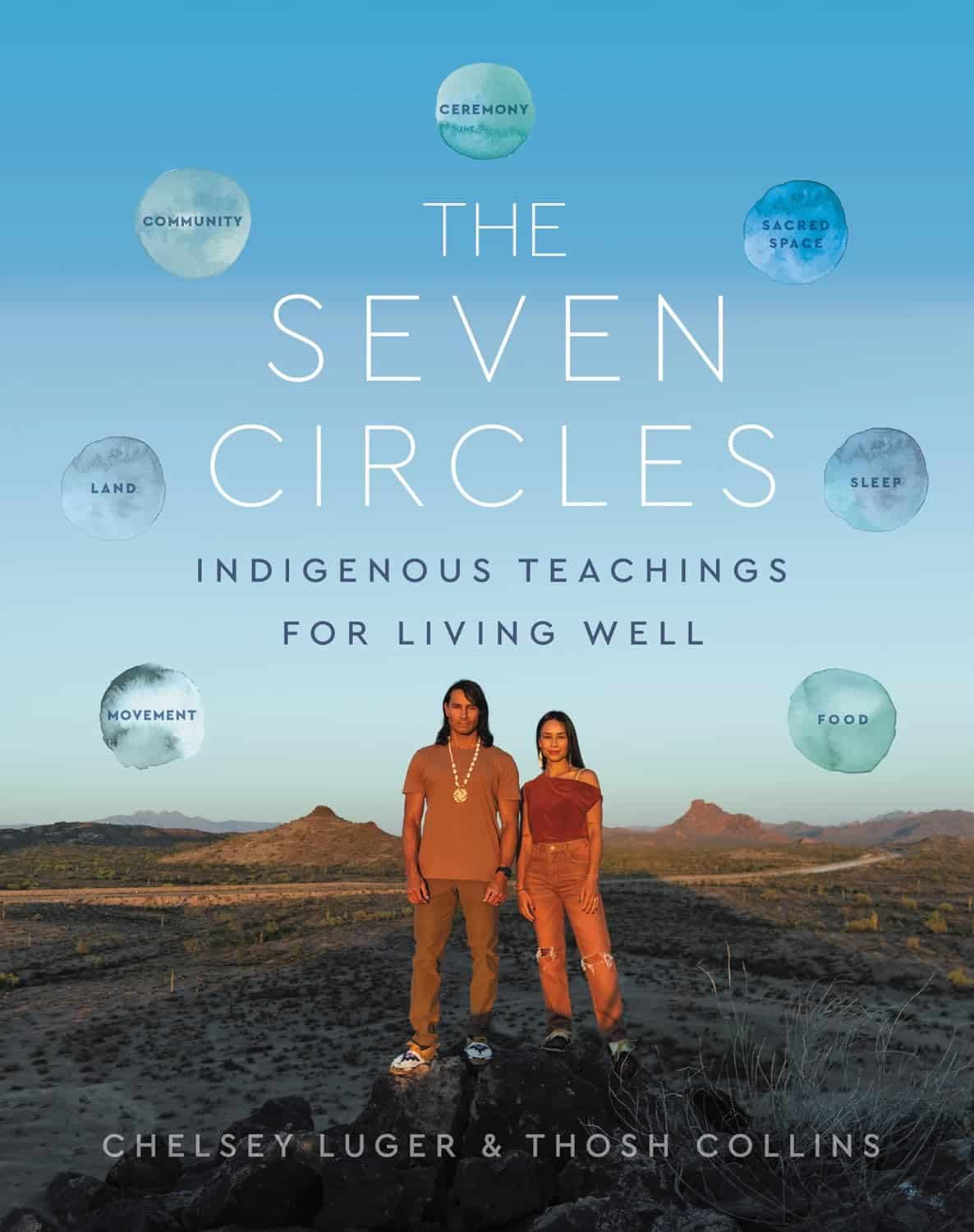
The Seven Circles – by Chelsey Luger & Thosh Collins
10almonds is reader-supported. We may, at no cost to you, receive a portion of sales if you purchase a product through a link in this article.
At first glance, this can seem like an unscientific book—you won’t find links to studies in this one, for sure! However, if we take a look at the seven circles in question, they are:
- Food
- Movement
- Sleep
- Ceremony
- Sacred Space
- Land
- Community
Regular 10almonds readers may notice that these seven items contain five of the things strongly associated with the “supercentenarian Blue Zones”. (If you are wondering why Native American reservations are not Blue Zones, the answer there lies less in health science and more in history and sociology, and what things have been done to a given people).
The authors—who are Native American, yes—present in one place a wealth of knowledge and know-how. Not even just from their own knowledge and their own respective tribes, but gathered from other tribes too.
Perhaps the strongest value of this book to the reader is in the explanation of noting the size of each of those circles, how they connect with each other, and providing a whole well-explained system for how we can grow each of them in harmony with each other.
Or to say the same thing in sciencey terms: how to mindfully improve integrated lifestyle factors synergistically for greater efficacy and improved health-adjusted quality-of-life years.
Bottom line: if you’re not averse to something that mostly doesn’t use sciencey terms of have citations to peer-reviewed studies peppered through the text, then this book has wisdom that’s a) older than the pyramids of Giza, yet also b) highly consistent with our current best science of Blue Zone healthy longevity.
Don’t Forget…
Did you arrive here from our newsletter? Don’t forget to return to the email to continue learning!
Recommended
Learn to Age Gracefully
Join the 98k+ American women taking control of their health & aging with our 100% free (and fun!) daily emails:
-
Healing Arthritis – by Dr. Susan Blum
10almonds is reader-supported. We may, at no cost to you, receive a portion of sales if you purchase a product through a link in this article.
We previously reviewed another book by this author, her Immune System Recovery Plan, and today it’s more specific: healing arthritis
Of course, not all arthritis is rooted in immune dysfunction, but a) all of it is made worse by immune dysfunction and b) rheumatoid arthritis, which is an autoimmune disease, affects 1% of the population.
This book tackles all kinds of arthritis, by focusing on addressing the underlying causes and treating those, and (whether it was the cause or not) reducing inflammation without medication, because that will always help.
The “3 steps” mentioned in the subtitle are three stages of a plan to improve the gut microbiome in such a way that it not only stops worsening your arthritis, but starts making it better.
The style here is on the hard end of pop-science, so if you want something more conversational/personable, then this won’t be so much for you, but if you just want the information and explanation, then this does it just fine, and it has frequent references to the science to back it up, with a reassuringly extensive bibliography.
Bottom line: if you have arthritis and want a book that will help you to get either symptom-free or as close to that as is possible from your current condition (bearing in mind that arthritis is generally degenerative), then this is a great book for that.
Share This Post
-
Coffee’s Paradoxical Blood Pressure Effects
10almonds is reader-supported. We may, at no cost to you, receive a portion of sales if you purchase a product through a link in this article.
Usually, when we talk about coffee (and/or caffeine) and cardiovascular health, the question is more about potential increase of health risks, often because of dipterpenes such as cafestol and kahweol, which can raise LDL cholesterol:
However, that’s not the whole story…
A matter of time
The crux here, when it comes to “is coffee good or bad for blood pressure?”, is the question of “in the moment, or generally?”
Because most of coffee’s interesting effects come from:
- its stimulant qualities in the moment
- its antioxidant qualities in general
The stimulant qualities are relevant in the moment because they will invariably increase adrenaline release, narrow blood vessels, and sometimes (depends on the person) raise heart rate, all of which can increase systolic pressure by about 3-15 mmHg and diastolic pressure by about 4-13 mmHg for several hours after consumption, especially in people who are caffeine-sensitive, infrequent users, or already hypertensive.
Note: caffeine levels peak 30–120 minutes after oral intake and/but caffeine’s half-life is 3–6 hours, hence the “for several hours” qualification.
You can read more about this, here: Timing of Blood Pressure Measurement Related to Caffeine Consumption
The antioxidant qualities are relevant in general because of how they improve endothelial function and nitric oxide bioavailability in the arterial vasculature.
You can read more about this, here: Antihypertensive effects and mechanisms of chlorogenic acids ← this paper is just about the chlorogenic acids, but the broad principles apply to most if not all of the many antioxidants found in coffee.
Indeed, in a recent meta-analysis of 13 studies:
❝We included a total of 13 longitudinal cohort studies, which involved a total of 64,650 incident cases of hypertension among 314,827 participants. In a random effects model meta-analysis of all the studies, coffee intake was not significantly associated with the risk of hypertension (relative risk [RR], 0.97; 95% confidence interval [CI], 0.90–1.05; I2 = 58.0%; n = 13). In the subgroup meta-analysis, coffee intake was associated with a decreased risk of hypertension in studies conducted in America (RR, 0.93; 95% CI, 0.87–0.98; I2 = 4.6%; n = 5) and in low-quality studies (RR, 0.92; 95% CI, 0.88–0.96; I2 = 0.0%; n = 7). In the remaining subgroup meta-analyses by amount of coffee intake, gender, type of coffee (decaffeinated vs. caffeinated), smoking, and years of follow-up, coffee intake was not significantly associated with the risk of hypertension.❞
Source: Coffee Intake and Risk of Hypertension: A Meta-Analysis of Cohort Studies
In other words: coffee can temporarily raise blood pressure, but moderate consumption is usually actively heart-healthy for most people; your overall cardiovascular will still depend on your baseline blood pressure, genetics, and other lifestyle factors, though.
What else does coffee do for us?
As a quick recap:
- 43% reduced risk of liver cancer for coffee-drinkers
- 53% reduced suicide risk for coffee-drinkers
- Coffee is the world’s biggest source of antioxidants
- 65% reduced risk of Alzheimer’s for coffee-drinkers
- 67% reduced risk of type 2 diabetes for coffee-drinkers*
*See also: The Other Thing Coffee Does To Your Blood Sugars
As well as other benefits, such as Coffee & Your Gut ← gut bacteria do not, by the way, have a preference about how you make your coffee or whether it is caffeinated or not
Aaaaaand, we recently shared new research on how coffee appears to be protective against frailty in older age. We say “appears to be”, because it was a longitudinal study and so technically we cannot say categorically that the link was causal, but the association is very strong, to the point that it’d take quite some explaining if it’s anything other than the coffee consumption that caused it.
You can read about that here: Coffee vs Frailty!
Not a fan of coffee?
If you’re not a fan of coffee, but also not a fan of high blood pressure, frailty, cancer, Alzheimer’s, suicide, diabetes, atrial fibrillation, and more, fear not; there is a supplement option available:
Green Coffee Bean Extract: Coffee Benefits Without The Coffee?
Enjoy!
Share This Post
-
The Body: A Guide for Occupants – by Bill Bryson
10almonds is reader-supported. We may, at no cost to you, receive a portion of sales if you purchase a product through a link in this article.
Better known for his writings on geography and history, here Bryson puts his mind to anatomy and physiology. How well does he do?
Very well, actually—thanks no doubt to the oversight of the veritable flock of consulting scientists mentioned in the acknowledgements. To this reviewer’s knowledge, no mistakes made it through into publication.
That said, Bryson’s love of history does shine through, and in this case, the book is as much a telling of medical history, as it is of the human body. That’s a feature not a bug, though, as not only is it fascinating in and of itself, but also, it’d be difficult to fully understand where we’re at in science, without understanding how we got here.
The style of the book is easy-reading narrative prose, but packed with lots of quirky facts, captivating anecdotes, and thought-provoking statistics. For example:
- The least effective way to spread germs is kissing. It proved ineffective among volunteers (in what sounds like a fun study) who had been successfully infected with the cold virus. Sneezes and coughs weren’t much better. The only really reliable way to transfer cold germs was physically by touch.
- The United States has 4% of the world’s population but consumes 80% of its opiates.
- Allowing a fever to run its course (within limits) could be the wisest thing. An increase of only a degree or so in body temperature slows the replication rate of viruses by a factor of 200.
Still, these kinds of things are woven together so well, that it doesn’t feel at all like reading a trivia list!
Bottom line: if you’d like to know a lot more about anatomy and physiology, but prefer a very casual style rather than sitting down with a stack of textbooks, this book is a great option.
Click here to check out The Body, and learn more about yours!
Share This Post
Related Posts
-
Healing Your Gut: Anastasia’s Journey and Tips
10almonds is reader-supported. We may, at no cost to you, receive a portion of sales if you purchase a product through a link in this article.
Anastasia Gurova shares her inspiring journey from chronic gut issues to vibrant health.
A Personal Journey to Gut Health
In the below video, Anastasia shares her long struggle with gut problems, including SIBO, IBS, and gastritis. She talks about ending up in the hospital with severe bloating, only to find that a range of medical approaches didn’t provide her with any lasting relief. This led her to explore the importance of the microbiome and its crucial role in gut health, which is what we’ll be focusing on in this overview.
Key Insights and Tips
The most valuable parts of Anastasia’s story for 10almonds readers are, in our opinion, the solutions she discovered to her gut issues. You’ll have to watch her video to discover all of them, but here are some of our favorites:
- Reintroduce Whole Grains and Legumes: Despite the popularity of grain-free diets, Anastasia found significant improvements in her gut health by adding whole grains like quinoa, oats, and buckwheat back into her diet. These foods provide essential fibers that feed beneficial gut bacteria.
- Soaking and Fermenting Foods: To make grains and legumes more digestible, Anastasia recommends soaking them overnight. This is similar to the common technique people use on oats. She also includes fermented foods like sauerkraut, kimchi, and yogurt in her diet, which introduce beneficial bacteria to the gut.
- Resistant Starches: Foods like cooked and cooled rice, potatoes, and green bananas contain resistant starches that promote healthy gut bacteria. Anastasia emphasizes incorporating these into meals to support gut health.
- Mindful Eating: Anastasia found that taking time to chew food thoroughly and savor each bite helped improve her digestion. She avoids distractions like TV while eating and pays attention to the textures and flavors of her meals.
- Avoid Overly Restrictive Diets: Anastasia warns against overly restrictive diets like keto and strict SIBO diets that cut out all carbs and fiber. These can worsen gut health by starving beneficial bacteria.
That’s Only The Beginning
Anastasia’s video goes far beyond what we’ve covered in this short introduction; she provides a detailed look at the steps she took, from dietary changes to lifestyle adjustments, and offers tips that anyone can apply. Plus, she explains the science behind these changes, which, of course, we love.
Enjoy the video! (It would be remiss for us to not bring up our general intro to gut health, or our more specific article on the gut-brain connection)
Good luck on your gut-health journey!
Don’t Forget…
Did you arrive here from our newsletter? Don’t forget to return to the email to continue learning!
Learn to Age Gracefully
Join the 98k+ American women taking control of their health & aging with our 100% free (and fun!) daily emails:
-
What Are The “Bright Lines” Of Bright Line Eating?
10almonds is reader-supported. We may, at no cost to you, receive a portion of sales if you purchase a product through a link in this article.
This is Dr. Susan Thompson. She’s a cognitive neuroscientist who has turned her hand to helping people to lose weight and maintain it at a lower level, using psychology to combat overeating. She is the founder of “Bright Line Eating”.
We’ll say up front: it’s not without some controversy, and we’ll address that as we go, but we do believe the ideas are worth examining, and then we can apply them or not as befits our personal lives.
What does she want us to know?
Bright Line Eating’s general goal
Dr. Thompson’s mission statement is to help people be “happy, thin, and free”.
You will note that this presupposes thinness as desirable, and presumes it to be healthy, which frankly, it’s not for everyone. Indeed, for people over a certain age, having a BMI that’s slightly into the “overweight” category is a protective factor against mortality (which is partly a flaw of the BMI system, but is an interesting observation nonetheless):
When BMI Doesn’t Quite Measure Up
Nevertheless, Dr. Thompson makes the case for the three items (happy, thin, free) coming together, which means that any miserable or unhealthy thinness is not what the approach is valuing, since it is important for “thin” to be bookended by “happy” and “free”.
What are these “bright lines”?
Bright Line Eating comes with 4 rules:
- No flour (no, not even wholegrain flour; enjoy whole grains themselves yes, but flour, no)
- No sugar (and as a tag-along to this, no alcohol) (sugars naturally found in whole foods, e.g. the sugar in an apple if eating an apple, is ok, but other kinds are not, e.g. foods with apple juice concentrate as a sweetener; no “natural raw cane sugar” etc is not allowed either; despite the name, it certainly doesn’t grow on the plant like that)
- No snacking, just three meals per day(not even eating the ingredients while cooking—which also means no taste-testing while cooking)
- Weigh all your food (have fun in restaurants—but more seriously, the idea here is to plan each day’s 3 meals to deliver a healthy macronutrient balance and a capped calorie total).
You may be thinking: “that sounds dismal, and not at all bright and cheerful, and certainly not happy and free”
The name comes from the idea that these rules are lines that one does not cross. They are “bright” lines because they should be observed with a bright and cheery demeanour, for they are the rules that, Dr. Thompson says, will make you “happy, thin, and free”.
You will note that this is completely in opposition to the expert opinion we hosted last week:
What Flexible Dieting Really Means
Dr. Thompson’s position on “freedom” is that Bright Line Eating is “very structured and takes a liberating stand against moderation”
Which may sound a bit of an oxymoron—is she really saying that we are going to be made free from freedom?
But there is some logic to it, and it’s about the freedom from having to make many food-related decisions at times when we’re likely to make bad ones:
Where does the psychology come in?
Dr. Thompson’s position is that willpower is a finite, expendable resource, and therefore we should use it judiciously.
So, much like Steve Jobs famously wore the same clothes every day because he had enough decisions to make later in the day that he didn’t want unnecessary extra decisions to make… Bright Line Eating proposes that we make certain clear decisions up front about our eating, so then we don’t have to make so many decisions (and potentially the wrong decisions) later when hungry.
You may be wondering: ”doesn’t sticking to what we decided still require willpower?”
And… Potentially. But the key here is shutting down self-negotiation.
Without clear lines drawn in advance, one must decide, “shall I have this cake or not?”, perhaps reflecting on the pros and cons, the context of the situation, the kind of day we’re having, how hungry we are, what else there is available to eat, what else we have eaten already, etc etc.
In short, there are lots of opportunities to rationalize the decision to eat the cake.
With clear lines drawn in advance, one must decide, “shall I have this cake or not?” and the answer is “no”.
So while sticking to that pre-decided “no” still may require some willpower, it no longer comes with a slew of tempting opportunities to rationalize a “yes”.
Which means a much greater success rate, both in adherence and outcomes. Here’s an 8-week interventional study and 2-year follow-up:
Bright Line Eating | Research Publications
Counterpoint: pick your own “bright lines”
Dr. Thompson is very keen on her 4 rules that have worked for her and many people, but she recognizes that they may not be a perfect fit for everyone.
So, it is possible to pick and choose our own “bright lines”; it is after all a dietary approach, not a religion. Here’s her response to someone who adopted the first 3 rules, but not the 4th:
Bright Lines as Guidelines for Weight Loss
The most important thing for Bright Line Eating, therefore, is perhaps the action of making clear decisions in advance and sticking to them, rather than seat-of-the-pantsing our diet, and with it, our health.
Want to know more from Dr. Thompson?
You might like her book, which we reviewed a while ago:
Bright Line Eating – by Dr. Susan Peirce Thompson
Enjoy!
Don’t Forget…
Did you arrive here from our newsletter? Don’t forget to return to the email to continue learning!
Learn to Age Gracefully
Join the 98k+ American women taking control of their health & aging with our 100% free (and fun!) daily emails:
-
What Happens Every Day When You Quit Sugar For 30 Days
10almonds is reader-supported. We may, at no cost to you, receive a portion of sales if you purchase a product through a link in this article.
We all know that sugar isn’t exactly a health food, but it can be hard to quit. How long can cravings be expected to last, and when can we expect to see benefits? Today’s video covers the timeline in a realistic yet inspiring fashion:
What to expect on…
Day 1: expect cravings and withdrawal symptoms including headaches, fatigue, mood swings, and irritability—as well as tiredness, without the crutch of sugar.
Days 2 & 3: more of the same, plus likely objections from the gut, since your Candida albicans content will not be enjoying being starved of its main food source.
Days 4–7: reduction of the above symptoms, better energy levels, improved sleep, and likely the gut will be adapting or have adapted.
Days 8–14: beginning of weight loss, clearer skin, improved complexion; taste buds adapt too, making foods taste sweeter. Continued improvement in energy and focus, as well.
Days 15–21: more of the same improvements, plus the immune system will start getting stronger around now. But watch out, because there may still be some cravings from time to time.
Days 22–30: all of the above positive things, few or no cravings now, and enhanced metabolic health as a whole.
For more specificity on each of these stages, enjoy:
Click Here If The Embedded Video Doesn’t Load Automatically!
Want to learn more?
You might also like to read:
The Not-So-Sweet Science Of Sugar Addiction
Take care!
Don’t Forget…
Did you arrive here from our newsletter? Don’t forget to return to the email to continue learning!
Learn to Age Gracefully
Join the 98k+ American women taking control of their health & aging with our 100% free (and fun!) daily emails:


