
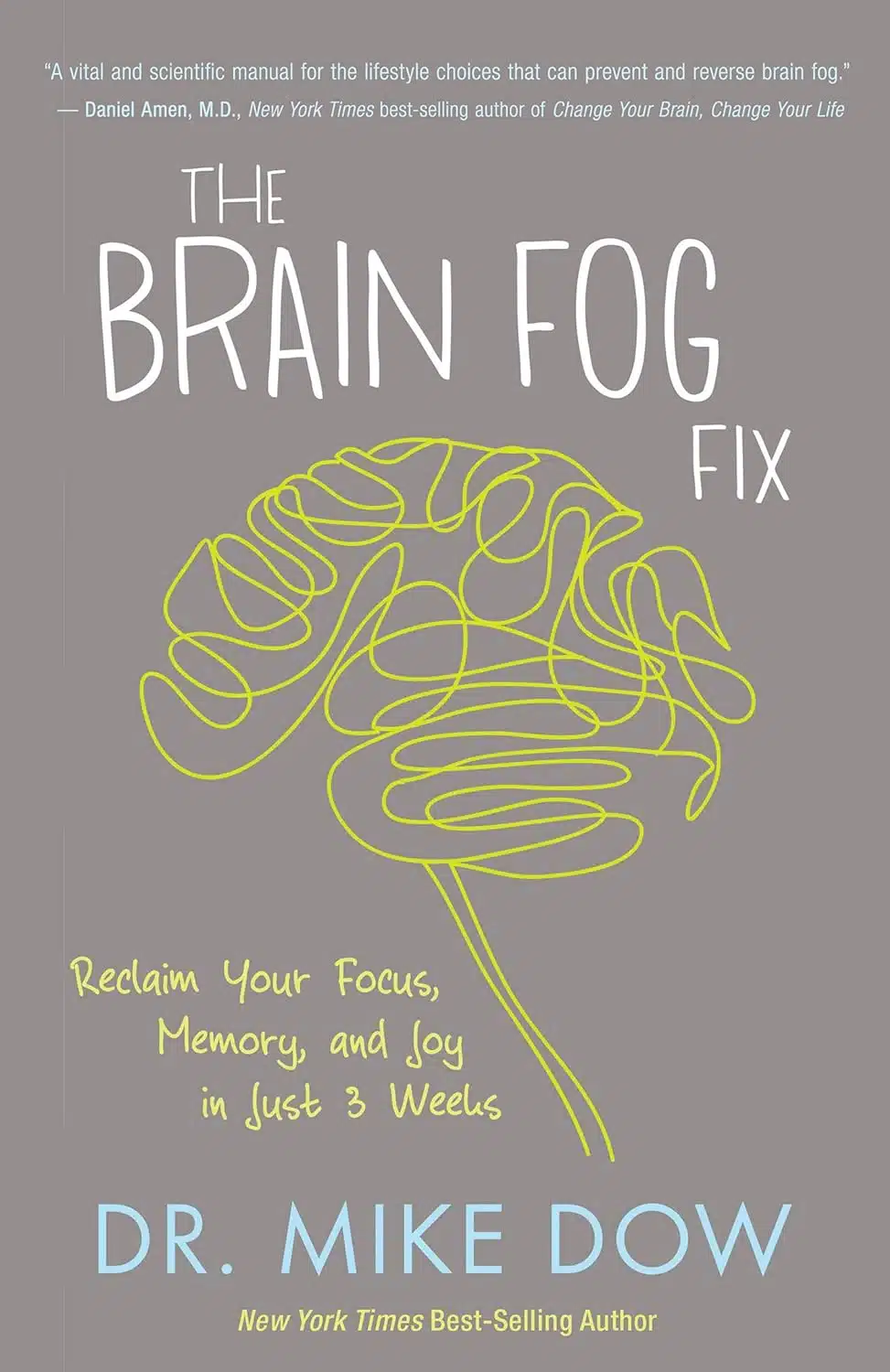
The Brain Fog Fix – by Dr. Mike Dow

10almonds is reader-supported. We may, at no cost to you, receive a portion of sales if you purchase a product through a link in this article.

The three weeks mentioned in the subtitle is in fact a week-by-week plan:

  1. Adjusting diet (inclusions and exclusions) and cognitive strategies
  2. Focusing on sleep, exercise, and memory-boosting “brain games”
  3. Bringing in the social aspect, and connection to something larger than oneself

In this reviewer’s opinion, a week is too short a time to completely overhaul one’s diet; most changes need to be gradual, so doing several at once in a week is quite extreme. But, even if it takes a month for each stage instead of a week, the method is reasonable.

The nutritional advice is good, and consistent with current best science on the topic. There’s a lot about keeping even blood sugars and improving insulin sensitivity, as well as doing what is best for the heart and blood in general (e.g. fiber, managing triglycerides, doing the right kinds of exercise, etc).

As a psychotherapist, he also talks a fair bit about neurotransmitters, and making sure one’s gut and brain are fed appropriately to keep the correct balance (remembering for example that serotonin is made in the gut, and dopamine is made in the brain). Unlike many of his colleagues, he’s not a fan of medicating beyond absolute necessity.

The style is a little salesy for this reviewer’s personal taste—but then again, perhaps he made the reasonable assumption that a person reading a book entitled “the brain fog fix” needs their attention grabbing and re-grabbing every paragraph or so. As such, maybe it’s not a bad call.

Bottom line: if you have brain fog and would like to not have brain fog, this book offers a scientifically sound, evidence-based, holistic approach that can certainly improve things.

Click here to check out The Brain Fog Fix, and fix your brain fog!

Don’t Forget…

Did you arrive here from our newsletter? Don’t forget to return to the email to continue learning!

Learn to Age Gracefully

Join the 98k+ American women taking control of their health & aging with our 100% free (and fun!) daily emails:

  • Hypertension: Factors Far More Relevant Than Salt

    10almonds is reader-supported. We may, at no cost to you, receive a portion of sales if you purchase a product through a link in this article.

    Hypertension: Factors Far More Relevant Than Salt

    Firstly, what is high blood pressure vs normal, and what do those blood pressure readings mean?

    Rather than take up undue space here, we’ll just quickly link to…

    Blood Pressure Readings Explained (With A Colorful Chart)

    More details of specifics, at:

    Hypotension | Normal | Elevated | Stage 1 | Stage 2 | Danger zone

    Keeping Blood Pressure Down

    As with most health-related things (and in fact, much of life in general), prevention is better than cure.

    People usually know “limit salt” and “manage stress”, but there’s a lot more to it!

    Salt isn’t as big a factor as you probably think

    That doesn’t mean go crazy on the salt, as it can cause a lot of other problems, including organ failure. But it does mean that you can’t skip the salt and assume your blood pressure will take care of itself.

    This paper, for example, considers “high” sodium consumption to be more than 5g per day, and urinary excretion under 3g per day is considered to represent a low sodium dietary intake:

    Sodium Intake and Hypertension

    Meanwhile, health organizations often recommend to keep sodium intake to under 2g or under 1.5g

    Top tip: if you replace your table salt with “reduced sodium” salt, this is usually sodium chloride (regular table salt) cut with potassium chloride, which is almost as “salty” tastewise, but obviously contains less sodium. Not only that, but potassium actually helps the body eliminate sodium, too.

    The rest of what you eat is important too

    The Mediterranean Diet is as great for this as it is for most health conditions.

    If you sometimes see the DASH diet mentioned, that stands for “Dietary Approaches to Stop Hypertension”, and is basically the Mediterranean Diet with a few tweaks.

    What are the tweaks?

    • Beans went down a bit in priority
    • Red meat got removed entirely instead of “limit to a tiny amount”
    • Olive oil was deprioritized, and/but vegetable oil is at the bottom of the list (i.e., use sparingly)

    You can check out the details here, with an overview and examples:

    DASH Eating Plan—Description, Charts, and Recipes

    Don’t drink or smoke

    And no, a glass of red a day will not help your heart. Alcohol does make us feel relaxed, but that is because of what it does to our brain, not what it does to our heart.

    In reality, even a single drink will increase blood pressure. Yes, really:

    Alcohol Intake and Blood Pressure Levels: A Dose-Response Meta-Analysis of Nonexperimental Cohort Studies

    And smoking? It’s so bad that even second-hand smoke increases blood pressure:

    Associations of Smoke‐Free Policies in Restaurants, Bars, and Workplaces With Blood Pressure Changes in the CARDIA Study

    Get those Zs in

    Sleep is a commonly underestimated/forgotten part of health, precisely because in a way, we’re not there for it when it happens. We sleep through it! But it is important, including to protect against hypertension:

    Short- and long-term health consequences of sleep disruption

    Move your body!

    Moving your body often is far more important for your heart than running marathons or bench-pressing your spouse.

    Those 150 minutes “moderate exercise” (e.g. walking) per week are important, and can be for example:

    • 22 minutes per day, 7 days per week
    • 25 minutes per day, 6 days per week
    • 30 minutes per day, 5 days per week
    • 75 minutes per day, 2 days per week

    If you’d like to know more about the science and evidence for this, as well as practical suggestions, you can download the complete second edition of the Physical Activity Guidelines for Americans here (it’s free, and no sign-up required!)

    If you prefer a bite-size summary, then here’s their own:

    Top 10 Things to Know About the Second Edition of the Physical Activity Guidelines for Americans

    PS: Want a blood pressure monitor? We don’t sell them (or anything else), but for your convenience, here’s a good one you might want to consider.

    Share This Post

  • Blackberries vs Dates – Which is Healthier?

    10almonds is reader-supported. We may, at no cost to you, receive a portion of sales if you purchase a product through a link in this article.

    Our Verdict

    When comparing blackberries to dates, we picked the dates.

    Why?

    Both are great! But…

    In terms of macros, dates have nearly 2x the fiber, as well as more carbs and protein, making them the more nutrient-dense option in this category.

    In the category of vitamins, blackberries have more of vitamins C, E, and K, while dates have more of vitamins B1, B2, B3, B5, and B6, winning here too.

    Looking at minerals, blackberries have more manganese and zinc, while dates have more calcium, copper, iron, magnesium, phosphorus, potassium, and selenium, winning their third round in a row.

    In other considerations, both are great for polyphenols, but blackberries do have more, so that’s a point in blackberries’ favor.

    Adding up the sections makes for a clear overall win for dates, but by all means do enjoy either or both, as diversity is best!

    Want to learn more?

    You might like:

    From Apples to Bees, and High-Fructose Cs: Which Sugars Are Healthier, And Which Are Just The Same? ← for any wondering about the sugariness of dates, and why they’re just fine regardless 😎

    Enjoy!

    Share This Post

  • Cherries vs Gooseberries – Which is Healthier?

    10almonds is reader-supported. We may, at no cost to you, receive a portion of sales if you purchase a product through a link in this article.

    Our Verdict

    When comparing cherries to gooseberries, we picked the gooseberries.

    Why?

    In terms of macros, cherries have slightly more carbs while gooseberries have nearly 3x the fiber, winning this round easily.

    In the category of vitamins, cherries have more of vitamins A, B2, B3, and B9, while gooseberries have more of vitamins B1, B5, B6, C, and E, scoring a modestly marginal win here.

    Looking at minerals, cherries have more copper, while gooseberries have more calcium, magnesium, manganese, phosphorus, potassium, selenium, and zinc, for an easy third win.

    When it comes to other consideration, cherries have more polyphenols by far, mostly anthocyanins and hydroxycinnamic acids, which are largely responsible for the special health benefits of cherries detailed in the link in the “Learn more” section below.

    Adding up the sections makes for a clear overall win for gooseberries, but as you can see, cherries absolutely have their merits too, so by all means enjoy either or both!

    Want to learn more?

    You might like:

    Cherries’ Very Healthy Wealth Of Benefits!

    Enjoy!

    Share This Post

  • What Causes Your Appendix To Burst?

    10almonds is reader-supported. We may, at no cost to you, receive a portion of sales if you purchase a product through a link in this article.

    And what does it feel like?

    Spoiler: it isn’t fun

    Story time: in April 1961, during the Sixth Soviet Antarctic Expedition, Dr. Leonid Rogozov developed appendicitis while isolated by a blizzard, leaving him with the choice of waiting for help (near certain death) or performing surgery on himself (not an enviable task, but fair chance of survival); he successfully removed his own appendix under local anesthesia and returned to work two weeks later.

    And that’s why it’s now not uncommon to have a prophylactic appendectomy before going there!

    First, let’s bust a myth: the appendix is a small, worm-shaped pouch attached to the large intestine that contains a diverse community of gut microbes; although once considered a useless evolutionary remnant, evidence suggests it evolved independently in many mammals, suggesting it serves some useful functions, such as (at the very least) acting as a non-moving (unlike the rest of the gut) reservoir for beneficial gut bacteria, and/or contributing to beneficial immune responses.

    However. Sometimes the immune responses are not at all beneficial, and appendicitis usually begins when the appendix becomes blocked, often by an appendicolith (hardened feces), or when infections and/or misfiring immune responses cause nearby lymph tissue to swell and seal its opening.

    This gets very dangerous very quickly because the appendix is a closed-ended pouch, meaning blockage causes pressure to build, allowing bacteria to multiply rapidly; as swelling increases, blood flow is reduced, weakening the appendix until it may rupture, releasing bacteria into the abdominal cavity and causing a potentially life-threatening infection.

    How to recognize it: appendicitis typically causes pain that begins near the belly button before moving to the lower right abdomen and becoming more severe, unlike a typical stomach ache.

    Not included in the video, but there’s a useful self-check that you can do too: if you are experiencing a sharp pain in that general area and are worrying if it is appendicitis, then pressing on the appropriately named McBurney’s point is a first-line test for appendicitis. If, after pressing, it hurts a lot more upon removal of pressure (rather than upon application of pressure), this is considered a likely sign of appendicitis. Get thee to a hospital, quickly.

    And if it doesn’t? Still get it checked out at your earliest convenience, of course (better safe than sorry), but you might make an appointment instead of calling an ambulance.

    For more on all of this (apart from that last addition of ours), enjoy:

    Click Here If The Embedded Video Doesn’t Load Automatically!

    Want to learn more?

    You might also like:

    Women and Minorities Bear the Brunt of Medical Misdiagnosis

    Take care!

    Don’t Forget…

    Did you arrive here from our newsletter? Don’t forget to return to the email to continue learning!

    Learn to Age Gracefully

    Join the 98k+ American women taking control of their health & aging with our 100% free (and fun!) daily emails:

  • War in Ukraine affected wellbeing worldwide, but people’s speed of recovery depended on their personality

    10almonds is reader-supported. We may, at no cost to you, receive a portion of sales if you purchase a product through a link in this article.

    The war in Ukraine has had impacts around the world. Supply chains have been disrupted, the cost of living has soared and we’ve seen the fastest-growing refugee crisis since World War II. All of these are in addition to the devastating humanitarian and economic impacts within Ukraine.

    Our international team was conducting a global study on wellbeing in the lead up to and after the Russian invasion. This provided a unique opportunity to examine the psychological impact of the outbreak of war.

    As we explain in a new study published in Nature Communications, we learned the toll on people’s wellbeing was evident across nations, not just in Ukraine. These effects appear to have been temporary – at least for the average person.

    But people with certain psychological vulnerabilities struggled to recover from the shock of the war.

    Tracking wellbeing during the outbreak of war

    People who took part in our study completed a rigorous “experience-sampling” protocol. Specifically, we asked them to report their momentary wellbeing four times per day for a whole month.

    Data collection began in October 2021 and continued throughout 2022. So we had been tracking wellbeing around the world during the weeks surrounding the outbreak of war in February 2022.

    We also collected measures of personality, along with various sociodemographic variables (including age, gender, political views). This enabled us to assess whether different people responded differently to the crisis. We could also compare these effects across countries.

    Our analyses focused primarily on 1,341 participants living in 17 European countries, excluding Ukraine itself (44,894 experience-sampling reports in total). We also expanded these analyses to capture the experiences of 1,735 people living in 43 countries around the world (54,851 experience-sampling reports) – including in Australia.

    A global dip in wellbeing

    On February 24 2022, the day Russia invaded Ukraine, there was a sharp decline in wellbeing around the world. There was no decline in the month leading up to the outbreak of war, suggesting the change in wellbeing was not already occurring for some other reason.

    However, there was a gradual increase in wellbeing during the month after the Russian invasion, suggestive of a “return to baseline” effect. Such effects are commonly reported in psychological research: situations and events that impact our wellbeing often (though not always) do so temporarily.

    Unsurprisingly, people in Europe experienced a sharper dip in wellbeing compared to people living elsewhere around the world. Presumably the war was much more salient for those closest to the conflict, compared to those living on an entirely different continent.

    Interestingly, day-to-day fluctuations in wellbeing mirrored the salience of the war on social media as events unfolded. Specifically, wellbeing was lower on days when there were more tweets mentioning Ukraine on Twitter/X.

    Our results indicate that, on average, it took around two months for people to return to their baseline levels of wellbeing after the invasion.

    Different people, different recoveries

    There are strong links between our wellbeing and our individual personalities.

    However, the dip in wellbeing following the Russian invasion was fairly uniform across individuals. None of the individual factors assessed in our study, including personality and sociodemographic factors, predicted people’s response to the outbreak of war.

    On the other hand, personality did play a role in how quickly people recovered. Individual differences in people’s recovery were linked to a personality trait called “stability”. Stability is a broad dimension of personality that combines low neuroticism with high agreeableness and conscientiousness (three traits from the Big Five personality framework).

    Stability is so named because it reflects the stability of one’s overall psychological functioning. This can be illustrated by breaking stability down into its three components:

    1. low neuroticism describes emotional stability. People low in this trait experience less intense negative emotions such as anxiety, fear or anger, in response to negative events
    2. high agreeableness describes social stability. People high in this trait are generally more cooperative, kind, and motivated to maintain social harmony
    3. high conscientiousness describes motivational stability. People high in this trait show more effective patterns of goal-directed self-regulation.

    So, our data show that people with less stable personalities fared worse in terms of recovering from the impact the war in Ukraine had on wellbeing.

    In a supplementary analysis, we found the effect of stability was driven specifically by neuroticism and agreeableness. The fact that people higher in neuroticism recovered more slowly accords with a wealth of research linking this trait with coping difficulties and poor mental health.

    These effects of personality on recovery were stronger than those of sociodemographic factors, such as age, gender or political views, which were not statistically significant.

    Overall, our findings suggest that people with certain psychological vulnerabilities will often struggle to recover from the shock of global events such as the outbreak of war in Ukraine.The Conversation

    Luke Smillie, Professor in Personality Psychology, The University of Melbourne

    This article is republished from The Conversation under a Creative Commons license. Read the original article.

    Don’t Forget…

    Did you arrive here from our newsletter? Don’t forget to return to the email to continue learning!

    Learn to Age Gracefully

    Join the 98k+ American women taking control of their health & aging with our 100% free (and fun!) daily emails:

  • Unlimited Memory – by Kevin Horsley

    10almonds is reader-supported. We may, at no cost to you, receive a portion of sales if you purchase a product through a link in this article.

    Premise: there are easily learnable techniques to rapidly (and greatly) improve one’s memory. We’ve touched on some of these methods before at 10almonds, but being a newsletter rather than a book, we’ve not been able to go as deeply into it as Horsley!

    Your memory is far, far, far more powerful than you might realize, and this book will help unlock that. To illustrate…

    Some of the book is given over to what are for most purposes “party tricks”, such as remembering pi to 10,000 places. Those things are fun, even if not as practical in today’s world of rarely needing to even know the actual digits of a phone number. However, they do also serve as a good example of just how much of “super memory” isn’t a matter of hard work, so much as being better organized about it.

    Most of the book is focused on practical methods to improve the useful aspects of memory—including common mistakes!

    If the book has any flaw it’s that the first chapter or so is spent persuading the reader of things we presumably already believe, given that we bought the book. For example, that remembering things is a learnable skill and that memory is functionally limitless. However, we still advise to not skip those chapters as they do contain some useful reframes as well.

    Bottom line: if you read this book you will be astonished by how much you just learned—because you’ll be able to recall whole sections in detail! And then you can go apply that whatever areas of your life you wanted to when you bought the book.

    Get your copy of Unlimited Memory from Amazon today!

    Don’t Forget…

    Did you arrive here from our newsletter? Don’t forget to return to the email to continue learning!

    Learn to Age Gracefully

    Join the 98k+ American women taking control of their health & aging with our 100% free (and fun!) daily emails: