
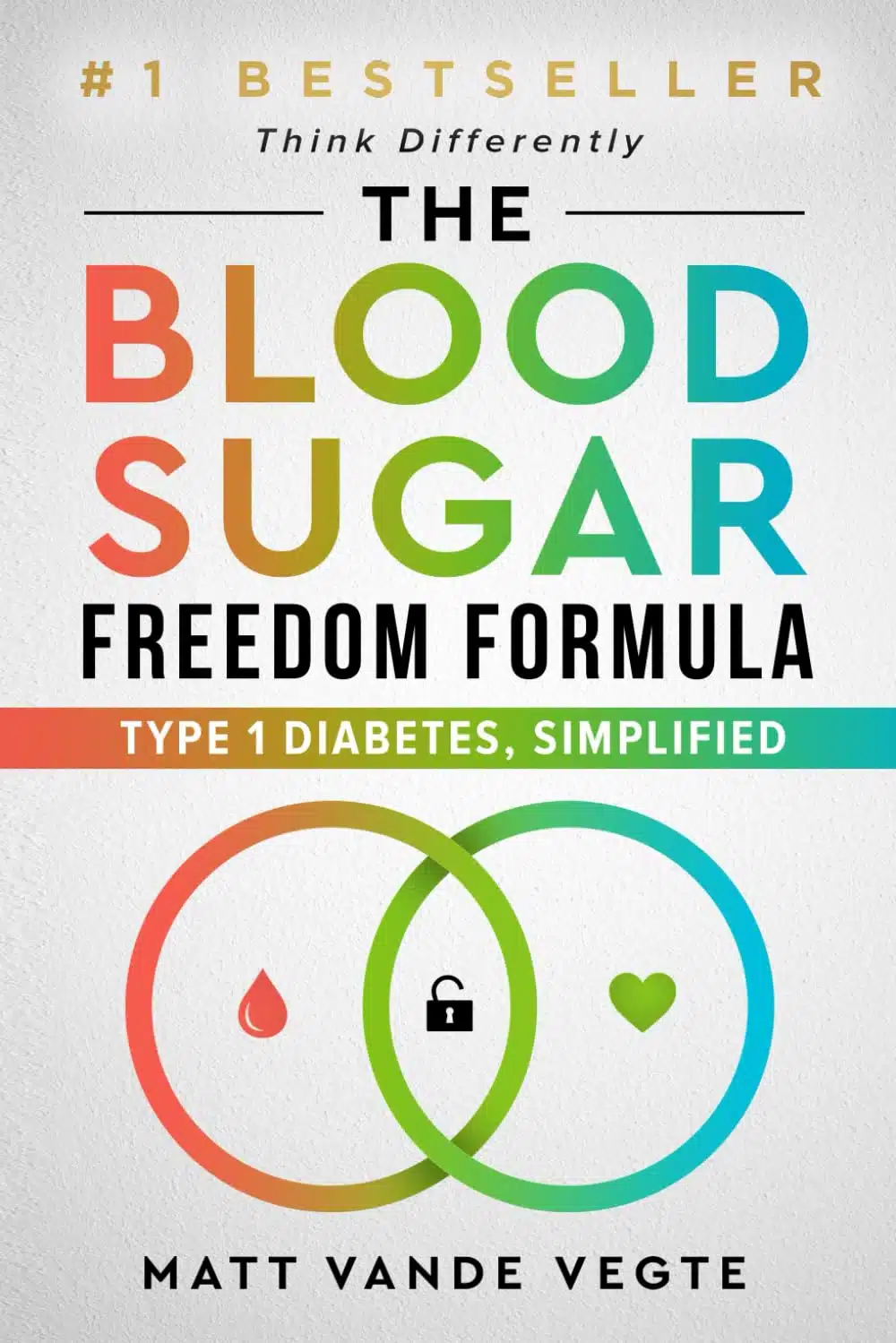
The Blood Sugar Freedom Formula − by Matt Vande Vegte
10almonds is reader-supported. We may, at no cost to you, receive a portion of sales if you purchase a product through a link in this article.
It’s often the case that well-educated person who has lived with a chronic disease for many years ends up knowing more about it than general practice doctors, and sometimes more than some specialists, depending on the disease.
This author is such a person. He’s a physiotherapist by profession, an endurance athlete by passion, and a Type 1 Diabetic by chance.
Most books about diabetes out there are for the much more common type 2 diabetes, and while much of the advice carries over (things improve/reduce insulin sensitivity are still going to be good/bad, respectively), a lot does not, because unlike in type 2 diabetes, your pancreas is not making meaningful amounts of insulin (and that’s always going to be a limitation that no dietary change is going to get around), and you have an active autoimmune disease, which as such, has a lot of impact on other aspects of health.
This book details all these things and more, and also discusses what he has found works, based on a foundation of research and thereafter, on personal trial-and-improvement (or sometimes just plain trial-and-error).
The style is a bit hypey, and he does try earnestly to persuade the reader to sign up for his special course and things like that, but there’s more than enough practical information in the book already to make it worthwhile reading.
Bottom line: if you and/or a loved one has Type 1 Diabetes, this is a great book to read!
Click here to check out The Blood Sugar Freedom Formula, and live more easily!
Don’t Forget…
Did you arrive here from our newsletter? Don’t forget to return to the email to continue learning!
Recommended
Learn to Age Gracefully
Join the 98k+ American women taking control of their health & aging with our 100% free (and fun!) daily emails:
-
Foot Drop!
10almonds is reader-supported. We may, at no cost to you, receive a portion of sales if you purchase a product through a link in this article.
It’s Q&A Day at 10almonds!
Have a question or a request? We love to hear from you!
In cases where we’ve already covered something, we might link to what we wrote before, but will always be happy to revisit any of our topics again in the future too—there’s always more to say!
As ever: if the question/request can be answered briefly, we’ll do it here in our Q&A Thursday edition. If not, we’ll make a main feature of it shortly afterwards!
So, no question/request too big or small
❝Interesting about DVT after surgery. A friend recently got diagnosed with foot drop. Could you explain that? Thank you.❞
First, for reference, the article about DVT after surgery was:
DVT Risk Management Beyond The Socks
As for foot drop…
Foot drop is descriptive of the main symptom: the inability to raise the front part of the foot due to localized weakness/paralysis. Hence, if a person with foot drop dangles their feet over the edge of the bed, for example, the affected foot will simply flop down, while the other (if unaffected) can remain in place under its own power. The condition is usually neurological in origin, though there are various more specific causes:
When walking unassisted, this will typically result in a distinctive “steppage gait”, as it’s necessary to lift the foot higher to compensate, or else the toes will scuff along the ground.
There are mobility aids that can return one’s walking to more or less normal, like this example product on Amazon.
Incidentally, the above product will slightly shorten the lifespan of shoes, as it will necessarily pull a little at the front.
There are alternatives that won’t like this example product on Amazon, but this comes with the different problem that it limits the user to stepping flat-footedly, which is not only also not an ideal gait, but also, will serve to allow any muscles down there that were still (partially or fully) functional to atrophy. For this reason, we’d recommend the first product we mentioned over the second one, unless your personal physiotherapist or similar advises otherwise (because they know your situation and we don’t).
Both have their merits, though:
Trends and Technologies in Rehabilitation of Foot Drop: A Systematic Review
Of course, prevention is better than cure, so while some things are unavoidable (especially when it comes to neurological conditions), we can all look after our nerve health as well as possible along the way:
Peripheral Neuropathy: How To Avoid It, Manage It, Treat It
…as well as the very useful:
What Does Lion’s Mane Actually Do, Anyway?
…which this writer personally takes daily and swears by (went from frequent pins-and-needles to no symptoms and have stayed that way, and that’s after many injuries over the years).
If you’d like a more general and less supplements-based approach though, check out:
Steps For Keeping Your Feet A Healthy Foundation
Take care!
Share This Post
-
Brown Rice vs Pearl Barley – Which is Healthier?
10almonds is reader-supported. We may, at no cost to you, receive a portion of sales if you purchase a product through a link in this article.
Our Verdict
When comparing brown rice to pearl barley, we picked the barley.
Why?
Both have their strong merits! But…
In terms of macros, pearl barley has more than 4x the fiber, for the same carbs and slightly more protein. So, a clear win for pearl barley in this category.
In the category of vitamins, brown rice has more of vitamins B1, B3, B5, B6, and E, while pearl barley has more of vitamins A, B2, and K, yielding to rice a 5:3 win in this round.
Looking at minerals next, brown rice has more magnesium, manganese, and phosphorus, while pearl barley has notably more calcium, copper, iron, potassium, and selenium, giving pearl barley the win here.
Adding up the sections makes for a clear overall win for pearl barley, but do enjoy either or both, as diversity is best!
Unless you have a gluten allergy, in which case, maybe skip the pearl barley, which is indeed barley that has been pearled, and thus does have gluten. But for most people that’s a non-issue, so we won’t include it in the general reckoning.
Want to learn more?
You might like:
- Gluten: What’s The Truth?
- Grains: Bread Of Life, Or Cereal Killer?
- Should You Go Light Or Heavy On Carbs?
- Why Going Gluten-Free Could Be A Bad Idea
- Why You’re Probably Not Getting Enough Fiber (And How To Fix It)
- What Do The Different Kinds Of Fiber Do? 30 Foods That Rank Highest
- What Matters Most For Your Heart? Eat More (Of This) For Lower Blood Pressure ← Spoiler: it’s fiber
Enjoy!
Share This Post
-
These shoes are best for hip and knee arthritis, according to science
10almonds is reader-supported. We may, at no cost to you, receive a portion of sales if you purchase a product through a link in this article.
People with hip and knee osteoarthritis are advised to wear “appropriate footwear” to minimise their pain.
Does that mean heels are out? Does it matter if you wear runners or something a little stiffer? How about using insoles?
Our research, including our latest clinical trial published today in Annals of Internal Medicine, provides some answers.
We show that stable, more supportive shoes aren’t necessarily the best option, despite what you might have heard.
Francisco Emilio Diaz/Pexels What is osteoarthritis?
Osteoarthritis is a condition that affects the tissues in and around a joint, including bone, cartilage, ligaments and muscles. It is more common in older people, and people with excess body weight. It causes joint pain and stiffness, and can lead to disability.
About 2.35 million Australians have osteoarthritis and this number is predicted to increase as the population ages and obesity rates rise.
Osteoarthritis commonly affects the hip and knee joints, making it difficult to walk. There is no cure, so self-management is important.
That includes wearing the right type of shoes.
How can shoes affect symptoms?
There are many causes of osteoarthritis, but excessive force inside the joint when someone is walking is thought to play a role. Excessive joint forces can also increase the chance of osteoarthritis worsening over time.
Shoes are our connection to the ground and can influence how forces are transmitted up the leg during every step. Some shoe features are particularly important.
Shoes with higher heels increase joint forces. For example, shoes with six-centimetre heels increase knee forces by an average 23% compared to walking barefoot.
Some shoes come with supportive features, such as insoles that support the arches. Other supportive features include being made with a stiffer material in the sole or heel.
Many people, and clinicians, think these stable and supportive shoe features are best for people with osteoarthritis.
But biomechanical research shows shoes with these supportive features actually increase knee force by up to 15% compared to shoes without them. Arch-supporting insoles also increase knee force by up to 6% when added to shoes.
So, are flatter, flexible shoes without stable supportive features – such as ballet flats – better for knee and hip osteoarthritis?
Not necessarily. We also need to look at people’s pain.
What we found
Our biomechanical research from 2017 in people with knee osteoarthritis showed flat flexible shoes reduced knee forces by an average 9% compared to stable supportive shoe styles.
This suggests flat flexible shoes could be better for osteoarthritis. To find out, we conducted two clinical trials to look at people’s pain levels.
Our new clinical trial involved 120 people with hip osteoarthritis.
They were randomised to wear different types of flat flexible shoes, such as flexible ballet flats, or different types of stable supportive shoes, such as supportive runners. People were asked to wear their shoes for at least six hours a day. After six months we measured the change in hip pain when they walked.
We found flat flexible shoes were no better than stable supportive shoes for reducing hip pain.
These findings differ to those from our 2021 clinical trial in 164 people with knee osteoarthritis. In that trial, we found wearing stable supportive shoes for six months reduced knee pain when walking by an average 63% more than wearing flat flexible shoes.
It’s unclear why findings differed between the knee and hip. But it might be because joint forces are higher in knee compared to hip osteoarthritis, and so there may be greater potential for stable supportive shoes to reduce knee forces, and therefore knee pain.
In both trials, more complications, such as foot pain, were reported by people who wore flat flexible shoes. This might be because these shoe styles provide less protection for the feet.
So which shoes should I wear?
For people with knee osteoarthritis, stable supportive shoes are likely to be more beneficial than flat flexible ones.
For people with hip osteoarthritis, neither shoe type is better than the other for improving hip pain.
But for all older people – including those with hip and knee osteoarthritis – it is sensible to avoid ill-fitting shoes, as well as shoes with high or narrow heels, due to an increased risk of falls.
For younger people with knee or hip osteoarthritis but who are not at risk of falls, it may still be advisable to avoid high heels given their potential to increase joint forces.
Who should you talk to?
If you are concerned about your hip or knee osteoarthritis, talk to your GP or other health-care provider, such as a podiatrist or physiotherapist.
Other non-surgical treatments, such as exercise, weight management, nutrition and some pain medicines can help.
Kade Paterson, Associate Professor of Musculoskeletal Health, The University of Melbourne and Rana Hinman, Professor in Physiotherapy, The University of Melbourne
This article is republished from The Conversation under a Creative Commons license. Read the original article.
Share This Post
Related Posts
-
Ghosted by a friend? 4 expert tips on how to handle the hurt
10almonds is reader-supported. We may, at no cost to you, receive a portion of sales if you purchase a product through a link in this article.
When we talk about “ghosting”, we usually think it relates to dating. But what happens when you’ve been ghosted by someone you’ve known for years – your childhood best friend, a parent, a child?
These disappearances can be harder to explain, and even harder to heal from.
It’s also surprisingly common. For instance, one study showed 38.6% of people have been ghosted by a friend.
So why do people ghost those closest to them? What impact does it have on those left behind? How do you begin to move on?
martin-dm/Getty What is ghosting?
Ghosting is when someone abruptly, or gradually, cuts off all communication without explanation. Whether it’s a friend, family member or love interest, the signs are much the same – messages left on read or calls ignored. Sometimes you’re blocked.
Ghosting doesn’t just happen online. It can also play out in person, when someone deliberately ignores you – avoiding eye contact, refusing attempts to engage in conversation, pretending you’re not there.
Unlike relationships that gradually wither over time, or end abruptly after an argument, ghosting is a one-sided withdrawal from a relationship that happens without closure.
For the person left behind, it can feel like grief.
Why do people ghost family and friends?
People often ghost friends for the same reasons they ghost romantic partners.
Ghosting is more common – and considered more acceptable – in brief or casual romantic relationships or friendships. That’s when people may ghost because they lose interest, wish to avoid confrontation, or find it easier than facing the discomfort of ending things directly.
In longer-term relationships, ghosting may stem from incompatibility, be prompted by different priorities, physical distance, or growing apart over time.
Major life transitions – such as becoming a parent, entering the workforce, moving, or going through a divorce – can often provide the catalyst for someone to shrink their social network.
In some cases, ghosting is driven by self-preservation or concerns for personal safety, particularly when ghosting involves family members.
People report ghosting in response to toxic, emotionally draining, or abusive relationships, often when previous attempts to resolve issues were met with abuse or aggression. In such instances, ghosting isn’t so much an avoidance strategy, but a last resort to preserve someone’s safety and psychological wellbeing.
Ghosting has also been linked to certain personality traits. One study found people who reported ghosting others tended to score higher in narcissism (tend towards entitlement and lack of empathy) and borderline traits (so have trouble regulating emotions and are impulsive).
Why does it hurt so much?
People often ghost as they hope to spare the other person the pain of rejection. But that is rarely the case.
Being ghosted by someone you’ve been close to for a long time is often associated with grief, much like the death of the loved one. After the initial shock, there is often anger and sadness.
Ghosting also involves “ambiguous loss”. This ambiguity – the uncertainty and lack of closure – can almost freeze the grief process, making it particularly hard to move on.
In addition to grief-like emotions, ghosting is also often associated with self-blame, rumination, feelings of worthlessness, and trust issues that can affect how someone relates to others in the future.
How to cope if you’ve been ghosted
There’s no easy fix and you can’t force someone to communicate with you if they don’t want to. But research points to some strategies that may help you move on and ease the pain:
- Acknowledge your feelings. Grief-like emotions are a normal reaction to being ghosted. Accept your emotions and express them in healthy ways. This is better than suppressing them, which is linked to depression, low self-esteem and reduced wellbeing.
- Seek social support. Social support is linked to a range of mental health benefits. Talk about your experience with friends, family or a mental health professional. This can help reduce feeling of isolation, and low self-worth. Greater social support is also associated with post-traumatic growth – positive psychological change that can emerge after a challenging life event.
- Choose self-compassion over rumination. It’s easy to get caught in the trap of replaying what happened and wondering what went wrong. But this can prolong distress and make it harder to move on. Instead treat yourself as you would a close friend – with kindness, compassion and care. Self-compassion has been linked to reduced rumination, anxiety and depression. Exercise, mindfulness and spending time in nature are examples of self-care with similar psychological benefits.
- Create your own closure. Being ghosted can often leave you stuck in a cycle of uncertainty and unanswered questions. You may never get an explanation and waiting for answers will only make it harder to move on. Writing a letter you don’t send can help create closure. This form of expressive writing can help you articulate your thoughts and emotions and make sense of your experience – and is linked to a range of psychological benefits.
Megan Willis, Associate Professor, School of Behavioural and Health Sciences, Australian Catholic University
This article is republished from The Conversation under a Creative Commons license. Read the original article.
Don’t Forget…
Did you arrive here from our newsletter? Don’t forget to return to the email to continue learning!
Learn to Age Gracefully
Join the 98k+ American women taking control of their health & aging with our 100% free (and fun!) daily emails:
-
Why can’t I keep still after intense exercise?
10almonds is reader-supported. We may, at no cost to you, receive a portion of sales if you purchase a product through a link in this article.
Do you ever feel like you can’t stop moving after you’ve pushed yourself exercising? Maybe you find yourself walking around in circles when you come off the pitch, or squatting and standing and squatting again when you finish a run.
Sometimes the body knows what’s best for us, even if we’re not aware of the science.
Moving around after intense exercise actually helps the body recover faster. Here’s how it works – plus a tip for if you feel exactly the opposite (and just want to lie down).
Drazen Zigic/Shutterstock What is ‘intense’ exercise?
There are different ways to measure exercise intensity. One is simply how hard it feels to you, known as the “rating of perceived exertion”.
This takes into account how fast you’re breathing, how much you’re sweating and how tired your muscles are. It also considers heart rate.
The average resting heart rate when you’re not exerting yourself is around 60–80 beats per minute, although this can vary between people.
The maximum healthy heart rate is based on subtracting your age from 220. So, if you’re 20 years old, that’s 200 beats per minute when you’re exercising as hard as you can.
This decreases as you age. If you’re 50 years old, your maximum heart rate would be around 170 beats per minute.
An increased heart rate helps pump blood faster to deliver fuel and oxygen to the muscles that are working hard. Once you stop exercising your body will begin its recovery, to return to resting levels.
Let’s look at how continuing to move after intense exercise helps do this.
Removing waste from the muscles
Whenever the body converts fuel into energy it also produces leftover substances, known as metabolic byproducts. This includes lactate (sometimes called lactic acid).
During intense exercise we need to burn more fuel (oxygen and glucose) and this can make the body produce lactate much more quickly than it can clear it. When lactate accumulates in the muscles it may delay their recovery.
We can reuse lactate to provide energy to the heart and brain and modulate the immune system. But to do this, lactate must be cleared from the muscles into the bloodstream.
After intense exercise, continuing to move your body – but less intensely – can help do this. This kind of active recovery has been shown to be more efficient than passive recovery (meaning you don’t move).
Intense exercise can mean your muscles produce more metabolic byproducts. Tom Wang/Shutterstock Returning blood to the heart
Intense exercise also makes our heart pump more blood into the body. The volume pumped to the muscles increases dramatically, while blood flow to other tissues – especially the abdominal organs such as the kidneys – is reduced.
Moving after intense exercise can help redistribute the blood flow and speed up recovery of the respiratory and cardiovascular systems. This will also clear metabolic byproducts faster.
After a long run, for example, there will be much more blood in your leg muscles. If you stand still for a long time, you may feel dizzy or faint, thanks to lowered blood pressure and less blood flow to the brain.
Moving your legs, whether through stretching or walking, will help pump blood back to the heart.
In fact around 90% of the blood returning from the legs via veins relies on the foot, calf and thigh muscles moving and pumping. The calf muscle plays the largest role (about 65%). Moving your heels up and down after exercising can help activate this motion.
What if you don’t feel like moving?
Maybe after exercise you just want to sit down in a heap. Should you?
If you’re too tired to do light movement such as stretching or walking, you may still benefit from elevating your legs.
You can lie down – research has shown blood from the veins returns more easily to the heart after exercise when you’re lying down, compared to sitting up, even if you’re still. Elevating your legs has an added benefit, as it reverses the effect of gravity and helps circulation.
Ken Nosaka, Professor of Exercise and Sports Science, Edith Cowan University
This article is republished from The Conversation under a Creative Commons license. Read the original article.
Don’t Forget…
Did you arrive here from our newsletter? Don’t forget to return to the email to continue learning!
Learn to Age Gracefully
Join the 98k+ American women taking control of their health & aging with our 100% free (and fun!) daily emails:
-
What’s Your Vascular Dementia Risk?
10almonds is reader-supported. We may, at no cost to you, receive a portion of sales if you purchase a product through a link in this article.
We often say that “what’s good for your heart is good for your brain”, and this is because the former feeds the latter, with oxygen and nutrients, and also clears away detritus like beta-amyloid (associated with Alzheimer’s) and alpha-synuclein (associated with Parkinson’s).
For more on those, see: How To Clean Your Brain (Glymphatic Health Primer)
For this reason, there are many risk factors that apply equally cardiovascular disease (CVD), and neurodegenerative diseases like Alzheimer’s and other vascular dementias, as well as stroke risk.
The link between the two has also been studied; recently a team of scienists led by Dr. Anisa Dhana asked the question:
❝What is the association between cardiovascular health (CVH) and biomarkers of neurodegeneration, including neurofilament light chain and total tau?❞
To answer this, they looked at data from more than 10,000 Americans aged 65+; of these, they were able to get serum samples from 5,470 of them, and tested those samples for the biomarkers of neurodegeneration mentioned above.
They then tabulated the results with cardiovascular health scores based on the American Heart Association (AHA)’s “Life’s Simple 7” tool, and found, amongst other things:
- 34.6% of participants carried the APOE e4 allele, a genetic risk factor for Alzheimer’s.
- Higher CVH scores were associated with lower NfL levels, but not with t-tau concentrations.
- APOE e4 carriers with high CVH had significantly lower NfL levels.
- Race did not influence the CVH-NfL relationship.
- Higher CVH was linked to a slower annual increase in NfL levels but did not affect t-tau changes.
- Over 10 years, participants with the lowest CVH scores saw a 7.1% annual increase in NfL levels, while those with the highest CVH scores had a 5.2% annual increase.
- Better CVH is linked to lower serum NfL levels, regardless of age, sex, or race.
- CVH is particularly crucial for APOE e4 carriers
In other words: higher cardiovascular health meant lower markers of neurodegeneration, and this not only still held true for APOE e4 carriers, but also, the benefits actually even more pronounced in those participants.
You may be wondering: “but it said it helped with NfL levels, not t-tau concentrations?” And, indeed, it is so. But this means that the overall neurodegeneration risk is still inversely proportional to cardiovascular health; it just means it’s not a magical panacea and we must still do other things too.
See also: How To Reduce Your Alzheimer’s Risk
And as for the study, you can read the paper itself in full here:
Cardiovascular Health and Biomarkers of Neurodegenerative Disease in Older Adults
Life’s Simple 7
We mentioned that they used the AHA’s “Life’s Simple 7” tool to assess cardiovascular health; it is indeed simple, but important. Here it is:
Metric Poor Intermediate Ideal Current smoking Yes Former ≤12 mo Never or quit >12 mo BMI, kg/m2 ≥30 25–29.9 <25 Physical activity None 1–149 min/wk of moderate activity or 1–74 min/wk of vigorous activity or 1–149 min/wk of moderate and vigorous activity ≥150 min/wk of moderate activity or ≥75 min/wk of vigorous activity or ≥150 min/wk of moderate and vigorous activity Diet pattern score* 0–1 2–3 4–5 Total cholesterol, mg/dL ≥240 200–239 or treated to goal <200 Blood pressure, mm Hg SBP ≥140 or DBP ≥90 SBP 120–139 or DBP 80–89 or treated to goal <120/<80 Fasting plasma glucose, mg/dL ≥126 100–125 or treated to goal <100 *Each of the following 5 diet elements is given a score of 1: (1) ≥4.5 cups/day of fruits and vegetables; (2) ≥2 servings/week of fish; (3) ≥3 servings/day of whole grains; (4) no more than 36 oz/wk of sugar‐sweetened beverages; and (5) no more than 1500 mg/d of sodium.
As the AHA notes,
❝Unfortunately, 99% of the U.S. adult population has at least one of seven cardiovascular health risks: tobacco use,
poor diet, physical inactivity, unhealthy weight, high blood pressure, high cholesterol or high blood glucose.❞It then goes on to talk about the financial burden of this on employers, but this was taken from a workplace health resource, and we recognize the rest of it won’t be of pressing concern for most of our readers. In case you are interested though, here it is:
American Heart Association | Life’s Simple 7® Journey to Health™
For a more practical (if you’re just a private individual and employee healthcare is not your main concern) overview, see:
Want to know more?
Here are some very good starting points for improving each of those 7 metrics, as necessary:
- Which Addiction-Quitting Methods Work Best?
- How To Lose Weight (Healthily!)
- The Doctor Who Wants Us To Exercise Less, & Move More
- Which Diet? Top Diets Ranked By Experts
- Lower Cholesterol Naturally, Without Statins
- 10 Ways To Lower Blood Pressure Naturally
- 10 Ways To Balance Your Blood Sugars
Take care!
Don’t Forget…
Did you arrive here from our newsletter? Don’t forget to return to the email to continue learning!
Learn to Age Gracefully
Join the 98k+ American women taking control of their health & aging with our 100% free (and fun!) daily emails:


