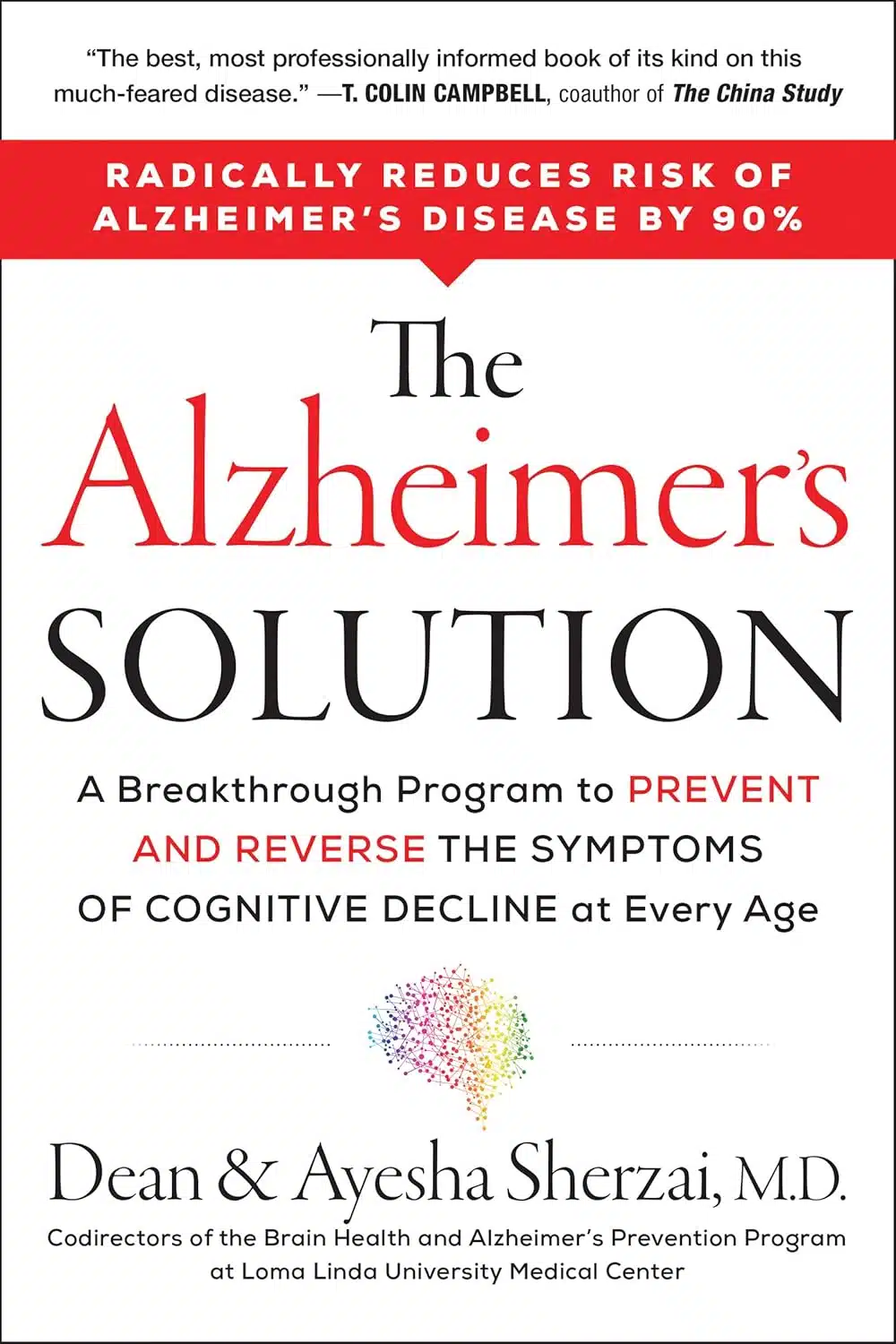
The Alzheimer’s Solution – by Dr. Dean Sherzai and Dr. Ayesha Sherzai

10almonds is reader-supported. We may, at no cost to you, receive a portion of sales if you purchase a product through a link in this article.

After discussing the myths and misunderstandings that surround Alzheimer’s, the authors (both neurologists) explain the importance of evidence-based lifestyle medicine, which many people underestimate and thus neglect.

There’s a risk assessment for the reader to perform, which can help inform what things will be the highest priority when it comes to, as the subtitle promises, preventing and reversing Alzheimer’s.

How they go about this: they note the four main biological processes that drive the development of Alzheimer’s:

  • Inflammation
  • Oxidation
  • Glucose dysregulation
  • Lipid dysregulation

…and then focus on how to prevent or reverse those four things, each of which are better-understood by current science than Alzheimer’s in its entirety.

As for how they present that in practical terms, they offer the acronym NEURO:

  • Nutrition
  • Exercise
  • Unwind
  • Restore
  • Optimize

You may be wondering what the distinction between “unwind” and “restore” is; the former is about stress management, while the latter is about restorative sleep.

Within each of these five categories, each of which gets a chapter devoted to it, they give instructions for making one’s own personalized program for each part.

The style is direct and explanatory, with no fluff or padding, no sensationalization, no detours into anecdotes of cherry-picked case studies, just science, data, explanations. In terms of legibility for those not accustomed to reading scientifically dense texts: it’s easier to read than most actual papers, though for many it may be beneficial to read the book cover-to-cover, because the authors define terms early and then will expect the reader to remember them later (although, one can also refer to the glossary, included). Speaking of scientific papers, there’s a generous bibliography here, nearly 40 pages of such.

Bottom line: if you’re serious about preventing/reversing Alzheimer’s, and you want an evidence-based holistic approach, this book lays out the most important things currently known to science, and how to do them optimally.

Click here to check out The Alzheimer’s Solution, and improve your odds!

Don’t Forget…

Did you arrive here from our newsletter? Don’t forget to return to the email to continue learning!

Learn to Age Gracefully

Join the 98k+ American women taking control of their health & aging with our 100% free (and fun!) daily emails:

  • The Philosophy Gym – by Dr. Stephen Law

    10almonds is reader-supported. We may, at no cost to you, receive a portion of sales if you purchase a product through a link in this article.

    If you’d like to give those “little gray cells” an extra workout, this book is a great starting place.

    Dr. Stephen Law is Director of Philosophy at the Department of Continuing Education, University of Oxford. As such, he’s no stranger to providing education that’s both attainable and yet challenging. Here, he lays out important philosophical questions, and challenges the reader to get to grips with them in a systematic fashion.

    Each of the 25 questions/problems has a chapter devoted to it, and is ranked:

    • Warm-up
    • Moderate
    • More Challenging

    But, he doesn’t leave us to our own devices, nor does he do like a caricature of a philosopher and ask us endless rhetorical questions. Instead, he looks at various approaches taken by other philosophers over time, and invites the reader to try out those methods.

    The real gain of this book is not the mere enjoyment of reading, but rather in taking those thinking skills and applying them in life… because most if not all of them do have real-world applications and/or implications too.

    The book’s strongest point? That it doesn’t assume prior knowledge (and yet also doesn’t patronize the reader). Philosophy can be difficult to dip one’s toes into without a guide, because philosophers writing about philosophy can at first be like finding yourself at a party where you know nobody, but they all know each other.

    In contrast, Law excels at giving quick, to-the-point ground-up summaries of key ideas and their progenitors.

    In short: a wonderful way to get your brain doing things it might not have tried before!

    Get your copy of The Philosophy Gym from Amazon today!

    Share This Post

  • Common Hospital Blood Pressure Mistake (Don’t Let This Happen To You Or A Loved One)

    10almonds is reader-supported. We may, at no cost to you, receive a portion of sales if you purchase a product through a link in this article.

    There’s a major issue in healthcare, Dr. Suneel Dhand tells us, pertaining to the overtreatment of hypertension in hospitals. Here’s how to watch out for it and know when to question it:

    Under pressure

    When patients, particularly from older generations, are admitted to the hospital, their blood pressure often fluctuates due to illness, dehydration, and other factors. Despite this, they are often continued on their usual blood pressure medications, which can lead to dangerously low blood pressure.

    Why does this happen? The problem arises from rigid protocols that dictate stopping blood pressure medication only if systolic pressure is below a certain threshold, often 100. However, Dr. Dhand argues that 100 is already low*, and administering medication when blood pressure is close to this can cause it to drop dangerously lower

    *10almonds note: low for an adult, anyway, and especially for an older adult. To be clear: it’s not a bad thing! That is the average systolic blood pressure of a healthy teenager and it’s usually the opposite of a problem if we have that when older (indeed, this very healthy writer’s blood pressure averages 100/70, and suffice it to say, it’s been a long time since I was a teenager). But it does mean that we definitely don’t want to take medications to artificially lower it from there.

    Low blood pressure from overtreatment can lead to severe consequences, requiring emergency interventions to stabilize the patient.

    Dr. Dhand’s advice for patients and families is:

    • Ensure medication accuracy: make sure the medical team knows the correct blood pressure medications and dosages for you or your loved one.
    • Monitor vital signs: actively check blood pressure readings, especially if they are in the low 100s or even 110s, and discuss any medication concerns with the medical team.
    • Watch for symptoms of low blood pressure: be alert for symptoms like dizziness or weakness, which could indicate dangerously low blood pressure.

    For more on all of this, enjoy:

    Click Here If The Embedded Video Doesn’t Load Automatically!

    Want to learn more?

    You might also like to read:

    The Insider’s Guide To Making Hospital As Comfortable As Possible

    Take care!

    Share This Post

  • Why 10,000 Steps Might Be Making Your Pain Worse (+ What To Do Instead)

    10almonds is reader-supported. We may, at no cost to you, receive a portion of sales if you purchase a product through a link in this article.

    Walking can be pleasant, but (unless you’re walking on rough terrain) in biomechanical terms it’s very repetitive, and doesn’t challenge muscles enough to build strength or improve balance.

    So, wear and tear can occur, but development won’t happen much after a certain very base level.

    Dr. Alyssa Kuhn, arthritis expert, explains how to fix that:

    Different Movements

    If you sometimes find yourself struggling with stairs, low chairs, or daily movement, that usually means your muscles lack the correct strength. As with any kind of strength training, your muscles need to be challenged with increasing resistance, not just the same repetitive movement, or else they will have no reason to get stronger.

    Dr. Kuhn recommends these exercises in particular:

    • Chair stands: sit at the edge of a chair, stand up, and sit back down to work your thighs, glutes, hamstrings, feet, and ankles. To make it easier, raise the seat height or use the chair arms for support. Alternatively to make it harder, hold a weight to your chest. Goal: 8–12 reps, 2–3 sets; optional 30-second test for number of stands.
    • Step-back with knee march: step one leg backwards, then bring your knee up to your chest before repeating to build your hips, glutes, core, and balance. To make it easier, shorten your step and knee lift, and hold a chair for support. To make it harder, take a bigger step, make a faster knee drive, and step up onto a stool. Goal: 10–12 reps per side, 2–3 sets.
    • Balance with weight pass: stand on one leg (or use your back toes as a sort kickstand for balance purposes, without putting much weight there) and pass a weight or object hand-to-hand. To make it harder, use a heavier weight and hold it further from your body. Goal: 20–30 passes or 30–60 seconds per side, 2–3 sets.

    For more on all of this plus visual demonstrations, enjoy:

    Click Here If The Embedded Video Doesn’t Load Automatically!

    Want to learn more?

    You might also like:

    How To Make Downhill Walking Easier On The Knees

    Take care!

    Share This Post

  • Scattered Minds – by Dr. Gabor Maté

    10almonds is reader-supported. We may, at no cost to you, receive a portion of sales if you purchase a product through a link in this article.

    This was not the first book that Dr. Maté sat down to write, by far. But it was the first that he actually completed. Guess why.

    Writing from a position of both personal and professional experience and understanding, Dr. Maté explores the inaptly-named Attention Deficit Disorder (if anything, there’s often a surplus of attention, just, to anything and everything rather than necessarily what would be most productive in the moment), its etiology, its presentation, and its management.

    This is a more enjoyable book than some others by the same author, as while this condition certainly isn’t without its share of woes (often, for example, a cycle of frustration and shame re “why can’t I just do the things; this is ruining my life and it would be so easy if I could just do the things!”), it’s not nearly so bleak as entire books about trauma, addiction, and so forth (worthy as those books also are).

    Dr. Maté frames it specifically as a development disorder, and one whereby with work, we can do the development later that (story of an ADHDer’s life) we should have done earlier but didn’t. In terms of practical advice, he includes a program for effecting this change, including as an adult.

    The style is easy-reading, in small chapters, with ADHD’d-up readers in mind, giving a strong sense of speeding pleasantly through the book.

    Bottom line: when it’s a book by Dr. Gabor Maté, you know it’s going to be good, and this is no exception. Certainly read it if you, anyone you care about, or even anyone you just spend a lot of time around, has ADHD or similar.

    Click here to check out Scattered Minds, and unscatter yours!

    Don’t Forget…

    Did you arrive here from our newsletter? Don’t forget to return to the email to continue learning!

    Learn to Age Gracefully

    Join the 98k+ American women taking control of their health & aging with our 100% free (and fun!) daily emails:

  • The Diet Compass – by Bas Kast

    10almonds is reader-supported. We may, at no cost to you, receive a portion of sales if you purchase a product through a link in this article.

    Facts about nutrition and health can be hard to memorize. There’s just so much! And often there are so many studies, and while the science is not usually contradictory, pop-science headlines sure can be. What to believe?

    Bas Kast brings us a very comprehensive and easily digestible solution.

    A science journalist himself, he has gone through the studies so that you don’t have to, and—citing them along the way—draws out the salient points and conclusions.

    But, he’s not just handing out directions (though he does that too); he’s arranged and formatted the information in a very readable and logical fashion. Chapter by chapter, we learn the foundations of important principles for “this is better than that” choices in diet.

    Most importantly, he lays out for us his “12 simple rules for healthy eating“, and they are indeed as simple as they are well-grounded in good science.

    Bottom line: if you want “one easy-reading book” to just tell you how to make decisions about your diet, simply follow those rules and enjoy the benefits… Then this book is exactly that.

    Click here to check out The Diet Compass and get your diet on the right track!

    Don’t Forget…

    Did you arrive here from our newsletter? Don’t forget to return to the email to continue learning!

    Learn to Age Gracefully

    Join the 98k+ American women taking control of their health & aging with our 100% free (and fun!) daily emails:

  • The Five Pillars Of Longevity

    10almonds is reader-supported. We may, at no cost to you, receive a portion of sales if you purchase a product through a link in this article.

    The Five Pillars Of Longevity

    This is Dr. Mark Hyman. He’s a medical doctor, and he’s the board president of clinical affairs of the Institute for Functional Medicine. He’s also the founder and medical director of the UltraWellness Center!

    What he’d like you to know about is what he calls the “Five Pillars of Longevity”.

    Now, here at 10almonds, we often talk about certain things that science finds to be good for almost any health condition, and have made a habit of referencing what we call “The Usual Five Things™” (not really a trademark, by the way—just a figure of speech), which are:

    1. Have a good diet
    2. Get good exercise
    3. Get good sleep
    4. Reduce (or eliminate) alcohol consumption
    5. Don’t smoke

    …and when we’re talking about a specific health consideration, we usually provide sources as to why each of them are particularly relevant, and pointers as to the what/how associated with them (ie what diet is good, how to get good sleep, etc).

    Dr. Hyman’s “Five Pillars of Longevity” are based on observations from the world’s “Blue Zones”, the popular name for areas with an unusually high concentration of supercentenarians—Sardinia and Okinawa being famous examples, with a particular village in each being especially exemplary.

    These Five Pillars of Longevity partially overlap with ours for three out of five, and they are:

    1. Good nutrition
    2. Optimized workouts
    3. Reduce stress
    4. Get quality sleep
    5. Find (and live) your purpose

    We won’t argue against those! But what does he have to say, for each of them?

    Good nutrition

    Dr. Hyman advocates for a diet he calls “pegan”, which he considers to combine the paleo and vegan diets. Here at 10almonds, we generally advocate for the Mediterranean Diet because of the mountains of evidence for it, but his approach may be similar in some ways, since it looks to consume a majority plant diet, with some unprocessed meats/fish, limited dairy, and no grains.

    By the science, honestly, we stand by the Mediterranean (which includes whole grains), but if for example your body may have issues of some kind with grains, his approach may be a worthy consideration.

    Optimized workouts

    For Dr. Hyman, this means getting in three kinds of exercise regularly:

    • Aerobic/cardio, to look after your heart health
    • Resistance training (e.g. weights or bodyweight strength-training) to look after your skeletal and muscular health
    • Yoga or similar suppleness training, to look after your joint health

    Can’t argue with that, and it can be all too easy to fall into the trap of thinking “I’m healthy because I do x” while forgetting y and/or z! Thus, a three-pronged approach definitely has its merits.

    Reduce stress

    Acute stress (say, a cold shower) is can confer some health benefits, but chronic stress is ruinous to our health and it ages us. So, reducing this is critical. Dr. Hyman advocates for the practice of mindfulness and meditation, as well as journaling.

    Get quality sleep

    Quality here, not just quantity. As well as the usual “sleep hygiene” advices, he has some more unorthodox methods, such as the use of binaural beats to increase theta-wave activity in the brain (and thus induce more restful sleep), and the practice of turning off Wi-Fi, on the grounds that Wi-Fi signals interfere with our sleep.

    We were curious about these recommendations, so we checked out what the science had to say! Here’s what we found:

    In short: probably not too much to worry about in those regards. On the other hand, worrying less, unlike those two things, is a well-established way improve sleep!

    (Surprised we disagreed with our featured expert on a piece of advice? Please know: you can always rely on us to stand by what the science says; we pride ourselves on being as reliable as possible!)

    Find (and live!) your purpose

    This one’s an ikigai thing, to borrow a word from Japanese, or finding one’s raison d’être, as we say in English using French, because English is like that. It’s about having purpose.

    Dr. Hyman’s advice here is consistent with what many write on the subject, and it’d be an interesting to have more science on, but meanwhile, it definitely seems consistent with commonalities in the Blue Zone longevity hotspots, where people foster community, have a sense of belonging, know what they are doing for others and keep doing it because they want to, and trying to make the world—or even just their little part of it—better for those who will follow.

    Being bitter, resentful, and self-absorbed is not, it seems a path to longevity. But a life of purpose, or even just random acts of kindness, may well be.

    Don’t Forget…

    Did you arrive here from our newsletter? Don’t forget to return to the email to continue learning!

    Learn to Age Gracefully

    Join the 98k+ American women taking control of their health & aging with our 100% free (and fun!) daily emails: