
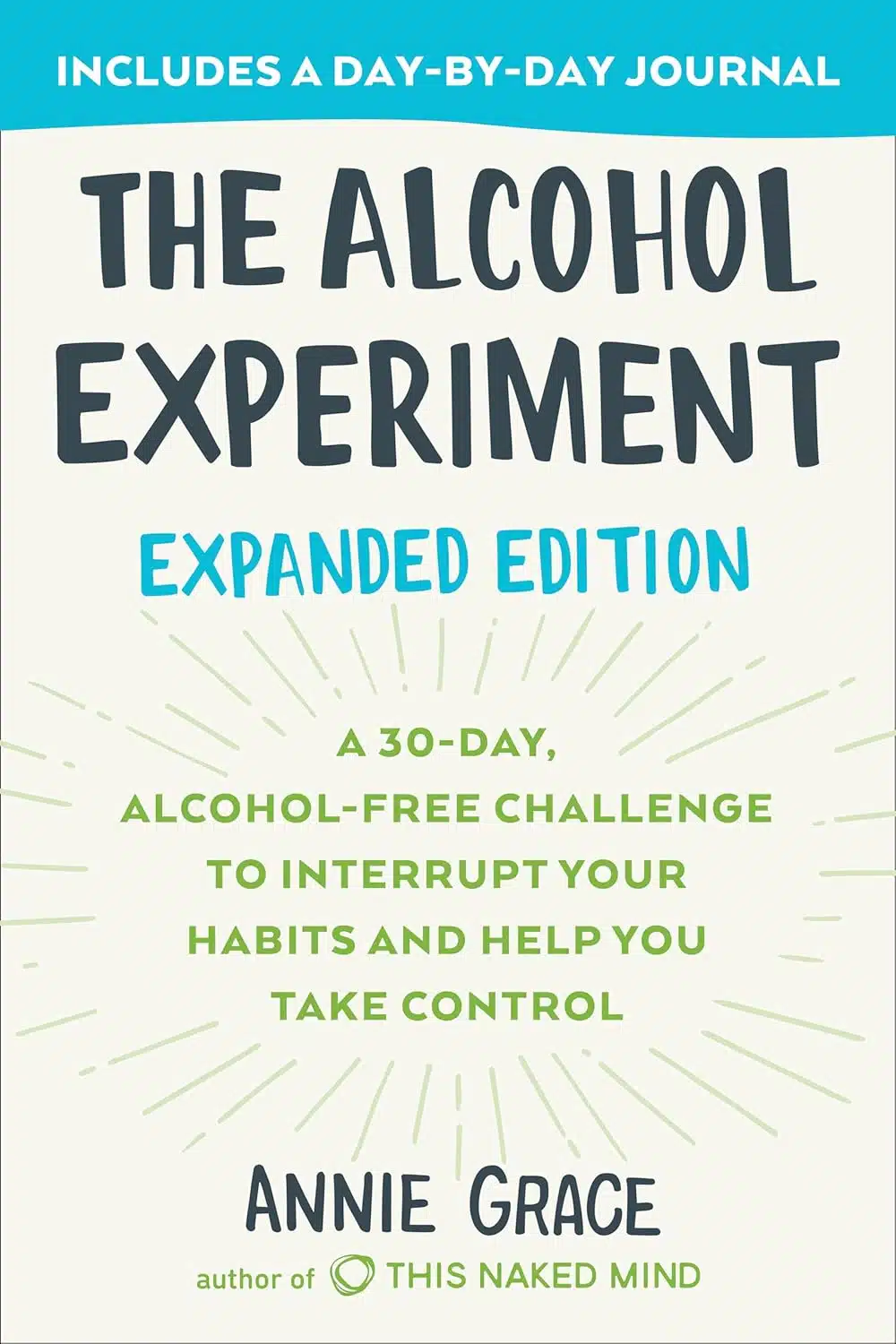
The Alcohol Experiment – by Annie Grace

10almonds is reader-supported. We may, at no cost to you, receive a portion of sales if you purchase a product through a link in this article.

We previously reviewed this author’s “This Naked Mind”, which explored the psychological and sociological aspects of alcohol addiction, or rather, how such factors funnel us to drinking in the first place.

This time, it’s more about the practical side of things, though there’s plenty of science here too; it just not the emphasis. Instead, the focus is on understanding what has been going wrong, and fixing it, with tools that are presented one at a time and added to the reader’s toolbox as we go.

You may be wondering: does this mean you need to be committed to stopping drinking? And the answer is no, except for these 30 days. It’s written for people who are of two minds about alcohol; who want to drink less but also feel deprived or upset if you abstain, or people who drink mostly out of habit or boredom, or to self-medicate against stress, for example.

For those who like to be guided through things step-by-step, that’s what the author offers here, with a chapter and journal prompt for each day of the 30-day challenge.

Bottom line: if the above describes you or a loved one, then this book can help.

Click here to check out The Alcohol Experiment, and find your way forwards!

Don’t Forget…

Did you arrive here from our newsletter? Don’t forget to return to the email to continue learning!

Learn to Age Gracefully

Join the 98k+ American women taking control of their health & aging with our 100% free (and fun!) daily emails:

  • Oranges vs Lemons – Which is Healthier?

    10almonds is reader-supported. We may, at no cost to you, receive a portion of sales if you purchase a product through a link in this article.

    Our Verdict

    When comparing oranges to lemons, we picked the oranges.

    Why?

    In the battle of these popular citrus fruits, there is a clear winner on the nutritional front.

    Things were initially promising for lemons when looking at the macros—lemons have a little more fiber while oranges are slightly higher in carbs, but the differences are small and both are very healthy in this regard.

    However, alas for this writer who prefers sour fruits to sweet ones (I’m sweet enough already), the micronutrient profiles tell a different story:

    In terms of vitamins, oranges have more of vitamins A, B1, B2, B3, B5, B9, E, and choline. In contrast, lemons have a (very) little more vitamin B6. You might be wondering about vitamin C, since both fruits are famous for that—they’re equal on vitamin C. But, with that stack we listed above, oranges clearly win the vitamin category easily.

    As for minerals, oranges boast more calcium, copper, magnesium, potassium, selenium, and zinc, while lemons have more iron, manganese, and phosphorus.

    Technically lemons also have more sodium, but the numbers are truly miniscule (by coincidence, we discover upon grabbing a calculator, you’d need to eat approximately your own bodyweight in whole lemons to get to the RDA of sodium—and that’s to reach the RDA, not the upper healthy limit) so we’ll overlook the tiny sodium difference as irrelevant. Which means, while closer than the vitamins category, oranges win on minerals with a 6:3 lead over lemons.

    Both fruits offer generous helpings of flavonoids and other polyphenols such as naringenin and hesperidin, which have anti-inflammatory properties and more specifically can also reduce allergy symptoms (unless, of course, you are allergic to citrus fruits, which is a relatively rare but extant allergy).

    In short: as ever, enjoy both; diversity is great for the health. But if you want to maximize the nutrients you get, it’s oranges.

    Want to learn more?

    You might like to read:

    Lemons vs Limes – Which is Healthier?

    Take care!

    Share This Post

  • Solitary Fitness – by Charles Bronson

    10almonds is reader-supported. We may, at no cost to you, receive a portion of sales if you purchase a product through a link in this article.

    Sometimes it can seem that every new diet and/or exercise regime you want to try will change your life, if just you first max out your credit card on restocking your kitchen and refurbishing your home gym, not to mention buying all the best supplements, enjoying the latest medical gadgets, and so on and so forth.

    And often… Most of those things genuinely are good! And it’s great that such things are becoming more accessible and available.

    But… Wouldn’t it be nice to know how to have excellent strength and fitness without any of that, even if just as a “bare bones” protocol to fall back on? That’s what Manson provides in this book.

    The writing style is casual and friendly; Manson is not exactly an academic, but he knows his stuff when it comes to what works. And a good general rule of thumb is: if it’s something that he can do in his jail cell, we can surely do it in the comfort of our homes.

    Bottom line: if you want functional strength and fitness with zero gimmicks, this is the book for you (as an aside, it’s also simply an interesting and recommendable read, sociologically speaking, but that’s another matter entirely).

    Click here to check out Solitary Fitness, and get good functional strength and fitness with nothing fancy!

    Share This Post

  • Parent Effectiveness Training – by Dr. Thomas Gordon

    10almonds is reader-supported. We may, at no cost to you, receive a portion of sales if you purchase a product through a link in this article.

    Do you want your home (or workplace, for that matter) to be a place of peace? This book literally got the author nominated for a Nobel Peace Prize. Can’t really get much higher praise than that.

    The title is “Parent Effectiveness Training”, but in reality, the advice in the book is applicable to all manner of relationships, including:

    • romantic relationships
    • friends
    • colleagues
    • …and really any human interaction.

    It covers some of the same topics we did today (and more) in much more detail than we ever could in a newsletter. It lays out formulae to use, gives plenty of examples, and/but is free from undue padding.

    • Pros: this isn’t one of those “should have been an article” books. It has so much valuable content.
    • Cons: It is from the 1970s* so examples may feel “dated” now.

    In addition to going into much more detail on some of the topics covered in today’s issue of 10almonds, Dr. Gordon also talks in-depth about the concept of “problem-ownership”.

    In a nutshell, that means: whose problem is a given thing? Who “has” what problem? Everyone needs to be on the same page about everyone else’s problems in the situation… as well as their own, which is not always a given!

    Dr. Gordon presents, in short, tools not just to resolve conflict, but also to pre-empt it entirely. With these techniques, we can identify and deal with problems (together!) well before they arise.

    Everybody wins.

    Get your copy of “Parent Effectiveness Training” from Amazon today!

    *Note: There is an updated edition on the market, and that’s what you’ll find upon following the above link. This reviewer (hi!) has a battered old paperback from the 1970s and cannot speak for what was changed in the new edition. However: if the 70s one is worth more than its weight in gold (and it is), the new edition is surely just as good, if not better!

    Share This Post

  • How Bones Can Actually Get Stronger With Osteoporosis 

    10almonds is reader-supported. We may, at no cost to you, receive a portion of sales if you purchase a product through a link in this article.

    Dr. Alyssa Kuhn explains:

    By the science

    Bones are living tissue that constantly break down and rebuild, and weakness happens when breakdown outpaces rebuilding.

    The “construction crew” for bones are living cells, and their cue to make things stronger is movement and exercise, and too little or too-easy movement doesn’t send a strong enough signal to rebuild. The body is very efficient like that, and won’t “waste” resources where it doesn’t see they’re needed.

    Consequently, exercises must feel difficult enough to trigger adaptation, not just familiar or comfortable.

    Due to Wolff’s law, it’s important to have variety: changing directions, speeds, and movement patterns (sideways, backwards, uphill) applies new stresses at different angles, and that’s what stimulate bone growth.

    Since the level of resistance is also a factor, adding weights, resistance bands, or controlled impact increases bone-loading and improves rebuilding efficiency.

    Some notes on some common strategies:

    • Jumping practice: jumping can strengthen bones, but only when the landing creates enough force and when your joints and muscles are ready.
      • Also, generally a bad idea if your bones are already very weak, as the landing may create enough force to also fracture a bone, which you don’t want.
    • Balance training: improving balance reduces fall risk and strengthens hips, core, and posture, which indirectly protects bones.
      • Obviously, do it in a way that ensures your safety so you don’t fall while training.
    • Rebounding training: mini trampolines improve fitness and balance but absorb impact too much to significantly strengthen bones.
      • And if you land badly with weak bones, you may not rebound into good health.
    • Weight vest use: light vests during normal walking are usually underdosed and less effective than targeted resistance training.
      • On the bright side, they’re less likely to cause harm than the other approaches above.
    • Vibration plate use: vibration plates show small benefits but are weaker than resistance and weight-based exercises.
      • They are, nevertheless, probably the lowest-risk approach.

    Some exercises to consider:

    • Chair squats: squats are effective because difficulty can be increased with lower chairs, added weight, or more volume.
    • Balance pass: standing on one leg while passing a weight challenges balance, hips, and core simultaneously.
    • Heel drops: controlled heel drops provide mild impact when jumping isn’t appropriate.
    • Step-up variations: step-ups build bone when height, load, or direction is varied beyond daily stair use.

    In summary: bone strengthening works best when movement is challenging, varied, progressive, and done consistently over time.

    For more on all of this plus some visual demonstrations, enjoy:

    Click Here If The Embedded Video Doesn’t Load Automatically!

    Want to learn more?

    You might also like:

    Osteoporosis & Exercises: Which To Do (And Which To Avoid)

    Take care!

    Don’t Forget…

    Did you arrive here from our newsletter? Don’t forget to return to the email to continue learning!

    Learn to Age Gracefully

    Join the 98k+ American women taking control of their health & aging with our 100% free (and fun!) daily emails:

  • What Flexible Dieting Really Means

    10almonds is reader-supported. We may, at no cost to you, receive a portion of sales if you purchase a product through a link in this article.

    When Flexibility Is The Dish Of The Day

    This is Alan Aragon. Notwithstanding not being a “Dr. Alan Aragon”, he’s a research scientist with dozens of peer-reviewed nutrition science papers to his name, as well as being a personal trainer and fitness educator. Most importantly, he’s an ardent champion of making people’s pursuit of health and fitness more evidence-based.

    We’ll be sharing some insights from a book of his that we haven’t reviewed yet, but we will link it at the bottom of today’s article in any case.

    What does he want us to know?

    First, get out of the 80s and into the 90s

    In the world of popular dieting, the 80s were all about calorie-counting and low-fat diets. They did not particularly help.

    In the 90s, it was discovered that not only was low-fat not the way to go, but also, regardless of the diet in question, rigid dieting leads to “disinhibition”, that is to say, there comes a point (usually not far into a diet) whereby one breaks the diet, at which point, the floodgates open and the dieter binges unhealthily.

    Aragon would like to bring our attention to a number of studies that found this in various ways over the course of the 90s measuring various different metrics including rigid vs flexible dieting’s impacts on BMI, weight gain, weight loss, lean muscle mass changes, binge-eating, anxiety, depression, and so forth), but we only have so much room here, so here’s a 1999 study that’s pretty much the culmination of those:

    Flexible vs. Rigid Dieting Strategies: Relationship with Adverse Behavioral Outcomes

    So in short: trying to be very puritan about any aspect of dieting will not only not work, it will backfire.

    Next, get out of the 90s into the 00s

    …which is not only fun if you read “00s” out loud as “naughties”, but also actually appropriate in this case, because it is indeed important to be comfortable being a little bit naughty:

    In 2000, Dr. Marika Tiggemann found that dichotomous perceptions of food (e.g. good/bad, clean/dirty, etc) were implicated as a dysfunctional cognitive style, and predicted not only eating disorders and mood disorders, but also adverse physical health outcomes:

    Dieting and Cognitive Style: The Role of Current and Past Dieting Behaviour and Cognitions

    This was rendered clearer, in terms of physical health outcomes, by Dr. Susan Byrne & Dr. Emma Dove, in 2009:

    ❝Weight loss was negatively associated with pre-treatment depression and frequency of treatment attendance, but not with dichotomous thinking. Females who regard their weight as unacceptably high and who think dichotomously may experience high levels of depression irrespective of their actual weight, while depression may be proportionate to the degree of obesity among those who do not think dichotomously❞

    Read more: Effect of dichotomous thinking on the association of depression with BMI and weight change among obese females

    Aragon’s advice based on all this: while yes, some foods are better than others, it’s more useful to see foods as being part of a spectrum, rather than being absolutist or “black and white” about it.

    Next: hit those perfect 10s… Imperfectly

    The next decade expanded on this research, as science is wont to do, and for this one, Aragon shines a spotlight on Dr. Alice Berg’s 2018 study with obese women averaging 69 years of age, in which…

    Flexible Eating Behavior Predicts Greater Weight Loss Following a Diet and Exercise Intervention in Older Women

    In other words (and in fact, to borrow Dr. Berg’s words from that paper),

    ❝encouraging a flexible approach to eating behavior and discouraging rigid adherence to a diet may lead to better intentional weight loss for overweight and obese older women❞

    You may be wondering: what did this add to the studies from the 90s?

    And the key here is: rather than being observational, this was interventional. In other words, rather than simply observing what happened to people who thought one way or another, this study took people who had a rigid, dichotomous approach to food, and gave them a 6-month behavioral intervention (in other words, support encouraging them to be more flexible and open in their approach to food), and found that this indeed improved matters for them.

    Which means, it’s not a matter of fate or predisposition, as it could have been back in the 90s, per “some people are just like that; who’s to say which factor causes which”. Instead, now we know that this is an approach that can be adopted, and it can be expected to work.

    Beyond weight loss

    Now, so far we’ve talked mostly about weight loss, and only touched on other health outcomes. This is because:

    • weight loss a very common goal for many
    • it’s easy to measure so there’s a lot of science for it

    Incidentally, if it’s a goal of yours, here’s what 10almonds had to say about that, along with two follow-up articles for other related goals:

    Spoiler: we agree with Aragon, and recommend a relaxed and flexible approach to all three of these things

    Aragon’s evidence-based approach to nutrition has found that this holds true for other aspects of healthy eating, too. For example…

    To count or not to count?

    It’s hard to do evidence-based anything without counting, and so Aragon talks a lot about this. Indeed, he does a lot of counting in scientific papers of his own, such as:

    How much protein can the body use in a single meal for muscle-building? Implications for daily protein distribution

    and

    The effect of protein timing on muscle strength and hypertrophy: a meta-analysis

    …as well as non-protein-related but diet-related topics such as:

    Does Timing Matter? A Narrative Review of Intermittent Fasting Variants and Their Effects on Bodyweight and Body Composition

    But! For the at-home health enthusiast, Aragon recommends that the answer to the question “to count or not to count?” is “both”:

    • Start off by indeed counting and tracking everything that is important to you (per whatever your current personal health intervention is, so it might be about calories, or grams of protein, or grams of carbs, or a certain fat balance, or something else entirely)
    • Switch to a more relaxed counting approach once you get used to the above. By now you probably know the macros for a lot of your common meals, snacks, etc, and can tally them in your head without worrying about weighing portions and knowing the exact figures.
    • Alternatively, count moderately standardized portions of relevant foods, such as “three servings of beans or legumes per day” or “no more than one portion of refined carbohydrates per day”
    • Eventually, let habit take the wheel. Assuming you have established good dietary habits, this will now do you just fine.

    This latter is the point whereby the advice (that Aragon also champions) of “allow yourself an unhealthy indulgence of 10–20% of your daily food”, as a budget of “discretionary calories”, eventually becomes redundant—because chances are, you’re no longer craving that donut, and at a certain point, eating foods far outside the range of healthiness you usually eat is not even something that you would feel inclined to do if offered.

    But until that kicks in, allow yourself that budget of whatever unhealthy thing you enjoy, and (this next part is important…) do enjoy it.

    Because it is no good whatsoever eating that cream-filled chocolate croissant and then feeling guilty about it; that’s the dichotomous thinking we had back in the 80s. Decide in advance you’re going to eat and enjoy it, then eat and enjoy it, then look back on it with a sense of “that was enjoyable” and move on.

    The flipside of this is that the importance of allowing oneself a “little treat” is that doing so actively helps ensure that the “little treat” remains “little”. Without giving oneself permission, then suddenly, “well, since I broke my diet, I might as well throw the whole thing out the window and try again on Monday”.

    On enjoying food fully, by the way:

    Mindful Eating: How To Get More Nutrition Out Of The Same Food

    Want to know more from Alan Aragon?

    Today we’ve been working heavily from this book of his; we haven’t reviewed it yet, but we do recommend checking it out:

    Flexible Dieting: A Science-Based, Reality-Tested Method for Achieving and Maintaining Your Optimal Physique, Performance & Health – by Alan Aragon

    Enjoy!

    Don’t Forget…

    Did you arrive here from our newsletter? Don’t forget to return to the email to continue learning!

    Learn to Age Gracefully

    Join the 98k+ American women taking control of their health & aging with our 100% free (and fun!) daily emails:

  • Healthy Made Simple – by Ella Mills

    10almonds is reader-supported. We may, at no cost to you, receive a portion of sales if you purchase a product through a link in this article.

    Often, cookbooks leave a gap between “add the beans to the rice, then microwave” and “delicately embarrass the green-shooted scallions with assiduous garlic before adding to the matelote of orrazata flamed in Sapient Pear Brandy”. This book fills that gap:

    It has dishes good for entertaining, and dishes good for eating on a Tuesday night after a long day. Sometimes, they’re even the same dishes.

    It has a focus on what’s pleasing, easy, healthy, and consistent with being cooked in a real home kitchen for real people.

    The book offers 75 recipes that:

    1. Take under 30 minutes to make*
    2. Contain 10 ingredients or fewer
    3. Have no more than 5 steps
    4. Are healthy and packed with goodness
    5. Are delicious and flavorful

    *With a selection for under 15 minutes, too!

    A strength of the book is that it’s based on practical, real-world cooking, and as such, there are sections such as “Prep-ahead [meals]”, and “cook once, eat twice”, etc.

    Just because one is cooking with simple fresh ingredients doesn’t mean that everything bought today must be used today!

    Bottom line: if you’d like simple, healthy recipe ideas that lend themselves well to home-cooking and prepping ahead / enjoying leftovers the next day, this is an excellent book for you.

    Click here to check out Healthy Made Simple, enjoy the benefits to your health, the easy way!

    Don’t Forget…

    Did you arrive here from our newsletter? Don’t forget to return to the email to continue learning!

    Learn to Age Gracefully

    Join the 98k+ American women taking control of their health & aging with our 100% free (and fun!) daily emails: