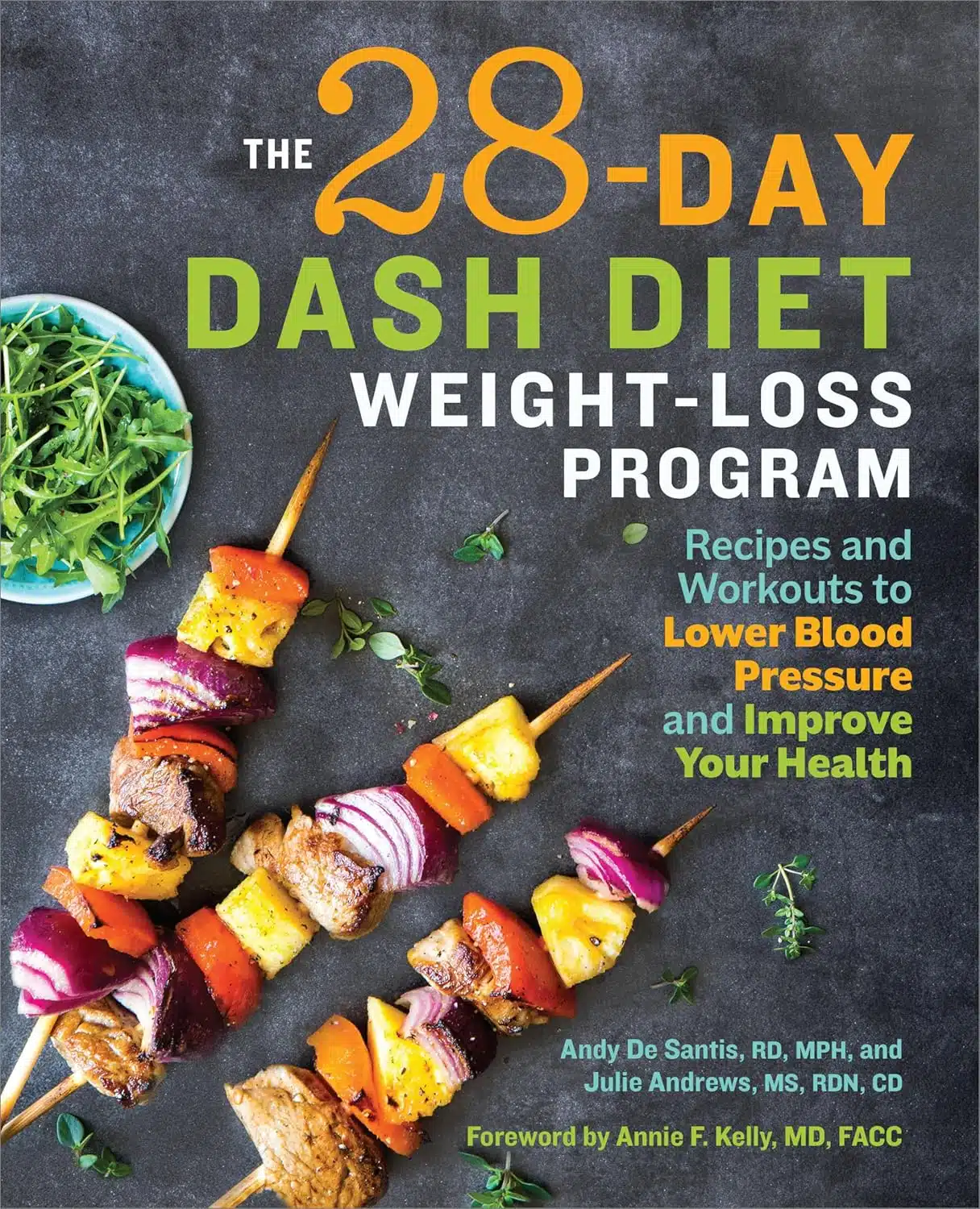
The 28-Day DASH Diet Weight Loss Program – by Julie Andrews RDN & Andy De Santis RD

10almonds is reader-supported. We may, at no cost to you, receive a portion of sales if you purchase a product through a link in this article.

Dietary Approaches to Stop Hypertension”, or DASH, is a Mediterranean-adjacent way of eating that, as the name suggests, is focussed on cardiovascular health.

By “Mediterranean-adjacent”, we don’t mean Anatolian or such, we mean: it’s basically the Mediterranean diet with a few tweaks, such as eliminating red meat (of which the Mediterranean allows for a small amount) and moving fish up the list in terms of worthy protein sources.

In this book, we get an overview of what makes up the DASH diet and why, what proportions of various food groups we want to aim for, and for those who want to still include red meat, there’s advice on how to make it less bad (e.g. portion size capped at 1oz and fat trimmed off, etc).

You may be wondering about sodium; they use the 2.3g daily limit to start, working toward a 1.5mg daily limit. Which, considering the various international bodies’ recommended limits on sodium, are quite generous while still representing a reduction for most people, and especially for most Americans.

The recipes themselves are varied, easy without being uninteresting, and plants-forward while still including many recipes that have animal products. We will mention though, that most of them don’t have pictures, which will be a downside for people who prefer such.

The subtitle mentioning “recipes and workouts” makes it sound like equal amounts of both; in reality there are a few pages devoted to exercise (within a chapter devoted to exercise, stress management, and sleep) and aside from that one chapter, we get 10 chapters about diet.

Bottom line: if you’d like to take up the DASH diet and aren’t sure where to start, this guide will get you up-and-running with its 28-day program.

Click here to check out The 28-Day DASH Diet Weight Loss Program, and take care of your heart!

Don’t Forget…

Did you arrive here from our newsletter? Don’t forget to return to the email to continue learning!

Learn to Age Gracefully

Join the 98k+ American women taking control of their health & aging with our 100% free (and fun!) daily emails:

  • From Painkillers To Hunger-Killers

    10almonds is reader-supported. We may, at no cost to you, receive a portion of sales if you purchase a product through a link in this article.

    Here’s this week’s selection of health news discoveries, the science behind them, what they mean for you, and where you can go from there:

    Killing more than pain

    It’s well-known that overuse of opioids can lead to many problems, and here’s another one: messing with the endocrine system. This time, mostly well-evidenced in men—however, the researchers are keen to point out that absence of evidence is very much not evidence of absence, hence “the hidden effects” in the headline below. It’s not that the effects are hard to see—it’s that a lot of the research has yet to be done. For now, though, we know at the very least that there’s an association between opioid use and hyperprolactinemia in men. The same research also begins to shine a light on the effects of opioid use on the hypothalamic-pituitary system and bone health, too:

    Read in full: The hidden effects of opioid use on the endocrine system

    Related: The 7 Approaches To Pain Management

    Gut microbiome dysbiosis may lead to slipping disks

    These things sound quite unconnected, but the association is strong. The likely mechanism of action is that the gut dysbiosis influences systemic inflammation, and thus spinal health—because the gut-spine axis cannot really be disconnected (while you’re alive, at least). It’s especially likely if you’re over 50 and female:

    Read in full: Are back problems influenced by your gut?

    Related: Is Your Gut Leading You Into Osteoporosis?

    The Internet is really really great (for brains)

    It’s common to see many articles on the Internet telling us, paradoxically, that we should spend less time on the Internet. However… Remember when in the 90s, it was all about “the information superhighway”? It turns out, the fact that it’s more like “the information spaghetti junction” these days doesn’t change the fact that stimulation is good for our brains, and daily Internet use improves memory, because of the different way that we index and store information that came from a virtual source. While there are parts of your brain for “things at home” and “things at the local supermarket”, there are also parts for “things at 10almonds” and “things at Facebook” and so forth. You are, in effect, building a vast mental library as you surf:

    Read in full: Daily internet use supercharges your memory!

    Related: Make Social Media Work For Your Mental Health

    Fall back

    Around this time of year in many places in the Northern Hemisphere, the clocks go back an hour (it’s next weekend in the US and Canada, by the way, and this weekend in most of Europe). Many enjoy this as the potential for an extra hour’s sleep, but for night owls, it can be more of a nuisance than a benefit—throwing out what’s often an already difficult relationship with the clock, and presenting challenges both practical and physiological (different processing of melatonin, for instance). Here be science:

    Read in full: Why night owls struggle more when the clocks go back

    Related: Early Bird Or Night Owl? Genes vs Environment

    Can you outrun your hunger?

    It seems so, though benefits are strongest in women. We say “outrun”, though this study did use stationary cycling. To put it in few words, intense exercise (but not moderate exercise) significantly reduced acylated ghrelin (hunger hormone) levels, and subjective reports of hunger, especially in women:

    Read in full: Study finds intense exercise may suppress appetite in healthy humans

    Related: 3 Appetite Suppressants Better Than Ozempic

    Take care!

    Share This Post

  • How Your Diet May Be Causing Chronic Tightness (& How To Fix It)

    10almonds is reader-supported. We may, at no cost to you, receive a portion of sales if you purchase a product through a link in this article.

    There is often more to hamstring flexibility than just stretching:

    Three steps

    The method focuses on three areas: diet, mindset, and movement.

    Why diet? Poor gut health and inflammation, often caused by processed and fast foods, contribute to chronic hamstring tightness. The video suggests nutrient-dense meals like Greek yogurt with poached eggs. As for collagen, that is found most abundantly in the bones and skin of fish and other animals, but if you are vegan/vegetarian, fear not, you can just make sure to eat plenty of its constituent parts instead, and synthesize it yourself like any other animal. See also: The Best Foods For Collagen Production

    Why mindset? Addressing pain and other somatic (bodily) concerns involves understanding the body as a single interconnected system. So, it’s necessary to also take care of any emotional stress or other underlying conditions, as well as ensuring your hormones are all in order.

    Why movement? Machine-based training, which isolates muscles, can cause imbalances. Instead, consider functional movements like hanging and compound exercises such as Pilates or other calisthenics systems. These improve core strength, enhance flexibility, and prevent stiffness, ensuring better overall function.

    Some example exercises:

    • Bent knee hamstring stretch: hold for 2 seconds; do 10–12 reps (2 sets per leg).
    • Straight leg active isolation: focus on quad engagement with assistance from a band; 10–12 reps (2 sets per leg).
    • Active hip abductors: target IT band and glute medius; 1 set of 12 reps per leg.
    • Active lunge stretch: incorporate a band to intensify the stretch; 2 seconds at the top range.

    For more on all of this plus visual demonstrations of the exercises, enjoy:

    Click Here If The Embedded Video Doesn’t Load Automatically!

    Want to learn more?

    You might also like:

    Fix Tight Hamstrings In Just 3 Steps

    Take care!

    Share This Post

  • A new emergency procedure for cardiac arrests aims to save more lives – here’s how it works

    10almonds is reader-supported. We may, at no cost to you, receive a portion of sales if you purchase a product through a link in this article.

    As of January this year, Aotearoa New Zealand became just the second country (after Canada) to adopt a groundbreaking new procedure for patients experiencing cardiac arrest.

    Known as “double sequential external defibrillation” (DSED), it will change initial emergency response strategies and potentially improve survival rates for some patients.

    Surviving cardiac arrest hinges crucially on effective resuscitation. When the heart is working normally, electrical pulses travel through its muscular walls creating regular, co-ordinated contractions.

    But if normal electrical rhythms are disrupted, heartbeats can become unco-ordinated and ineffective, or cease entirely, leading to cardiac arrest.

    Defibrillation is a cornerstone resuscitation method. It gives the heart a powerful electric shock to terminate the abnormal electrical activity. This allows the heart to re-establish its regular rhythm.

    Its success hinges on the underlying dysfunctional heart rhythm and the proper positioning of the defibrillation pads that deliver the shock. The new procedure will provide a second option when standard positioning is not effective.

    Using two defibrillators

    During standard defibrillation, one pad is placed on the right side of the chest just below the collarbone. A second pad is placed below the left armpit. Shocks are given every two minutes.

    Early defibrillation can dramatically improve the likelihood of surviving a cardiac arrest. However, around 20% of patients whose cardiac arrest is caused by “ventricular fibrillation” or “pulseless ventricular tachycardia” do not respond to the standard defibrillation approach. Both conditions are characterised by abnormal activity in the heart ventricles.

    DSED is a novel method that provides rapid sequential shocks to the heart using two defibrillators. The pads are attached in two different locations: one on the front and side of the chest, the other on the front and back.

    A single operator activates the defibrillators in sequence, with one hand moving from the first to the second. According to a recent randomised trial in Canada, this approach could more than double the chances of survival for patients with ventricular fibrillation or pulseless ventricular tachycardia who are not responding to standard shocks.

    The second shock is thought to improve the chances of eliminating persistent abnormal electrical activity. It delivers more total energy to the heart, travelling along a different pathway closer to the heart’s left ventricle.

    Evidence of success

    New Zealand ambulance data from 2020 to 2023 identified about 1,390 people who could potentially benefit from novel defibrillation methods. This group has a current survival rate of only 14%.

    Recognising the potential for DSED to dramatically improve survival for these patients, the National Ambulance Sector Clinical Working Group updated the clinical procedures and guidelines for emergency medical services personnel.

    The guidelines now specify that if ventricular fibrillation or pulseless ventricular tachycardia persist after two shocks with standard defibrillation, the DSED method should be administered. Two defibrillators need to be available, and staff must be trained in the new approach.

    Though the existing evidence for DSED is compelling, until recently it was based on theory and a small number of potentially biased observational studies. The Canadian trial was the first to directly compare DSED to standard treatment.

    From a total of 261 patients, 30.4% treated with this strategy survived, compared to 13.3% when standard resuscitation protocols were followed.

    The design of the trial minimised the risk of other factors confounding results. It provides confidence that survival improvements were due to the defibrillation approach and not regional differences in resources and training.

    The study also corroborates and builds on existing theoretical and clinical scientific evidence. As the trial was stopped early due to the COVID-19 pandemic, however, the researchers could recruit fewer than half of the numbers planned for the study.

    Despite these and other limitations, the international group of experts that advises on best practice for resuscitation updated its recommendations in 2023 in response to the trial results. It suggested (with caution) that emergency medical services consider DSED for patients with ventricular fibrillation or pulseless ventricular tachycardia who are not responding to standard treatment.

    Training and implementation

    Although the evidence is still emerging, implementation of DSED by emergency services in New Zealand has implications beyond the care of patients nationally. It is also a key step in advancing knowledge about optimal resuscitation strategies globally.

    There are always concerns when translating an intervention from a controlled research environment to the relative disorder of the real world. But the balance of evidence was carefully considered before making the decision to change procedures for a group of patients who have a low likelihood of survival with current treatment.

    Before using DSED, emergency medical personnel undergo mandatory education, simulation and training. Implementation is closely monitored to determine its impact.

    Hospitals and emergency departments have been informed of the protocol changes and been given opportunities to ask questions and give feedback. As part of the implementation, the St John ambulance service will perform case reviews in addition to wider monitoring to ensure patient safety is prioritised.

    Ultimately, those involved are optimistic this change to cardiac arrest management in New Zealand will have a positive impact on survival for affected patients.The Conversation

    Vinuli Withanarachchie, PhD candidate, College of Health, Massey University; Bridget Dicker, Associate Professor of Paramedicine, Auckland University of Technology, and Sarah Maessen, Research Associate, Auckland University of Technology

    This article is republished from The Conversation under a Creative Commons license. Read the original article.

    Share This Post

  • Elderhood – by Dr. Louise Aronson

    10almonds is reader-supported. We may, at no cost to you, receive a portion of sales if you purchase a product through a link in this article.

    Where does “middle age” end, and “old age” begin? By the United States’ CDC’s categorization, human life involves:

    • 17 stages of childhood, deemed 0–18
    • 5 stages of adulthood, deemed 18–60
    • 1 stage of elderhood, deemed 60+

    Isn’t there something missing here? Do we just fall off some sort of conveyor belt on our sixtieth birthdays, into one big bucket marked “old”?

    Yesterday you were 59 and enjoying your middle age; today you have, apparently, the same medical factors and care needs as a 114-year-old.

    Dr. Louise Aronson, a geriatrician, notes however that medical science tends to underestimate the differences found in more advanced old age, and underresearch them. That elders consume half of a country’s medicines, but are not required to be included in clinical trials. That side effects not only are often different than for younger adults, but also can cause symptoms that are then dismissed as “Oh she’s just old”.

    She explores, mostly through personal career anecdotes, the well-intentioned disregard that is frequently given by the medical profession, and—importantly—how we might overcome that, as individuals and as a society.

    Bottom line: if you are over the age of 60, love someone over the age of 60, this is a book for you. Similarly if you and/or they plan to live past the age of 60, this is also a book for you.

    Click here to check out Elderhood, and empower yours!

    Don’t Forget…

    Did you arrive here from our newsletter? Don’t forget to return to the email to continue learning!

    Learn to Age Gracefully

    Join the 98k+ American women taking control of their health & aging with our 100% free (and fun!) daily emails:

  • Sleeping on Your Back after 50; Yea or Nay?

    10almonds is reader-supported. We may, at no cost to you, receive a portion of sales if you purchase a product through a link in this article.

    Sleeping Differently After 50

    Sleeping is one of those things that, at any age, can be hard to master. Some of our most popular articles have been on getting better sleep, and effective sleep aids, and we’ve had a range of specific sleep-related questions, like whether air purifiers actually improve your sleep.

    But perhaps there’s an underlying truth hidden in our opening sentence…is sleeping consistently difficult because the way we sleep should change according to our age?

    Inspired by Brad and Mike’s video below (which was published to their 5 million+ subscribers!), there are 4 main elements to consider when sleeping on your back after you’ve hit the 50-year mark:

    1. Degenerative Disk Disease: As you age, your spine may start to show signs of wear and tear, which directly affects comfort while lying on your back.
    2.  Sleep Apnea and Snoring: Sleep Apnea and snoring become more of an issue with age, and sleeping on your back can exacerbate these problems; when you sleep on your back, the soft tissues in your throat, as well as your tongue, “fall back” and partly obstruct your the airway.
    3.  Spinal Stenosis: Spinal Stenosis–the often-age-related narrowing of your spinal canal–can put pressure on the nerves that travel through the spine, which equally makes back-sleeping harder.
    4.  GERD: The all-too-familiar gastroesophageal reflux disease can be more problematic when lying flat on your back, as doing so can allow easy access for stomach acid to move upwards.

    Alternatives to Back Sleeping

    Referencing the Mayo Clinic’s Sleep Facility’s director, Dr. Virend Somers, today’s video suggests a simple solution: sleeping on your side. The video goes into a bit more detail but, as you know, here at 10almonds we like to cut to the chase. 

    Modifications for Back Sleeping

    If you’re a lifelong back-sleeping and cannot bear the idea of changing to your side, or your stomach, then there are a few modifications that you can make to ease any pain and discomfort.

    Most solutions revolve around either leg wedges or pillow adjustments. For instance, if you’re suffering from back pain, try propping your knees up. Or if GERD is your worst enemy, a wedge pillow could help keep that acid down.

    As can be expected, the video dives into more detail:

    How was the video? If you’ve discovered any great videos yourself that you’d like to share with fellow 10almonds readers, then please do email them to us!

    Don’t Forget…

    Did you arrive here from our newsletter? Don’t forget to return to the email to continue learning!

    Learn to Age Gracefully

    Join the 98k+ American women taking control of their health & aging with our 100% free (and fun!) daily emails:

  • How Artery Widening (Not Just Narrowing) Can Also Cause Strokes

    10almonds is reader-supported. We may, at no cost to you, receive a portion of sales if you purchase a product through a link in this article.

    We’ve written about stroke before; most centrally, our “how to” article, Reduce Your Stroke Risk ← so definitely do check this one out and do those things!

    All that remains valid, but a new risk factor has been identified, and, paradoxically, it’s the widening of arteries:

    Too wide!

    Researchers (Dr. Joanna Wardlaw et al.) have done a study whose results challenge the long-standing idea that lacunar ischemic stroke (a common small vessel stroke) is mainly caused by fatty plaque narrowing in larger arteries; instead, Dr. Wardlaw and her team found that widened, enlarged brain arteries (arterial dolichoectasia) were much more strongly linked to lacunar stroke and cerebral small vessel disease (with 4x greater risk thereof).

    As to how this problem arises when logically a wider blood vessel should mean better blood flow, the paper (that we’ll link shortly) discusses how “nonatheromatous intrinsic microvascular pathology” is to blame, which translating from sciences, means the structural disorganization of small brain arterioles, rather than the cholesterol plaque buildup in larger vessels.

    In other words, imagine if your house were built quite a bit larger but with only the same building materials; you see how it’d have problems? Same deal for your blood vessels.

    This means that antiplatelet drugs such as aspirin mainly target clotting and atherosclerotic plaque-related events, but if lacunar stroke is primarily driven by intrinsic small vessel structural damage rather than plaque blockage, then antiplatelet approaches are not likely to be a lot of help in this case!

    Important note: this does not mean that arterial narrowing (let alone blockage) is fine. It’s not. It just causes different strokes for different folks, so to speak. And, by consequence, this also doesn’t mean cholesterol, plaque, or antiplatelet therapy are unimportant for all stroke types (indeed, atherosclerosis remains a major cause of many other strokes) but simply that lacunar stroke will require other approaches:

    ❝This study provides strong evidence that lacunar stroke is not caused by fatty blockage of larger arteries, but by disease of the small vessels within the brain itself.

    Recognizing this distinction is crucial, because it explains why conventional treatments like antiplatelet drugs are not as effective for this type of stroke and highlights the urgent need to develop new therapies that target the underlying microvascular damage❞

    ~ Dr. Joanna Wardlaw

    So, research in this regard will now be focusing on protecting or restoring small vessel integrity rather than just on (the also worthy goal of) preventing clot formation; the same team’s LACI-3 trial is already testing whether drugs such as cilostazol and isosorbide mononitrate will better target these mechanisms.

    You can read the paper in full, here: Implications of Cranial Arterial Stenosis and Dolichoectasia for Cerebral Small-Vessel Disease Etiopathogenesis: Findings From a Prospective Mild Stroke Cohort

    But what if you do have a stroke?

    All is not necessarily lost; there are options! For example: What To Do If Having A Stroke Alone? ← with the caveat that, if you have a stroke, there’s a good chance you’ll forget all this. However, this is good to know anyway, in case someone else is having a stroke (and if you don’t live alone, it can be good for whoever is with you to know this too).

    There are also such resources as: Reverse Stroke Damage (Within A 6-Hour Window) ← there is a drug that does this now, but time is of the essence

    Want to learn more?

    Everyone even vaguely health-conscious knows that prevention is better than cure, but many still don’t think about a lot of things until they’re too late, and stroke definitely falls all-too-often into that category:

    Each year in the US, over half a million people have a first stroke; however, up to 80% of strokes may be preventable.❞

    ~ American Stroke Association

    Source: New guideline: Preventing a first stroke may be possible with screening, lifestyle changes

    To be ahead of that curve, check out:

    Don’t Get Caught Out By These “Nontraditional” Stroke Risk Factors

    And, for that matter,

    6 Signs Of Stroke (One Month In Advance)

    Take care!

    Don’t Forget…

    Did you arrive here from our newsletter? Don’t forget to return to the email to continue learning!

    Learn to Age Gracefully

    Join the 98k+ American women taking control of their health & aging with our 100% free (and fun!) daily emails: