
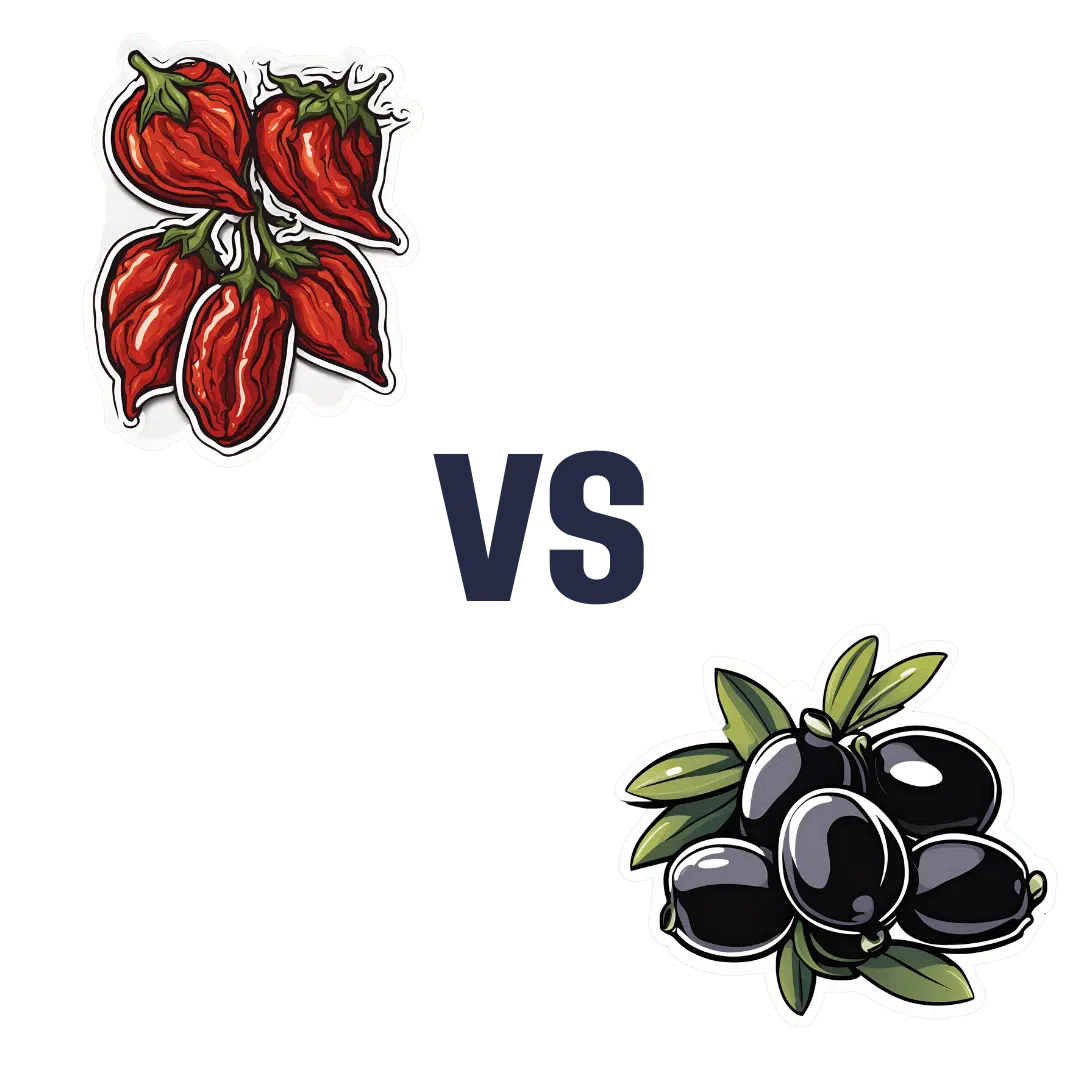
Sun-dried Tomatoes vs Black Olives – Which is Healthier?
10almonds is reader-supported. We may, at no cost to you, receive a portion of sales if you purchase a product through a link in this article.
Our Verdict
When comparing sun-dried tomatoes to black olives, we picked the sun-dried tomatoes.
Why?
These common snack-salad items may seem similar in consistency, but their macros are very different: the tomatoes, being dried, have proportionally a lot more protein, carbs, and fiber. The olives, meanwhile, have more fat (and/but yes, a very healthy blend of fats). Note that these comments are true for the things themselves; be aware that sun-dried tomatoes are often sold in vegetable oil, which would obviously change the macros considerably and be much less healthy. So, for the sake of statistics, we’re assuming you got sun-dried tomatoes that aren’t soaked in oil. All in all, we’re calling this category a win for the tomatoes, but those fats from the olives are very good too.
In terms of vitamins, the sun-dried tomatoes being dried again means that the loss of water weight means the vitamin content is proportionally much higher; the tomatoes are higher in vitamins A, B1, B2, B3, B5, B6, B9, C, and K, while olives are higher only in vitamin E (but in their defence, olives have 165x more vitamin E than sun-dried tomatoes). Still, a win for sun-dried tomatoes here.
When it comes to minerals, it’s a similar story for the same reason; the loss of water weight in the sun-dried tomatoes makes them much more nutritionally dense; they are higher in calcium, copper, iron, magnesium, manganese, phosphorus, potassium, selenium, and zinc, while the olives are higher only in sodium. Note, we’re looking at black olives today; green olives would be even higher in sodium than black ones, as they are “cured” for longer.
Lastly, in terms of polyphenols, they both have a lot of great things to bring, but sun-dried tomatoes are pretty much the richest natural source of lycopene, which itself a very powerful polyphenol even my general polyphenol standards, so we’d call this one a win for the sun-dried tomatoes too.
Want to learn more?
You might like to read:
Lycopene’s Benefits For The Gut, Heart, Brain, & More
Take care!
Don’t Forget…
Did you arrive here from our newsletter? Don’t forget to return to the email to continue learning!
Recommended

Learn to Age Gracefully
Join the 98k+ American women taking control of their health & aging with our 100% free (and fun!) daily emails:
-
A Better Second Half – by Liz Earle
10almonds is reader-supported. We may, at no cost to you, receive a portion of sales if you purchase a product through a link in this article.
Here we have a book that’s aimed at women from midlife onwards. The author is not a doctor or scientist, but has been in the wellness industry in one form or another for pretty much her entire career (and she’s now in her 60s), so you can imagine she’s accumulated a lot of knowledge and experience.
As a result, what she delivers is a guide to aging female health that is comprehensive in its recommendations, while being quite light on the underlying science (which she herself may or may not understand—she neither shows scientific expertise nor scientific ignorance; she simply doesn’t discuss the science beyond the level of mentioning that it is there).
To this end, we get practical advice on supplements, HRT, nutrition, exercise, brain health specifically, sleep, stress-management, social considerations, and even “beauty bio-hacks”.
The style is polished, including in her self-presentation when discussing her own practices and life history. The book is written in British English, by the way, which means not only spellings such as “oestrogen” but also things like her mentioning when she was at her heaviest, post-pregnancy, she weighed 12 stone. This European reviewer had to look up what that is (apparently it’s 76 kg, or 168 lbs, for Americans).
Bottom line: the advice here is good, albeit by no means groundbreaking or deep. If you’re a regular 10almonds reader, you’ll doubtlessly know the main content already, though you’ll probably also pick up at least some new information, since she peppers a great miscellany of facts throughout her work. Which, given the very minimal referencing, may then require fact-checking by the reader, but either way, learning occurs. Which is what we’re all about!
Click here to check out A Better Second Half, and enjoy a better second half!
Share This Post
-
How GLP-1 Drugs Affect Gene Expression
10almonds is reader-supported. We may, at no cost to you, receive a portion of sales if you purchase a product through a link in this article.
…and other items from this week’s health news:
GLP-1 receptor agonists affect more than we knew
Normally, short-lived hormonal signals trigger a quick response and then fade. Synthetic GLP-1 agonists remain in the body much longer than the natural hormone whose receptor’s they’re sneakily agonizing (sounds bad, but in this context it’s good), allowing sustained activation of gene programs.
How exactly? It increases signaling, which ultimately leads to phosphorylation of the Med14 protein within the Mediator transcription complex.
That’s a lot of big words, so to simplify a little: the Mediator complex controls large sets of genes rather than a single pathway, so activating Med14 can switch on broad gene programs that reshape how cells function over time.
Researchers (Dr. Sam Van de Velde et al.) examined the practical side of this, and found for example that in pancreatic beta cells, the result is improved stress resistance, greater survival, and enhanced insulin production, which helps counter metabolic syndrome, and its associated more specific maladies such as type 2 diabetes, heart disease of various kinds, etc.
And because these processes (per the Med14 switch etc) can occur in many different kinds of tissue, similar gene-expression changes may be occuring in the heart, brain, blood vessels, and fat tissue—but more research will be needed to confirm that, of course.
Read in full: How do GLP-1 agonists affect gene expression?
Related: Demystifying Peptides ← remember that GLP-1 is a peptide! GLP stands for “glucagon-like peptide”, and we talk about peptides’ effects on gene expression here too
The schizophrenia biomarker hiding in your cheek
Schizophrenia currently has no single definitive laboratory test, so clinicians rely mainly on observing symptoms such as hallucinations, delusions, and disorganized thinking, which can delay diagnosis for months, not to mention leave a lot of room for subjectivity on the part of the clinician.
However, researchers (Dr. Christen Crosta et al.) compared cheek-swab samples from 27 people with schizophrenia and 27 matched healthy controls, and found that patients with schizophrenia showed significantly higher activity of the Sp4 gene, which is involved in brain development and whose elevated expression correlated with more severe symptoms such as hallucinations and delusions.
Dr. Crosta and her team also found that schizophrenic patients had higher levels of the protein HSP60, which appears to be regulated by Sp4 and may act as a sort of “downstream” biological indicator of schizophrenia.
In short, if confirmed in larger studies, a simple cheek swab could help detect schizophrenia earlier or monitor disease progression in a fast and non-invasive way.
Read in full: Cheek cells may provide clues to schizophrenia risk
Related: The Disordered Mind – by Dr. Eric Kandel
A spray-on immune shield has been developed!
Organ transplant recipients usually take immunosuppressants to prevent rejection, but these drugs weaken the entire immune system (thus leaving the patient very vulnerable to infections; it’s a lot like giving someone a slightly weaker form of AIDS) and also can cause complications such as kidney toxicity.
So, it’s not great. Better than not having the organ in question, of course, but not great.
However! Researchers (Dr. Hyung Joon Cha et al.) have developed microscopic gel particles containing immunosuppressants that stick to organ surfaces using adhesive proteins inspired by mussels’ ability to cling to wet surfaces.
In other words: the sprayed microgels form an invisible layer on the organ that remains attached to the wet tissue and slowly releases the drug locally at the transplant site.
And, it worked! Because the medication stays mainly on the transplanted organ rather than circulating through the bloodstream, this approach is able to suppress rejection while minimizing whole-body side effects.
Read in full: Spray-on “immune-shield” coats transplant organs to curb rejection
Related: Rapamycin Can Slow Aging By 20% (But Watch Out) ← an alternative immunosuppressant
Take care!
Share This Post
-
The Power Foods Diet – by Dr. Neal Barnard
10almonds is reader-supported. We may, at no cost to you, receive a portion of sales if you purchase a product through a link in this article.
First, what this is not: it’s not a cookbook. There are recipes, more than a hundred if we consider such things as “barbecue sauce” as a standalone recipe, and if we overlook such things as how “perfect hot oatmeal” is followed on the next page by a recipe for “perfect hot oatmeal with berries”.
However, as we say, it’s not a cookbook; it’s first and foremost an educational text on the topic of nutrition.
Here we will learn about good eating for general health, which foods are natural appetite-suppressants, which foods reduce our body’s absorption of sugars from foods (not merely slowing, but flushing them away so they cannot be absorbed at all), and which foods actually boost metabolism for a few hours after the meal.
Dr. Barnard also talks about some foods that are more healthy, or less healthy, than popularly believed, and how to use all this information to craft a good, optimized, dietary plan for you.
Bottom line: there’s a lot of good information here, and the recipes are simply a bonus.
Click here to check out The Power Foods Diet, and optimize yours!
Share This Post
Related Posts
-
Why You Should Diversify Your Nuts!
10almonds is reader-supported. We may, at no cost to you, receive a portion of sales if you purchase a product through a link in this article.
Time to go nuts for nuts!
Nuts, in popular perception, range from “basically the healthiest food anyone can eat” to “basically high calorie salty snacks”. And, they can be either!
Some notes, then:
- Raw is generally better that not
- Dry roasted is generally better than the kind with added oils
- Added salt is neither necessary nor good
Quick tip: if “roasted salted” are the cheapest or most convenient to buy, you can at least mitigate that by soaking them in warm water for 5 minutes, before rinsing and (if you don’t want wet nuts) drying.
You may be wondering: who does want wet nuts? And the answer is, if for example you’re making a delicious cashew and chickpea balti, the fact you didn’t dry them before throwing them in won’t make a difference.
Now, let’s do a quick run-down; we don’t usually do “listicles” but it seemed a good format here, so we’ve picked a top 5 for nutritional potency:
Almonds
We may have a bias. We accept it. But almonds are also one of the healthiest nuts around, and generally considered by most popular metrics the healthiest.
Not only are they high in protein, healthy fat, fiber, vitamins, and minerals, but they’re even a natural prebiotic that increases the populations of healthy gut bacteria, while simultaneously keeping down the populations of gut pathogens—what more can we ask of a nut?
Read more: Prebiotic effects of almonds and almond skins on intestinal microbiota in healthy adult humans
Pistachios
Not only are these super tasty and fun to eat (and mindful eating is all but guaranteed, as shelling them by hand slows us down and makes us more likely to eat them one at a time rather than by the handful), but also they contain lots of nutrients and are lower in calories than most nuts, so they’re a great option for anyone who’d like to eat more nuts but is doing a calorie-controlled diet and doesn’t want to have half a day’s calories in a tiny dish of nuts.
Walnuts
Popularly associated with brain health (perhaps easy to remember because of their appearance), they really are good for the brain:
Check it out: Beneficial Effects of Walnuts on Cognition and Brain Health
Cashews
A personal favorite of this writer for their versatility in cooking, food prep, or just as a snack, they also do wonders for metabolic health:
Brazil nuts
The most exciting thing about these nuts is that they’re an incredibly potent source of selenium, which is important not just for hair/skin/nails as popularly marketed, but also for thyroid hormone production and DNA synthesis.
But don’t eat too many, because selenium is definitely one of those “you can have too much of a good thing” nutrients, and selenium poisoning can make your hair (however beautiful and shiny it got because of the selenium) fall out if you take too much.
Know the numbers: Brazil nuts and selenium—health benefits and risks
Bottom line on nuts:
- Nuts are a great and healthful part of almost anyone’s diet
- Obviously, if you have a nut allergy, then we’re sorry; this one won’t have helped you so much
- Almonds are one of the most healthful nuts out there
- Brazil nuts are incredibly potent, to the point where moderation is recommended
- A handful of mixed nuts per day is a very respectable option—when it comes to food and health, diversity is almost always good!
Don’t Forget…
Did you arrive here from our newsletter? Don’t forget to return to the email to continue learning!
Learn to Age Gracefully
Join the 98k+ American women taking control of their health & aging with our 100% free (and fun!) daily emails:
-
Every Woman Should Be Able To Do A Pull-Up
10almonds is reader-supported. We may, at no cost to you, receive a portion of sales if you purchase a product through a link in this article.
Cori Lefkowitz, of “Strong At Every Age”, talks us through what’s actually important (and why):
It’s not about the pull-up
The important part here is to challenge self-imposed limits, rather than literally apply to every individual circumstance. If, for example, you do not have arms, then quite possibly pull-ups are indeed not the ideal target exercise for you!
There’s a common mental barrier that applies to [this and] a lot of things: people often treat a single failed attempt as proof they’ll never succeed, instead of recognizing that strength skills (just like most other skills) require progressive training.
And then it gets worse, because avoiding challenging movements over time is (of course!) one of the major things that contributes to declining strength with age.
But let’s say you do want to do pull-ups, specifically. A laudable goal! And an intrinsically worthy one too, because working towards a pull-up can reduce neck, shoulder, elbow, and upper-back discomfort by improving posture and joint function.
With that in mind…
- Mobility first: improving chest, lat, and spinal mobility through foam rolling, stretching, and movement prep is essential before building strength.
- Scapular control next: developing the ability to move your shoulder blades (retraction, depression, elevation, and protraction) is key for both strength and injury reduction.
- Progressive strengthening thereafter: exercises like lat pulldowns, assisted variations, and pull-up holds help build the specific strength needed over time.
This isn’t exactly a detailed how-to, so we’ll link a more detailed “how-to” in the “learn more” section below.
Meanwhile, the most important thing to learn from today’s video is: instead of asking “can I do it now,” the better question is “what can I do to work towards it?”
For more on all of this and surprisingly little in the category of visual demonstrations, enjoy:
Click Here If The Embedded Video Doesn’t Load Automatically!
Want to learn more?
You might also like:
Take care!
Don’t Forget…
Did you arrive here from our newsletter? Don’t forget to return to the email to continue learning!
Learn to Age Gracefully
Join the 98k+ American women taking control of their health & aging with our 100% free (and fun!) daily emails:
-
How Many Steps Per Day To Beat Alzheimer’s? (A Lot Fewer Than You Might Think)
10almonds is reader-supported. We may, at no cost to you, receive a portion of sales if you purchase a product through a link in this article.
“Walking is good for the health” is not, of course, breaking news.
“Exercise helps keep Alzheimer’s at bay”, meanwhile, is something that probably most people don’t know, but regular 10almonds readers certainly will.
There are numerous reasons, and the first and foremost is that “what’s good for your heart is good for your brain” (because the heart feeds the brain, and also ultimately clears away detritus, including the amyloid-β famously associated with Alzheimer’s).
For more on how this works, see: What’s Your Vascular Dementia Risk? ← includes actual numbers and a risk calculator tool and things like that
How many steps?
We previously wrote about merely moving one’s body enough to not be considered to have a “sedentary lifestyle” is already hugely beneficial.
How To Walk Away From Alzheimer’s ← this is less about how much you exercise or how intensely, and more about how much time you spend simply “not sitting”. So, for example, walking.
Most recently, researchers (Dr. Wendy Yau et al.) found that regular walking, even in modest amounts, help build cognitive resilience and delay symptom onset in preclinical Alzheimer’s disease.
How modest? To put it in numbers,
- walking under 3,000 steps/day meant faster buildup of amyloid-β and tau proteins, and quicker cognitive and functional decline.
- walking 3,000–5,000 steps/day delayed cognitive decline by about 3 years.
- walking 5,000–7,500 steps/day delayed decline by about 7 years.
In other words, even a day in which you just amble around the house, perhaps doing some housework, can probably clock up 3,000 steps per day, and is already beneficial.
Of course, more is better; as you can clearly see, there’s a dose-dependent response, at least up as far as 7,500 steps/day.
To quote Dr. Yau herself,
❝Every step counts—and even small increases in daily activities can build over time to create sustained changes in habit and health.❞
Read the paper in full: Physical activity as a modifiable risk factor in preclinical Alzheimer’s disease
As for that “build over time” part, this is very important too. For example another study recently found that being physically active over long periods (not just sporadically) was mostly strongly linked to maintaining better cognitive health. and that the more often and longer people stayed active, the stronger the protective effect became—which means that yes, those benefits grew over time.
You can read that paper in full too, here: Long-term cumulative physical activity associated with less cognitive decline: Evidence from a 16-year cohort study
So with that in mind, you might want to check out: No-Exercise Exercise! ← for ways to get that regular physical activity in, without it feeling like you are doing so
There are more things you can do too, of course; exercise is not the only tool available (albeit it is a critical one).
For a more comprehensive overview of anti-Alzheimer’s tools, enjoy: How To Reduce Your Alzheimer’s Risk
Want to learn more?
You might like this book that we reviewed a little while back:
Take care!
Don’t Forget…
Did you arrive here from our newsletter? Don’t forget to return to the email to continue learning!
Learn to Age Gracefully
Join the 98k+ American women taking control of their health & aging with our 100% free (and fun!) daily emails:


