
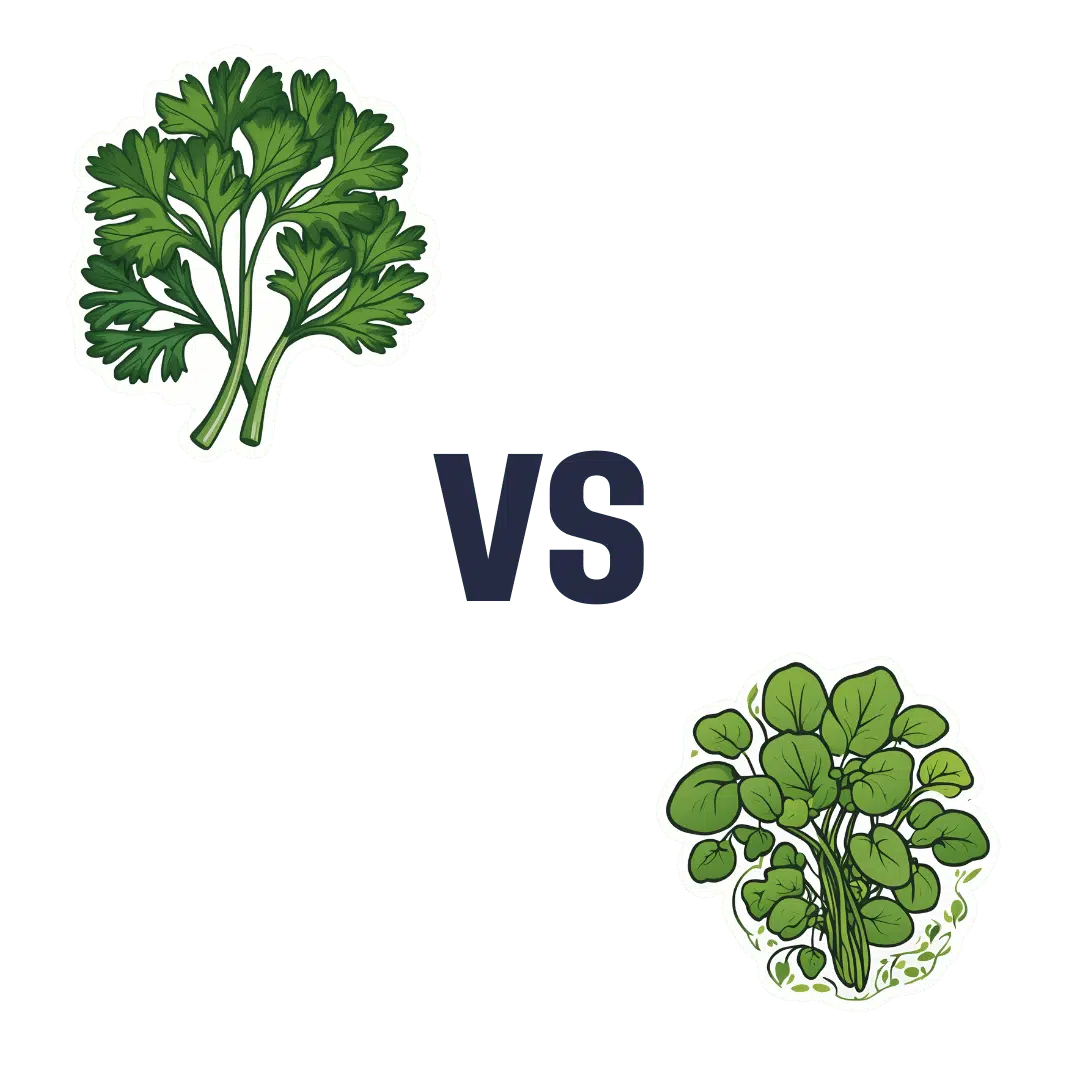
Parsley vs Watercress – Which is Healthier?
10almonds is reader-supported. We may, at no cost to you, receive a portion of sales if you purchase a product through a link in this article.
Our Verdict
When comparing parsley to watercress, we picked the parsley.
Why?
It wasn’t close:
In terms of macros, parsley has more than 6x the fiber, more than 4x the carbs, and slightly more protein, winning this round.
In the category of vitamins, parsley has much more of vitamins A, B3, B5, B7, B9, C, K, and choline, while watercress has slightly more of vitamins B2, B6, and E, making a compelling win for parsley.
Looking at minerals, parsley has more calcium, copper, iron, magnesium, potassium, and zinc, while watercress has more manganese and selenium, meaning another easy win for parsley.
In other considerations, parsley scores higher on polyphenols, winning this round too.
Adding up the sections makes for a clear overall win for parsley, but by all means enjoy either or both; diversity is good!
Want to learn more?
You might like:
What’s Your Plant Diversity Score?
Enjoy!
Don’t Forget…
Did you arrive here from our newsletter? Don’t forget to return to the email to continue learning!
Recommended
Learn to Age Gracefully
Join the 98k+ American women taking control of their health & aging with our 100% free (and fun!) daily emails:
-
Hate salad or veggies? Just keep eating them. Here’s how our tastebuds adapt to what we eat
10almonds is reader-supported. We may, at no cost to you, receive a portion of sales if you purchase a product through a link in this article.
Do you hate salad? It’s OK if you do, there are plenty of foods in the world, and lots of different ways to prepare them.
But given almost all of us don’t eat enough vegetables, even though most of us (81%) know eating more vegetables is a simple way to improve our health, you might want to try.
If this idea makes you miserable, fear not, with time and a little effort you can make friends with salad.
Why don’t I like salads?
It’s an unfortunate quirk of evolution that vegetables are so good for us but they aren’t all immediately tasty to all of us. We have evolved to enjoy the sweet or umami (savoury) taste of higher energy foods, because starvation is a more immediate risk than long-term health.
Vegetables aren’t particularly high energy but they are jam-packed with dietary fibre, vitamins and minerals, and health-promoting compounds called bioactives.
Those bioactives are part of the reason vegetables taste bitter. Plant bioactives, also called phytonutrients, are made by plants to protect themselves against environmental stress and predators. The very things that make plant foods bitter, are the things that make them good for us.
Unfortunately, bitter taste evolved to protect us from poisons, and possibly from over-eating one single plant food. So in a way, plant foods can taste like poison.
For some of us, this bitter sensing is particularly acute, and for others it isn’t so bad. This is partly due to our genes. Humans have at least 25 different receptors that detect bitterness, and we each have our own genetic combinations. So some people really, really taste some bitter compounds while others can barely detect them.
This means we don’t all have the same starting point when it comes to interacting with salads and veggies. So be patient with yourself. But the steps toward learning to like salads and veggies are the same regardless of your starting point.
It takes time
We can train our tastes because our genes and our receptors aren’t the end of the story. Repeat exposures to bitter foods can help us adapt over time. Repeat exposures help our brain learn that bitter vegetables aren’t posions.
And as we change what we eat, the enzymes and other proteins in our saliva change too. This changes how different compounds in food are broken down and detected by our taste buds. How exactly this works isn’t clear, but it’s similar to other behavioural cognitive training.
Add masking ingredients
The good news is we can use lots of great strategies to mask the bitterness of vegetables, and this positively reinforces our taste training.
Salt and fat can reduce the perception of bitterness, so adding seasoning and dressing can help make salads taste better instantly. You are probably thinking, “but don’t we need to reduce our salt and fat intake?” – yes, but you will get more nutritional bang-for-buck by reducing those in discretionary foods like cakes, biscuits, chips and desserts, not by trying to avoid them with your vegetables.
Adding heat with chillies or pepper can also help by acting as a decoy to the bitterness. Adding fruits to salads adds sweetness and juiciness, this can help improve the overall flavour and texture balance, increasing enjoyment.
Pairing foods you are learning to like with foods you already like can also help.
The options for salads are almost endless, if you don’t like the standard garden salad you were raised on, that’s OK, keep experimenting.
Experimenting with texture (for example chopping vegetables smaller or chunkier) can also help in finding your salad loves.
Challenge your biases
Challenging your biases can also help the salad situation. A phenomenon called the “unhealthy-tasty intuition” makes us assume tasty foods aren’t good for us, and that healthy foods will taste bad. Shaking that assumption off can help you enjoy your vegetables more.
When researchers labelled vegetables with taste-focused labels, priming subjects for an enjoyable taste, they were more likely to enjoy them compared to when they were told how healthy they were.
The bottom line
Vegetables are good for us, but we need to be patient and kind with ourselves when we start trying to eat more.
Try working with biology and brain, and not against them.
And hold back from judging yourself or other people if they don’t like the salads you do. We are all on a different point of our taste-training journey.
Emma Beckett, Senior Lecturer (Food Science and Human Nutrition), School of Environmental and Life Sciences, University of Newcastle
This article is republished from The Conversation under a Creative Commons license. Read the original article.
Share This Post
-
Resistance band Training – by James Atkinson
10almonds is reader-supported. We may, at no cost to you, receive a portion of sales if you purchase a product through a link in this article.
For those who’d like a full gym workout at home, without splashing out thousands on a home gym, resistance bands provide a lot of value. But how much value, really?
As James Atkinson demonstrates, there’s more exercise available than one might think.
Did you know that you can use the same band to strengthen your triceps as well as your biceps, for instance? and the same goes for your quadriceps and biceps femoris. And core strength? You bet.
The style here is not a sales pitch (though he does, at the end, offer extra resources if desired), but rather, instructional, and this book is in and of itself already a complete guide. With clear instructions and equally clear illustrations, you don’t need to spend a dime more (unless you don’t own a resistance band, in which case then yes, you will need one of those).
Bottom line: if you’d like to give your body the workout it deserves, this book is a potent resource.
Click here to check out Resistance Band Training, and get training!
Share This Post
-
Kale vs Spinach – Which is Healthier?
10almonds is reader-supported. We may, at no cost to you, receive a portion of sales if you purchase a product through a link in this article.
Our Verdict
When comparing kale to spinach, we picked the kale.
Why?
In terms of macros, kale has more fiber, carbs, and protein, making it the more nutrient-dense option in this category.
When it comes to vitamins, kale has more of vitamins A, B1, B3, B5, B6, C, and K, while spinach has more of vitamins B2, B9, and E, yielding a 7:3 victory to kale.
Looking at minerals next, kale has more calcium, copper, and phosphorus, while spinach has more iron, magnesium, and manganese, and as they’re equal in other minerals, that makes this round a 3:3 tie.
In other considerations, kale is highest in carotenoids and polyphenols (though spinach is good too), while spinach is high in oxalates (kale has negligible oxalates), which latter is irrelevant to most people, but if you have kidney issues, it can cause problems there. So, a win for kale in this category because of its higher carotenoids and polyphenols, and the negligible oxalates.
Adding up the sections makes for a clear overall win for kale, but by all means enjoy either or both, unless you need to avoid oxalates, in which case then very definitely opt for the kale!
Want to learn more?
You might like:
Brain Food? The Eyes Have It! ← this is about leafy greens, and their lutein in particular
Enjoy!
Share This Post
Related Posts
-
The High-Protein, High-Fiber Superfood Salad You’ll Want To Enjoy Daily
10almonds is reader-supported. We may, at no cost to you, receive a portion of sales if you purchase a product through a link in this article.
This salad from Nisha Vora at Rainbow Plant Life has 30g protein and takes minutes to prepare, while being tasty enough to look forward to eating each day:
Easy preparation
Prepare the toppings first; you can do a week’s in advance at once:
- Roasted chickpeas:
- Drain, rinse, and dry two cans of chickpeas.
- Toss with olive oil, salt, and pepper.
- Roast at 425°F for 30–35 minutes.
- Roasted walnuts:
- Chop and toss with olive oil, salt, and pepper.
- Roast at 350°F for 12 minutes after chickpeas finish.
As for the salad base:
- Kale:
- Remove tough stems, slice thinly.
- Wash and massage with lemon juice and salt to soften.
- Cabbage:
- Slice thinly with a knife or mandolin.
- Store in a sealed bag in the fridge for up to a week.
Red wine vinaigrette dressing:
- Key ingredients: red wine vinegar, lemon juice, red pepper flakes, garlic, olive oil.
- Can be stored in the fridge for up to 10 days.
Putting it all together:
- Toss kale and cabbage with vinaigrette by hand.
- Add roasted chickpeas and walnuts for crunch.
- Include a protein source like tofu (store-bought curry tofu recommended).
- Mix in fresh vegetables like grated carrots, sliced bell peppers, or beets.
- Add extras like sauerkraut, avocado, pickled onions, and such.
- Top with fresh herbs (she recommends parsley, basil, or dill).
Click Here If The Embedded Video Doesn’t Load Automatically!
Want to learn more?
You might also like:
21 Most Beneficial Polyphenols & What Foods Have Them
Take care!
Don’t Forget…
Did you arrive here from our newsletter? Don’t forget to return to the email to continue learning!
Learn to Age Gracefully
Join the 98k+ American women taking control of their health & aging with our 100% free (and fun!) daily emails:
- Roasted chickpeas:
-
How Much THC Is Safe?
10almonds is reader-supported. We may, at no cost to you, receive a portion of sales if you purchase a product through a link in this article.
It’s Q&A Day at 10almonds!
Have a question or a request? We love to hear from you!
In cases where we’ve already covered something, we might link to what we wrote before, but will always be happy to revisit any of our topics again in the future too—there’s always more to say!
No question/request too big or small 😎
❝What dose of THC is safe, is there a safe limit or is it more about using it too frequently?❞
Fantastic questions, and science is starting to catch up on these things! We say “catch up”, as research in the US in particular was held up for a long time due to the “war on drugs”, which didn’t really reduce drug usage, but it sure did cramp science.
Now, bad news first:
❝Although the only way of ensuring no harm from cannabis is to not use at all, people who use cannabis could benefit from accurate information regarding their risk❞
For more on that, see: Lower-Risk Cannabis Use Guidelines (LRCUG) for reducing health harms from non-medical cannabis use: A comprehensive evidence and recommendations update
This is a little similar the World Health Organization’s declaration that the only safe amount of alcohol is zero: WHO: No level of alcohol consumption is safe for our health, and for more on the relative risks of alcohol vs THC, see our previous article on that topic:
More recently, researchers (Dr. Rachel Thorn et al.) have proposed cannabis “units” based on THC content, similar to alcohol units, to help people monitor use and reduce harm.
- How the unit works: one standard THC unit equals 5 mg of THC, shifting focus from how often cannabis is used to how much psychoactive substance is actually consumed.
- Safer-use threshold for adults: the study suggests adults shouldn’t exceed 8 THC units per week.
- Please note that this does not say “safe”, it says “safer”, i.e. it is relatively less unsafe than…
- Higher-risk levels: risk of more severe cannabis use disorder, which rises above about 13 THC units per week in adults.
This numbers are based on a longitudinal study that followed 150 cannabis users over 12 months, and in the study sample…
- 80% of adults using below 8 THC units did not meet criteria for cannabis use disorder
- 70% of adults using above this level did meet the criteria for cannabis use disorder
That’s not an arbitrary distinction; cannabis use disorder is characterized by impaired control, cravings, and interference with work, family, or social functioning, and affects an estimated 22% of regular users.
You can read more about that, here: What is cannabis use disorder? And how do you know if you have a problem?
And, for that matter: Cannabis & Mental Health: Good Or Bad?
As for the study itself, here it is for you: Estimating thresholds for risk of cannabis use disorder using standard delta-9-tetrahydrocannabinol (THC) units
So, what does this mean for medical usage?
There can be tradeoffs.
For example, another team of researchers (Dr. Danielle Haley et al.) found that states legalizing cannabis for both medical and adult recreational use saw a 9-to-11-percentage-point decline in daily opioid use.
This is important, because as she points out, increased access to regulated cannabis allows for substitution away from an unstable and toxic opioid supply, lowering overdose risk in a population where opioids account for more than 75% of fatal overdoses in the US.
Further,
❝The magnitude of decrease in opioid use that we observed among a population that is experienced with opioid use and likely to experience unpleasant withdrawal symptoms after reducing this use is very profound and important❞
Here’s a pop-science article about that, and you can also click through to the study itself:
Cannabis legalization may lead to a decline in daily opioid use
Want to learn more?
Check out:
Take care!
Don’t Forget…
Did you arrive here from our newsletter? Don’t forget to return to the email to continue learning!
Learn to Age Gracefully
Join the 98k+ American women taking control of their health & aging with our 100% free (and fun!) daily emails:
-
If Retinal Is Messing Up Your Skin…
10almonds is reader-supported. We may, at no cost to you, receive a portion of sales if you purchase a product through a link in this article.
Dr. Andrea Suarez helps us put it right:
Retin-ouch?
First, what it is: retinal (retinaldehyde) is a topical vitamin A derivative that increases cell turnover, thus rejuvenating the skin, and as such can improve the appearance of fine lines, uneven texture, and pigmentation. although it requires one fewer conversion step in the skin than retinol and thus is generally considered more effective*, both can improve visible signs of aging and support collagen production with consistent use.
*Which can be a good or bad thing depending on your skin; sometimes more effective is not what you want, when it comes to a product whose mechanism of action involves irritating the cells enough to get your body to jettison them in favor of new ones!
Now, as retinal increases skin-cell turnover, it temporarily raises transepidermal water loss, which can lead to dryness, peeling, flaking, stinging, and sensitivity during the first few months. Lifestyle factors such as hot showers, heaters, fireplaces, alcohol consumption, and overwashing can make these effects worse.
So, to support your skin while that happens, it can be a good to use only a gentle cleanser, thoroughly rinse away cleanser residue, consider double cleansing with an oil cleanser followed by a mild cream cleanser when removing makeup (if you wear such), apply moisturizers containing ceramides, use a richer moisturizer or occlusive ointment at night if tolerated, run a humidifier while sleeping (if appropriate for your climate), and avoid exfoliating more than necessary.
You can also make things easier for your skin if you:
- start just a few nights per week and gradually increase towards nightly use
- avoid alternating between multiple retinoids
- use the moisturizer-retinal-moisturizer “sandwich method”
- protect sensitive areas such as your eyelids, lips, neck, and earlobe creases with petroleum jelly
- consider short-contact therapy by rinsing retinal off after about 30 minutes if your skin is highly sensitive
- apply only enough product to form a thin film!
For more on all of this plus some visual illustrations, enjoy:
Click Here If The Embedded Video Doesn’t Load Automatically!
Want to learn more?
You might also like:
Retinoids: Retinol vs Retinal vs Retinoic Acid vs..? ← for demystifying this list of similar-sounding words and what they all mean and what it means for you 😎
Take care!
Don’t Forget…
Did you arrive here from our newsletter? Don’t forget to return to the email to continue learning!
Learn to Age Gracefully
Join the 98k+ American women taking control of their health & aging with our 100% free (and fun!) daily emails:


