
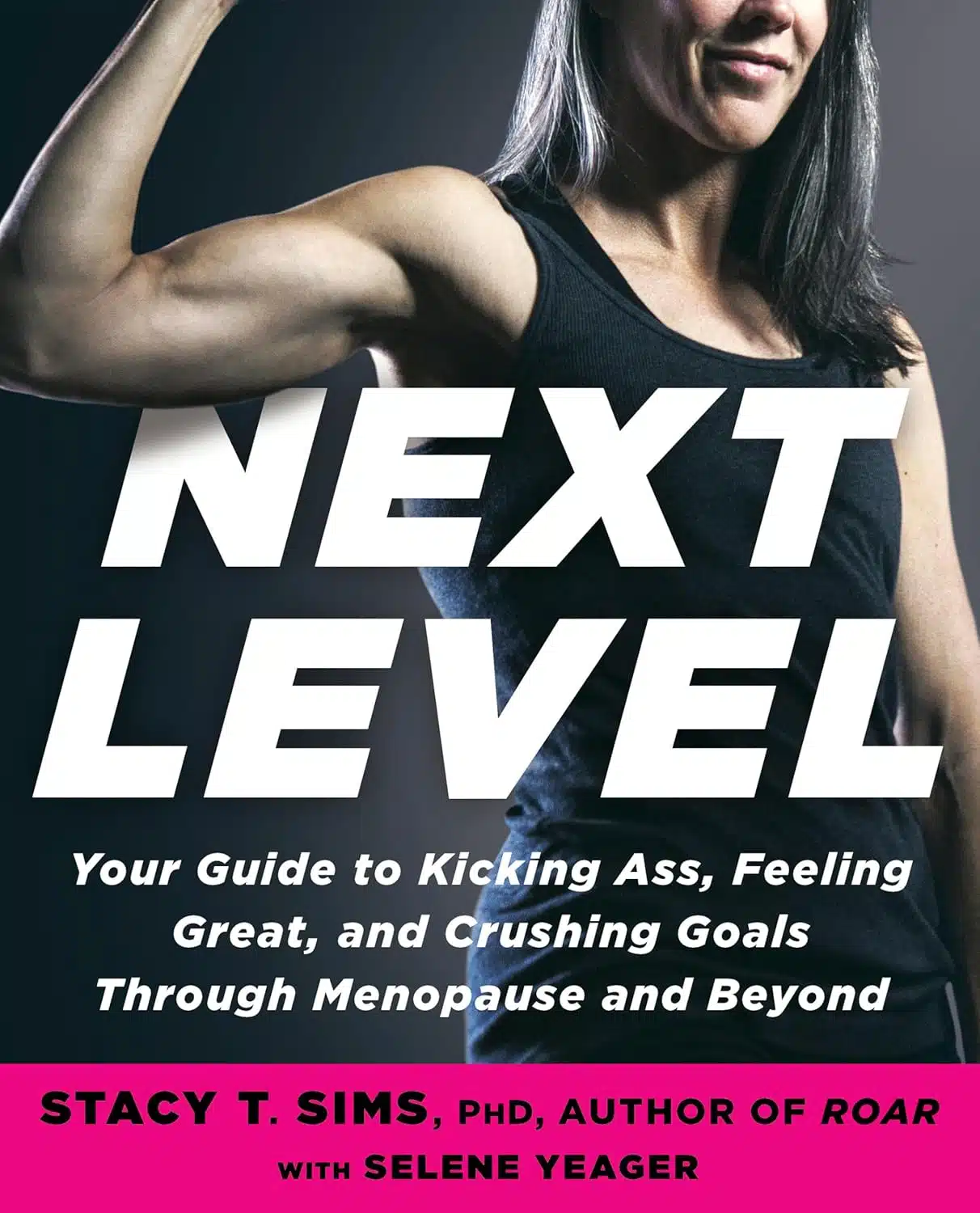
Next Level – by Dr. Stacy Sims

10almonds is reader-supported. We may, at no cost to you, receive a portion of sales if you purchase a product through a link in this article.

First of all: if you are a man, you will probably get little to nothing out of this book on a personal level (you may, however, find it of interest anyway if you have women in your life), as it is heavily tailored towards women.

We previously reviewed this author’s “ROAR”, which is about boosting athletic performance with female hormones in mind. This time, the focus is on thriving through menopause (including: postmenopause) and going from strength to strength.

Dr. Sims uses the first few chapters to explain the menopause in more detail than most people know it, before launching into the main part of the book, which is the “what to do” section.

Here, we learn about HRT, adaptogens, and other interventions, the respective roles of cardio and resistance training, the undervalued yet critical importance of gut health, how to make sure your body gets all of what it needs in terms of nutrition when what it needs is changing, the dos and don’t of bone health when it comes to later-life athleticism, and a lot of mythbusting with regard to supplements (for some and against others), and plenty more besides.

The style is accessible pop-science, with various facts, statistics, charts, and the like peppered throughout. On which note, there are no citations while reading, but there is a bibliography at the back, arranged on a chapter-by-chapter basis.

Bottom line: if you find even just 10% of this book’s advices new and useful, then buying and reading this book will have been worthwhile and will have made a substantive difference (specifically: improvements) to your life.

Click here to check out Next Level, and take your health to the next level!

Don’t Forget…

Did you arrive here from our newsletter? Don’t forget to return to the email to continue learning!

Learn to Age Gracefully

Join the 98k+ American women taking control of their health & aging with our 100% free (and fun!) daily emails:

  • The Diet That Reduces Stroke Risk By Up To 25% In Women

    10almonds is reader-supported. We may, at no cost to you, receive a portion of sales if you purchase a product through a link in this article.

    The Mediterranean Diet is considered by many to be the current “gold standard” of healthy eating, and with good reason. With 10,000+ studies underpinning it and counting, it has a pretty hefty weight of evidence.

    (For contrast, the Ketogenic Diet for example has under 5,000 studies at time of writing,and many of those include mentioning the problems with it. That’s not to say the Keto is without its merits! It certainly can help achieve some short term goals, but that’s getting a little off-topic here so we’ll not derail)

    Wondering what the Mediterranean Diet consists of? We outlined it in a previous main feature, so here it is for your convenience:

    The Mediterranean Diet: What Is It Good For? ← also covers which foods actually go into it, and which don’t 😎

    To get us started today, we’ll quickly drop some links to a few of those Mediterranean Diet studies from the top:

    The short version is: it glows, in a good way.

    There’s nothing mid about about the Med when it comes to the mind

    For that matter, there is also a brain-focused set of tweaks to the Mediterranean diet!

    The MIND (Mediterranean-DASH Intervention for Neurodegenerative Delay) diet also adds extra portions of specific brain-foods, that already exist in the above diets, but get a more substantial weighting in this one:

    MIND and Mediterranean diets linked to fewer signs of Alzheimer’s brain pathology

    See also: The cognitive effects of the MIND diet

    And now, most recently, researchers (Dr. Ayesha Sherzai et al.) did a prospective cohort analysis in which she and her team followed 105,614 women for an average of 20.5 years (in the longitudinal study sense, not in the stalker sense) and found that higher adherence to a Mediterranean diet was associated with a lower risk of total, ischemic, and hemorrhagic stroke.

    How much lower, you ask?

    Well, the title of today’s article is a bit of a giveaway, but let’s break it down. During follow-up there were 4,083 strokes in total, including 3,358 ischemic strokes and 725 hemorrhagic strokes, and…

    • Overall stroke risk: high adherence was associated with a 18% lower risk of any stroke, even after adjusting for smoking, physical activity, high blood pressure, and other factors.
    • Ischemic stroke: high adherence was associated with a 16% lower risk of ischemic stroke, the most common type caused by blocked blood flow to the brain.
    • Hemorrhagic stroke: high adherence was associated with a 25% lower risk of hemorrhagic stroke, a less frequent but more severe type caused by bleeding in the brain.

    So, all in all, very good news!

    You can read the paper in full, here: Mediterranean Diet and the Risk of Stroke Subtypes in Women

    So, with that in mind…

    Want to learn more?

    Everyone even vaguely health-conscious knows that prevention is better than cure, but many still don’t think about a lot of things until they’re too late.

    To be ahead of that curve, check out:

    Don’t Get Caught Out By These “Nontraditional” Stroke Risk Factors

    And, for that matter,

    6 Signs Of Stroke (One Month In Advance)

    Take care!

    Share This Post

  • Energize! – by Dr. Michael Breus & Stacey Griffith

    10almonds is reader-supported. We may, at no cost to you, receive a portion of sales if you purchase a product through a link in this article.

    We previously reviewed another book book by Dr. Breus, The Power Of When. So what’s different in this one?

    While the chronotypes featured in The Power Of When also feature here (and sufficient explanation is given to make this a fine stand-alone book), this book has a lot to do with metabolism also. By considering a person’s genetically predisposed metabolic rate to be fast, medium, or slow (per being an ectomorph, mesomorph, or endomorph), and then putting that next to one’s sleep chronotype, we get 12 sub-categories that in this book each get an optimized protocol of sleep, exercise (further divided into: what kind of exercise when), and eating/fasting.

    Which, in effect, amounts to a personalized coaching program for optimized energy!

    The guidance is based on a combination of actual science plus “if this then that” observation-based principles—of the kind that could be described as science if they had been studied clinically instead of informally. Dr. Breus is a sleep scientist, by the way, and his co-author Stacey Griffith is a fitness coach. So between the two of them, they have sleep and exercise covered, and the fasting content is very reasonable and entirely consistent with current consensus of good practice.

    The style is very pop-psychology, and very readable, and has a much more upbeat feel than The Power Of When, which seems to be because of Griffith’s presence as a co-author (most of the book is written from a neutral perspective, and some parts have first-person sections by each of the authors, so the style becomes distinct accordingly).

    Bottom line: if you’d like to be more energized but [personal reason why not here] then this book may not fix all your problems, but it’ll almost certainly make a big difference and help you to stop sabotaging things and work with your body rather than against it.

    Click here to check out Energize!, and do just that!

    Share This Post

  • Hitting the beach? Here are some dangers to watch out for – plus 10 essentials for your first aid kit

    10almonds is reader-supported. We may, at no cost to you, receive a portion of sales if you purchase a product through a link in this article.

    Summer is here and for many that means going to the beach. You grab your swimmers, beach towel and sunscreen then maybe check the weather forecast. Did you think to grab a first aid kit?

    The vast majority of trips to the beach will be uneventful. However, if trouble strikes, being prepared can make a huge difference to you, a loved one or a stranger.

    So, what exactly should you be prepared for?

    FTiare/Shutterstock

    Knowing the dangers

    The first step in being prepared for the beach is to learn about where you are going and associated levels of risk.

    In Broome, you are more likely to be bitten by a dog at the beach than stung by an Irukandji jellyfish.

    In Byron Bay, you are more likely to come across a brown snake than a shark.

    In the summer of 2023–24, Surf Life Saving Australia reported more than 14 million Australian adults visited beaches. Surf lifesavers, lifeguards and lifesaving services performed 49,331 first aid treatments across 117 local government areas around Australia. Surveys of beach goers found perceptions of common beach hazards include rips, tropical stingers, sun exposure, crocodiles, sharks, rocky platforms and waves.

    Sun and heat exposure are likely the most common beach hazard. The Cancer Council has reported that almost 1.5 million Australians surveyed during summer had experienced sunburn during the previous week. Without adequate fluid intake, heat stroke can also occur.

    Lacerations and abrasions are a further common hazard. While surfboards, rocks, shells and litter might seem more dangerous, the humble beach umbrella has been implicated in thousands of injuries.

    Sprains and fractures are also associated with beach activities. A 2022 study linked data from hospital, ambulance and Surf Life Saving cases on the Sunshine Coast over six years and found 79 of 574 (13.8%) cervical spine injuries occurred at the beach. Surfing, smaller wave heights and shallow water diving were the main risks.

    Rips and rough waves present a higher risk at areas of unpatrolled beach, including away from surf lifesaving flags. Out of 150 coastal drowning deaths around Australia in 2023–24, nearly half were during summer. Of those deaths:

    • 56% occurred at the beach
    • 31% were rip-related
    • 86% were male, and
    • 100% occurred away from patrolled areas.

    People who had lived in Australia for less than two years were more worried about the dangers, but also more likely to be caught in a rip.

    Pathway to Australian beach cove with blue water
    Safety Beach on Victoria’s Mornington Peninsula. Still bring your first aid essentials though. Julia Kuleshova/Shutterstock

    Knowing your DR ABCs

    So, beach accidents can vary by type, severity and impact. How you respond will depend on your level of first aid knowledge, ability and what’s in your first aid kit.

    A first aid training company survey of just over 1,000 Australians indicated 80% of people agree cardiopulmonary resuscitation (CPR) is the most important skill to learn, but nearly half reported feeling intimidated by the prospect.

    CPR training covers an established checklist for emergency situations. Using the acronym “DR ABC” means checking for:

    • Danger
    • Response
    • Airway
    • Breathing
    • Circulation

    A complete first aid course will provide a range of skills to build confidence and be accredited by the national regulator, the Australian Skills Quality Authority.

    What to bring – 10 first aid essentials

    Whether you buy a first aid kit or put together you own, it should include ten essential items in a watertight, sealable container:

    1. Band-Aids for small cuts and abrasions
    2. sterile gauze pads
    3. bandages (one small one for children, one medium crepe to hold on a dressing or support strains or sprains, and one large compression bandage for a limb)
    4. large fabric for sling
    5. a tourniquet bandage or belt to restrict blood flow
    6. non-latex disposable gloves
    7. scissors and tweezers
    8. medical tape
    9. thermal or foil blanket
    10. CPR shield or breathing mask.

    Before you leave for the beach, check the expiry dates of any sunscreen, solutions or potions you choose to add.

    If you’re further from help

    If you are travelling to a remote or unpatrolled beach, your kit should also contain:

    • sterile saline solution to flush wounds or rinse eyes
    • hydrogel or sunburn gel
    • an instant cool pack
    • paracetamol and antihistamine medication
    • insect repellent.

    Make sure you carry any “as-required” medications, such as a Ventolin puffer for asthma or an EpiPen for severe allergy.

    Vinegar is no longer recommended for most jellyfish stings, including Blue Bottles. Hot water is advised instead.

    In remote areas, also look out for Emergency Response Beacons. Located in high-risk spots, these allow bystanders to instantly activate the surf emergency response system.

    If you have your mobile phone or a smart watch with GPS function, make sure it is charged and switched on and that you know how to use it to make emergency calls.

    First aid kits suitable for the beach range in price from $35 to over $120. Buy these from certified first aid organisations such as Surf Lifesaving Australia, Australian Red Cross, St John Ambulance or Royal Life Saving. Kits that come with a waterproof sealable bag are recommended.

    Be prepared this summer for your trip to the beach and pack your first aid kit. Take care and have fun in the sun.

    Andrew Woods, Lecturer, Nursing, Faculty of Health, Southern Cross University and Willa Maguire, Associate Lecturer in Nursing, Southern Cross University

    This article is republished from The Conversation under a Creative Commons license. Read the original article.

    Share This Post

  • The Only Arm Exercises You Need After 60

    10almonds is reader-supported. We may, at no cost to you, receive a portion of sales if you purchase a product through a link in this article.

    It’s important, but it’s not so complicated that you have to do a lot of things for it:

    Keeping your strength up

    Age-related muscle loss (sarcopenia) starts in our 30s if we’re not careful, but it accelerates sharply after 60, especially without resistance training. This, of course, leads to reduced independence in daily tasks like lifting, carrying, and pushing, and generally is a harbinger of systemic decline (i.e. the rest of your body gives up too).

    However! Research (cited in the video) shows strength can be rebuilt at any age, even into your 80s and 90s.

    First, understand the general idea: use resistance training 2–3 times weekly for about 20 minutes each session, focusing on compound exercises rather than isolated moves, because compound movements strengthen multiple muscle groups more efficiently, and also reflect how we actually use our bodies in day-to-day life.

    Now, settle into a core arm routine:

    • 3 sets of 8–15 controlled repetitions of a dumbbell row to strengthen your arms, shoulders, and back
    • A curl, twist, and press to build your biceps, triceps, shoulders, and rotator cuff
    • A pushing exercise chosen at your level (e.g. wall press, chair press, knee push-up, or full push-up) to strengthen your chest, triceps, and shoulders.

    How to progress safely as you go: do the most challenging variation you can complete with good form for 8–15 reps, progress when you can exceed 15 easily, and take care to move slowly rather than using momentum, prioritizing good form.

    For more on all of this plus visual demonstrations, enjoy:

    Click Here If The Embedded Video Doesn’t Load Automatically!

    Want to learn more?

    You might also like:

    Resistance Is Useful! (Especially As We Get Older)

    Take care!

    Don’t Forget…

    Did you arrive here from our newsletter? Don’t forget to return to the email to continue learning!

    Learn to Age Gracefully

    Join the 98k+ American women taking control of their health & aging with our 100% free (and fun!) daily emails:

  • Stop Checking Your Likes – by Susie Moore

    10almonds is reader-supported. We may, at no cost to you, receive a portion of sales if you purchase a product through a link in this article.

    You might think this one’s advice is summed up sufficiently by the title, that there’s no need for a book! But…

    There’s a lot more to this than “stop comparing the worst out-takes of your life to someone else’s highlight reel”, and there’s a lot more to this than “just unplug”.

    Instead, Susie Moore discusses the serious underlying real emotional considerations of the need for approval (and even just acceptance) by our community, as well the fear of missing out.

    It’s not just about how social media is designed to hijack various parts of our brain, or how The Alogorithm™ is out to personally drag your soul through Hell for a few more clicks; it’s also about the human element that would exist even without that. Who remembers MySpace? No algorithm in those days, but oh the drama potential for those “top 8 friends” places. And if you think that kind of problem is just for young people 20 years ago, you have mercifully missed the drama that older generations can get into on Facebook.

    Along with the litany of evil, though, Moore also gives practical advice on how to overcome those things, how to “see the world through comedy-colored glasses”, how to ask “what’s missing, really?”, and how to make your social media experience work for you, rather than it merely using you as fuel. ← link is to our own related article!

    Bottom line: if social media sucks a lot of your time, there may be more to it than just “social media sucks in general”, and there are ways to meet your emotional needs without playing by corporations’ rules to do so.

    Click here to check out Stop Checking Your Likes, and breathe easy!

    Don’t Forget…

    Did you arrive here from our newsletter? Don’t forget to return to the email to continue learning!

    Learn to Age Gracefully

    Join the 98k+ American women taking control of their health & aging with our 100% free (and fun!) daily emails:

  • Skincare Habits To Stop

    10almonds is reader-supported. We may, at no cost to you, receive a portion of sales if you purchase a product through a link in this article.

    Dr. Sam Ellis, dermatologist, explains:

    Mistakes to avoid

    There are quite a number of things that many people do that unintentionally sabotage their skin health; here’s what to do about that:

    • stop overexfoliating your skin: many people exfoliate too often, leading to redness, breakouts, and dullness instead of the desired glow; Dr. Ellis recommends removing exfoliants and actives for at least two weeks, then reintroduce exfoliants just 1–2 times a week based on your skin’s needs.
    • how to exfoliate properly: use gentler products like mandelic acid serums for sensitive skin, or stronger ones like glycolic acid peels less frequently; always balance with moisturizers and avoid combining with retinoids on the same night.
    • stop constantly changing your skincare routine: your skin needs consistency to respond well; using the same few products long-term is more effective than always trying the latest thing—only make changes for major climate shifts.
    • stop picking at your skin: picking causes scarring, red or brown marks, and prolongs healing; instead, use hydrocolloid pimple patches to protect and heal blemishes faster and reduce the urge to pick. She also advises that supplementing with n-acetyl cysteine (NAC) can help reduce compulsive skin picking behavior.
    • stop smoking and reduce* alcohol: both accelerate skin aging, dullness, dehydration, and wrinkles; cutting back or stopping can make a visible difference in skin appearance.
    • don’t sleep in your makeup: this prevents your skin from recovering overnight and can clog pores; even just removing makeup without applying other skincare is better than leaving it on—micellar water is gentler than makeup wipes and recommended.
    • stop skimping on sunscreen: most people underapply it; aim for two full finger lengths or ¼ teaspoon for proper coverage; if textures bother you, try lightweight non-greasy oil-based sunscreens.

    *She says “reduce”, we’d advise “stop”. The fact that drinking alcohol is still considered socially normal, while smoking is not, does not change the fact that just like smoking, the only safe amount of alcohol is zero.

    For more on each of these things, enjoy:

    Click Here If The Embedded Video Doesn’t Load Automatically!

    Want to learn more?

    You might also like:

    The Evidence-Based Skincare That Beats Product-Specific Hype

    Take care!

    Don’t Forget…

    Did you arrive here from our newsletter? Don’t forget to return to the email to continue learning!

    Learn to Age Gracefully

    Join the 98k+ American women taking control of their health & aging with our 100% free (and fun!) daily emails: