
We don’t all need regular skin cancer screening – but you can know your risk and check yourself
10almonds is reader-supported. We may, at no cost to you, receive a portion of sales if you purchase a product through a link in this article.
Australia has one of the highest skin cancer rates globally, with nearly 19,000 Australians diagnosed with invasive melanoma – the most lethal type of skin cancer – each year.
While advanced melanoma can be fatal, it is highly treatable when detected early.
But Australian clinical practice guidelines and health authorities do not recommend screening for melanoma in the general population.
Given our reputation as the skin cancer capital of the world, why isn’t there a national screening program? Australia currently screens for breast, cervical and bowel cancer and will begin lung cancer screening in 2025.
It turns out the question of whether to screen everyone for melanoma and other skin cancers is complex. Here’s why.
The current approach
On top of the 19,000 invasive melanoma diagnoses each year, around 28,000 people are diagnosed with in-situ melanoma.
In-situ melanoma refers to a very early stage melanoma where the cancerous cells are confined to the outer layer of the skin (the epidermis).
Instead of a blanket screening program, Australia promotes skin protection, skin awareness and regular skin checks (at least annually) for those at high risk.
About one in three Australian adults have had a clinical skin check within the past year.

Why not just do skin checks for everyone?
The goal of screening is to find disease early, before symptoms appear, which helps save lives and reduce morbidity.
But there are a couple of reasons a national screening program is not yet in place.
We need to ask:
1. Does it save lives?
Many researchers would argue this is the goal of universal screening. But while universal skin cancer screening would likely lead to more melanoma diagnoses, this might not necessarily save lives. It could result in indolent (slow-growing) cancers being diagnosed that might have never caused harm. This is known as “overdiagnosis”.
Screening will pick up some cancers people could have safely lived with, if they didn’t know about them. The difficulty is in recognising which cancers are slow-growing and can be safely left alone.
Receiving a diagnosis causes stress and is more likely to lead to additional medical procedures (such as surgeries), which carry their own risks.
2. Is it value for money?
Implementing a nationwide screening program involves significant investment and resources. Its value to the health system would need to be calculated, to ensure this is the best use of resources.
Narrower targets for better results
Instead of screening everyone, targeting high-risk groups has shown better results. This focuses efforts where they’re needed most. Risk factors for skin cancer include fair skin, red hair, a history of sunburns, many moles and/or a family history.
Research has shown the public would be mostly accepting of a risk-tailored approach to screening for melanoma.
There are moves underway to establish a national targeted skin cancer screening program in Australia, with the government recently pledging $10.3 million to help tackle “the most common cancer in our sunburnt country, skin cancer” by focusing on those at greater risk.
Currently, Australian clinical practice guidelines recommend doctors properly evaluate all patients for their future risk of melanoma.
Looking with new technological eyes
Technological advances are improving the accuracy of skin cancer diagnosis and risk assessment.
For example, researchers are investigating 3D total body skin imaging to monitor changes to spots and moles over time.
Artificial intelligence (AI) algorithms can analyse images of skin lesions, and support doctors’ decision making.
Genetic testing can now identify risk markers for more personalised screening.
And telehealth has made remote consultations possible, increasing access to specialists, particularly in rural areas.
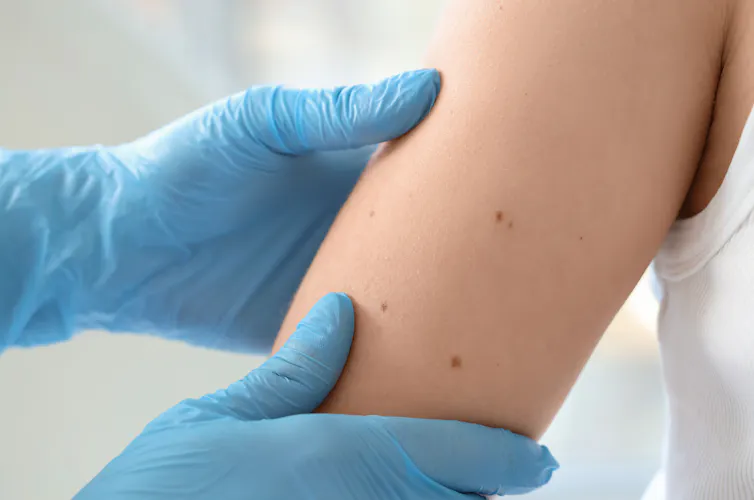
Check yourself – 4 things to look for
Skin cancer can affect all skin types, so it’s a good idea to become familiar with your own skin. The Skin Cancer College Australasia has introduced a guide called SCAN your skin, which tells people to look for skin spots or areas that are:
1. sore (scaly, itchy, bleeding, tender) and don’t heal within six weeks
2. changing in size, shape, colour or texture
3. abnormal for you and look different or feel different, or stand out when compared to your other spots and moles
4. new and have appeared on your skin recently. Any new moles or spots should be checked, especially if you are over 40.
If something seems different, make an appointment with your doctor.
You can self-assess your melanoma risk online via the Melanoma Institute Australia or QIMR Berghofer Medical Research Institute.
H. Peter Soyer, Professor of Dermatology, The University of Queensland; Anne Cust, Professor of Cancer Epidemiology, The Daffodil Centre and Melanoma Institute Australia, University of Sydney; Caitlin Horsham, Research Manager, The University of Queensland, and Monika Janda, Professor in Behavioural Science, The University of Queensland
This article is republished from The Conversation under a Creative Commons license. Read the original article.
Don’t Forget…
Did you arrive here from our newsletter? Don’t forget to return to the email to continue learning!
Recommended
Learn to Age Gracefully
Join the 98k+ American women taking control of their health & aging with our 100% free (and fun!) daily emails:
-
What does it mean to be transgender?
10almonds is reader-supported. We may, at no cost to you, receive a portion of sales if you purchase a product through a link in this article.
Transgender media coverage has surged in recent years for a wide range of reasons. While there are more transgender television characters than ever before, hundreds of bills are targeting transgender people’s access to medical care, sports teams, gender-specific public spaces, and other institutions.
Despite the increase in conversation about the transgender community, public confusion around transgender identity remains.
Read on to learn more about what it means to be transgender and understand challenges transgender people may face.
What does it mean to be transgender?
Transgender—or “trans”—is an umbrella term for people whose gender identity or gender expression does not conform to their sex assigned at birth. People can discover they are trans at any age.
Gender identity refers to a person’s inner sense of being a woman, a man, neither, both, or something else entirely. Trans people who don’t feel like women or men might describe themselves as nonbinary, agender, genderqueer, or two-spirit, among other terms.
Gender expression describes the way a person communicates their gender through their appearance—such as their clothing or hairstyle—and behavior.
A person whose gender expression doesn’t conform to the expectations of their assigned sex may not identify as trans. The only way to know for sure if someone is trans is if they tell you.
Cisgender—or “cis”—describes people whose gender identities match the sex they were assigned at birth.
How long have transgender people existed?
Being trans isn’t new. Although the word “transgender” only dates back to the 1960s, people whose identities defy traditional gender expectations have existed across cultures throughout recorded history.
How many people are transgender?
A 2022 Williams Institute study estimates that 1.6 million people over the age of 13 identify as transgender in the United States.
Is being transgender a mental health condition?
No. Conveying and communicating about your gender in a way that feels authentic to you is a normal and necessary part of self-expression.
Social and legal stigma, bullying, discrimination, harassment, negative media messages, and barriers to gender-affirming medical care can cause psychological distress for trans people. This is especially true for trans people of color, who face significantly higher rates of violence, poverty, housing instability, and incarceration—but trans identity itself is not a mental health condition.
What is gender dysphoria?
Gender dysphoria describes a feeling of unease that some trans people experience when their perceived gender doesn’t match their gender identity, or their internal sense of gender. A 2021 study of trans adults pursuing gender-affirming medical care found that most participants started experiencing gender dysphoria by the time they were 7.
When trans people don’t receive the support they need to manage gender dysphoria, they may experience depression, anxiety, social isolation, suicidal ideation, substance use disorder, eating disorders, and self-injury.
How do trans people manage gender dysphoria?
Every trans person’s experience with gender dysphoria is unique. Some trans people may alleviate dysphoria by wearing gender-affirming clothing or by asking others to refer to them by a new name and use pronouns that accurately reflect their gender identity. The 2022 U.S. Trans Survey found that nearly all trans participants who lived as a different gender than the sex they were assigned at birth reported that they were more satisfied with their lives.
Some trans people may also manage dysphoria by pursuing medical transition, which may involve taking hormones and getting gender-affirming surgery.
Access to gender-affirming medical care has been shown to reduce the risk of depression and suicide among trans youth and adults.
To learn more about the trans community, visit resources from the National Center for Transgender Equality, the Trevor Project, PFLAG, and Planned Parenthood.
If you or anyone you know is considering suicide or self-harm or is anxious, depressed, upset, or needs to talk, call the Suicide & Crisis Lifeline at 988 or text the Crisis Text Line at 741-741. For international resources, here is a good place to begin.
This article first appeared on Public Good News and is republished here under a Creative Commons license.
Share This Post
-
The AFib Cure – by Dr. John Day & Dr. Jared Bunch
10almonds is reader-supported. We may, at no cost to you, receive a portion of sales if you purchase a product through a link in this article.
The authors—cardiologists and AFib specialists—make the case that if you have atrial fibrillation, you do in fact have more options than “take these pills and suffer”.
To be clear: they’re not anti-medication per se and they also acknowledge that for some people the meds may still have their place (safety first, and all), but they do fall on the side of “it would be nice to not have to, if possible, so let’s see what we can do”.
Rather, they recommend lifestyle adjustments (no surprises there), and certain biomarker optimizations (this is where it gets more in-depth), which have a good record of reducing symptoms to the point of remission and freedom from medications.
The book is first a primer on the topic of AFib, and then a how-to manual of fixing the problems that you now understand, by biomarker monitoring, lifestyle optimization, and if those things don’t work, ablative therapy which they argue is safer, easier, and more successful than you might think.
The style is clear and easy to understand, with frequent scholarly citations throughout. On the downside, the tone can sometimes be a little on the pushy side for this reviewer’s tastes, but if one overlooks that, it doesn’t detract from the useful content.
Bottom line: if you or a loved one have AFib and would like more treatment/management options than have hitherto been presented, this book will give you that.
Click here to check out The AFib Cure, and look after your heart!
Share This Post
-
Caffeine: Cognitive Enhancer Or Brain-Wrecker?
10almonds is reader-supported. We may, at no cost to you, receive a portion of sales if you purchase a product through a link in this article.
The Two Sides Of Caffeine
We asked you for your health-related opinions on caffeine itself, not necessarily the coffee, tea, energy drinks, etc that might contain it.
We have, by the way previously written about the health effects of coffee and tea specifically:
As for our question about caffeine itself, though, we got the above-depicted, below-described, set of results:
- About 59% said “caffeine is a safe stimulant and cognitive enhancer”
- About 31% said “caffeine is a moderately safe recreational drug”
- About 8% said “caffeine’s addictive properties make it de facto bad”
- One (1) person said “caffeine will leave you a trembling exhausted wreck”
But what does the science say?
Caffeine is addictive: True or False?
True, though one will find occasional academics quibbling the definition. Most of the studies into the mechanisms of caffeine addiction have been conducted on rats, but human studies exist too and caffeine is generally considered addictive for humans, for example:
See also:
Notwithstanding its addictive status, caffeine is otherwise safe: True or False?
True-ish, for most people. Some people with heart conditions or a hypersensitivity to caffeine may find it is not safe for them at all, and for the rest of us, the dose makes the poison. For example:
❝Can too much caffeine kill you? Although quite rare, caffeine can be fatal in cases of overdose; such circumstances are generally not applicable to healthy individuals who typically consume caffeine via beverages such as tea or coffee.❞
this paper, by the way, also includes a good example of academics quibbling the definition of addiction!
Caffeine is a cognitive enhancer: True or False?
True, but only in the case of occasional use. If you are using it all the time, your physiology will normalize it and you will require caffeine in order to function at your normal level. To attain higher than that, once addicted to caffeine, would now require something else.
Read more: Caffeine: benefits and drawbacks for technical performance
Caffeine will leave you a trembling exhausted wreck: True or False?
True or False depending on usage:
- The famously moderate 3–5 cups per day will not, for most people, cause any such problems.
- Using/abusing it to make up for lost sleep (or some other source of fatigue, such as physical exhaustion from exertion), however, is much more likely to run into problems.
In the latter case, caffeine really is the “payday loan” of energy! It’ll give you an adrenal boost now (in return, you must suffer the adrenal dumping later, along with lost energy expended in the adrenaline surge), and also, the tiredness that you thought was gone, was just caffeine’s adenosine-blocking activities temporarily preventing you from being able to perceive the tiredness. So you’ll have to pay that back later, with interest, because of the extra time/exertion too.
Want to make caffeine a little more gentle on your system?
Taking l-theanine alongside caffeine can ameliorate some of caffeine’s less wonderful effects—and as a bonus, l-theanine has some nifty benefits of its own, too:
Enjoy!
Share This Post
Related Posts
-
Broccoli vs Red Cabbage – Which is Healthier?
10almonds is reader-supported. We may, at no cost to you, receive a portion of sales if you purchase a product through a link in this article.
Our Verdict
When comparing broccoli to red cabbage, we picked the broccoli.
Why?
Both are certainly great! Which is usual for any Brassica oleracea cultivar (as both of these vegetables are). But there is a clear winner:
In terms of macros, broccoli has more fiber and protein, while red cabbage has more carbs. Now, nobody is getting metabolic disease from eating cabbage, but by the numbers, this is a simple win for broccoli, especially on account of the fiber.
In the category of vitamins, broccoli has more of vitamins B1, B2, B3, B5, C, E, and K, while red cabbage has more of vitamins A and B6, yielding a tidy 7:2 win to broccoli.
Looking at minerals, it’s a similar story: broccoli has more copper, magnesium, phosphorus, potassium, selenium, and zinc, while red cabbage has more iron and manganese. They’re equal in calcium, by the way, so that’s a 6:2 win for broccoli here.
In other considerations, both are good for polyphenols, but broccoli has more in total, as well as more variety, so yet another win for broccoli here, even before taking into account sulforaphane content (see the “learn more” section below).
Now, standing next to broccoli has made red cabbage look bad, but we want to assure you that red cabbage is itself a nutritional powerhouse—broccoli is just even more so.
So of course and as ever, by all means do enjoy either or both; diversity is best!
Want to learn more?
You might like:
Broccoli Sprouts & Sulforaphane
Enjoy!
Don’t Forget…
Did you arrive here from our newsletter? Don’t forget to return to the email to continue learning!
Learn to Age Gracefully
Join the 98k+ American women taking control of their health & aging with our 100% free (and fun!) daily emails:
-
The Doctor’s Kitchen – by Dr. Rupy Aujla
10almonds is reader-supported. We may, at no cost to you, receive a portion of sales if you purchase a product through a link in this article.
We’ve featured Dr. Aujla before as an expert-of-the-week, and now it’s time to review a book by him. What’s his deal, and what should you expect?
Dr. Aujla first outlines the case for food as medicine. Not just “eat nutritionally balanced meals”, but literally, “here are the medicinal properties of these plants”. Think of some of the herbs and spices we’ve featured in our Monday Research Reviews, and add in medicinal properties of cancer-fighting cruciferous vegetables, bananas with dopamine and dopamine precursors, berries full of polyphenols, hemp seeds that fight cognitive decline, and so forth.
Most of the book is given over to recipes. They’re plant-centric, but mostly not vegan. They’re consistent with the Mediterranean diet, but mostly Indian. They’re economically mindful (favoring cheap ingredients where reasonable) while giving a nod to where an extra dollar will elevate the meal. They don’t give calorie values etc—this is a feature not a bug, as Dr. Aujla is of the “positive dieting” camp that advocates for us to “count colors, not calories”. Which, we have to admit, makes for very stress-free cooking, too.
Dr. Aujla is himself an Indian Brit, by the way, which gives him two intersecting factors for having a taste for spices. If you don’t share that taste, just go easier on the pepper etc.
As for the medicinal properties we mentioned up top? Four pages of references at the back, for any who are curious to look up the science of them. We at 10almonds do love references!
Bottom line: if you like tasty food and you’re looking for a one-stop, well-rounded, food-as-medicine cookbook, this one is a top-tier choice.
Don’t Forget…
Did you arrive here from our newsletter? Don’t forget to return to the email to continue learning!
Learn to Age Gracefully
Join the 98k+ American women taking control of their health & aging with our 100% free (and fun!) daily emails:
-
The Great Nerve – by Dr. Kevin Tracey
10almonds is reader-supported. We may, at no cost to you, receive a portion of sales if you purchase a product through a link in this article.
Regular 10almonds readers will doubtlessly be aware of the merits of tending to one’s vagus nerve for reasons of relaxation and general health (per accessing the body’s “rest and digest” mode, and/or at the very least exiting the body’s “fight or flight” mode, which can be great in a crisis, but usually not what one wants at one’s desk on a Tuesday morning).
So, what does this book offer that stands out?
In this case it is much more of a focus on active healing, rather than simply avoiding harm.
Dr. Tracey covers how the vagus nerve (in and of itself, and/or in its role as the primary means of gut-brain information exchange) can be used torebalance inflammation (i.e., reduce general inflammation while increasing the immune response where and when and how it’s actually needed), regulate weight, improve metabolism, and reap the many health benefits that come with those things, especially if one’s starting point in one or more of those categories is Not Good™.
In terms of practicalities, he recommends an array of tools: meditation and breathwork, cold and exercise, and technological gadgets, with notes on therapies for various conditions.
The style is formal in tone, with lots of stories, and feels a lot like a for-the-public scientific presentation by an academic whose goal is more to engage the audience than necessarily to educate with a lot of details, as one might with an audience of students of one’s field. There are no citation markers as we go, although there is a respectable-sized bibliography at the back. The lack of referencing as we go is however quite a flaw, since it makes it much more difficult to check the sources for claims. It’s the equivalent of “yes, there is evidence for this claim; if you don’t believe me, here’s the library”.
Bottom line: if you’re looking for clinical understanding, this isn’t the best book for you. If you’re looking for just the practicalities, this book will feel quite padded with anecdotes. If, however, you want to learn about the vagus nerve in storytime fashion while curled up in your armchair, then you’ll probably find this book quite enjoyable.
Don’t Forget…
Did you arrive here from our newsletter? Don’t forget to return to the email to continue learning!
Learn to Age Gracefully
Join the 98k+ American women taking control of their health & aging with our 100% free (and fun!) daily emails:


