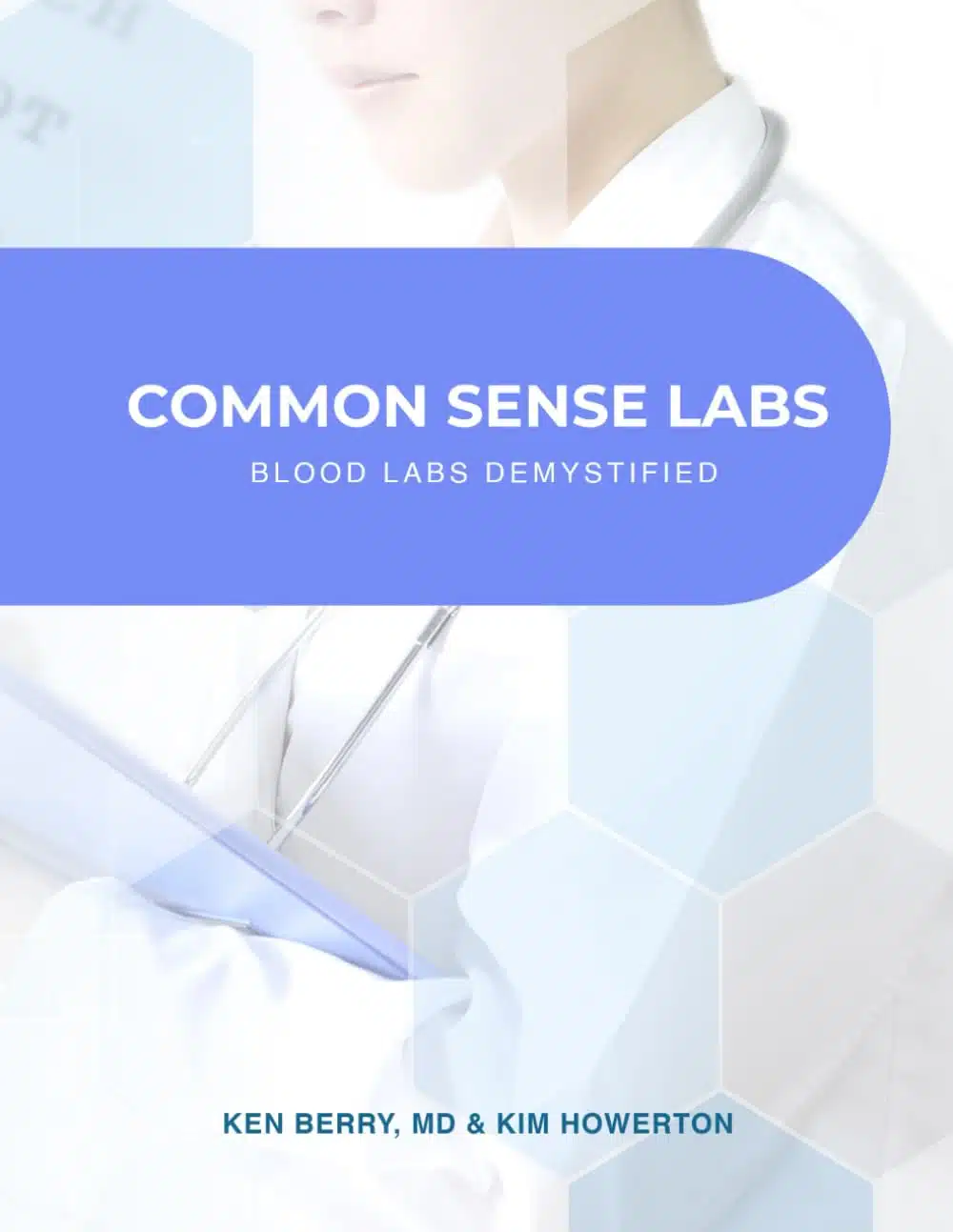
Common Sense Labs: Blood Labs Demystified – by Dr. Ken Berry & Kim Howerton

10almonds is reader-supported. We may, at no cost to you, receive a portion of sales if you purchase a product through a link in this article.

Most people, if given their test results as a set of numbers, will have no idea what they mean.

And a doctor or nurse saying “this is good”, “this is a bit low”, “this is very high” etc isn’t that much more informative, as it doesn’t really give a true feel for the information.

Dr. Berry produced this book to bridge that knowledge gap, and in his words, “put the power of health back in the hands of the people”. The book also covers what blood tests to recommend annually (finding common recommendations insufficient), and how to go about asking for those if your doctor might be keen to brush you off.

This is a short book (weighing in at a lithe 78 pages), but the information contained therein is very dense, and very convenient to have it all in one place.

As one Amazon reviewer wrote,

❝Someone said you can find the information on the Internet, but I would say good luck with that. It will be many many many hours compiling the gold that is in this book.❞

Writer’s anecdote: indeed, I recently had 14 blood tests done as part of a regular checkup (I’m pleased to report I could not be in better health), and while interpreting the results, I had to look up a lot of things (which were often in the wrong units*), and if I’d had this book already, it would have been a breeze, as it covers everything I had done!

*On which note, this book does provide results in US and International units, so you won’t be left wondering how to convert mmol/mol into mmol/L or mg/dL or such.

Bottom line: if you are a person who has blood, this book will at some point be of immense value to you, if not immediately!

Click here to check out Common Sense Labs, and understand what your blood is saying!

Don’t Forget…

Did you arrive here from our newsletter? Don’t forget to return to the email to continue learning!

Learn to Age Gracefully

Join the 98k+ American women taking control of their health & aging with our 100% free (and fun!) daily emails:

  • The Brain Nutrient That 90% Of Americans Don’t Get Enough Of

    10almonds is reader-supported. We may, at no cost to you, receive a portion of sales if you purchase a product through a link in this article.

    Spoiler: it’s choline

    Underconsumed and underappreciated

    Choline is essential for:

    • methylation and brain metabolism
    • mood and cognitive regulation
    • cell membrane integrity
    • acetylcholine production (important for memory and general signaling)
    • and more

    …which all add up to making it quite unfortunate that about 90% of Americans do not get an adequate intake of this vital nutrient!

    Source: Choline: The Underconsumed and Underappreciated Essential Nutrient

    Per some recent research, this does appear to have an important effect on mental health: a meta-analysis of 25 brain spectroscopy studies (370 people with anxiety disorders, 342 controls) found a consistent pattern—people with anxiety disorders had about 8% lower cortical choline-containing compounds (tCho), especially in the prefrontal cortex, that being a region that’s very important for emotional regulation, decision-making, and stress control.

    This is notable because it’s one of the first biomarkers found across multiple anxiety disorders (generalized anxiety disorder, panic disorder, and social anxiety disorder), suggesting anxiety may involve measurable metabolic changes—not just psychological symptoms.

    As for why this happens, the researchers suggest that chronic hyperarousal and elevated norepinephrine* (so, “fight-or-flight” activation) may increase the brain’s demand for choline faster than supply can bring it, thus lowering measurable brain choline over time.

    *You can learn more about this here: Neurotransmitter Cheatsheet

    There were other biomarkers too, for example reduced levels N-acetylaspartate (NAA), a marker associated with neuronal integrity, were also seen in some cortical analyses, which suggest further neuronal stress/dysfunction—but that’s beyond the scope of our article today.

    If you do want to read in more detail though, here’s the paper itself: Transdiagnostic reduction in cortical choline-containing compounds in anxiety disorders: a ¹H-magnetic resonance spectroscopy meta-analysis

    As for where to get choline in terms of foods, animal organ meats are generally rich in it but come with other health risks; less risky choline-rich food sources include eggs (especially the yolks) and soybeans.

    Learn more: Food sources of choline and their contribution to choline adequacy in U.S. older adults ← eggs scored best!

    See also:

    And for nuance: Vegetarian & Vegan Diets: Good Or Bad For Brain Health?

    Of course, ensuring you meet your recommended choline intake through diet is a good idea for general brain health, but please do note that this should complement, not replace, other approaches such as therapy, medication if needed, sleep, exercise, and so forth.

    See also:

    Want to raise your choline levels?

    Dietary intake is all well and good, but you might want to consider:

    Citicoline: Better Than Dietary Choline?

    Take care!

    Share This Post

  • Sweet Potato vs Cassava – Which is Healthier?

    10almonds is reader-supported. We may, at no cost to you, receive a portion of sales if you purchase a product through a link in this article.

    Our Verdict

    When comparing sweet potato to cassava, we picked the sweet potato.

    Why?

    For any unfamiliar with cassava, it’s also called manioc or yuca/yucca, and it’s a tuber that can be used a lot like sweet potato. It’s popular in S. America, often in recipes that aren’t the healthiest (deep-fried chunky “cassava chips” are popular in Brazil, for example, and farofa, a flour made from cassava, is less healthy even than refined white flour from wheat), but today we’re going to judge it on its own merit—since after all, almost anything can be deep-fried and many things can be turned into flour, but it doesn’t mean we have to do that.

    Let’s talk macros first: sweet potato has nearly 2x the protein, while cassava has nearly 2x the carbs. As for fiber to soften those carbs’ impact on our blood sugars, well, sweet potato has about 2x the fiber. All in all for macros, a clear and easy win for sweet potato.

    Important note: as for the impact that has on glycemic index: the exact glycemic index will depend on what you do with it (different cooking methods change the GI), but broadly speaking, sweet potatoes are considered a medium GI food, while cassava is a very high GI food, to the point that it’s higher than sucrose, and nearly equal to pure glucose. Which is impressive, for a tuber.

    In terms of vitamins, sweet potato’s famously high vitamin A content raises the bar, but it’s not all it has to offer: sweet potato has more of vitamins A, B1, B2, B3, B5, B6, E, and K, while cassava has more of vitamins B9 and choline. Just for amusement’s sake, let’s note that the sweet potato has over 1,478x the vitamin A content. In any case, the vitamins category is another clear win for sweet potato.

    When it comes to minerals, it’s again quite one-sided: sweet potato has more calcium, copper, iron, magnesium, manganese, phosphorus, and potassium, while cassava has more selenium. So, sweet potato wins yet again.

    In short: definitely a case of “the less widely-available option is not necessarily the healthier”!

    Want to learn more?

    You might like to read:

    Glycemic Index vs Glycemic Load vs Insulin Index

    Take care!

    Share This Post

  • Robert F. Kennedy Jr says vitamin A protects you from deadly measles. Here’s what the study he cites actually says

    10almonds is reader-supported. We may, at no cost to you, receive a portion of sales if you purchase a product through a link in this article.

    Robert F. Kennedy Jr, who oversees the health of more than 340 million Americans, says vitamin A can prevent the worst effects of measles rather than urging more people to get vaccinated.

    In an opinion piece for Fox News, the US health secretary said he was “deeply concerned” about the current measles outbreak in Texas. However, he said the decision to vaccinate was a “personal one” and something for parents to discuss with their health-care provider.

    Kennedy mentioned updated advice from the Centers for Disease Control (CDC) to treat measles with vitamin A. He also cited a study he said shows vitamin A can reduce the risk of dying from measles.

    Here’s what the vitamin A study actually says and why public health officials are so concerned about Kennedy’s latest statement.

    RobsPhoto/Shutterstock

    Why is a measles outbreak so worrying?

    Measles is a highly contagious disease caused by a virus. It spreads easily including when an infected person breathes, coughs or sneezes.

    Measles initially infects the respiratory tract and then the virus spreads throughout the body. Symptoms include a high fever, cough, red eyes, runny nose and a rash all over the body.

    Measles can also be severe, can cause complications including blindness and swelling of the brain, and can be fatal. Measles can affect anyone but is most common in children.

    The Texan health department has confirmed 150-plus cases of measles and one death of an unvaccinated child during the current outbreak. While this is by far the largest measles outbreak in the US in 2025, the CDC has reported smaller outbreaks in several other states so far this year.

    Why vitamin A?

    Vitamin A is essential for our overall health. It has many roles in the body, from supporting our growth and reproduction, to making sure we have healthy vision, skin and immune function.

    Foods rich in vitamin A or related molecules include orange, yellow and red coloured fruits and vegetables, green leafy vegetables, as well as dairy, egg, fish and meat. You can take it as a supplement.

    Vitamin A can also be used therapeutically. In other words, doctors may prescribe vitamin A to treat a deficiency. Vitamin A deficiency has long been associated with more severe cases of infectious disease, including measles. Vitamin A boosts immune cells and strengthens the respiratory tract lining, which is the body’s first defence against infections.

    Because of this, the CDC has recently said vitamin A can also be prescribed as part of treatment for children with severe measles – such as those in hospital – under doctor supervision.

    One key message from the CDC’s advice is that people are already sick enough with measles to be in hospital. They’re not taking vitamin A to prevent catching measles in the first place.

    The other key message is vitamin A is taken under medical supervision, under specific circumstances, where patients can be closely monitored to prevent toxicity from high doses.

    Vitamin A toxicity can cause birth defects and increase the risk of fractures in elderly people. Vitamin A and beta-carotene (which the body turns into vitamin A) from supplements may also increase your risk of cancer, especially if you smoke.

    Pregnant woman having ultrasound
    Taking too much vitamin A can lead to toxicity and cause birth defects. ChameleonsEye/Shutterstock

    How about the study Kennedy cites?

    Kennedy cites and links to a 2010 study, a type known as a systematic review and meta-analysis. Researchers reviewed and analysed existing studies, which included ones that looked at the effectiveness of vitamin A in preventing measles deaths.

    They found three studies that looked at vitamin A treatment by specific dose. There were different doses depending on the age of the children, measured in IU (international units). Having two doses of vitamin A (200,000IU for children over one year of age or 100,000IU for infants below one year) reduced mortality by 62% compared to children who did not have vitamin A.

    The 2010 study did not show vitamin A reduced your risk of getting measles from another infected person. To my knowledge no study has shown this.

    To be fair, Kennedy did not say that vitamin A stops you from catching measles from another infected person. Instead, he used the following vague statement:

    Studies have found that vitamin A can dramatically reduce measles mortality.

    It’s easy to see how a reader could misinterpret this as “take vitamin A if you want to avoid dying from measles”.

    We know what works – vaccines

    The World Health Organization recommends all children receive two doses of measles vaccine.

    The CDC states two doses of the measles vaccine (measles-mumps-rubella or MMR vaccine) is 97% effective against getting measles. This means out of every 100 people who are vaccinated only three will get it, and this will be a milder form.

    But these facts were missing from Kennedy’s statement. Should we be surprised? Kennedy is well known for his vaccine sceptism and for undermining vaccination efforts, including for the measles vaccine.

    As Sue Kressly, president of the American Academy of Pediatrics, told the Washington Post:

    relying on vitamin A instead of the vaccine is not only dangerous and ineffective […] it puts children at serious risk.

    Evangeline Mantzioris, Program Director of Nutrition and Food Sciences, Accredited Practising Dietitian, University of South Australia

    This article is republished from The Conversation under a Creative Commons license. Read the original article.

    Share This Post

  • Why do some people get a curved back as they age and what can I do to avoid it?

    10almonds is reader-supported. We may, at no cost to you, receive a portion of sales if you purchase a product through a link in this article.

    As we age, it’s common to notice posture changes: shoulders rounding, head leaning forward, back starting to curve. You might associate this with older adults and wonder: will this happen to me? Can I prevent it?

    It’s sometimes called “hunchback” or “roundback”, but the medical term for a curved back is kyphosis.

    When the curve is beyond what’s considered normal (greater than 40 degrees), we refer to this as hyperkyphosis. In more severe cases, it may lead to pain, reduced mobility and physical function, or lower quality of life.

    Here’s how it happens, and how to reduce your risk.

    fran_kie/Shutterstock

    What causes a curved back?

    A healthy spine has an elongated s-shape, so a curve in the upper spine is completely normal.

    But when that curve becomes exaggerated and fixed (meaning you can’t stand up straight even if you try), it can signal a problem.

    One common cause of a curved back is poor posture. This type, called postural kyphosis, usually develops over time due to muscle imbalances, particularly in younger people who spend hours:

    • hunched over a desk
    • slouched in a chair, or
    • looking down at a phone.

    Fortunately, this kind of curved back is often reversible with the right exercises, stretches and posture awareness.

    Man with impaired posture position
    When the curve in your back becomes exaggerated and fixed, it can signal a problem. Undrey/Shutterstock

    Older adults often develop a curved back, known as age-related kyphosis or hyperkyphosis.

    This is usually due to wear and tear in the spine, including vertebral compression fractures, which are tiny cracks in the bones of the spine (vertebrae).

    These cracks are most often caused by osteoporosis, a condition that makes bones more fragile with age.

    In these cases, it’s not just bad posture – it’s a structural change in the spine.

    An older man with a curved back walks on a path.
    Older adults often develop a curved back, known as age-related kyphosis or hyperkyphosis. nhk_nhk/Shutterstock

    How can you tell the difference?

    Signs of age-related hyperkyphosis include:

    • your back curves even when you try to stand up straight
    • back pain or stiffness
    • a loss of height (anything greater than 3-4 centimetres compared to your peak adult height may be considered outside of “normal” ageing).

    Other causes of a curved back include:

    • Scheuermann’s kyphosis (which often develops during adolescence when the bones in the spine grow unevenly, leading to a forward curve in the upper back)
    • congenital kyphosis (a rare condition present from birth, caused by improper formation of the spinal bones. It can result in a more severe, fixed curve that worsens as a child grows)
    • scoliosis (where the spine curves sideways into a c- or s-shape when viewed from behind), and
    • lordosis (an excessive inward curve in the lower back, when viewed from the side).

    In addition to these structural conditions, arthritis, and in rare cases, spinal injuries or infections, can also play a role.

    Should I see a doctor about my curved back?

    Yes, especially if you’ve noticed a curve developing, have ongoing back pain, or have lost height over time.

    These can be signs of vertebral fractures, which can occur in the absence of an obvious injury, and are often painless.

    While one in five older adults have a vertebral fracture, as many as two-thirds of these fractures are not diagnosed and treated.

    In Australia, the Royal Australian College of General Practitioners and Healthy Bones Australia recommend a spine x-ray for:

    • people with kyphosis
    • height loss equal to or more than 3 centimetres, or
    • unexplained back pain.

    What can I do to reduce my risk?

    If you’re young or middle-aged, the habits you build today matter.

    The best way to prevent a curved back is to keep your bones strong, muscles active, and posture in check. That means:

    • doing regular resistance training, especially targeting upper back muscles
    • staying physically active, aiming for at least 150 minutes per week
    • getting enough protein, calcium, and vitamin D to support bone and muscle health
    • avoiding smoking and limiting alcohol to reduce risk factors that worsen bone density and overall wellbeing

    Pay attention to your posture while sitting and standing. Position your head over your shoulders and shoulders over your hips. This reduces strain on your spine.

    A woman sits hunched over her laptop
    If you’re young or middle-aged, the habits you build today matter. Doucefleur/Shutterstock

    What exercises help prevent and manage a curved back?

    Focus on exercises that strengthen the muscles that support an upright posture, particularly the upper back and core, while improving mobility in the chest and shoulders.

    In general, you want to prioritise extension-based movements. These involve straightening or lifting the spine and pulling the shoulders back.

    Repeated forward-bending (or flexion) movements may make things worse, especially in people with osteoporosis or spinal fractures.

    Good exercises include:

    • back extensions (gently lift your chest off the floor while lying face down)
    • resistance exercises targeting the muscles between your shoulder blades
    • weight-bearing activities (such as brisk walking, jogging, stair climbing, or dancing) to keep bones strong and support overall fitness
    • stretching your chest and hip flexors to open your posture and relieve tightness.

    Flexibility and balance training (such as yoga and pilates) can be beneficial, particularly for posture awareness, balance, and mobility. But research increasingly supports muscle strengthening as the cornerstone of prevention and management.

    Muscle strengthening exercises, such as weight lifting or resistance training, reduces spinal curvature while enhancing muscle and bone mass.

    If you suspect you have kyphosis or already have osteoporosis or a vertebral fracture, consult a health professional before starting an exercise program. There may be some activities to avoid.

    Woman using lat pulldown machine in gym
    Resistance training is crucial. Yakobchuk Yiacheslav/Shutterstock

    Can a curved back be reversed?

    If it’s caused by poor posture and muscle weakness, then yes, it’s possible.

    But if it’s caused by bone changes, especially vertebral fractures, then full reversal is unlikely. However, treatment can reduce pain, improve function, and slow further progression.

    Protecting your posture isn’t just about appearance. It’s about staying strong, mobile and independent as you age.

    Jakub Mesinovic, Research Fellow at the Institute for Physical Activity and Nutrition, Deakin University and David Scott, Associate Professor (Research) and NHMRC Emerging Leadership Fellow, Deakin University

    This article is republished from The Conversation under a Creative Commons license. Read the original article.

    Don’t Forget…

    Did you arrive here from our newsletter? Don’t forget to return to the email to continue learning!

    Learn to Age Gracefully

    Join the 98k+ American women taking control of their health & aging with our 100% free (and fun!) daily emails:

  • Built to Move – by Kelly starrett & Juliet Starrett

    10almonds is reader-supported. We may, at no cost to you, receive a portion of sales if you purchase a product through a link in this article.

    In our everyday lives, for most of us anyway, it’s not too important to be able to run a marathon or leg-press a car. Rather more important, however, are such things as:

    • being able to get up from the floor comfortably
    • reach something on a high shelf without twinging a shoulder
    • being able to put our socks on without making a whole plan around this task
    • get accidentally knocked by an energetic dog or child and not put our back out
    • etc

    Starrett and Starrett, of “becoming a supple leopard” fame, lay out for us how to make sure our mobility stays great. And, if it’s not already where it needs to be, how to get there.

    The “ten essential habits” mentioned in the subtitle “ten essential habits to help you move freely and live fully”, in fact also come with ten tests. No, not in the sense of arduous trials, but rather, mobility tests.

    For each test, it’s explained to us how to score it out of ten (this is an objective assessment, not subjective). It’s then explained how to “level up” whatever score we got, with different advices for different levels of mobility or immobility. And if we got a ten, then of course, we just build the appropriate recommended habit into our daily life, to keep it that way.

    The writing style is casual throughout, and a strong point of the book is its very clear illustrations, too.

    Bottom line: if you’d like to gain/maintain good mobility (at any age), this book gives a very reliable outline for doing so.

    Click here to check out Built to Move, and take care of your body!

    Don’t Forget…

    Did you arrive here from our newsletter? Don’t forget to return to the email to continue learning!

    Learn to Age Gracefully

    Join the 98k+ American women taking control of their health & aging with our 100% free (and fun!) daily emails:

  • Coconut & Lemongrass Protein Soup

    10almonds is reader-supported. We may, at no cost to you, receive a portion of sales if you purchase a product through a link in this article.

    The main protein here is pea protein, but the soup’s health benefits don’t stop there. With healthy MCTs from the coconut, as well as phytochemical benefits from the ginger and chili, this wonderfully refreshing soup has a lot to offer.

    You will need

    • 1 can coconut milk
    • 1 cup vegetable stock (making your own, or buying a low-sodium option)
    • 1 cup frozen petits pois
    • 1 oz fresh ginger, roughly chopped
    • ½ oz lemongrass stalk, crumpled without being broken into multiple pieces
    • 1 red chili, roughly chopped
    • 1 tbsp white miso paste
    • zest and juice of 1 lime
    • Optional: garnish of your choice

    Method

    (we suggest you read everything at least once before doing anything)

    1) Mix the coconut milk, vegetable stock, ginger, and chili in a saucepan, and simmer for 15 minutes

    2) Remove the lemongrass and ginger (and the chili if you don’t want more heat), and add the petit pois. Bring back to a simmer for about 2 minutes more, stir in the miso paste and lime, then take off the heat.

    3) Blend the soup to a smooth purée. Since it is hot, you will need to either use a stick blender, or else a food processor that is ok with blending hot liquids (many are not, so don’t use yours unless you’re sure, as it might explode if it’s not made for that). Alternatively, you can let it cool, blend it, and then reheat it.

    4) Serve, adding a garnish if you so wish:

    Enjoy!

    Want to learn more?

    For those interested in some of the science of what we have going on today:

    Take care!

    Don’t Forget…

    Did you arrive here from our newsletter? Don’t forget to return to the email to continue learning!

    Learn to Age Gracefully

    Join the 98k+ American women taking control of their health & aging with our 100% free (and fun!) daily emails: