
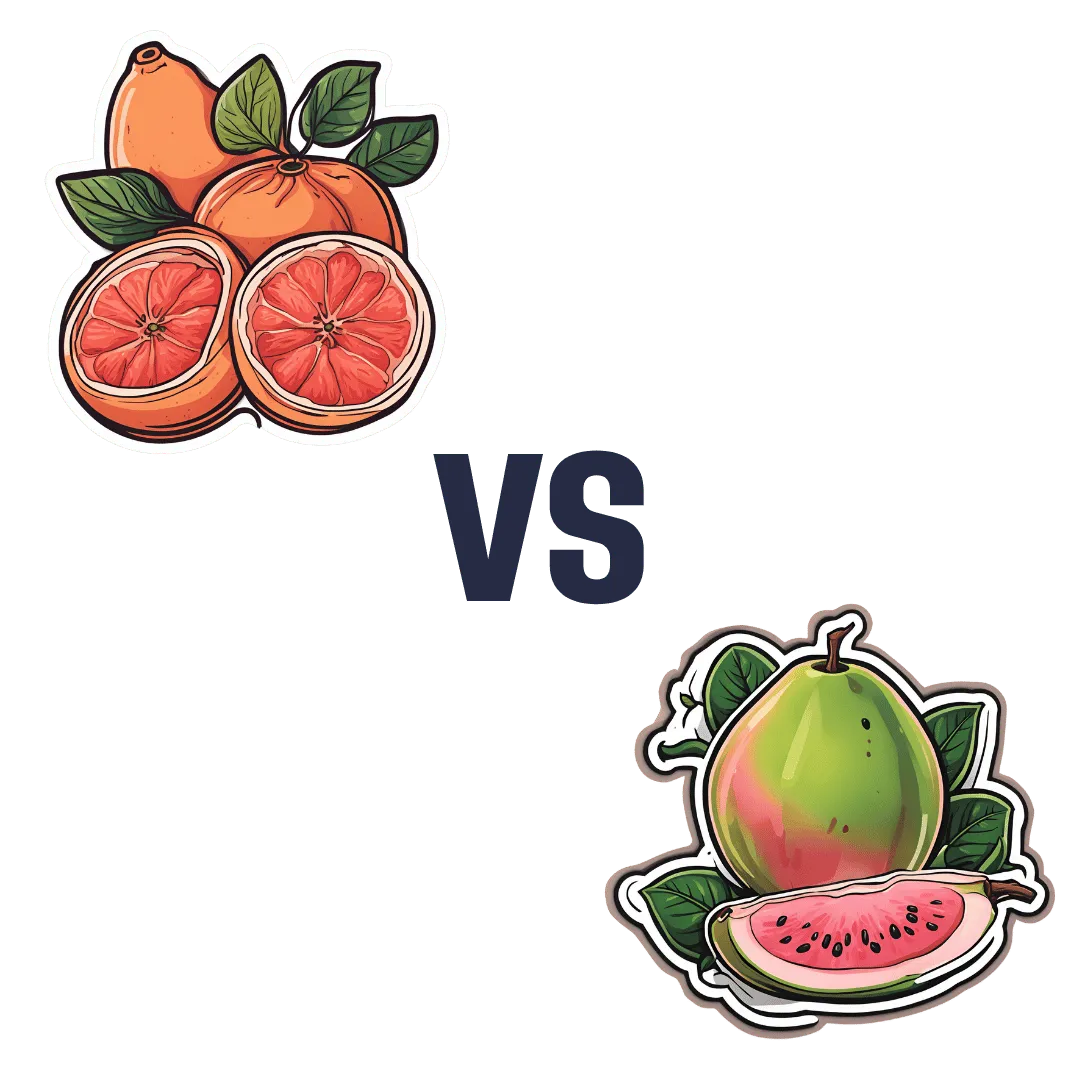
Grapefruit vs Guava – Which is Healthier?
10almonds is reader-supported. We may, at no cost to you, receive a portion of sales if you purchase a product through a link in this article.
Our Verdict
When comparing grapefruit to guava, we picked the guava.
Why?
It’s not close:
In terms of macros, guava has 3x the fiber, slightly more carbs, and 3x the protein, winning easily in this category.
In the category of vitamins, grapefruit has more vitamin A, while guava has more of vitamins A, B1, B2, B3, B5, B6, B7, B9, C, E, and K, sweeping its second round in a row.
Looking at minerals, grapefruit has a tiny touch more calcium, while guava has a lot more copper, iron, magnesium, manganese, phosphorus, potassium, selenium, and zinc, winning its third round by a long way.
One more consideration that’s not shown in the nutritional values, is that grapefruit contains high levels of furanocoumarins, which can inhibit cytochrome P-450 3A4 isoenzyme and P-glycoptrotein transporters in the intestine and liver—slowing down their drug metabolism capabilities, thus effectively increasing the bioavailability of many drugs manifold.
This may sound superficially like a good thing (improving bioavailability of things we want), but in practice it means that in the case of many drugs, if you take them with (or near in time to) grapefruit or grapefruit juice, then congratulations, you just took an overdose. This happens with a lot of meds for blood pressure, cholesterol (including statins), calcium channel-blockers, anti-depressants, benzo-family drugs, beta-blockers, and more. Oh, and Viagra, too. Which latter might sound funny, but remember, Viagra’s mechanism of action is blood pressure modulation, and that is not something you want to mess around with unduly. So, do check with your pharmacist to know if you’re on any meds that would be affected by grapefruit or grapefruit juice!
PS: the same substance is quite available in pummelos and sour oranges (but not meaningfully in sweet oranges); you can see a chart here showing the relative furanocoumarin contents of many citrus fruits, or lack thereof as the case may be, as it is for lemons and most limes).
Adding up the sections makes for an overwhelming overall win for guava, but by all means do enjoy either or both, unless any of the furanocoumarin contraindications apply!
Want to learn more?
You might like:
Watch Out For Furanocoumarins!
Enjoy!
Don’t Forget…
Did you arrive here from our newsletter? Don’t forget to return to the email to continue learning!
Recommended
Learn to Age Gracefully
Join the 98k+ American women taking control of their health & aging with our 100% free (and fun!) daily emails:
-
The Autoimmune Cure – by Dr. Sara Gottfried
10almonds is reader-supported. We may, at no cost to you, receive a portion of sales if you purchase a product through a link in this article.
We’ve featured Dr. Gottfried before, as well as another of her books (“Younger”), and this one’s a little different, and on the one hand very specific, while on the other hand affecting a lot of people.
You may be thinking, upon reading the subtitle, “this sounds like Dr. Gabor Maté’s ideas” (per: “When The Body Says No”), and 1) you’d be right, and 2) Dr. Gottfried does credit him in the introduction and refers back to his work periodically later.
What she adds to this, and what makes this book a worthwhile read in addition to Dr. Maté’s, is looking clinically at the interactions of the immune system and nervous system, but also the endocrine system (Dr. Gottfried’s specialty) and the gut.
Another thing she adds is more of a focus on what she writes about as “little-t trauma”, which is the kind of smaller, yet often cumulative, traumas that often eventually add up over time to present as C-PTSD.
While “stress increases inflammation” is not a novel idea, Dr. Gottfried takes it further, and looks at a wealth of clinical evidence to demonstrate the series of events that, if oversimplified, seem unbelievable, such as “you had a bad relationship and now you have lupus”—showing evidence for each step in the snowballing process.
The style is a bit more clinical than most pop-science, but still written to be accessible to laypersons. This means that for most of us, it might not be the quickest read, but it will be an informative and enlightening one.
In terms of practical use (and living up to its subtitle promise of “cure”), this book does also cover all sorts of potential remedial approaches, from the obvious (diet, sleep, supplements, meditation, etc) to the less obvious (ketamine, psilocybin, MDMA, etc), covering the evidence so far as well as the pros and cons.
Bottom line: if you have or suspect you may have an autoimmune problem, and/or would just like to nip the risk of such in the bud (especially bearing in mind that the same things cause neuroinflammation and thus, putatively, depression and dementia too), then this is one for you.
Click here to check out the Autoimmune Cure, and take care of your body and mind!
Share This Post
-
How To Get Rid Of Ingrown Toenails Once And For All
10almonds is reader-supported. We may, at no cost to you, receive a portion of sales if you purchase a product through a link in this article.
It’s Q&A Day at 10almonds!
Have a question or a request? We love to hear from you!
In cases where we’ve already covered something, we might link to what we wrote before, but will always be happy to revisit any of our topics again in the future too—there’s always more to say!
As ever: if the question/request can be answered briefly, we’ll do it here in our Q&A Thursday edition. If not, we’ll make a main feature of it shortly afterwards!
So, no question/request too big or small 😎
❝Advice about ingrown toenails that isn’t just “cut them straight”? That seems to just make them worse as they get pushed in at the edges, or if I cut them very short, it just digs in differently as it grows back❞
So, “cut them straight” is correct advice, but it’s also incomplete advice.
First of all, you will want made-for-purpose toenail clippers that:
- are sharp and strong (obvious, but it’s amazing how many aren’t)
- have a straight cutting edge (no curves at the sides)
- have a wide blade (ideally wider than your toenail)
Here’s an example product on Amazon, but feel free to shop around. Interestingly, most big strong nail clippers are marketed as “for men”, which a) in marketing terms, means “we promise it’s not demeaning your masculinity to want nice toenails”, and b) is actually fair, since testosterone toughens nails and estrogen doesn’t. However, in the case of the product we linked, we see this one’s marketed as “for men, women, and seniors”. Ah yes, the three genders.
More seriously, they probably put that for search engine optimization reasons (i.e. in case people are including those terms in their search).
All you really need to know is: if it fits the three bullet points we gave just above, it’ll be good, regardless of your age or gender.
Next, put those aside from now, and soak your feet in a warm salt bath (magnesium salts, such as Epsom salts, are great, but literally just table salt is also fine for this purpose).
This is the opposite of what we advised in: The Counterintuitive Dos and Don’ts of Nail Health
However, that was in a different circumstance, and was a caveat against trying to make brittle nails less brittle by soaking them (which will make things worse, for reasons we explain).
In the case of ingrown toenails, however, you want your nail to be soft, and other considerations are secondary.
When the nail is soft, you can (carefully!) bend it up away from your flesh where it’s causing trouble. You can use a Q-tip for extra gentleness when doing this, if you don’t have another implement you prefer. Whatever you use should obviously be clean, and certainly nothing sharp.
Now, you have two options:
- leave a little wad of cotton wool or similar between the offending nail and your tender flesh, soaked with a little body-safe oil
- remove the little wad of cotton wool or similar, but apply a drop or two of body-safe oil, and reapply regularly
About that oil: almond oil is popular for this, though this writer used ginger oil to good effect for exactly this problem last year, choosing it because it also has antimicrobial and anti-inflammatory properties. It’s not recommended to use undiluted essential oils directly on the skin (as this writer did), so you might want to dilute it in some medical grade almond oil in any case.
See also: Do Essential Oils Really Have Medicinal Properties?
And: Ginger Does A Lot More Than You Think
Now, the most important part
None of that care will help long-term if the thing that caused your ingrown toenails is still a thing.
And that’s almost always: your shoes
Specifically, you want to have good, wide amount of room for your toes to sit comfortably, without being compressed.
The worst offenders for this are:
- narrow-toed shoes
- shoes with heels
- narrow-toed shoes with heels
The narrowness of the toe area is self-explanatory; the reason heels can be a problem is then the force of gravity tends to press the toes into the toe-end of the shoe more. Indeed, this writer’s ingrown toenail last year was directly after wearing heeled boots to a garden party (normally I wear zero-drop shoes most of the time, but they didn’t look right with the dress I was wearing, hence the heeled boots).
For more on this side of foot care, see: Steps For Keeping Your Feet A Healthy Foundation
Putting it all together
If you have taken good care to soften and lift the offending part of the nail, and keep it soft and lifted, and are not wearing shoes that will compress your toes, then when the nail gets to an appropriate length, you can clip it in a straight line with the clippers we recommended, and all should be (and stay!) well.
If you have more serious problems (especially: if there is any sign of infection), then please see a local professional (pharmacist, doctor, chiropodist, etc) for the best advice tailored to you.
Finally, if you’d like to learn a lot more about foot care, then check out this very good (and remarkably comprehensive) book that we reviewed a while back:
The Foot Book – by Dr. Todd Brennan & Dr. Leslie Johnston
Take care!
Share This Post
-
What Seasonal Allergies Mean For Your Heart
10almonds is reader-supported. We may, at no cost to you, receive a portion of sales if you purchase a product through a link in this article.
Most people associate seasonal allergies with itchy eyes and stuffy noses, but the effects can go a lot deeper.
This is because allergic reactions don’t just affect the respiratory system; they trigger chronic inflammation throughout the body, and in fact:
❝Allergic disease is a systemic and inflammatory condition❞
~ Dr. Rauno Joks, whose work we will cite in a moment
The important thing to understand in terms of heart health, is that chronic* systemic inflammation can contribute to coronary artery disease, where plaque buildup in arteries (bearing in mind, arterial plaque is in large part made of dead immune cells) raises the risk of heart attacks and strokes.
*Yes, a season once or twice per year counts as “chronic”.
A large (n=603,140) study found that allergic rhinitis (hay fever) increased the odds of coronary heart disease by 25% and heart attacks by 20%. Asthma, especially during flare-ups, posed an even greater risk:
Beyond biology
The effects aren’t just biological; allergies can limit physical activity, leading to a sedentary lifestyle that harms heart health.
In other words: if you’re not going outdoors because there’s pollen, and you’re not exercising because you’re exhausted, then the rest of your health is going to take a nose-dive (so to speak) too.
So, one more reason to take it seriously and not just dismiss it as “it’s just allergies, I’ll survive”.
Practical takeaways
Some things we can all do:
- Monitor your risk factors; i.e. keep on top of your heart health metrics, especially blood pressure and cholesterol, as well as any known genetic predisposition to cardiovascular disease.
- Watch out for alternative causes: symptoms like fatigue or shortness of breath may not always be allergies; they could signal asthma, reflux (for example if wheezing), or even heart disease. An allergist is a good first port-of-call, though.
- Be cautious with medications: some decongestants / allergy meds / asthma meds can raise blood pressure and/or interfere with other medications. Your pharmacist is the best person to speak to about this; they know this kind of thing much better than doctors, as a rule. And whenever you get a new medication, it is good practice to make a habit of always reading the information leaflet that comes with it, and/or look it up on a reputable website such as Drugs.com or the the BNF, to learn about what it is, how it works, what the risks are, what its contraindications are, etc.
- Don’t ignore warning signs: lightheadedness or chest pain could indicate a heart issue and should be addressed immediately. It’s better to be wrong and temporarily embarrassed, than wrong and permanently dead. Besides, even if it’s not a heart issue, it may be something else that would benefit from attention, so taking it seriously is always a good idea.
Want to know more?
Check out:
- What Your Mucus Says About Your Health
- Antihistamines’ Generation Gap
- Oh, Honey: The Bee’s Knees? ← what science has to say about “honey will inoculate you against allergies”
Take care!
Share This Post
Related Posts
-
The 5 Training Rules To Build Your Metabolism (Not Just Lose Weight)
10almonds is reader-supported. We may, at no cost to you, receive a portion of sales if you purchase a product through a link in this article.
Cori Lefkowitz of “Strong At Every Age” shows us how:
Strong body, strong metabolism
Diet is an important factor in whether you lose weight, but strength training determines what you lose—fat versus muscle—and that distinction shapes how lean you actually look.
A mistake that many people make: heavy cardio plus calorie restriction makes your body more efficient (yay) by shedding metabolically expensive muscle (oh no), slowing your metabolism, and stalling fat loss over time, and/or increasing it as soon as you eat more food than is required to survive (at which point, we’re rescinding the “yay”).
In contrast, resistance training preserves and builds muscle, thus supports hormones and insulin sensitivity, raises resting metabolic rate, and pushes your body to burn fat instead of muscle during a deficit. So that’s what we’ll be doing instead.
Five tips to do it right:
- Prioritize compound lifts: base workouts around big movements like squats, deadlifts, presses, rows, lunges, and pull-ups to maximize muscle recruitment and long-term metabolic impact.
- Train the system, not body parts: use full-body or functional splits instead of traditional body-part days to train muscles more frequently, and thus create stronger metabolic signals with less gym time.
- Increase training density: use supersets, circuits, and paired exercises to do more meaningful work per minute—but still without turning strength training into pure cardio!
- Chase stimulus, not just load: muscle growth comes from mechanical tension, metabolic stress, and muscle damage (the body will not adapt if it’s not given a reason to adapt; it’s efficient like that, so we need to give it a compelling reason to adapt, and that compelling reason is (small, manageable!) damage to muscle fibers), so make sure to vary tools, tempos, ranges of motion, and positions, instead of only adding weight.
- Use activation in your warm-up: short activation drills before lifting improve muscle recruitment, stability, and hypertrophy potential, making each workout more effective.
Some myths to not fall for
- “Lifting makes you bulky”: true muscle gain requires years of structured training and sufficient calories; most “bulk” fears are bloat, inflammation, or fat masking muscle.
- “Soreness equals success”: soreness reflects novelty, not effectiveness; consistent, repeatable stimulus drives real progress.
- “The numbers on the scale don’t lie”: fat loss is a body composition change, so measurements, photos, strength gains, and how clothes fit matter more than scale weight.
For more on all of this, enjoy:
Click Here If The Embedded Video Doesn’t Load Automatically!
Want to learn more?
You might also like:
Burn! How To Boost Your Metabolism
Take care!
Don’t Forget…
Did you arrive here from our newsletter? Don’t forget to return to the email to continue learning!
Learn to Age Gracefully
Join the 98k+ American women taking control of their health & aging with our 100% free (and fun!) daily emails:
-
Built from Broken – by Scott Hogan, CPT, COES
10almonds is reader-supported. We may, at no cost to you, receive a portion of sales if you purchase a product through a link in this article.
So many exercise programs come with the caveat “consult your doctor before engaging in any new activity”, and the safe-but-simple “do not try to train through an injury”.
Which is all very well and good for someone in fabulous health who sprained an ankle while running and can just wait a bit, but what about those of us carrying…
- long-term injuries
- recurring injuries
- or just plain unfixable physical disabilities?
That’s where physiotherapist Scott Hogan comes in. The subtitle line goes:
❝A Science-Based Guide to Healing Painful Joints, Preventing Injuries, and Rebuilding Your Body❞
…but he does also recognize that there are some things that won’t bounce back.
On the other hand… There are a lot of things that get written off by doctors as “here’s some ibuprofen” that, with consistent mindful training, could actually be fixed.
Hogan delivers again and again in this latter category! You’ll see on Amazon that the book has thousands of 4- and 5-star ratings and many glowing reviews, and it’s for a reason or three:
- The book first lays a foundational knowledge of the most common injuries likely to impede us from training
- It goes on to give step-by-step corrective exercises to guide your body through healing itself. Your body is trying to heal itself anyway; you might as well help it accomplish that!
- It finishes up with a comprehensive (and essential) guide to train for the strength and mobility that will help you avoid future problems.
In short: a potentially life-changing book if you have some (likely back- or joint-related) problem that needs overcoming!
And if you don’t? An excellent pre-emptive guide all the same. This is definitely one of those “an ounce of prevention is better than a pound of cure” things.
Don’t Forget…
Did you arrive here from our newsletter? Don’t forget to return to the email to continue learning!
Learn to Age Gracefully
Join the 98k+ American women taking control of their health & aging with our 100% free (and fun!) daily emails:
-
The Power Foods Diet – by Dr. Neal Barnard
10almonds is reader-supported. We may, at no cost to you, receive a portion of sales if you purchase a product through a link in this article.
First, what this is not: it’s not a cookbook. There are recipes, more than a hundred if we consider such things as “barbecue sauce” as a standalone recipe, and if we overlook such things as how “perfect hot oatmeal” is followed on the next page by a recipe for “perfect hot oatmeal with berries”.
However, as we say, it’s not a cookbook; it’s first and foremost an educational text on the topic of nutrition.
Here we will learn about good eating for general health, which foods are natural appetite-suppressants, which foods reduce our body’s absorption of sugars from foods (not merely slowing, but flushing them away so they cannot be absorbed at all), and which foods actually boost metabolism for a few hours after the meal.
Dr. Barnard also talks about some foods that are more healthy, or less healthy, than popularly believed, and how to use all this information to craft a good, optimized, dietary plan for you.
Bottom line: there’s a lot of good information here, and the recipes are simply a bonus.
Click here to check out The Power Foods Diet, and optimize yours!
Don’t Forget…
Did you arrive here from our newsletter? Don’t forget to return to the email to continue learning!
Learn to Age Gracefully
Join the 98k+ American women taking control of their health & aging with our 100% free (and fun!) daily emails:


