
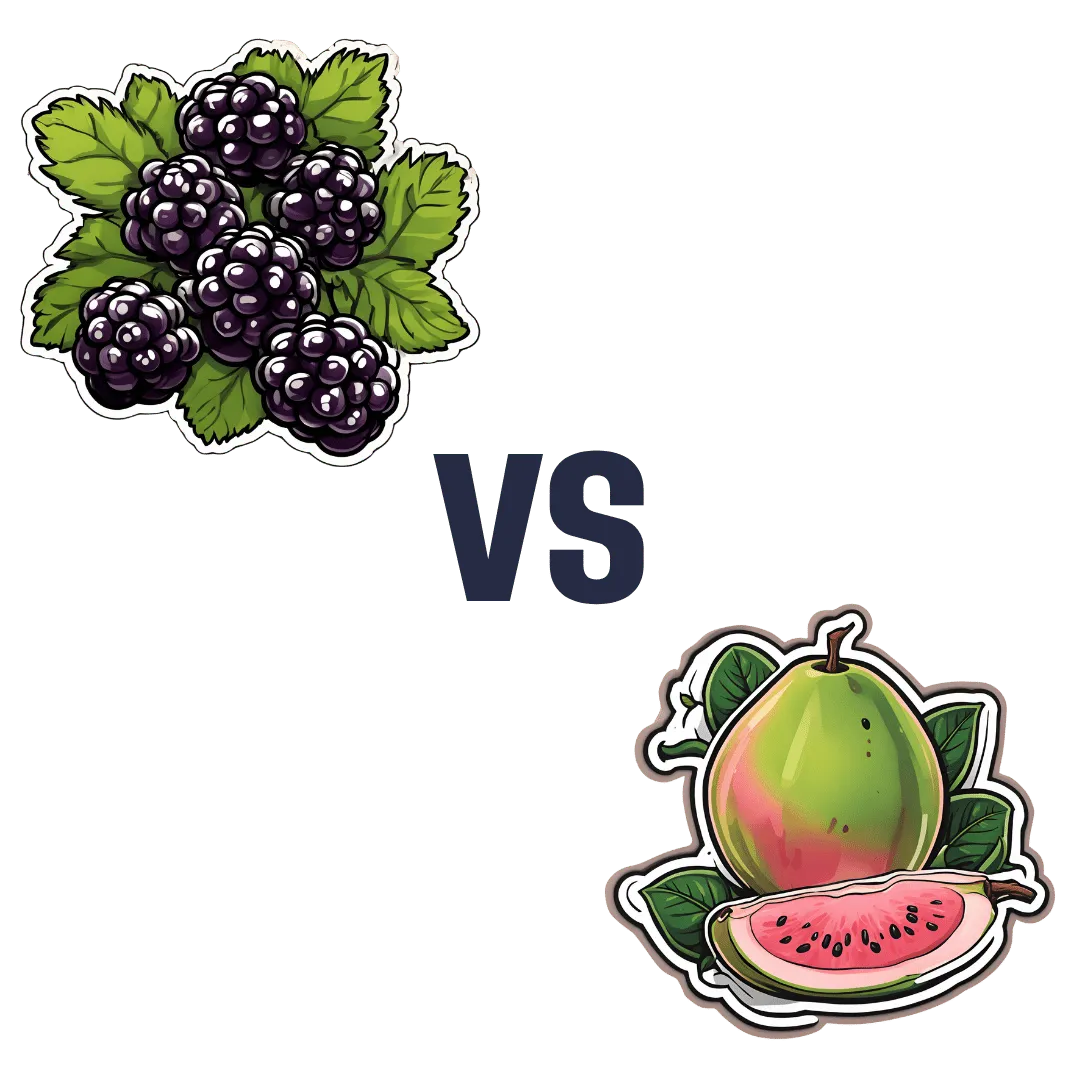
Blackberries vs Guava – Which is Healthier?

10almonds is reader-supported. We may, at no cost to you, receive a portion of sales if you purchase a product through a link in this article.

Our Verdict

When comparing blackberries to guava, we picked the guava.

Why?

These are both excellent options, but…

In terms of macros, guava has slightly more fiber, carbs, and protein, scoring a marginal first-round win.

In the category of vitamins, blackberries have more of vitamins E and K, while guava has more of vitamins A, B1, B2, B3, B5, B6, B7. B9, and C, winning the second round by a country mile.

Looking at minerals, blackberries have more calcium, iron, manganese, and zinc, while guava has more copper, magnesium, phosphorus, potassium, and selenium, for a more modest win this time.

In other considerations, both are excellent for polyphenols, but blackberries have more, and thus win a round finally.

Adding up the sections makes for a clear overall win for guava, but by all means do enjoy either or both, as diversity is best!

Want to learn more?

You might like:

21 Most Beneficial Polyphenols & What Foods Have Them

Enjoy!

Don’t Forget…

Did you arrive here from our newsletter? Don’t forget to return to the email to continue learning!

Learn to Age Gracefully

Join the 98k+ American women taking control of their health & aging with our 100% free (and fun!) daily emails:

  • Air Purifiers & Sleep

    10almonds is reader-supported. We may, at no cost to you, receive a portion of sales if you purchase a product through a link in this article.

    It’s Q&A Day at 10almonds!

    Have a question or a request? We love to hear from you!

    In cases where we’ve already covered something, we might link to what we wrote before, but will always be happy to revisit any of our topics again in the future too—there’s always more to say!

    As ever: if the question/request can be answered briefly, we’ll do it here in our Q&A Thursday edition. If not, we’ll make a main feature of it shortly afterwards!

    So, no question/request too big or small

    ❝I’ve read that air pollution has a negative effect on sleep quality and duration. Since I live next to a busy road, I was wondering whether I should invest in an air purifier. What are 10Almonds’s views?❞

    Going straight to the science, there are two questions here:

    • Does air pollution negatively affect sleep quality and duration?
    • Does the use of an air purify actually improve the air quality in the way(s) necessary to make a difference?

    We thought we’d have to tackle these questions separately, but we did find one study that addressed your question directly. It was a small study (n=30 if you believe the abstract; n=29 if you read the paper itself—one person dropped out); the results were modest but clear:

    ❝The purifier filter was associated with increased total sleep time for an average of 12 min per night, and increased total time in bed for an average of 19 min per night relative to the placebo.

    There were several sleep and mood outcomes for which no changes were observed, and time awake after sleep onset was higher for the purifier filter. Air quality was better during the high-efficiency particulate air filter condition.

    These findings offer positive indications that environmental interventions that improve air quality can have benefits for sleep outcomes in healthy populations who are not exhibiting clinical sleep disturbances.❞

    Source: Can air purification improve sleep quality? A 2-week randomised-controlled crossover pilot study in healthy adults

    In the above-linked paper’s introduction, it does establish the deleterious effect of air pollution on a wide variety of health metrics, including sleep, this latter evidenced per Caddick et al. (2018): A review of the environmental parameters necessary for an optimal sleep environment

    Now, you may be wondering: is an extra 12 minutes per night worth it?

    That’s your choice to make, but we would argue that it is. We can make many choices in our lives that affect our health slightly for the better or the worse. If we make a stack of choices in a particular direction, the effects will also stack, if not outright compound.

    So in the case of sleep, it might be (arbitrary numbers for the sake of illustration):

    • Get good exercise earlier in the day (+3%)
    • Get good food earlier in the day (+2.5%)
    • Practice mindfulness/meditation before bed (+2.5%)
    • Have a nice dark room (+5%)
    • Have fresh bedding (+2.5%)
    • Have an air purifier running (+3%)

    Now, those numbers are, as we said, arbitrary*, but remember that percentages don’t add up; they compound. So that “+3%” starts being a lot more meaningful than if it were just by itself.

    *Confession: the figure of 3% for the air purifier wasn’t entirely arbitrary; it was based on 100(12/405) = 80/27 ≈ 3, wherein the 405 figure was an approximation of the average total time (in minutes) spent sleeping with placebo, based on a peep at their results graph. There are several ways the average could be reasonably calculated, but 6h45 (i.e., 405 minutes) was an approximate average of those reasonable approximate averages.

    So, 12 minutes is a 3% improvement on that.

    Don’t have an air purifier and want one?

    We don’t sell them, but here’s an example on Amazon, for your convenience

    Take care!

    Share This Post

  • Unbreakable: A Woman’s Guide to Aging with Power – by Dr. Vonda Wright

    10almonds is reader-supported. We may, at no cost to you, receive a portion of sales if you purchase a product through a link in this article.

    The author, an orthopedic surgeon and longevity specialist, puts the focus on a) women b) musculoskeletal health.

    Because, while when thinking about hormones and health a lot of people focus on visible things like hair and nails and such, when it comes to the effects of untreated menopause, let’s face it: more people die from the consequences of a broken hip than from a broken nail.

    So, she wants us to avoid the train of sarcopenia → osteopenia → osteoporosis → fractures → infections → death, by reducing our risk factors early, and staying more robust and biologically younger.

    She advises doing this in four main ways:

    • Exercise: because stronger muscles mean stronger bones, and the impact on metabolic health is important too
    • Nutrition: nourishing our muscles and bones, looking after our gut microbiome, and eliminating inflammation
    • Supplements: mostly things we can’t reasonably get from diet, such as senolytics that tackle aging on a cellular level
    • Lifestyle: in ways not already covered by the above three methods, so now we’re adding such things as sleep, stress management, and so forth.
      • This may sound like an optional add-on, but the reality is that our body can’t do the other things properly if we don’t also have this in hand.

    With these things in order, she argues, we can reasonably expect to go from strength to strength, rather than the decline that most people experience in later years.

    The style is light and personable easy-reading pop-science, with minimal jargon, and any necessary terms explained. After a respectable bibliography, there are also appendices with exercise protocols, recipes, and a how-to guide for managing pain and injury.

    Bottom line: if you are a woman and/or care about a woman, the contents of this book are something you should know inside-out, because it’s that important.

    Click here to check out Unbreakable, and make yourself as unbreakable as humanly possible!

    Share This Post

  • No Time to Panic – by Matt Gutman

    10almonds is reader-supported. We may, at no cost to you, receive a portion of sales if you purchase a product through a link in this article.

    Matt Gutman is not a doctor or a psychologist. He’s a journalist, accustomed to asking questions and then asking more probing questions, unrelenting until he gets the answers he’s looking for.

    This book is the result of what happened when he needed to overcome his own anxiety and panic attacks, and went on an incisive investigative journey.

    The style is as clear and accessible as you’d expect of a journalist, and presents a very human exploration, nonetheless organized in a way that will be useful to the reader.

    It’s said that “experience is a great teacher, but she sends hefty bills”. In this case as in many, it’s good to learn from someone else’s experience!

    By the end of the book, you’ll have a good grounding in most approaches to dealing with anxiety and panic attacks, and an idea of efficacy/applicability, and what to expect.

    Bottom line: without claiming any magic bullet, this book presents six key strategies that Gutman found to work, along with his experiences of what didn’t. Valuable reading if you want to curb your own anxiety, or want to be able to help/support someone else with theirs.

    Click here to check out No Time To Panic, and find the peace you deserve!

    Share This Post

  • What Causes Your Appendix To Burst?

    10almonds is reader-supported. We may, at no cost to you, receive a portion of sales if you purchase a product through a link in this article.

    And what does it feel like?

    Spoiler: it isn’t fun

    Story time: in April 1961, during the Sixth Soviet Antarctic Expedition, Dr. Leonid Rogozov developed appendicitis while isolated by a blizzard, leaving him with the choice of waiting for help (near certain death) or performing surgery on himself (not an enviable task, but fair chance of survival); he successfully removed his own appendix under local anesthesia and returned to work two weeks later.

    And that’s why it’s now not uncommon to have a prophylactic appendectomy before going there!

    First, let’s bust a myth: the appendix is a small, worm-shaped pouch attached to the large intestine that contains a diverse community of gut microbes; although once considered a useless evolutionary remnant, evidence suggests it evolved independently in many mammals, suggesting it serves some useful functions, such as (at the very least) acting as a non-moving (unlike the rest of the gut) reservoir for beneficial gut bacteria, and/or contributing to beneficial immune responses.

    However. Sometimes the immune responses are not at all beneficial, and appendicitis usually begins when the appendix becomes blocked, often by an appendicolith (hardened feces), or when infections and/or misfiring immune responses cause nearby lymph tissue to swell and seal its opening.

    This gets very dangerous very quickly because the appendix is a closed-ended pouch, meaning blockage causes pressure to build, allowing bacteria to multiply rapidly; as swelling increases, blood flow is reduced, weakening the appendix until it may rupture, releasing bacteria into the abdominal cavity and causing a potentially life-threatening infection.

    How to recognize it: appendicitis typically causes pain that begins near the belly button before moving to the lower right abdomen and becoming more severe, unlike a typical stomach ache.

    Not included in the video, but there’s a useful self-check that you can do too: if you are experiencing a sharp pain in that general area and are worrying if it is appendicitis, then pressing on the appropriately named McBurney’s point is a first-line test for appendicitis. If, after pressing, it hurts a lot more upon removal of pressure (rather than upon application of pressure), this is considered a likely sign of appendicitis. Get thee to a hospital, quickly.

    And if it doesn’t? Still get it checked out at your earliest convenience, of course (better safe than sorry), but you might make an appointment instead of calling an ambulance.

    For more on all of this (apart from that last addition of ours), enjoy:

    Click Here If The Embedded Video Doesn’t Load Automatically!

    Want to learn more?

    You might also like:

    Women and Minorities Bear the Brunt of Medical Misdiagnosis

    Take care!

    Don’t Forget…

    Did you arrive here from our newsletter? Don’t forget to return to the email to continue learning!

    Learn to Age Gracefully

    Join the 98k+ American women taking control of their health & aging with our 100% free (and fun!) daily emails:

  • This Is Your Brain on Music – by Dr. Daniel Levitin

    10almonds is reader-supported. We may, at no cost to you, receive a portion of sales if you purchase a product through a link in this article.

    Music has sometimes been touted as having cognitive benefits, by its practice and even by the passive experience of it. But what’s the actual science of it?

    Dr. Levitin, an accomplished musician and neuroscientist, explores and explains.

    We learn about how music in all likelihood allowed our ancestors to develop speech, something that set us apart (and ahead!) as a species. How music was naturally-selected-for in accordance with its relationship with health. How processing music involves almost every part of the brain. How music pertains specifically to memory. And more.

    As a bonus, as well as explaining a lot about our brain, this book offers those of us with limited knowledge of music theory a valuable overview of the seven main dimensions of music, too.

    Bottom line: if you’d like to know more about the many-faceted relationship between music and cognitive function, this is a top-tier book about such.

    Click here to check out “This Is Your Brain On Music”, and learn more about yours!

    Don’t Forget…

    Did you arrive here from our newsletter? Don’t forget to return to the email to continue learning!

    Learn to Age Gracefully

    Join the 98k+ American women taking control of their health & aging with our 100% free (and fun!) daily emails:

  • Which Diet? Top Diets Ranked By Experts

    10almonds is reader-supported. We may, at no cost to you, receive a portion of sales if you purchase a product through a link in this article.

    A panel of 69 doctors and nutritionists examined the evidence for 38 diets, and scored them in 21 categories (e.g. best for weight loss, best for heart, best against diabetes, etc).

    We’ll not keep it a mystery: the Mediterranean diet has been ranked as “best overall” for the 8th year in a row.

    The Mediterranean (And Its Close Friends & Relations)

    We’ve written before about the Mediterranean diet, here:

    The Mediterranean Diet: What Is It Good For? ← What isn’t it good for?

    👆 the above article also delineates what does and doesn’t go in a Mediterranean diet—hint, it’s not just any food from the Mediterranean region!

    The Mediterranean diet’s strengths come from various factors including its good plant:animal ratio (leaning heavily on the plants), colorful fruit and veg minimally processed, and the fact that olive oil is the main source of fat:

    All About Olive Oil ← pretty much one of the healthiest fats we can consume, if not healthiest all-rounder fat

    The Mediterranean diet also won 1st place in various more specific categories, including:

    • Best against arthritis (followed by Dr. Weil’s Anti-inflammatory, MIND, DASH)
    • Best for mental health (followed by MIND, Flexitarian, DASH)
    • Best against diabetes (followed by Flexitarian, DASH, MIND)
    • best for liver regeneration (followed by Flexitarian, Vegan, DASH, MIND)
    • Best for gut heath (followed by Vegan, DASH, Flexitarian, MIND)

    If you’re not familiar with DASH and MIND, there are clues in their full names: Dietary Approaches to Stop Hypertension and Mediterranean-DASH Intervention for Neurodegenerative Delay, and as you might well suspect, they are simply tweaked variations of the Mediterranean diet:

    Four Ways To Upgrade The Mediterranean ← DASH and MIND are the heart-healthiest and brain-healthiest versions of the Mediterranean; this article also includes a gut-healthiest version and a most anti-inflammatory version

    What aren’t those best for?

    The Mediterranean diet scored 1st or 2nd in most of the 21 categories, and usually had the other above-named diets keeping it company in the top few.

    When it comes to weight loss, the Mediterranean scored 2nd place and wasn’t flanked by its usual friends and relations; instead in first place was commercial diet WeightWatchers (likely helped a lot by being also a peer support group), and in third place was the Volumetrics diet, which we wrote about here:

    Some Surprising Truths About Hunger And Satiety

    And when it comes to rapid weight loss specifically, the Mediterranean didn’t even feature in the top spots at all, because it’s simply not an extreme diet and it prioritizes health over shedding the pounds at any cost. The top in that category were mostly commercial diets:

    1. Jenny Craig
    2. Slimfast
    3. Keto
    4. Nutrisystem
    5. WeightWatchers

    We’ve not as yet written about any of those commercial diets, but we have written about keto here:

    Ketogenic Diet: Burning Fat Or Burning Out?

    Want to know more?

    You can click around, exploring by diet or by health category, here 😎

    Enjoy!

    Don’t Forget…

    Did you arrive here from our newsletter? Don’t forget to return to the email to continue learning!

    Learn to Age Gracefully

    Join the 98k+ American women taking control of their health & aging with our 100% free (and fun!) daily emails: